Pilgrimage for the Climate: All Saints’, Kingston to Christ Church, West Wimbledon 

You can find a map for this walk on Plot a Route – https://www.plotaroute.com/route/2485740?units=km

(This walk is going to be part of a series taking place in the Southwark Diocese for Lent 2024).

Beginning (If you arrive with time in hand do take a look round the church building and its many treasures)

Our journey today begins at the church of All Saints’ in Kingston. This place, rather than the building (which is old but not that old), is believed to have been where seven Saxon kings were crowned. Commemorating this, All Saints’ has commissioned a series of embroidered panels which will hang beneath the east window. Four are already complete and in place but to find out more about all seven visit – https://www.allsaintskingston.co.uk/wp-content/uploads/2022/11/All-Saints-Kingston-Seven-Saxons-Embroidery-Project-2022-.pdf

Of these King Athelstan stands out as being the first king of England who, having subdued or conquered the neighbouring Viking, Northumbrian and Welsh domains,  established a centralised form of government. He coronation at Kingston was also ground breaking as he was made monarch with a crown rather than a military helmet – all of which took place within a new order of service led by Archbishop Athelm. 

Did this unification create a period of peace and stability allowing the common person the chance to safely gather in the harvest without the threat of their home being burnt down? 

Possibly but retaliatory incursions and invasions nevertheless continued over the next hundred plus years. Although at times, the various kings would chose to pay tribute to their enemies as a price for peace.

It is interesting to note that after a while the newly established tribes of Israel decided that they did not want their lives governed by a panel of judges but wanted instead a king to govern over them: a king who might invaders or turn the tables and take over other adjoining territories. When they voiced their request, God advised them against it, telling them that kings would take their young men as soldiers, their daughters as servants, and the better proportion of  their lands, their crops and their livestock as payment. 1 Samuel 8:10-18.

The way a country is governed can vary from the absolute control of an absolute monarch (or dictator), governance by a ruling class or elite,  a combination of rule by monarchy and the elite, or a democracy (with a varying degree of shared governance depending on who is allowed the  vote – only the rich, only the men, only those of a particular religious faith etc). At times the seat of power can feel very remote which can be dissipated by devolving some of the powers eg  to local and district councils,  urban councils, (secular) parish councils etc. More recently democracies have experimented with citizens assemblies that can bring together a cross section of the populace together with experts, so as to discuss and agree policies that will be meaningful to the whole community. A citizens’ assembly was used to shape the  legislation created when abortions were made legal in Eire. 

Citizens’ Assemblies can provide a way of creating  legislation to tackle the climate crisis that reflects the long term view of people rather than the short term political constraints of an elected government. To learn more visit – https://citizensassembly.co.uk/

Setting off  As we prepare to set out on our pilgrimage from All Saints’, we will pause for prayer before we leave.

1. Walking along the Thames Path

The Thames is tidal as far as Kingston. It is navigable out to the estuary 56 miles downstream and upstream to Cricklade (135 miles). In the past it was an important means of communication between places of power – royal palaces, bishops’ palaces, abbeys and monastic houses, the houses of the aristocracy, and of Parliament itself. And upstream at Runnymede the Magna Carta Libertatum –  “Great Charter of Freedoms” – was sealed establishing a sharing of power between the monarch, the church and the leading aristocracy. 

Even today ease of communication is essential in ensuring a fair balance of power. It is important that all members of the electorate can contact their member of Parliament and local councillors and expect a reply. On the other hand there is much disquiet that large companies and organisations have an  unduly large influence on government decision-making both here and abroad.  At COP28 a record number of fossil fuel lobbyists – 2456 – were given access to the negotiations, far outweighing the 316 official Indigenous representatives. 

Pause for prayer

God of justice, 

we pray for all those who are marginalised 

by political systems, 

all those who lack a voice – 

especially those  forced to flee from their homes 

because of conflict and climate change. 

May their voices be heard, 

may their rights be upheld, 

may just governance prevail. 

Amen.

2. Through Canbury Gardens and along Kings Road, to The Keep.

The Keep was built as a brand new set of barracks for the local militia in 1874-5 on what was then agricultural land, as part of Edward Cardwell’s reform of the army. It became home to the East Surrey Regiment. The castellated battlements and arched entrance  was  designed to attract new recruits and enhance the image of the army. 

As we noted earlier at All Saints’, defence and the maintenance of law and order can be key in ensuring the peace needed for the good governance of a country. But as Christians we might want to question whether military might is the best way of establishing and maintaining that peace. 

Pause for prayer

God of peace, 

we pray for all those caught up 

in the machinations of war, 

for the homeless and dispossessed, 

the injured and traumatised, 

the fearful and those who have lost hope. 

We pray for the success of those who are peace makers, 

and those who bring aid and relief. 

We pray for those in power 

that their hearts may be softened 

and the minds refocused on the richness of peace. 

Amen. 

3. Continue in Kings Road to Richmond Park’s Kingston Gate. 

Richmond Park is a place of natural beauty as well as a place where biodiversity is cherished and enhanced. It was created as a new and larger royal hunting park for the palace at Richmond by Charles I. Having moved his court to Richmond in 1626 to avoid the plague, he commandeered 2500 acres of land and enclosed it with an 8 mile long wall. This acquisition of local farming land was hard  on the then local community (it was a parliamentary stronghold during the Civil War) but is now an asset from which the local community greatly benefits. 

One of the conditions when the Park was created was that pedestrians should continue to have access. When in the 1750s Princess Amelia tried to stop this right of access, a local businessman, John Lewis took legal action and successfully reinstated pedestrian access for all.

Richmond Park is designated a European Special Area of Conservation (SAC), a National Nature Reserve and a Site of Special Scientific Interest (SSI) for its stag beetle and saproxylic invertebrates – ie  invertebrates that are dependent on dead or decaying wood for part of their lifecycle. The Park is home to 1,300 veteran trees as recorded on the Ancient Tree Inventory, and around 320 of these are ‘ancient’. A veteran tree is one in its second or mature stage of life, whilst an ancient tree is one in the last third of its lifespan. The usual lifespan of a tree varies between species: an oak tree becomes  ancient when it is more than 500 years old. 

Pause for prayer 

Creator God, 

we give thanks for the beauty of creation. 

With awe we acknowledge its diversity;

with wonder we marvel it at its complexity, 

realising how little we know 

and how much there is yet for us to learn. 

Amen. 

6. Follow the path along the southern edge of the Park to Robin Hood Gate 

Robin Hood Gate owes its name to a pub of that name, long since gone. But the story of the counter-cultural hero still resonates with us. A nobleman skilled with both sword and bow, Robin Hood used his skills to stand up for the underdog, taking from the rich to give to the poor. 

It is still true today that those with wealth and riches have greater power to determine their own lives and those of others around them – for good or ill. We might want to reflect how we as individuals and as groups, can readjust the balance of power between those with money and those without. To what extent do our lives and actions live up to the challenge of the values of God’s Kingdom as expressed in the Magnificat? 

Pause for prayer

God of righteousness, 

we pray for those who are marginalised by poverty, 

for those whose life chances are limited by lack of money, 

for those whose needs are overlooked by the market. 

We pray for a restructuring of taxes and benefits, 

of markets and opportunities 

so that the divisions between rich and poor are closed. 

Amen. 

7. Leave the Park and make for St John the Baptist, Kingston Vale – and lunch 

St John the Baptist has its own orchard and throughout the year holds ‘orchard church’ services. 

Nearby Dorich House (now a museum) also has an orchard recently restored by the Orchard Project, whilst further afield in Kingston an allotment has been transformed into an orchard  known as the Kingston Edible Forest. 

From the story of creation in Genesis 2 we hear of the interdependency that God planned for humans, fruit trees and the soil. When we connect to the soil as tillers and guardians, and can eat produce of the tree we tend,  then are our lives truly enriched. 

In the aftermath of the English Civil War there was a radical movement called The Diggers. They believed that all men were created equal and that if the earth was treated as “a common treasury for all” poverty and oppression could be overcome. Their aims were first put into action at St George’s Hill, Weybridge, where they dug up and cultivated the common land to provide food for their newly formed community. Their success was short-lived as other landowners, feeling threatened, hired men to beat up the Diggers and destroyed their crops. 

The Diggers were nevertheless pursing a philosophy that dated back at least to the Peasants’ Revolt in1381 when verse of the Lollard priest, John Ball, wrote the verse: ‘When Adam delved and Eve span, who was then the gentleman?’

We may no longer all aspire to have enough land to grow our own food (although the sit com, The Good Life, set in Surbiton reflected such as desire), but we do now know how important it is for our mental and physical health to have access to green spaces.  In January 2023 the Government set a target (now only an ambition) that everyone should be able to access a blue or green space within 15 minutes walk from their home. Again part of the problem is inequality as surveys show that people  with low incomes, disabilities or from ethnic minority backgrounds have the least access to green spaces.  

For further information on the Green Infrastructure Framework visit – https://designatedsites.naturalengland.org.uk/GreenInfrastructure/Home.aspx

Pause for prayer 

God of green pastures, 

we praise you for the wisdom and delight 

with which you created the first garden 

and the first gardeners. 

May we reclaim our vocation 

as those called to till and tend the earth. 

May we ensure that that heritage is shared equally 

so that all may benefit from the bounty of the earth. 

Amen

8. Crossing the A3 and into Wimbledon Common

As we cross the main road notice the safe space that has been created for horses. The high wooden walls screen out the noise and flashing lights of the traffic which might spook them. Further on we are going to make  another crossing – this time by a bridge over the Beverley Brook. 

The climate crisis is going to lead to a greater number of climate refugees. How can their journeys be made less scary? How easily will they be able to cross borders? And how easily can they be integrated as citizens in their new homes?

Pause for prayer 

Shepherding God, 

be along side all those who travel 

to new lands and new homes. 

Guide those who feel lost.

Comfort those who are anxious and frightened.

And in Jesus Christ, be an example for us to follow.

Amen.

9. Follow the course of Beverley Brook along the bottom edge of Wimbledon Common.

The land that is Wimbledon Common was originally part of the manor of Mortlake and owned by the archbishop of Canterbury. During the reign of Henry VIII the land was given to the King. The land and it various properties was frequently bought and sold, such that it belonged at various times to members of royalty including Charles I, and to members of the aristocracy. 

As a manor  – which was effectively an estate – some of the land was farmed, some was sold off for the building of country residences,  whilst other parts were held as common land. Such land belonged to the Lord of the Manor but gave certain local residents commoners rights – such as grazing and gathering firewood. 

By the 19th century the Manor of Wimbledon belonged to Earl Spencer. He sought to buy out the commoners’ rights so that he could enclose  the land and develop it for housing. This was opposed by some local residents who greatly valued the amenity of the Common, and legislation was brought in the form of  the Wimbledon and Putney Commons Act of 1871 which states that it is to be used for the benefit of the general public for informal recreation and the preservation of natural flora and fauna. In recompense an annual annuity is paid to Earl Spencer, with a charge being levied on properties adjoining the Common. 

It is not uncommon for  people (or organisations) who own land and the people who use the land on a day to day basis, to have different desires and objectives. Owning land and property gives people power and the ability to raise capital through loans and mortgages. Do our current systems of tenure and inheritance laws, ensure a fair distribution of land and resources? Might it be better if more land and resources were held in common rather than being in the hands of a select few?

Pause for prayer

Generous God, 

you created and gave to your creatures 

a vast and beautiful planet, 

with resources enough for all to share.

With grateful hearts, we thank you.

With contrite hearts, 

we confess that have often put our desires 

before the needs of others.

Renew our hearts, 

that our actions may always reflect your generosity. 

Amen.

10.  Continue along the Beverley Brook

The name Beverley translates as “Beavers’ Meadow” indicating that beavers were once an important species for this stream. The South East Rivers Trust is working  with the Wimbledon and Putney Commons Conservators, to recreate a more natural shape to Beverly Brook, including obstructing parts of it with woody material imitating the activities of a beaver colony. Such processes create a more diverse range of habitats that can support a greater range of species. These  changes also slow the flow of the stream during periods of spate, whilst at the same time allowing the adjoining meadows to regain their character as water meadows, where excess water can be accommodated during and after periods of heavy rainfall. This can limit flood further down stream. As we walk along side Beverley Brook we will see this as first hand as we splodge through muddy patches and later cross on raised boards walks.  

We might reflect on the importance of working together with different organisations and with different parts of the natural world to create and maintain accessible green and blue spaces with biodiverse-rich ecosystems.

Pause for prayer

God of all that is, 

we give thanks for the resilience of the natural world, 

that when our past actions have caused damage, 

there is still the capacity for new growth and recreation. 

May we be ever ready to help 

and to love all our neighbours – 

plants and creatures and human beings. 

Amen.

Walking along the Beverly Brook as far as Beverly Meads, let us walk silence and enjoy God’s presence with us.

12. Walk up Copse Hill to our destination, Christ Church West Wimbledon 

Christ Church West Wimbledon was built in 1859 at a time when the population of Wimbledon was growing following the arrival of the railway. That said, the landscape then would have looked greener than at present with a mixture, on one hand, of fields and market gardens, and on the other, of Victorian villas with large gardens. 

Christ Church has its own green space – a well-tended garden – and a silver Eco-church award.

Reflecting back over our pilgrimage we can see how important it has been that individuals and communities stand up for, protect and enhance green spaces because they are vital to our well-being. May we to be inspired to be people and communities who are passionate about understanding themselves as an interdependent part of God’s beautiful, generous and vulnerable creation. 

Pilgrimage for the Planet

12th September 2023 – afterword

A Pilgrimage for the Planet –  

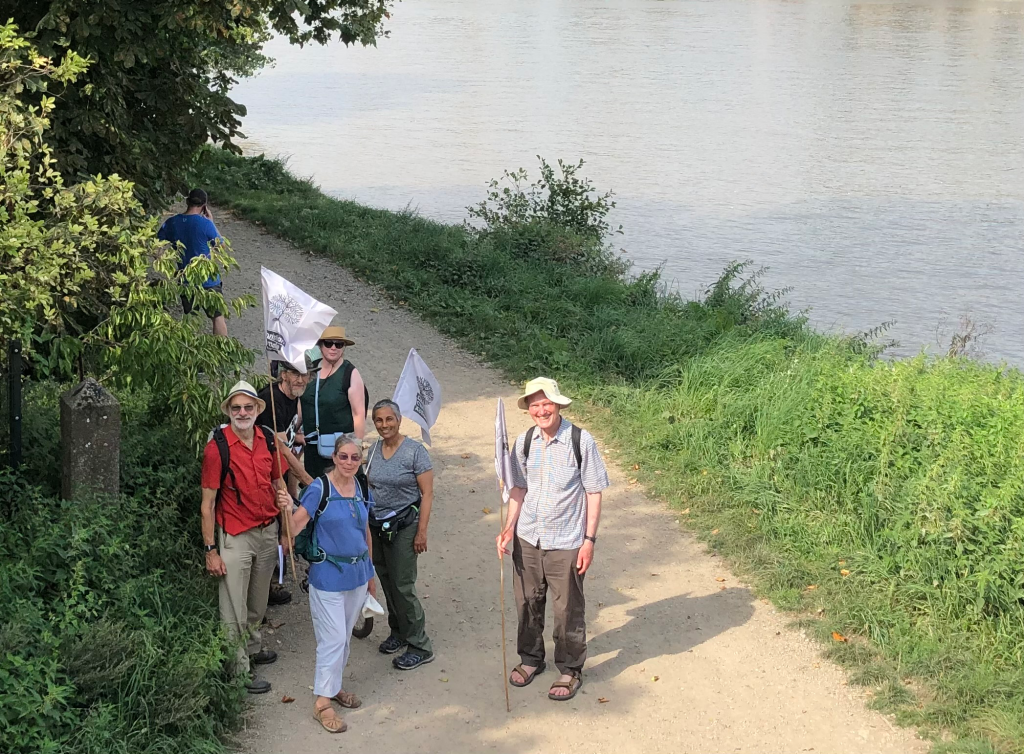
Out of thirteen pilgrimages organised by Christian Climate Action across the country, four took place along the Thames including the one from Putney to Richmond. Our small band of pilgrims were sent off with a blessing and prayers led by John Whitaker, vicar of St Mary’s Putney. As we followed the Thames Path upstream we paused to give thanks for the beauty and benefits of the river and its environment, as well as lament our shortcomings in caring for both its vitality and for our failure to ensure justice for the vulnerable in our local and global communities. pilgrimages organised by Christian Climate Action. Our recurring refrain was Let justice roll on like a river, righteousness like a never failing stream (Amos 5:24 and one of this year’s tag lines for creation-tide. Halfway we benefited from the welcomed hospitality offered by St Mary’s Mortlake as especially with the heat we needed to refill water bottles and enjoy the cool of the church. Exhausted (slightly fewer in number) but exultant we finally reached Richmond Bridge closing with a modern Franciscan blessing:

May God bless us with discomfort at easy answers, half-truths, and superficial relationships, so that we may live deep within our hearts.

May God bless us with anger at injustice, oppression, and exploitation of people, so that we may work for justice, freedom, and peace.

May God bless us with tears to shed for those who suffer from pain, rejection, hunger, and war, so that we may reach out our hands to comfort them and turn their pain into joy.

And may God bless us with enough foolishness to believe that we can make a difference in this world,  so that we can do what others claim cannot be done, to bring justice and kindness to all our children and the poor. Amen. 

For more information about Christian Climate Action visit https://christianclimateaction.org/ where similar events in the future will be advertised. 

Pilgrimage for the Planet

Today, 10th September I am leading a pilgrimage as part of CCA’s Weekend of pilgrimages.

These are the prayers we will be using as we walk from Putney to Richmond along the Thames Path.

“Let justice flow on like a river, righteousness like a never-failing stream.” Amos 5:24

The ancient practice of pilgrimage, honoured by many of the world’s great faiths, has a renewed focus in this age of climate and ecological emergency. Walking together with intention, mindfulness and prayer proclaims a different pace and place in relationship to the earth; and with each other. We become fellow travellers, learning again to ‘tread lightly’ on the earth. Pilgrimage invites a renewal of body, mind and spirit, while offering a visible sign of a different way of living and travelling.

Opening prayers:

Most High, all powerful, good Lord,
To you we offer praise and glory, the honour and blessing.
All creation – all that lives and breathes and moves – praises you. 

All the elements praise you – 

Brother Sun radiant with light and energy, beautiful and awesome,

And who with Sister Moon, establishes day and night,  tides and seasons. 

All praise to God!

Brother Wind and air, calm and serene, powerful and fearsome, 

Bringer of weather, and source of energy.

All praise to God!

Sister Water, humble yet precious, simple and beautiful, 

fluid energy and source of life. 

All praise to God!

Brother Fire, playful, robust and strong, 

offering warmth and comfort, yet to be handled with care!

All praise to God!

Sister-Mother Earth who sustains us and governs us,

And  produces plants and minerals, sustaining life in all its rich diversity.

All praise to God!

All the elements praise you 

and so too all that lives and breathes within your creation!

All praise to God!

In your bountiful love, 

forgive our carelessness, our greed and our destructive acts. 

Lord have mercy

Forgive our selfishness, and our failure to show compassion. 

Lord have mercy

Forgive our heartlessness, our narrowness of vision and  our failure to act justly.

Lord have mercy

Forgive our self-certainty, our disregard for your wisdom and our failure to learn.

Lord have mercy

With humility and contrition, we praise you 

and ask your blessing on our endeavours. 

May we serve you with humility,

seeking justice and showing loving care for all creation.

To you be all honour and power, praise and glory.

Amen. 

Pauses for prayer.

1. Putney Bridge, beneath which runs the newly constructed super sewer.

This tunnel will be 25km long and 7.2 metres in diameter, when it finishes construction in 2025. It will carry away London’s sewage and rainwater with sufficient capacity that even during storms effluent will not enter the Thames. Instead this effluent will make its way to Beckton Sewage Treatment Works before being discharged as clean water into the Thames estuary.

We give thanks for the super sewer that will prevent sewage spilling into the Thames. We give thanks for the rich diversity of wildlife – fish, flora and fauna – that a clean Thames can support. 

Yet we lament our human foolishness that so often allows harmful chemicals, sewage and litter to pollute the waterways on which we depend. 

Lord have mercy:

Let justice flow on like a river, righteousness like a never failing stream.

2. Betwixt the boat houses and the playground at Leader’s Gardens. 

We give thanks for joy that the Thames provides a place for recreation and relaxation, both in, on and by the water. We give thanks for the healing and health-giving capacity of the natural world.  

Yet we lament the thoughtless creep of urbanisation that can destroy such beauty and the inequalities of our society that precludes  everyone having easy access to blue and green spaces. 

Lord have mercy:

Let justice flow on like a river, righteousness like a never failing stream.

3. London’s Wetland Centre. Over the past twenty plus years these  disused Victorian reservoirs have been transformed to provide a rich habitat for different wetland – and other birds, including sand martins – insects, reptiles and amphibians, bats and various other small mammals. The Wetland Centre is also working with the Borough of  Richmond to rewild the lower sections of the Beverley Brook to help prevent locally flooding as well as enriching biodiversity. In the past  Beverley meant beaver meadow and, like Eel Pie Island, reminds us that in the past there were many more species resident in these waters. 

We give thanks for nature’s capacity to both recover and to recreate biodiverse rich habitats. We give thanks for those opportunities that have been taken to rewild the landscape, even within the confines of a city.

Yet we lament those times when nature has been pushed out of the picture. We lament lawns that have been lost to astroturf, flowers beds lost to driveways, streets that still lack the companionship of trees.

Lord have mercy:

Let justice flow on like a river, righteousness like a never failing stream.

4. Mortlake – where in the 17th century the famous Mortlake tapestries were woven by Flemish weavers. Some of the master weavers were granted English citizenship, whilst orphaned boys from the City  of London were taken on as apprentices. This river location has also attracted other migrants; we passed but the Swedish school  in Barnes, and if we went further  upstream we would pass the German school at Petersham. 

We give thanks for the diverse people who have settled along the Thames enriching the lives of their local communities.

Yet we lament the attitude of our our current government towards those who come to these shores seeking safety. We lament the affects of the climate crisis on communities across the globe, particularly for those who are already impoverished because of global inequalities. 

Lord have mercy:

Let justice flow on like a river, righteousness like a never failing stream.

5. Kew Gardens – which has a plant collection of some 17,000 species, whilst at its millennium seed bank at Wakehurst it has 2.4 billion seeds from around the world. Kew Gardens is also carrying  out research research into climate change-resistant crops, zero-carbon fertiliser and plant- and cell-based meat and dairy products.

We give thanks for the rich diversity of plants that exists around the world, and for the research being done to protect and enhance plants and habitats.

Yet we lament the industrialisation of farming and the over grazing and exploitation of land to satisfy our desire for meat. We lament the economic model that leave many in the world with inadequate and poor diets .

Lord have mercy:

Let justice flow on like a river, righteousness like a never failing stream.

6.  Richmond Lock. The Thames is still tidal here and the lock helps maintain water levels between here and Teddington Lock. Even so during height tides and/ or times of heavy rain land either side of the river can flood and the risk is growing as a result of the climate crisis with rising sea levels and extreme weather systems. To ease this, work is being

carried out in the Old Deer Park to create creeks and swales, allowing the land to become once again a real floodplain. 

We give thanks for the natural capacity of the soil, trees and plants to absorb rainfall. We give thanks for the diversity of habitats that create sustainable ecosystems.

Yet we lament the pressure we are placing on the environment to cope with the climate crisis that we have caused. We lament the threat that rising sea levels  causes for so many small nations. 

Lord have mercy:

Let justice flow on like a river, righteousness like a never failing stream.

Our final pause is at Richmond Bridge, the end of our pilgrimage. Having begun our journey with a variation of St Francis’s Canticle of the Creatures, let us end with a modern Franciscan blessing.

May God bless us with discomfort at easy answers, half-truths, and superficial relationships, so that we may live deep within our hearts.

May God bless us with anger at injustice, oppression, and exploitation of people, so that we may work for justice, freedom, and peace.

May God bless us with tears to shed for those who suffer from pain, rejection, hunger, and war, so that we may reach out our hands to comfort them and turn their pain into joy.

And may God bless us with enough foolishness to believe that we can make a difference in this world, so that we can do what others claim cannot be done, to bring justice and kindness to all our children and the poor.

Amen. 

further info:

Christian Climate Action  is a community of Christians who support each other to take meaningful action in the face of imminent and catastrophic anthropogenic climate breakdown. We are inspired by Jesus Christ and guided by the Holy Spirit. Following the example of social justice movements of the past, we carry out acts of public witness, nonviolent protest and civil disobedience to urge those in power to make the changes needed. We also work to engage and mobilise people to take action.

Earth Vigil – Westminster. Every Wednesday, 11-1pm, 1-3pm, we sit together outside parliament, praying to our Creator God For more info contact christianclimateaction@gmail.com

‘Make Polluters Pay’ 23rd September for a day of action with Christian Aid.

‘Oily Money Out’  17th – 19th October. Join us for protest, prayer and action outside the annual Oil and Money Conference 

Franciscan Prayer Walk

Franciscan Prayer Walk for The Big One 21st – 24th April 2023, 5pm daily

These prayers mark our concern for God’s creation in light of the climate crisis and climate justice crisis. In 2019 Parliament declared an environment and climate emergency, but words are not enough. Four years on radical action is needed by those in power, for, in the words of UN Secretary-General Antonio Guterres,“Humanity is on thin ice – and that ice is melting fast. Our world needs climate action on all fronts: everything, everywhere, all at once.”

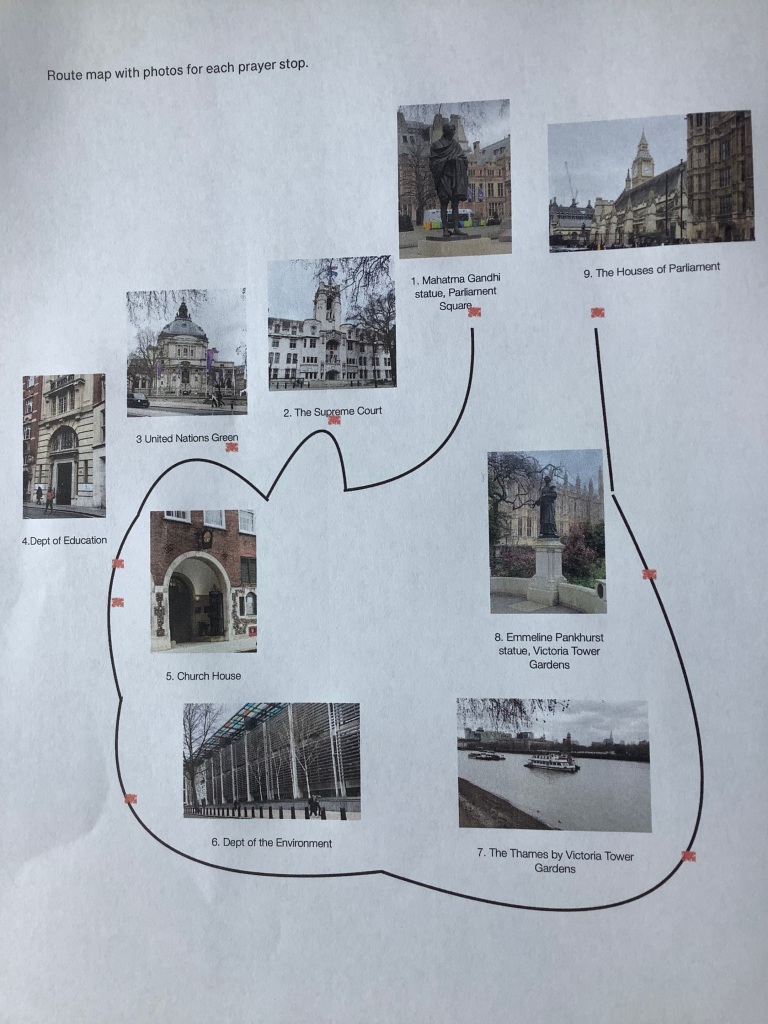
We will stop to pray as we circumnavigate Parliament Square, calling on those with power for  action. Each prayer will end with the phrase 

Help us to respond to the cry of the earth, to the cry of the poor:

To which please respond: Everything, everywhere, all at once.

Station 1 The Mahatma Gandhi statue 

Holy God, 

we are not just individuals but the peoples of the world.

As Mahatma Gandhi stood up for the rights of the poor in his age, may we stand up for the rights of the poor in our age.

May we be united in tackling the climate crisis which unfairly affects those least responsible.

Help us respond to  the cry of the earth, to  the cry of the poor:

Everything, everywhere, all at once. 

Station 2 The Supreme Court of Justice

Holy God,

In your ways we find the wisdom with which to shape our lives.

Inspire all who write and implement legislation that your wisdom may prevail and your will be done on earth as in heaven. 

Help us respond to  the cry of the earth, to  the cry of the poor:

Everything, everywhere, all at once. 

Station 3 United Nations Green

Holy God, 

We give thanks for the hope that the United Nations gives us, for the hope that nations will work together for the wellbeing of all. 

Empower all their meetings with energy and the power of possibility.

Help us respond to  the cry of the earth, to  the cry of the poor:

Everything, everywhere, all at once. 

Station 4  between The Department of Education and Westminster School, Gt Smith Street

Holy God, 

Life is an ongoing journey of learning. Help us to learn about the intricacies of your world, its interconnectedness and interdependencies, and make us willing to amend our way of life accordingly.

Bless all who teach and all who learn, that all our lives may be enriched.

Help us respond to  the cry of the earth, to  the cry of the poor:

Everything, everywhere, all at once. 

Station 5 Church House

Holy God,

Spread across denominations and faiths, you call us all to be your people, your church.

Guide and inspire all in positions of authority in the churches to witness truthfully to your word and to lead by example in caring for your creation.

Help us respond to  the cry of the earth, to  the cry of the poor:

Everything, everywhere, all at once. 

Station 6 by Marsham Street and Great Peter Street, The Home Office and other departments 

Holy God,

We live in a world of systems that constrain and shape our daily lives, and which have the capacity to exert power to seek the common good. 

Enrich all in power, those in the Civil Service and those elected, to desire what is good and life enhancing, and to shy away from self interest and self aggrandisement.

Help us respond to  the cry of the earth, to  the cry of the poor:

Everything, everywhere, all at once. 

Station 7 Victoria Tower Gardens

Holy God,

We give thanks for green and blue spaces that remind us of the beauty of your creation. 

Inspire us all to tend and care for what you have given to us, knowing that it is our mutual lifeline.

Help us respond to  the cry of the earth, to  the cry of the poor:

Everything, everywhere, all at once. 

Station 8 Emmeline Pankhurst statue 

Holy God,

We give thanks for all who have stood up for what is right, from your prophets of the biblical era, to the climate activists of our generation.

Imbue those who fight for justice with courage and patience, inspire them with your Spirit that the world may be transformed through the power of love.

Help us respond to  the cry of the earth, to  the cry of the poor:

Everything, everywhere, all at once. 

Station 9 The Houses of Parliament 

Holy God, 

We give thanks for Parliament’s declaration of an environment and climate emergency in 2017 in response to the climate protests made that year. Now we pray that you will soften the hearts and attune the ears of those now in Parliament, to hear the cry of this year’s climate protests. 

While there is yet a small window of opportunity, may they take action now!

Help us respond to  the cry of the earth, to  the cry of the poor:

Everything, everywhere, all at once. 

These prayers conclude with The Grace.