Green tau restoring biodiversity as part of the bigger picture

27th July 2026

“According to the Natural History Museum’s Biodiversity Intactness Index, the UK ranks 189th out of 240 countries and territories for how intact its nature and biodiversity remain. Just 53% of the UK’s original nature is left intact – far below the Index’s safe limit of 90% and the global average of 79%. Each of the four UK nations sits near the bottom of this ranking, with England at 47%, Northern Ireland at 50%, Wales at 51%, and Scotland at 56%.” (1)

Worryingly the government’s State of  Nature Report suggests this decline is still ongoing: “…more indicators are deteriorating or showing no change than improving, over both the long and short term.” And: “No indicators which are deteriorating in the long term, are showing improvement in the short term.” (2) 

19% Across the UK species studied have declined on average by 19% since 1970.

16% Nearly one in six species are threatened with extinction from Great Britain

151 of 10,008 species assessed have already become extinct since 1500 (3)

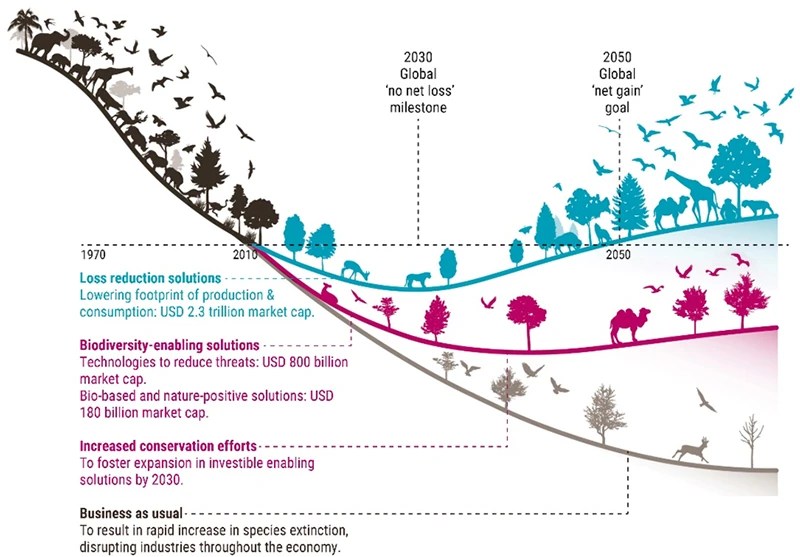
Scientists warn that if we don’t reverse this decline imminently – the Kunming Montreal framework target is protect 30% 2030  – it will become near impossible to reverse. 

https://www.robeco.com/en-uk/insights/2024/07/bending-the-curve-investing-in-biodiversity-as-an-economic-necessity

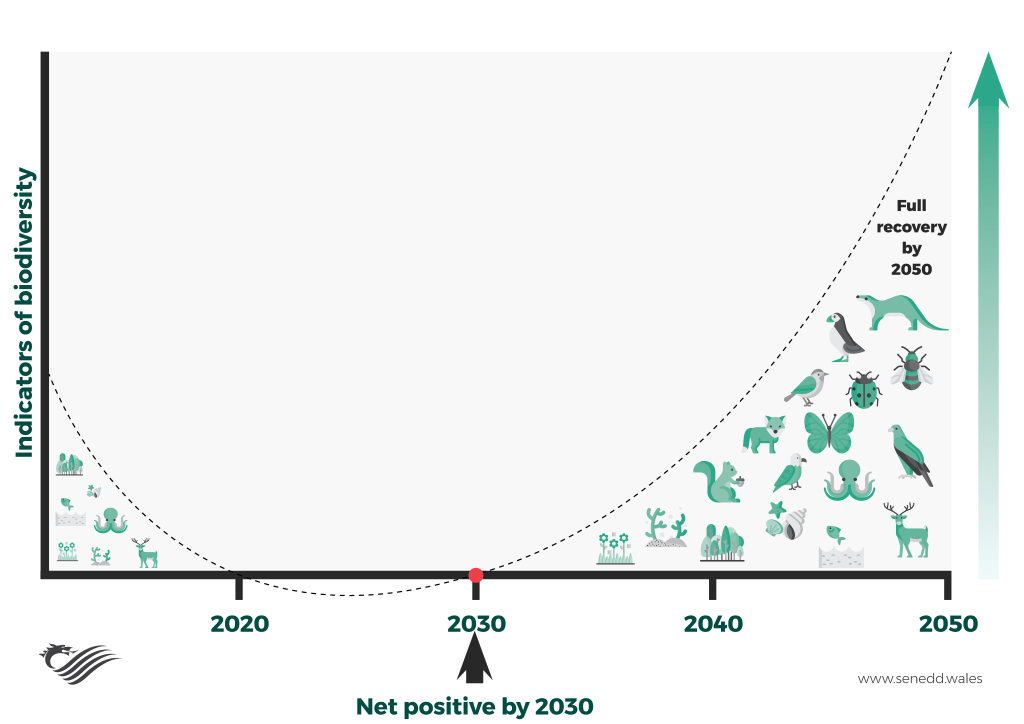
Conversely if we don’t manage to turn the tide by 2030, the prospects for improving biodiversity are good.  

To make a bit of a leap, I’m going to interpret increasing biodiversity as meaning restoring nature. But this too may not be clear cut. To restore nature could mean:  

https://research.senedd.wales/media/z4alhnt5/biodiversity-fig-2-en.png

“In simple terms, restoration means bringing more nature and biodiversity back across different ecosystems, from forests, peatlands and agricultural land, to freshwater, marine and urban ecosystems.

Restoration is a process of assisting the recovery of an ecosystem that has been degraded, damaged, or destroyed. This could be through rewetting wetlands and peatlands, improving degraded soil and agricultural land by adding natural features such as hedgerows and trees, recreating lost natural forests, removing invasive species, planting native vegetation, removing obsolete barriers from rivers, increasing tree coverage in cities, and much more.” (4)

It could mean restoring landscapes to their wild, pre-human state:-

“At Rewilding Britain, we define rewilding as the large-scale restoration of ecosystems to the point where nature is allowed to take care of itself. Rewilding seeks to reinstate natural processes and, where appropriate, missing species – allowing them to shape the landscape and the habitats within. It’s focused firmly on the future although we can learn from the past.

“Rewilding encourages a balance between people and the rest of nature so that we thrive together. It can provide opportunities for communities to diversify and create nature-based economies; for living systems to provide the ecological functions on which we all depend; and for people to reconnect with wild nature.

“Our vision is at least 5% of Britain rewilding, with 25% returned to broader mosaics of nature-friendly land and marine uses — including farming, forestry and fishing. We see this expansion reversing biodiversity loss and enabling nature to bounce back, helping us adapt to climate change as our complex ecosystems find their own answers.” (5)

Or it could be a pragmatic approach:-

  1. Restore nature now – the Government must honour its commitment to manage 30% of land for nature by 2030. That means designating more space for nature and paying our farmers properly to help nature thrive. 
  2. Defend nature and wildlife – stop weakening the laws that protect them. Introduce a strong Water Reform Bill to clean up our rivers, streams and seas, and make polluters pay.  
  3. Build places to be proud of – demand that neighbourhoods are rich in nature and end unfair access to green space, starting by publishing the Government’s long-promised action plan by the end of the year. (6)

However what I want to suggest is that however we set about restoring nature and reversing biodiversity loss, we cannot address this issue in isolation. If we consider why biodiversity has been in such sharp decline, why it is that we have lost to so much of our natural environments, we will see that these losses are linked to:-

  • Expansion of the built environment where buildings, roads and other transport links, mines and quarries, have encroached on land where nature previously existed. Many species are in decline because their habitats are disappearing.
  • Pollution from smoke (causing acid rain), from vehicles exhaust pipes, from industrial processes, and  the run off from farms of slurry, fertilisers etc. 
  • From intensive farming where large fields have resulted in the loss of trees and hedgerows that once provided essential habitats for many species, and the proliferation of monocultures which do not support a diversity of other life forms.
  • Replacing mixed broadleaf woodlands with monocultures of coniferous plantations.
  • Overgrazing of uplands and the replacement of meadows with grass monocultures suited purely for grazing cattle – again reducing habitats for other species.
  • Increasing use of pesticides and herbicides that do what it says in the tin – kills insects and plants.
  • Intensive cultivation of the soil destroying its natural structures and resident populations of insects, grubs, fungi and micro-organisms – and requiring their substitution with fertilisers to maintain the fertility of the soil.
  • Climate change which is human-induced and which has depleted native species who have been unable to adapt or to adapt fast enough to the increasing heat/ floods/ droughts and wildfires.

Unless we can address these issues to, no amount of planting native trees, or sowing wildflower meadows, or reintroducing lost species, is going to work. Restoring nature and improving biodiversity has to involve us in reviewing and reforming our whole way of living. 

For example, we need to review the way we farm and therefore what we eat. Our current agricultural system is designed to produce increasing amounts of meat and dairy, with the parallel need to produce – or import – more  animal feed, which necessitates the intensive farming methods that are widespread. If we wish to reduce that scale and intensity of livestock production we need to eat less meat and dairy products and instead adopt diets that are rich in tasty, diverse UK grown fruits, vegetables, nuts and beans. 

We may want to look at how land is farmed. Would it be better for nature – and for us as communities – if we had more smaller farm units, employing more people and less heavy equipment? Would it be better to have more hedgerows, more ponds and pockets of woodland? Would it be better to have more publicly accessible green spaces? 

Yes there would be a cost – food prices would go up – and that might mean reducing the lower rates of taxation, but that cost would surely be less than the costs of the continued loss of biodiversity and the resulting negative impact on climate change, on floods and droughts, on the fertility of the soil, on clean air and clean waterways, and of the loss of essential pollinators leading to depleted harvests. 

These are all serious issues that we need to consider as a society and which we need to address collectively.

  1. https://policy.friendsoftheearth.uk/insight/how-britain-became-one-most-nature-depleted-countries-world

(2) ditto

(3) https://stateofnature.org.uk/

(4) https://www.restorenature.eu/en/faq-on-nature-restoration#What is nature restoration

(5) https://www.rewildingbritain.org.uk/why-rewild/what-is-rewilding/an-introduction-to-rewilding/defining-rewilding

(6) https://www.nationaltrust.org.uk/our-cause/nature-climate/nature-conservation/nature-is-our-future

Green Tau: Ecosystems, Biodiversity and Sustainability 

24th July 2026

When ecosystems flourish they are rich with biodiversity. Conversely diminishing biodiversity causes ecosystems to fail. Currently biodiversity globally is in decline. In 2022 world leaders met to address this issue and the outcome was the Kunming-Montreal Global Biodiversity Framework (GBF). The headliner was that the national signatories undertook to restore for nature 30% of land and of sea by 2030 – abbreviated to 30by30. This is a huge undertaking – a highly necessary one – but perhaps not surprisingly it is something nations now struggle to meet. 

The whole planet is one large ecosystem in which water flows, plants grow, fish swim, birds fly, carbon  circulates, rocks erode etc etc. Is this a thriving ecosystem? Nine key measures  have been identified by which to assess  the  health of the earth’s ecosystem – and are known as planetary boundaries. One of these boundaries measures fresh water. If we consumer such water at a slower rate than it is replenished by the earth’s ecosystem, we can be assessed as living within the limits of that planetary boundary. If we consumer fresh water at a faster rate, then we are assessed a living beyond the limit of that boundary. Not only is this (and we have indeed exceeded this planetary boundary) damaging to the earth’s ecosystem it is also threatens our survival too (or rather the survival of the most vulnerable people). 

The other eight boundaries are – climate change, biosphere integrity (which assesses both biodiversity levels and the rate at which we extract resources such as timber, cereals etc), landuse change (balance between natural and human use), nutrients (particularly nitrogen and phosphorus), ocean acidification, aerosols in the atmosphere, ozone depletion, pollution of novel entities (manmade compounds such as plastics). Of these nine planetary boundaries, we are now living beyond the safe limits of seven – only with respect to ozone depletion and aerosol levels in the atmosphere, are we living within safe limits.

What we also know is that these nine areas are interconnected. Accelerating climate change adversely impacts biodiversity and freshwater systems. Out of balance landuse impacts both climate change and biodiversity. And so on. 

However we have so often seen ourselves as humans as being above and outside these ecosystems. We are the ones who instead control  and manipulate ecosystems to maximise our gains. We are the ones who determine what is good for humans and what is not, who select what should grow and what should be uprooted, who take without giving back. It is this failure to see ourselves as part of and dependent on the multiple layers of ecosystems, that has brought us to situation where we are living outside the safe boundaries of the planet.

Another way of viewing this is by looking at the date of Earth Overshoot Day. This day marks the point in the calendar when we have used up a year’s worth of the planets renewable resources (eg freshwater, clean air, fish, timber ……..) This year Earth Overshoot Day is July 30th. After that we are living in the red. This means for example, vis a vis freshwater, that we will be drawing on our capital of fresh water – water taken from aquifers that cannot be replaced. This means that some people will live with inadequate water supplies, and their crops and livestock will die. This means that wild animals, birds and insects will die.

If this were a financial  issue, we would be obliged to pull in our horns, to spend less and save more. But as we don’t pay – financially for many of these goods and services – there doesn’t seem to be any formalised way in which the global community is addressing this debt crisis. We should also note that this debt is not being shared equally. A large number of the people from the poorest and most remote  communities  are baring the bulk of the pain, whilst a far small number of people are continuing to live ever increasing lives of wealth – lives, in effect, of decadence. Where do I fit in? It could be as a middle class white western person be in the latter group.

To return to the 30by30 target, it seems obvious that it cannot be tackled in isolation but needs to be part of lifestyle revolution that recognises and works with the understanding that all ecosystems are interdependent and that humans are just one feature of each ecosystem of which they are a part.  I don’t think this observation makes the challenge any easier but it would ensure a greater likelihood that any policies of reform would actually work.

I don’t know of any country that is taking a wholistic approach. Here in the UK the likelihood that we will restore biodiversity to safe, sustainable levels by 2030 seems highly unlikely. Not least because it is not being approached as part of a national ecosystem. 

For example, to restore 30% of land such that nature can flourish, cannot happen without also looking at landuse – how much land can we safely use to graze livestock and grow fodder, as well as growing enough grain, fruit and vegetables to feed our population? If – as we would – have to reduce us the amount of land used to produce meat and dairy products, will we also look at our diets? Will we switch to a diet rich in plants and low in meat and dairy? 

Again will we at the same time look at how we use water? Changing how we use the land could have a positive impact on our use of fresh water supplies. But we should at the same time look at how water is used by industries, and especially by data centres. Conversely will we note that restoring nature across wide tracts of land will improve water retention by the land, improve flood resilience, reduce loss of water via evaporation during heat waves etc? Will we note that restoring nature across wide tracts of land will improve access to green spaces which we know improves mental and physical wellbeing?  Will we note that plant rich diets will significantly improve people’s health? 

It is surely within the capacity of human kind to restore a right relationship with the planet’s ecosystems such that not just our lives but the lives of those with whom we share this planet, can flourish sustainably?

Green Tau: the bigger picture 

16th July 2026

One of the things I like about the creation story in Genesis 2 is the way it draws in so many different strands. At the centre – or maybe it’s at the perimeter on the edge of the curve – is God. God creates the Earth (and heaven). But the Earth needs water to produce vegetation. So God provides water – not just an initial splash but a stream of water that encompasses the whole Earth – and we now understand how the water cycle keeps that life-giving water flowing. God uses the stuff of Earth to form the first human, and plants together the human and a garden. The former is to serve and watch over the latter; the latter to provide all manner of seeds and fruit for the former. God then uses more of the stuff of Earth to create a multitude of other beings to work alongside the human, and another  human as a partner. 

This is a story that tells of the interconnectedness and interdependence of all that makes up creation. As the story then unfolds, we see how by separating the different strands, the humans cause the degradation of what has been created. Eve separates what she knows to be God’s will from her consideration of the attractiveness of the fruit. She separates the word of the snake from the the word of God. Both Eve and Adam separate their undertaking to God from their action in eating the fruit. And when called to account both try and separate their responsibility for from the outcome of their actions. 

When we separate the interconnectedness of nature (and our own connectedness within that) and rather view things in separate silos, we are bound to make mistakes. 

When we separate maximising what we can harvest from the land from the need to care for the soil including all its multiple organisms, we end up depleting the fertility of the soil and destroying our means of growing food. 

When we separate the intricacies of the water system from the use of the land, and seek to sap and constrain the former to increase our use of the latter, we end up exacerbating the impacts of flood and droughts to our detriment. 

When we separate bugs and weeds from the  menu of biodiversity, killing off the latter with pesticides and herbicides, we diminish the robustness of the ecosystem in which plants grow. 

When we separate what we choose to eat – beef and dairy by the bucket load, strawberries in January and asparagus in August – from the limitations of the natural environment, we diminish the robustness of the environment which sustains our food supply. And invariably the ones who go hungry are those who are poor and powerless.

Even when we try and address these problems, we typically do so with a blinkered approach. We don’t see the interconnectedness. 

Cutting down tropical forests to grow animal fodder for cattle in Europe may provide cheaper meat in the UK but reduces the water levels of the River Amazon, increases local temperatures and releases more carbon dioxide into the atmosphere further driving temperatures upwards, accelerating climate change and exposing people both in the tropics and in Europe to ever more extreme weather events. 

Draining peatlands, clearing trees and hedgerows, and straightening rivers may expand arable fields, but when rains come the water will first quickly flood and then quickly disappear, damaging crops first with too much and then with too little water. And not only crops. Households too will face winter flooding and summer water shortages.

Only when we see and acknowledge the interconnectedness and the interdependency of the creation and respond attentively, will we reverse the ecological disaster that has been years in the making. Only then will we understand the intricacies and depth of our part in serving and watching over the garden in which, for our wellbeing, we have been planted.  

This week we have seen the Church of England – its governing synod and its Commissioners – fail to understand what is at stake if we do not care for our land holistically rather than seeing it as just a source of income.

This week we have seen the Government issues its own response to the loss of biodiversity, and failing to embrace the needs of the farmer for income, the land for good care, the people for food security, and the Government’s own role in leadership.

This week we continue to see whole swathes of people not having the information that informs about what makes a healthy diet,  nor having the necessary income for and access to healthy food, nor having knowledge, or hands-on experience, of how the natural and the farming worlds work.

Can we be part of a move to tell and explore the bigger picture?

Green Tau: issue 127

9th July 2026

Joining the Dots

As a child you may have done dot-to-dot puzzles. Joining together the dots in the page – in the order in which they are numbered – would reveal a picture that wasn’t obvious before.

In a world which is increasingly complicated there are just so many dots that it seems as if we can’t see the bigger picture. Joining the dots is not always straight forward as, unlike the dot-to-dot puzzles, they are not numbered. Sometimes a bit of thought and bit of reading, is sufficient to see which dots join together.

Climate Change

For example, looking at a chart showing temperature increases over the last two centuries and comparing it with a chart showing the concentration of carbon dioxide in the atmosphere, it is easy to join the dots and see the connection: as carbon emissions have increased so have temperatures. A little more probing and we can see the dots that tell us that it is human activity that has caused the increase in carbon emissions, principally through the burning of fossil fuels.

It may take a little more reflection and research to see that the increase in the burning of fossil fuels is linked with each of the following –

  • an increased number of diesel and petrol vehicles on the roads,
  • an increased number of air flights
  • an increased number of coal and gas power stations – and that linked to n increased demand for electricity 
  • an increased demand for plastics and other products based on fossil fuels.

Our human lifestyle is linked via fossil fuels to climate change.

Water Shortages

Water shortages become more acute during periods and dry weather. And yes, those weather conditions and more especially changes in climate, do contribute to water shortages. But with a bit of reflection, we may find other factors at play.

  • As more people move into drier regions (eg into the south east of England) local resources will struggle to meet demand.
  • Whilst showers use less water than baths, more frequent showers and the the use of power showers, will increase demand for water. Ditto power hoses. Ditto washing machines too use substantial amounts of water – may be as much as half our daily average consumption. 
  • Agriculture is a substantial consumer of water especially rearing livestock – including the water needed to grow animal feed. 
  • Clothing manufacture including the growing of cotton in particular the dying of fabrics, is water intensive. The more clothes we buy, the greater the stress we place on water reserves.
  • Data centre use large amounts of water to cool the equipment. We don’t always think to join the dots between our use of data – streaming, online games, storing data (much of it superfluous to use), use of Siri and other AI ‘helpers’, emailing etc – and the need for data centres and the knock on effect on water (and energy) supplies.

Our lifestyle choices can seriously impact other parts of our lives.

Animal welfare

In Britain we often pride ourselves on our love for animals. We also love our traditional meals – bacon and eggs, roast beef, chicken tikka masala etc – but don’t always join the dots.

  • The hen that lays our eggs will have outlived its brother who will have been killed day one. Her own life will be about 72 weeks after which it’s laying efficiency will assign it slaughter. Had she not been a commercial hen, her life span could be 7 to 8 years.
  • The hen that becomes ‘chicken’ will have had a life of about 6 weeks before its genetically design physique and feed, will have ensured a suitable slaughter weight.
  • Similarly constricted life spans apply to dairy and beef cattle, to pigs and sheep.

Deforestation 

Deforestation is widespread across the globe and its impact on temperatures, on biodiversity, on indigenous lifestyles, on rainfall patterns and  flooding, and on carbon levels, is devastating. Across the globe we bewail the loss of these trees and implement legislation that should halt the destruction. But we don’t always join the dots.

Deforestation is driven by increasing demand for:

  • Meat – large tracts of forest are cleared to make way for cattle farms and for vast fields growing animal fodder. The majority of the feed fed to livestock in the UK is imported.
  • Biofuels – large tracts of forest are cleared to make way for bio fuel crops such as sugar cane and palm oil.  Equally disconcerting is the clearance of forests to provide wood pellets for biomass heating and power stations.
  • Mining minerals such as copper, cadmium, lithium etc which on the one hand are essential for manufacturing batteries but on the other hand often involve the destruction of forests and the pollution of the land further da aging water supplies and biodiversity.

Our lives and what we consumer can be very complicated. Sometimes we have to make choices to restrain what we consume in order that we can ensure a sustainable future for everyone. 

Green Tau issue 126

26th June 2926

How can we better adapt to heat waves?

These are some initial thoughts on things that we could do as individuals, as communities and as a society.

  1. Insulate all buildings – insulation helps maintain a comfortable internal temperature, warm enough in winter and cooler enough in summer. Think how a cool bag or thermos flask can be used both to keep cold things cool and hot things warm.
  2. Government and local authorities can ensure that this happens through mandates, loans and grants.
  3. ‘Enough’ is a key word – warm enough in winter maybe 16-18C whilst cool enough in summer may be 24-26C.
  4. As well as insulation, adaptation to buildings – domestic and otherwise – should include shading of walls and windows exposed to the sun. This could be in the form verandas, awnings, blinds, shutters and planting of climbing or other shade-giving plants. These ideally would provide shade from the summer sun but allow winter warming when the sun’s rays fall at a lower angle.
  5. Other natural cooling could include vents at high-level that draw out hot air without allowing hot air back in and which can create a cooling air flow.
  6. In some situations – such as hospitals and care homes – air conditioning may well be essential. Who will foot the bill? The taxpayer?
  7. Prisons too should be be considered for air conditioning as people confined to a small space with limited options for cooling are vulnerable.
  8. For some vulnerable groups – the old and very young, people with particular disabilities or ailments – additional provision of air conditioning at home may be necessary.  Who will foot the bill? The tax payer who might then avoid the higher cost of medical care? Should grants/ loans be means-tested?
  9. Consider providing schools and libraries with air conditioning if these can then also be used  as cool hubs for other users. Encourage community networks that can check up on vulnerable people.
  10.  Expand number of cool hubs – encourage pubs, churches, community halls and libraries to participate – provide grants to encourage this. This map shows what is currently publicly available in London – https://apps.london.gov.uk/cool-spaces/
  11.  Ensure everyone is well informed about how to cope with heat waves – public health campaign etc. The Red Cross has food advice – could this be made available as a booklet? https://www.redcross.org.uk/get-help/prepare-for-emergencies/heatwaves-uk
  12.  Install more drinking water points and encourage people to carry refillable drinking bottles.
  13.  Public health campaigns to encourage everyone to use a sunhat and/or parasol. 
  14.  Switch to double summer time so that in the summer we are getting up two hours earlier when the day is much cooler. (The clock change could take place at the May bank holiday).
  15.  Set the school day to start an hour earlier to maximise use of cooler air. This would also encourage businesses and shops to adopt earlier opening hours. 
  16.  Switch the school year to start in January so that exams can be held when the weather is cooler. Consider dividing the academic year into four terms.
  17.  Encourage adoption of an afternoon siesta to include shops and businesses – but also consider could/ would this time be of benefit to staff.
  18.  Legislate for maximum working temperatures. Legislate for regular – paid for – rest periods during hot weather.
  19.  Mandate welfare provision such as access to toilets, drinking water, cool spaces etc for all work environments including bus, lorry and delivery drivers.
  20.  Expand planting of trees in streets and parks to create more cool places. 
  21.  Expand the creation of parklets to provide cool resting places.
  22.  Encourage where practical replacement of hard surfaces and drive ways with grass or other suitable planting. Encourage generally more planting to create localised cooler microclimates – as well as supporting biodiversity.
  23.  Public health campaign to encourage active travel so as to reduce the number of cars driving or parked on the streets where they absorb and radiate heat.
  24.  Encourage shops and businesses to install awnings to provide protection from the sun in summer and rain in winter. 
  25.  Mandate that premises using air conditioning keep doors closed to conserve energy. Such premises should not be attempting to cool the whole street! A public health campaign could encourage closing doors and windows to keep the heat out. 

Any other suggestions?

Further reading 

https://assets.redcross.org.uk/82b1e254-5524-0172-0612-9ce813c7824c/ce19462a-4490-41d2-9318-b469ac4e24bb/Overheating Adaptation Guide For Homes BRC.pdf

https://www.drk.de/fileadmin/user_upload/02_Hilfe_weltweit/023_Was_wir_tun/Gesundheit/Community_Cooling_Centre_Manual.pdf

Green Tau issue 125

Defence or security?

16th June 2026

A recent article in the Church Times reported on 

The director of Trinity Centre for Post-Conflict Justice, at Trinity College, Dublin, Dr Jude Lal FernandoI, was among the participants, alongside Anglican church leaders, theologians, church partners, and USPG support. He warned that security concerns were increasingly being prioritised over communities’ basic needs, while hundreds of millions were still living in extreme poverty. “When space for peace and dialogue decreases, the space for violence and oppression increases, especially for women and children,” he said.

This led me to ponder what is the difference between security and defence?

Defence typically refers to the armed services and all their equipment and resources that can be used to repel enemy invasion either of our territory (here in the UK or elsewhere, eg the Falklands) or to support our allies where they are similarly threatened. Such defence would also include defence against cyber attack. 

Security I think is a wider issue that encompasses not just protection from enemy attack or aggression, but is about safeguarding the wellbeing of society as a whole. Thus security issues would include:

  • Food security: can we feed our population? Can we do so largely independent of imports? Do we keep enough in store to weather emergencies and/or supply disruption? Do we pay enough for farmers to survive financially? Do we ensure sufficient incomes so that everyone can afford healthy food? Do we grow the right range of crops (inc livestock) that allows us also to ensure the security of biodiversity and the environment?
  • Health security: are we doing enough to ensure the population is in good health? Do we have enough medical staff, hospital beds, drugs etc? Do we ensure everyone has access to a healthy diet? Do we ensure everyone has access to secure, safe housing – ie accommodation that does not damage their health? Do we ensure everyone has access to dental care? To mental health care? To social care? Do we ensure everyone has access to green spaces essential for mental wellbeing and to sports/ exercise facilities etc essential for physical health?
  • Community security: do we ensure everyone has access to education? That everyone can read, write, calculate and interpret information such that they are not likely to be deceived by false information. Do we ensure enough community spaces that are essential for developing and maintaining good social bonds and networks? Do we do enough to tackle discrimination essential for ensuring equality and harmony within communities?
  • Job security: do we ensure that everyone has access to an appropriate and fulfilling job? Do we ensure everyone has suitable skills and qualifications to enable them to contribute to the economy? Do we ensure sufficient investment in businesses to ensure that they contribute to our wellbeing and do not damage our environment? Do we ensure sufficient investment in our businesses that we can be self-reliant for all essentials? Do we ensure that all stakeholders in a business – staff, customers, nature etc – have a fair share of power and influence in determining the shape and future of the business? Do we ensure that everyone derives a fair benefit from the economy? 
  • Economic security: do we ensure that the economy that supports us financially does so in a way that is fair for everyone, that allows everyone to afford a healthy lifestyle, that protects the environment, that is sustainable over the long term?
  • Energy security: do we ensure we can produce enough energy ourselves to be self sufficient? Do we ensure that we do so at price that is affordable? Do we ensure all buildings, equipment and infrastructure is energy efficient? Do we have measures to ration water if necessary?
  • Water security: do we ensure that everyone has access to sufficient water for a healthy lifestyle? Do we ensure water efficiency at every level to ensure we do not consume more than we extract from our water resources? Do balance the need to maintain water resources against competing demands – whether from industry, agriculture, data centres, domestic users – and do we have measures to ration water if necessary?
  • Environmental security: do we look after the wellbeing of the natural environment to ensure that it can continue to support our wellbeing? Do we see it an essential life support system ensuring clean water supplies, for flood prevention, for clean air, plants to absorb carbon dioxide and provide protection from heat and winds, biodiversity to ensure fertile soils for food and insects for pollination, biodiversity to enrich life and safeguard against future unknowns?
  • Political security: do we ensure fair and democratic forms of government? Do we ensure truthfulness from political parties in both what they say and what they do? Do we ensure fair access to politicians such that those with money and power do not override the views of others? Do we ensure freedom of speech and nonviolent protest? Do we ensure a society where everyone feels valued and everyone feels their voice can be heard?
  • Judicial security: do we ensure a judicial system that provides access to justice to everyone and which is not influenced or used by those with money and power? Do we ensure fair policing? Do we ensure appropriate sentencing that will benefit the whole of society including both those who are victims and those who are offenders? Do we ensure a well designed and resourced custodial system that protects society and ensures the wellbeing of those imprisoned? 
  • Internet etc security: do we ensure that our internet and other communications systems are secure, that they cannot be compromised by error or deliberate intent? Do we ensure there are other systems in place such that if primary systems fail, essential services will be maintained?  Do we ensure that social media etc enhances rather than detracts from our wellbeing?
  • National security: do we ensure all the above which are essential for national security? Do we ensure good diplomatic, trade and welfare relations with other nations such that we work together to ensure peace? Do we ensure through good diplomatic, trade and welfare relations the wellbeing of other nations? – for unless they are at peace and thriving there will always be the risk of conflict and war that will impact us as part of a shred global economy.  Do we with care for the consequences of war, ensure  our nation has appropriately trained personnel and equipment that we can defend ourselves attack?

It seems to me that this bigger vision that the need for security rather than just focusing on defence, is essential if we are to be a happy secure nation. Indeed I’m not sure we gain much from defence if what is being defended doesn’t ensure happiness and well being for everyone.

Green Tau: issue 124

25th May 2026

Rivers of Spirit: Spirit of Rivers – a reflection

On the last day of the festival, the great day, while Jesus was standing there, he cried out, “Let anyone who is thirsty come to me, and let the one who believes in me drink. As the scripture has said, ‘Out of the believer’s heart shall flow rivers of living water.’” Now he said this about the Spirit, which believers in him were to receive; for as yet there was no Spirit, because Jesus was not yet glorified. John 7:37-39

The above is one of the alternative readings given for Pentecost which thinks of the Spirit not as wind or fire, but as a river of water. 

Last Friday I took part in a thought-provoking event at St John’s Waterloo entitled Rivers of Spirit: Spirit of Rivers – https://stjohnswaterloo.org/tag/rivers-of-life/

 We began by going down on to the foreshore of the Thames where, like children, we looked at all the treasures on the little beach – shells and pebbles, smooth-worn glass, ends of clay pipes, rounded stubs of brick, sticks and pieces of bone. We sang and we prayed as, with increasing reverence, we were drawn to the sound and the movement of the river, to the ebbing-flowing tide – drawn to the Thames living presence.

From that reconnection with the river, we were more open to hear the wisdom of the afternoon’s speakers. 

Bishop Martin himself quoted from the passage from John’s Gospel, and talked about the living nature of water through the example of the eel. 

Eels are amazing creatures. They are laid as eggs in the Sargasso Sea from where they voyage by ocean currents some 6500km to reach Europe. During this first couple of years they develop from egg to glass eel. They leave the sea and swim inland up various rivers including the Thames, where they continue to develop becoming elvers and then yellow eels and finally silver eels – this can span from  5 to 20 years. Now they are mature enough to make the return journey to the Sargasso to begin the whole cycle again. Eels in the past were numerous in our rivers and a source of food for many (and not just humans). But due to the effects of climate change, pollution, loss of habitat  including from obstacles such as weirs and dams, their numbers over the last 40 years have declined  by a staggering 95-98%. (1)

God’s Spirit, like rivers of living water, is there to cleanse and refresh us. But what if we harden our hearts and do not seek forgiveness and renewal?

The first two speakers, Al Barrett and John White spoke about the importance of creating communities. Al Barrett is the vicar of the Hodge Hill Church in east Birmingham. John White is the founder of the Hazelnut Community and author of the Rooted in Rubble articles from which I have recently quoted.

Al spoke about creating ‘bumping places’ – places where parishioners from many and diverse backgrounds can meet and get to know and trust each other. He spoke how during Covid they ‘rediscovered’ the green places in the parish including the common. Commons have existed for hundreds of years as spaces designated for use by the community –  the commoners – who would have rights to graze animals, gather firewood etc. Where Commons remain today they are often important as essential green spaces for  local people and as essential habitats for wildlife. 

And Al described how finally he managed to ‘discover’ the River Tame which was barricaded out of sight and inaccessible to the community through which it flowed. 

John  spoke about how the Hazelnut Community’s  garden brings people together in the garden and in the gardening. Gardens root us and place us in a right relationship with creation.

Debbie Colvin described to us our place – our home – within the Thames basin which stretches from the Cotswolds to the estuary, from the Chilterns and northwards  to the South Downs. Within this area rainwater drains down to the Thames, but not just via stream and rivers, but also percolating down into  the strata deep below our feet where the water moves and buffers, hydrating the ground, feeding into springs and wells. A slow and measured process whereby rain falling on the hills of Reigate may take 10-20,000 years before reaching Trafalgar Square. (Prior to the 1930s the fountains in Trafalgar Square were fed by artesian wells (2)).

Paul Powlesland spoke about his life’s journey that finds him as a self appointed river guardian for the River Roding  and as the founder of the River Roding Trust. His love and respect of this river sees him clearing rubbish, planting willow and Black Poplar saplings and defending the rights of the river and the communities that live nearby. Called to jury service, Paul made his oath not on a Bible but on the River Roding, making this river a sacred thing, a being worthy of worship. (3) Much of this river, the third longest in London, is degraded – desecrated – by sewage, rubbish and pollution. Paul’s approach is hands on and includes pressing the Thames Water Authority to do its job properly. (4)

Paul himself  lives off grid on a narrow boat which means his life is intrinsically connected to that of the river and the environment. His awareness of the drought that we are currently facing, is measured by how much water remains in the rainwater that provides him with water. 

What struck me about the issues raised by these speakers was –

  • how little value we, as society, place on water,  
  • our lack of concern/ interest as to where our water comes from and 
  • our lack of concern as to whether it will be there in sufficient quantity in the future (humankind is extracting fresh water at a faster rate than the rate at which natural processes allow for replenishment (5)) 
  • our lack of concern for the health and wellbeing of our rivers – and not just our rivers, but the springs and aquifers from which they come, and
  • our lack of concern for the other living communities that depend upon rivers and the river environment.

At the same time, the speakers brought to mind way we might change our relationship with rivers:

  • looking at / treating rivers as living needs and rights, and 
  • as beings that give generously of themselves to our benefit, and further,
  • that maybe we should treat rivers as sacred –
  • and not just rivers, but all water. In the past wells were often considered as holy places so why not also taps and reservoirs today?

And from this came thoughts about what we might do as local communities and as churches.

  • Create a map that shows local rivers, streams and wells. 
  • Arrange pilgrimages to walk along or between these
  • To spend time in prayer and celebration in these places, to wonder and to rejoice.
  • Work out – maybe add to the map – where our drinking water comes from, and where it goes when we have used it
  • Find about local riverine habitats and whether they are in good or declining health.
  • To engage with – or establish – means of safeguarding and caring for wellbeing of your local river/ stream etc  – and allowing yourselves to benefit from its contribution to your wellbeing.
  • Identify our local water sources as sacred.
  • Arrange water blessings for local rivers, streams and wells and wells
  • Provide blessings for taps, drains and water butts
  • Encourage people to value water – to treat it as sacred and not as something to be consumed rashly or without consideration 
  • Encourage people to think about being less wasteful in the use of water. At current levels of consumption, we are likely by 2055 to see a shortage of 5 billion litres per day (6)
  • Encourage people to be aware of water cycles – seasonal changes, periods of rainfall and periods of droughts, of tidal cycles where appropriate. 
  • Encourage people to do even small scale gardening (cress seeds grown on blotting paper) to appreciate the importance of water in keeping plants – and therefore us too – alive.
  1. https://www.thamesriverstrust.org.uk/thames-catchment-community-eels-project/life-cycle-of-an-eel/
  2. https://londontraveller.org/2013/07/16/the-fountains-of-trafalgar-square/
  3. https://www.theguardian.com/environment/2022/dec/05/river-roding-barrister-paul-powlesland-london-polluters-footpaths?CMP=Share_iOSApp_Other
  4. https://www.bigissue.com/news/environment/river-sewage-east-london-pollution/
  5. https://www.planetaryhealthcheck.org/boundary/freshwater-change/
  6. https://www.gov.uk/government/news/england-faces-5-billion-litre-public-water-shortage-by-2055-without-urgent-action

Green Tau issue 123

22nd May 2026

Where as agents of change are we most effective?

I believe it is a Christian calling to be an agent for change. Indeed it is a necessary part of bringing in the Kingdom of God here on Earth. But bringing an agent for change is not exclusively a Christian activity – people from all different backgrounds wish to see change that makes the world a better place.

This week I have been involved in three different situations where I have been endeavouring to spur action that will address the climate and biodiversity poly-crises. 

Parish Annual Church Meeting 

The first was the parish’s Annual Church Meeting (we are a team ministry with three churches).  Not a large turnout given we have an electoral role of over 200. The fact that we are again running a deficit of £15,000 did not unduly concern those present. Was this indifference, complacency or a feeling that it wasn’t problem that none of us as individuals could address?

I spoke under AOB about the urgency of the climate and biodiversity crises and proposed a PCC sub group to help us focus on this. I suggested a proviso that such a group should only be formed if at least two people from each church were willing to join – otherwise the group could be always fighting a loosing battle against indifference. It did spark conversation – and objections – with the conclusion that there wasn’t a sufficient desire for this policy. There was the sense that the issue wasn’t that important, and that equally the climate was too big and too complicated an issue for us to deal with.

Shell AGM

On Tuesday I went to the Shell AGM which is now held in a hotel at Heathrow Terminal 5 to prevent attendees from having to encounter protestors on their way into the meeting. Inside security was very intense – thorough bag and body checks – and during the meeting security guards were it o my on the doors but sat at each end of each row of chairs. Separated from us by a 6 foot wall, the Board sat on a raised  platform. After  brief speeches applauding Shell’s successes by the chairman Andrew Mackenzie and  CEO Wael Sawan, the three and half hours of the meeting were dedicated to questions from the floor. Most of these were critical of Shell, questioning their policy of expanding oil and gas production, their failure to make good the environmental damage of oil production in the Niger Delta, their response to staff welfare and to whistleblowers, their contribution to the ongoing climate crisis and to the demise of AMOC. (My question is included below). 

The Board’s response was largely that Shell is a good business that ensures a secure flow of energy at a competitive price, that meets consumer demand. They argued that their products were low carbon – having reduced the scope 1 and 2 emissions linked to their upstream production. They contended that their products were essential for both industry and for underpinning renewable energy systems – and that therefore it was essential that they increase production for the benefit of all. 

The Board members were clearly convinced that their views about the future, about the cause and urgency of climate crises, and the importance of fossil fuels, were correct. Like most of us, I guess they pick and choose which scientific reports they read, which scenarios they believe. But I hope that having heard all that we on the other side of the floor had to say, they might at least be prompted to re-examine the evidence.

Rosebank Die-in

On Wednesday I joined Christian Climate Action’s die-in outside the Treasury. For the last two plus years, CCA along with other groups have been campaigning to persuade the government not to license for production the Rosebank oilfield. Whilst the decision finally rests with the Department for Energy Security and Net Zero, the Treasury also has an interest in the decision – both because the project would be underpinned by subsidies from the government and because once operational, there would be tax revenue on any profits. 

The action was die-in which meant that a number of us lay on the pavement wrapped in shrouds (sheets). Banners proclaimed our demands and two activists explained the reason for the action, highlighting the impact that drilling Rosebank would have on the climate and in particular on people’s lives – or rather loss there of. The whole action was witnessed by members of the press. Subsequent press releases included mention on Christian Premier Radio and others. (1) 

So where as agents are we most effective? 

Is it by working for change within our local community? Although here people will argue that as individuals there actions will make no difference.

Is it by challenging the big businesses whose products are the cause so much of the world’s troubles?

Although here, the business leaders say that they are only responding to consumer demand.

Is it by challenging government departments who have the power to mandate change?

Although here ministers say they must respond to what the electorate (or rather that part of the electorate that is vocal) wants.

Perhaps the answer is to be found in the words of António Guterres, United Nations Secretary-General, that we must all do ‘Everything, everywhere, all at once’ if we are going to break the cycle of ‘It’s not for me to act’!

My Question 

I am one of the group from Christian Climate Action who hold a weekly vigil outside your headquarters. We spend the hour praying for the wellbeing of the planet we share, for the people and the different ecosystems, we pray for the people passing by, for the staff going in and out of the building, for the security staff, and in particular we pray for you who have the responsibility for running the business, for the shareholders and financiers, in the belief that a better business model is possible – one that protects the environment, works for the common good and ensures a sustainable future for generations to come.

Last year I asked how morally you felt able to pursue a business that was destroying the planet in which we depend for our survival. Your answer was along the lines that business is in essence amoral. Yet if business is both part of economy and part of society, morality surely has a role to play. Simply to pursue profits with no regard for the impact your business has on the health of the planet, on the sustainability of life, on the wellbeing of generations to come, is surely not good business.

What I really want to know is when you will stop extracting oil and gas, and rather develop safe and secure renewable energy?

  1. https://www.thecanary.co/uk/news/2026/05/20/christian-climate-protesters-rosebank/

Green Tau

Mindful Sauntering

It is widely accepted that walking – especially in green or blue spaces – is good for our mental and physical wellbeing. It is also widely accepted that mindful activities where we slow down and allow ourselves to be more focused on the present moment are also good for our wellbeing.

And yet, we can still need a purpose or a stimulus to get us into such activities.

A few years ago I organised a series of what I called ‘mindful sauntering’. In essence this was a gentle walk early in the morning out in the beauty of Richmond Park. The walk began with the reading of a poem or a prayer to provide food for thought, after which we walked in silence. Returning, we then shared thoughts that had come to us we had walked. The whole finished with coffee and pastries in a local cafe. 

I used the word ‘sauntering’ because there is the suggestion* that a saunterer was a person walking to the Holy Land – sainte terre in French. From this it seems a small step to view sauntering as a form of holy or blessed walking. 

These mindful saunters were not much more than an hour in length and usually less to allow time for coffee. In a sense a mini pilgrimage. 

See as an example –  https://greentau.org/2026/04/20/mindful-sauntering-high-as-the-heavens/

Mindful Sauntering: High as the Heavens

The following material is as an aid to reflection whilst gently walking in a green space.

I will give thanks to you, O Lord, among the peoples;

    I will sing praises to you among the nations. 

For your loving kindness is as high as the heavens;

    your faithfulness reaches to the clouds.

Psalm 57:9,10

High Flight   by   JOHN GILLESPIE MAGEE JR.

Oh! I have slipped the surly bonds of Earth

And danced the skies on laughter-silvered wings;

Sunward I’ve climbed, and joined the tumbling mirth

of sun-split clouds,—and done a hundred things

You have not dreamed of—wheeled and soared and swung

High in the sunlit silence. Hov’ring there,

I’ve chased the shouting wind along, and flung

My eager craft through footless halls of air ….

Up, up the long, delirious, burning blue

I’ve topped the wind-swept heights with easy grace

Where never lark, or even eagle flew—

And, while with silent lifting mind I’ve trod

The high untrespassed sanctity of space,

Put out my hand, and touched the face of God.

See what love the Father has given us, that we should be called children of God; and that is what we are. 

1 John 3:1a