There is a suggestion that a saunterer is a person walking to the Holy Land, coming from the French ‘à la sainte-terre’. So let’s consider sauntering to be a form of holy or blessed walking.
3rd July is the feast day of St Thomas who seems to be always disparaged as Doubting Thomas. Thomas is not alone in doubting. Peter too has doubts and questions, and even challenges Jesus directly.
But is doubting a bad thing?
Benefits of doubting: we question assumptions, we are more ready to see if there is a different view point, we are less quick to deride others. We learn because we seek to understand.
Today let us question, doubt our place in creation. Are humans really the supreme beings? Should we be more humble, more willing to see ourselves as part of a greater whole, living harmoniously in an intricate and interdependent ecosystem that is beyond our control?
He also said, ‘The kingdom of God is as if someone would scatter seed on the ground, and would sleep and rise night and day, and the seed would sprout and grow, he does not know how. The earth produces of itself … Mark 4:26-28a
The earth will heal itself
when we are gone
the earth will heal itself
when we are gone
the air will breathe deep again
when we are gone
the clouds will carry their spring rain
when we are gone
the concrete will crumble to its core
when we are gone
the plastic will return to its source
when we are gone
the estuary will drink from the sea
when we are gone
the bees will nurture new colonies
when we are gone
the road will flower into a meadow
when we are gone
the tuna will leap for joy
when we are gone
the glass will grain into sand
when we are gone
the sun will warm new life
when we are gone
the earth will heal itself
when we are gone.
Ian Adams
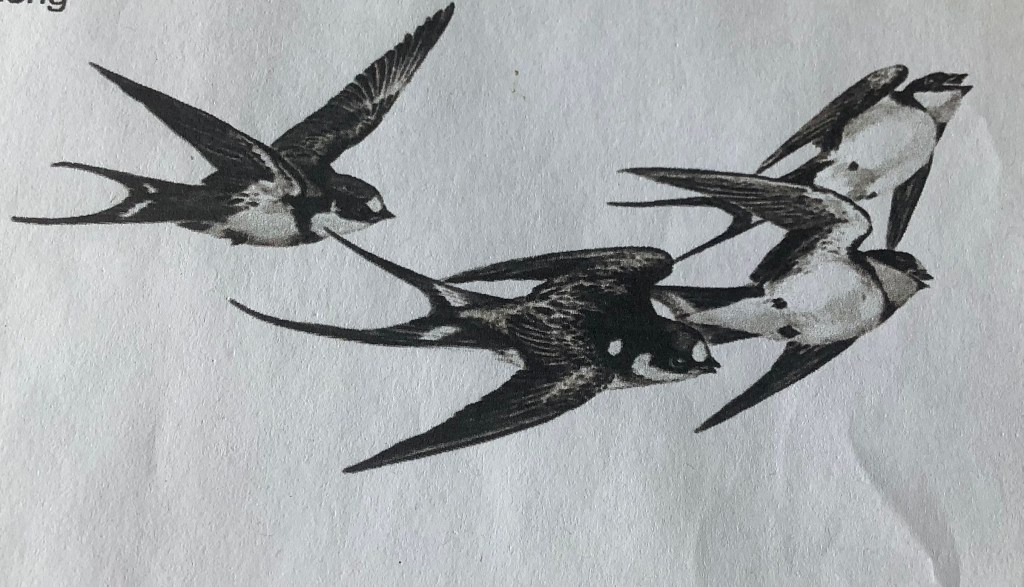
Birdsong brings comfort
to my longing
I’m just as ecstatic as they are,
but with nothing to say!
Please universal soul, practice
some song or something through me!
Rumi
May the eternal creator, sustainer and redeemer go with us as we walk. Amen.
The angel of the Lord appeared to Moses in a flame of fire out of a bush; Moses looked, and the bush was blazing, yet it was not consumed. Then he said, ‘I must turn aside and look at this great sight, and see why the bush is not burned up.’ When the Lord saw that he had turned aside to see, God called to him out of the bush, ‘Moses, Moses!’ And he said, ‘Here I am.’ Then God said, ‘Come no closer! Remove the sandals from your feet, for the place on which you stand is holy ground.
Exodus 3:2- 5
There is the suggestion that a saunterer is a person walking to the Holy Land, from the French ‘à la sainte-terre’. So let’s consider sauntering to be a form of holy or blessed walking. May our walking bring us closer to God.
Good Ground by Malcolm Guite
I love your simple story of the sower,
With all its close attention to the soil,
Its movement from the knowledge to the knower,
Its take on the tenacity of toil.
I feel the fall of seed a sower scatters,
So equally available to all,
Your story takes me straight to all that matters,
Yet understands the reasons why I fall.
Oh deepen me where I am thin and shallow,
Uproot in me the thistle and the thorn,
Keep far from me that swiftly snatching shadow,
That seizes on your seed to mock and scorn.
O break me open, Jesus, set me free,
Then find and keep your own good ground in me. (1)
There is a suggestion that a saunterer is a person walking to the Holy Land, coming from the French ‘à la sainte-terre’. So let’s consider sauntering to be a form of holy or blessed walking.
The scriptures give God many names as people try to describe their encounter with the presence of holiness. Such names – or descriptions – include beloved, father, mother, midwife and shepherd; or rock, tower, shield, light and sun of righteousness. In our prayers we may talk of God as Father, Son and Holy Spirit or alternatively as Creator, Redeemer and Sustainer.
I wonder if we have our own particular name that describes our experience of the presence of holiness.
i thank You God by e e cummings
i thank You God for most this amazing day: for the leaping greenly spirits of trees and a blue true dream of sky; and for everything which is natural which is infinite which is yes (i who have died am alive again today, and this is the sun’s birthday; this is the birth day of life and of love and wings: and of the gay great happening illimitably earth) how should tasting touching hearing seeing breathing any—lifted from the no of all nothing—human merely being doubt unimaginable You? (now the ears of my ears awake and now the eyes of my eyes are opened)
The heavens are telling the glory of God; they are a marvellous display of his craftsmanship.Day and night they keep on telling about God. Without a sound or word, silent in the skies, their message reaches out to all the world. Psalm 19:1-4a (Living Bible)
‘To pray is to walk in the full light of God, and to say simply, without holding back, ‘I am human and you are God’. Henri Nouwen
Very truly, I tell you, unless a grain of wheat falls into the earth and dies, it remains just a single grain; but if it dies, it bears much fruit. John 12:24
“For a seed to achieve its greatest expression, it must come completely undone. The shell cracks, its insides come out and everything changes. To someone who doesn’t understand growth, it would look like complete destruction.” Cynthia Occelli
Pentecost was in origin an agricultural festival celebrating the harvest of the abundance that each grain, sown in the spring, had produced. Today, at Pentecost, we celebrate the abundant riches of the Holy Spirit.
God’s Grandeur by Gerald Manley Hopkins
The world is charged with the grandeur of God.
It will flame out, like shining from shook foil;
It gathers to a greatness, like the ooze of oil
Crushed. Why do men then now not reck his rod?
Generations have trod, have trod, have trod;
And all is seared with trade; bleared, smeared with toil;
And wears man’s smudge and shares man’s smell: the soil
Is bare now, nor can foot feel, being shod.
And for all this, nature is never spent;
There lives the dearest freshness deep down things;
And though the last lights off the black West went
Oh, morning, at the brown brink eastward, springs —
Because the Holy Ghost over the bent
World broods with warm breast and with ah! bright wings.
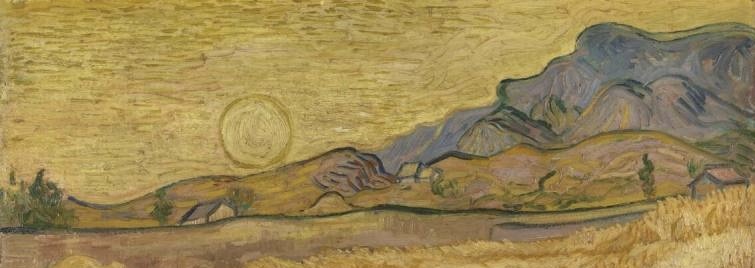
Reaper with wheat field and sun (part thereof) by Vincent Van Gogh
As we walk under the sky and on the earth, may God the Holy Spirit enfold us. Amen.
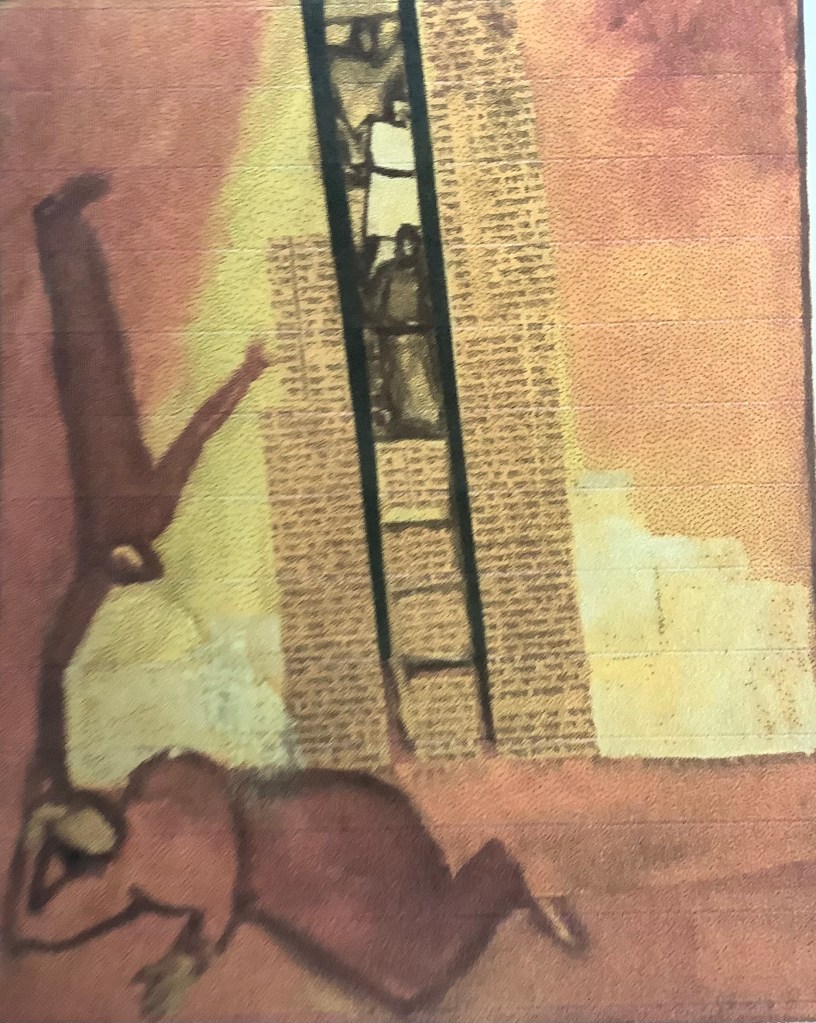
A collage variation of Chagall’s Jacob’s Ladder (source unknown)
And Jacob dreamed that there was a ladder set up on the earth, the top of it reaching to heaven; and the angels of God were ascending and descending on it. Genesis 28:12
Heaven and Earth are only three feet apart, but in thin places that distance is even smaller. A thin place is where the veil that separates Heaven and Earth is lifted and one is able to receive a glimpse of the glory of God. (Celtic tradition)
And Jesus said, ‘Very truly, I tell you, you will see heaven opened and the angels of God ascending and descending upon the Son of Man.’ John 1:51
Christ came down to raise us up, for Christ joins Earth with Heaven.
Lord Jesus Christ, through your life and death, you opened wide the way between Heaven and Earth, come close to us now that we may glimpse Heaven on Earth and so be inspired to lift our lives up to you. Amen.
Come … let us walk in the light of the Lord. Isaiah 2:5
You Lord, are the source of all good things:
We praise you.
You call us to tend and care for your creation:
May we strive to do your will.
You have made us as brothers and sisters with all that lives:
May we live together in peace.
A reading from Luke 24: 13-17, 25-29
Now on that same day two of them were going to a village called Emmaus, about seven miles from Jerusalem, and talking with each other about all these things that had happened. While they were talking and discussing, Jesus himself came near and went with them, but their eyes were kept from recognising him. And he said to them, ‘What are you discussing with each other while you walk along?’ They stood still, looking sad. Then he said to them, ‘Oh, how foolish you are, and how slow of heart to believe all that the prophets have declared! Was it not necessary that the Messiah should suffer these things and then enter into his glory?’ Then beginning with Moses and all the prophets, he interpreted to them the things about himself in all the scriptures.
As they came near the village to which they were going, he walked ahead as if he were going on. But they urged him strongly, saying, ‘Stay with us, because it is almost evening and the day is now nearly over.’ So he went in to stay with them.
Saturday 21st September: Hammersmith Bridge to Teddington Lock
The ancient practice of pilgrimage, honoured by many of the world’s great faiths, has a renewed focus in this age of climate and ecological emergency. Walking together with intention, mindfulness and prayer proclaims a different pace and place in relationship to the earth; and with each other. We become fellow travellers, learning again to ‘tread lightly’ on the earth. Pilgrimage invites a renewal of body, mind and spirit, while offering a visible sign of a different way of living and travelling.
We meet to start our journey in the community garden at Holy Trinity, Barnes – to leave by 10.30am following these opening prayers
Most High, all powerful, good Lord, To you we offer praise and glory, the honour and blessing. All creation – all that lives and breathes and moves – praises you.
All the elements praise you –
Brother Sun radiant with light and energy, beautiful and awesome,
And who with Sister Moon, establishes day and night, tides and seasons.
All praise to God!
Brother Wind and air, calm and serene, powerful and fearsome,
Bringer of weather, and source of energy.
All praise to God!
Sister Water, humble yet precious, simple and beautiful,
fluid energy and source of life.
All praise to God!
Brother Fire, playful, robust and strong,
offering warmth and comfort, yet to be handled with care!
All praise to God!
Sister-Mother Earth who sustains us and governs us,
And produces plants and minerals, sustaining life in all its rich diversity.
All praise to God!
All the elements praise you
and so too all that lives and breathes within your creation!
All praise to God!
In your bountiful love,
forgive our carelessness, our greed and our destructive acts.
Lord have mercy
Forgive our selfishness, and our failure to show compassion.
Lord have mercy
Forgive our heartlessness, our narrowness of vision and our failure to act justly.
Lord have mercy
Forgive our self-certainty, our disregard for your wisdom and our failure to learn.
Lord have mercy
With humility and contrition, we praise you
and ask your blessing on our endeavours.
May we serve you with humility,
seeking justice and showing loving care for all creation.
To you be all honour and power, praise and glory.
Amen.
Pauses for prayer.
1. Hammersmith Bridge – this bridge reminds us of the importance of rivers as means of transport and also the obstacle they can present if no bridges are available. The current bridge was designed to allows ships and boats to pass underneath as well as allowing pedestrians, cyclists and until recently, other vehicles, to cross over the river. Weaknesses in the structure have resulted in the bridge being closed to vehicular traffic since 2019. During the heat wave in July 2022, the chains were wrapped in foil and cooled with air-conditioning to 13°C to prevent further cracking – a reminder that climate change presents us with many unforeseen concerns.
We give thanks for bridges and sustainable means of transport that enable us to travel to school and work, to visit friends and family, to send and receive goods and services.
Yet we lament our human perverseness in developing and using modes of transport that damage the environment and disrupt life .
Lord have mercy:
Let justice flow on like a river, righteousness like a never failing stream.
2. Leg of Mutton reservoir – Built in 1838, the Leg o’ Mutton Reservoir supplied water until its decommission in 1960. After much toing and froing, it avoided becoming a house estate and in 1990, became a local nature reserve. The reservoir hosts a wealth of wildlife including over wintering teal and shovelers, Common terms, Pochards and Little Grebes, whilst the reed beds are home to various warblers and dragon flies.
We give thanks for these small but biodiverse rich pockets of wild habitat, that remind us of the beauty and interconnectedness of the natural world. We give thanks for the work and dedication of volunteers and staff who enable such places to flourish.
Yet we lament the relentless pursuit of profit which inhibits more widespread development of such sites, and we lament the ease with which we humans expect to dominate over nature and land use.
Lord have mercy:
Let justice flow on like a river, righteousness like a never failing stream.
3. Black poplar tree – the native black poplar is a rare tree in the UK so it is surprising and delightful to find that a number of them have been identified here along the tow path. They are a floodplain species that thrives in waterlogged habitats, but with many natural wetland areas being drained and cleared for other uses, the loss of habitat has contributed to their decline. To ensure their continued survival, cuttings have been taken allowing some 300 saplings to be planted both here and in suitable sites across the country.
We give thanks for the diversity of trees and plants in creation, each one uniquely special, and acknowledge that it is the diversity of flora that enables humans and other species to thrive.
We lament our shortsightedness in reducing the range of habitats that exist both here in the UK and across the world, and the knock on effect that has on the health and well being of so many human lives.
Lord have mercy:
Let justice flow on like a river, righteousness like a never failing stream.
4. Mortlake – here in the 17th century the famous Mortlake tapestries were woven by Flemish weavers. Some of the master weavers were granted English citizenship, whilst orphaned boys from the City of London were taken on as apprentices.
Following the potato famine in the 1840s many Irish people sought work in the market gardens that then abound in Mortlake, and this gave rise to the building of Mortlake’s first Roman Catholic Church – St Mary Magdelene’s.
This riverside location has also attracted other migrants; we passed by the Swedish school in Barnes, and further upstream we will pass the German school at Petersham.
We give thanks for the diverse people who have settled along the Thames enriching the lives of their local communities.
Yet we lament the failure of governments to assist those fleeing from climate disasters and the failure of harvests, and those fleeing from wars and conflicts inflamed by climate change.
We lament our failure to offer all in need safe passage and a warm welcome.
Lord have mercy:
Let justice flow on like a river, righteousness like a never failing stream.
5. Chiswick Bridge – where the Oxford and Cambridge boat race has its finishing line. The participating crews then celebrate or commiserate at the boathouse opposite home to the Quintin Boat Club and the University of Westminster Boat Club. Much of the land on the north bank is used for various sporting and fitness activities.
We give thanks for joy that the Thames provides a place for sport recreation both in, on and by the water, and for the health giving benefits of exercise.
We lament the inequalities of our society that precludes everyone having easy access to open spaces and sporting facilities. We lament the loss of school playing fields and youth clubs.
Lord have mercy:
Let justice flow on like a river, righteousness like a never failing stream.
6. Kew Gardens – which has a plant collection of some 17,000 species from around the world. Kew Gardens also carries out research into climatechange-resistant crops, zero-carbon fertiliser, and plant- and cell – based foods products. Yet even Kew Gardens is not free from the threat of climate change. A recent report has found that some 50% of Kew’s trees are threatened by rising temperatures, whilst plans are in place to relocate Kew’s herbarium to Reading to avoid the risk of flooding.
We give thanks for the rich diversity of plants that exists around the world, and for the research being done to protect and enhance plants, habitats and food supplies.
Yet we lament the industrialisation of farming and the over grazing and exploitation of land to satisfy our desire for meat. We lament the economic models that leave many in the world with inadequate and poor diets .
Lord have mercy:
Let justice flow on like a river, righteousness like a never failing stream.
Lunch break!
7. Richmond Lock. The Thames is still tidal here and the lock helps maintain water levels between here and Teddington Lock. Even so during high tides and/ or times of heavy rain land either side of the river can flood and the risk is growing as a result of the climate crisis with both rising sea levels and extreme weather systems. To ease this, work is being carried out in the Old Deer Park to create creeks and swales, allowing the land to become once again a real floodplain.
We give thanks for the natural capacity of the soil, trees and plants to absorb rainfall. We give thanks for the diversity of habitats that enhance sustainable ecosystems.
Yet we lament the pressure we are placing on the environment to cope with the climate crisis that we have caused. We lament the threat that rising sea levels causes for so many small nations.
Lord have mercy:
Let justice flow on like a river, righteousness like a never failing stream.
8. Water meadows and parks – between roughly Barnes/ Mortlake and upto Kingston /Weybridge, this section of the river is known as Arcadian Thames. It’s a leafy green environment with, as here, real water meadows, and a number of country houses whose grounds stretch down to the river side. These homes were built by past generations of the rich and influential who sought a rural retreat – and the area is still one of desirable and expensive housing. This stretch of the Thames forms part of a scheme called Rewilding Arcadia which seeks to restore the natural, intrinsic functioning of the flood plain as a means of reducing the risk and effects of flooding. Flooding will be – and indeed already is – an increasing problem due to the climate crisis. Rewilding the river allows new and better relationships between people and their lives, the river and its ecosystems.
We give thanks for the beauty of the Arcadian riverine environment, its green spaces and its relaxing atmosphere. We give thanks for the enhanced biodiversity that it supports, and we give thanks for the restorative and health-giving capacities of these blue and green spaces.
Yet we lament the thoughtless creep of urbanisation that can destroy such beauty. We lament the pollution that seeps into the river from roads and homes, from commercial and industrial sites. We lament the careless use of plastic in all its guises which so easily ends up in rivers and waterways.
Lord have mercy:
Let justice flow on like a river, righteousness like a never failing stream.
9. Teddington Lock – here the powers of the Port of London Authority give way to those of the Environment Agency. The locks allow the passage of boats of various sizes whilst the weir regulates the level of water upstream. A scheme to replace part of the weir with a hydro electric plant was turned down in 2016 because of the objections of the nearby Lensbury Club.
More recently this area is the subject of controversial proposals by Thames Water, involving extracting large volumes of water from the river for use by customers, and replacing it with treated sewage which would be released into the river, adversely affecting the biodiversity of this unique location where the tidal river meets the freshwater river.
Meanwhile the construction work involved would severely damage the special habitats that form the Ham Lands Local Nature Reserve.
Better alternatives would include fully treating sewage at the Mogden and Beckton treatment plants such that the water could be reused to fill key reservoirs, mending the leaks which account for the loss of some 600 million litres of water a day, and encouraging customers (both domestic ones like us and commercial customers) to use less water. Domestic use in the UK averages 140 litres per person whilst in Denmark it is 104 litres per person.
We give thanks for the gift of clean water for drinking and washing. We give thanks for gift of rain and for the streams and rivers which flow through each river basin bringing life and vitality to the environment. We give thanks for the diversity of plants and wildlife that these waters support.
We lament our folly when we let good water run to waste, when we let pollution damage our waterways, when we fail to value what is so precious. We lament our selfishness when we use water as if it was an endless supply, when we use more than we need, putting other lives at risk. We lament the economic system that allows water to be sold, profiting share holders at the expense of the vulnerable.
Lord have mercy:
Let justice flow on like a river, righteousness like a never failing stream.
10. St Richard’s, Ham
Let us make a final pause here at the end of our pilgrimage. Having begun our journey with a variation of St Francis’s Canticle of the Creatures, let us end with a modern Franciscan blessing.
May God bless us with discomfort at easy answers, half-truths, and superficial relationships, so that we may live deep within our hearts.
May God bless us with anger at injustice, oppression, and exploitation of people, so that we may work for justice, freedom, and peace.
May God bless us with tears to shed for those who suffer from pain, rejection, hunger, and war, so that we may reach out our hands to comfort them and turn their pain into joy.
And may God bless us with enough foolishness to believe that we can make a difference in this world, so that we can do what others claim cannot be done, to bring justice and kindness to all our children and the poor.
Amen.
Christian Climate Action – we are a community of Christians who support each other to take meaningful action in the face of imminent and catastrophic anthropogenic climate breakdown. We are inspired by Jesus Christ and guided by the Holy Spirit. Following the example of social justice movements of the past, we carry out acts of public witness, nonviolent protest and civil disobedience to urge those in power to make the changes needed. We also work to engage and mobilise people to take action.