Green Tau: issue 100

14th December 2024

How we can make a just transition? Agriculture and land use

Approximately 12% (58MtCO2 as of 2020) of the UK’s greenhouse gas emissions come from farming but of that 10% more than half is methane from livestock and a further 30% is nitrous oxides from fertilisers (1). As the UK moves to a net zero economy, it is obvious that emissions from agriculture need to be reduced – the Climate Change Committee’s target is 21 MtCO2 by 2050. (Agriculture – including deliberate none cultivation of the land – offers opportunities to increase natural carbon absorption which should more than offset this remaining 21Mt of CO2).

The Climate Change Committee which draws up carbon budgets and roadmaps to advise the Government as to the means by which net zero targets can be achieved, recommended in its 2020 report Land use: Policies for a Net Zero UK, the following policy proposals:

  • Increase tree planting – increasing UK forestry cover from 13% to at least 17% by 2050 by planting around 30,000 hectares (90 – 120 million trees) of broadleaf and conifer woodland each year.
  • Encourage low-carbon farming practices – such as ‘controlled-release’ fertilisers, improving livestock health and slurry acidification.
  • Restore peatlands – restoring at least 50% of upland peat and 25% of lowland peat.
  • Encourage bioenergy crops – expanding UK energy crops to around 23,000 hectares each year.
  • Reduce food waste and consumption of the most carbon-intensive foods – reduce the 13.6 million tonnes of food waste produced annually by 20% and the consumption of beef, lamb and dairy by at least 20% per person, well within current healthy eating guidelines. (2)

In the summer of this year, 2024, the Climate Change Committee’s report on progress found that reducing emissions from agriculture and land use had slowed and that ‘total emissions from agriculture have not significantly decreased since 2008’! (3) Commenting on the Report, ADAS  notes “A key CCC recommendation is that  tree planting and peatland restoration must be accelerated. Under the CCC pathways to net zero, tree planting must be scaled up in the 2020s in order for abatement (carbon sequestration and storage) to be sufficient to meet later carbon budgets and reach net zero by 2050. This will require a doubling of current rates to get as close as possible to the targets of 30,000ha of new woodland creation per year by 2025 and 32,000ha of peatland restoration a year by 2026.” (4) As regards reducing livestock levels, whilst figures previously showed a decline, this seems to have plateaued, suggesting further focus here is needed. 

Whether through converting more arable or grass lands to woodland, restoring peatlands or by reducing livestock numbers, the farming world is going to have to face ongoing change. 

The demands of climate change, go beyond just reducing carbon emissions, and include further action in protecting land, properties and lifestyles from the impacts of increasingly adverse weather conditions and rising sea levels. Again referencing the latest CCC report ADAS notes “This latest CCC report comes after the wettest 18 months on record in England. Farmers and land managers have been among the most affected with thousands of acres of farmland flooded, crop yields down and harvesting delayed, as well as knock-on impacts into this season and likely longer-term.

“The impacts of this record rainfall highlight the urgent need to adapt to the physical risks of climate change, to avoid more costly and less effective adaptations further down the line. The CCC reports that currently the UK’s Third National Adaption programme (NAP3) lacks the ambition and pace to address the scale of climate risks we are already experiencing in the UK”. (6)

Under the terms of the Climate Change Act 2008 the UK is required to produce ‘national adaptation plans’ setting out how the government will protect the country from the impacts of climate change by   constructing flood defences, developing green spaces, cultivating drought-resistant crops, and building resilient infrastructure etc. NAP3 covers the period 2023 to 2028. To date most commentators note that the provisions made by NAP3 are inadequate, but clearly they will impact on the farming world whether through more farmland suffering the adverse consequences of droughts and floods, or through changing agricultural practices and changes to land use – eg restoring water meadows, planting more woodland and re-setting peatlands.

At the same time as the need to address climate change by transitioning to net zero, the UK also needs to address biodiversity loss which is another issue linked with the need for change in agricultural practices. As regards England (other parts of the UK have their own policies) the Parliament has noted that “the Environment Act 2021 … set legally binding biodiversity targets ….:

  • to reduce the risk of species going extinct in 2042, compared with 2022
  • to create or restore 500,000 hectares of wildlife-rich habitats by 2042
  • to ensure overall species abundance is increasing rather than decreasing by 2030, and increases by 10% by 2042, compared with 2030”(5)

These are in addition to the UK’s commitment to meet the international Convention on Biological Diversity’s ‘30 by 30 target’ – vis achieving effective conservation and management of at least 30% of land and sea by 2030.

Again these are targets which are going to impact the farming world, through adopting less intensive farming techniques, and through the restoration – and expansion of – hedgerows, ponds, woods, peatlands and meadows etc. 

Not all these changes are going to be self financing. It is possible that less intensive farming by reducing the amount – and therefore cost –  of inputs such as fertilisers, may be cost neutral, but in most cases less intensive farming will only be financially viable if the end product can be sold to,the customer at an enhanced price.  But weather restoring a pond in a field or rewetting peatland will be self financing is perhaps more doubtful. On the other hand the benefit to us as a whole will be significant – so may be we need to work out how we put a value on that benefit and how we work out who pays and how. 

It seems to me that we need a conversation that allows farmers and consumers to explore what the options are and how the transition to  climate and biodiversity friendly farming can be achieved. If farms are going to have less livestock, are we consumers going to eat less meat? If crops are grown less intensively, are we consumers willing to pay more? And is the government going to ensure that wages and benefits increase commensurately? If farmers are to convert grazing land to woodlands, are we as tax payers, willing to pay for loss of income? Might we instead see the cost as the cost of protecting our homes from flooding? Might those with the resources (financial and volunteering capacity) be willing to purchase farmland with the aim of rewilding it? Will the government provide funds to encourage new rural industries that would provide employment and maintain or reinvigorate rural communities? 

We certainly need to have these conversations urgently to ensure both a just transition and to protect our climate and environment for the wellbeing of current and future generations to come. The next five years look as if they are increasingly going to be when decisive action (not just plans) happens.

  1. https://ahdb.org.uk/knowledge-library/carbon-footprints-food-and-farming
  2. https://www.theccc.org.uk/2020/01/23/major-shift-in-uk-land-use-needed-to-deliver-net-zero-emissions/

(3) https://www.theccc.org.uk/publication/progress-in-reducing-emissions-2024-report-to-parliament/

(4)  https://adas.co.uk/news/credible-plans-and-actions-urgently-needed-to-decarbonise-uk-agriculture-sector/

(5) https://commonslibrary.parliament.uk/biodiversity-loss-uk-international-obligations/

(6) https://adas.co.uk/news/credible-plans-and-actions-urgently-needed-to-decarbonise-uk-agriculture-sector/

Advent 14: a passing place

A passing place is there to allow two travellers going in opposite directions to pass. It is a road feature that enables cooperation. It is not there to be used as a lay-by or parking space – to do that would be selfish.  In the story of Exodus we hear how a cleft in a rock is used as a passing place so that God in dazzling glory can pass by Moses – Exodus 33:21-23 

Making room for others to pass, especially when there are obstructions, when people are going at different speeds, or when places are simply too crowded, makes it easier for everyone to move in the right direction. 

Each of you should look not only to your own interests, but also to the interests of others. Let this mind be in you which was also in Christ Jesus. 
Philippians 2:4-5

Advent 13: No entry

Sometimes our journey through life hits a brick wall. The way we wanted to go is closed before us. What bars our way ahead may be of our own making,  it may be of someone else’s making or it may be a purely random event. Somehow we have to cope with disappointment and move on by a different route. If we can do so and still smile, so much the better.

 I know how to live on almost nothing or with everything. I have learned the secret of living in every situation, whether it is with a full stomach or empty, with plenty or little. For I can do everything through Christ, who gives me strength. Philippians 4:12-13 

This is my command—be strong and courageous! Do not be afraid or discouraged. For the LORD your God is with you wherever you go.” Joshua 1:9

Advent 12: Give way more

NB this photo was taken during Covid when bright sparks would add additional text to signs!

My great great aunt told me that marriages need two bears in them: bear and forebear. To forebear, to give someone else priority, to hold back can be a virtue that make life less competitive and more harmonious, less judgemental and more inclusive. And this sign is perhaps particularly encouraging by inviting us to ‘give way more’!

So then, let us stop judging one another. Instead, you should decide never to do anything that would make others stumble or fall into sin. Romans 14:13

“… yet not my will, but yours be done.” Luke 22: 42b

Your kingdom come, Your will be done, on earth as it is in heaven. Matthew 6: 10

Advent 11: Life is not always plain sailing

Some roads are uneven. The same is true of life. Sometimes we hit rocky patches where life becomes  a bumpy ride. 

In reality this road sign warns of speed bumps in at least two directions. These are not intended as obstacles but are designed to slow the traffic. Sometimes if people go to fast they risk injuring themselves and others.

And the LORD answered, “My Presence will go with you, and I will give you rest.” Exodus 33:14 

I have told you all this so that you may have peace in me. Here on earth you will have many trials and sorrows. But take heart, because I have overcome the world.” John 16:33

Advent 10: Watch out for the unexpected

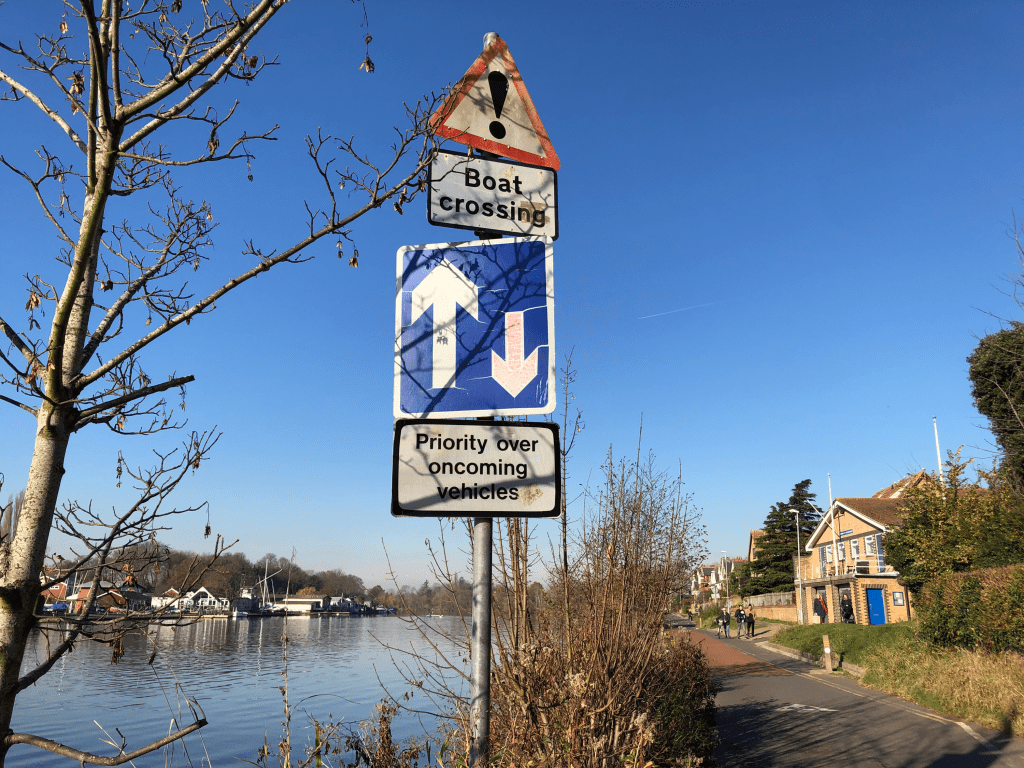
It is not everyday that you will come across a boat crossing the road! But life is full of unexpected things. Certainly for the Israelites on their journey to the promised land came across many unexpected surprises, not least finding the Red Sea opening up before them so they could cross with dry feet. And for Elijah, having killed all Queen Jezebel’s prophets, fled to the wilderness truly expected to die there and must have been most surprised when ravens brought him  a delivery of bread. 

Indeed the whole of the world God is creating overflows with the unexpected. 

There the ships go to and fro, and Leviathan*, whom you formed to frolic there. Psalm 104:26

*Leviathan is a large sea creature

Green Tau: issue 99

9th December 2024

How we can make a just transition?

Globally we know we have to reach net zero greenhouse gas emissions by 2050 – at the latest – if we are to curb the inexorable rise in temperatures, the associated increase in extreme weather events and any of the various tipping ecological points that would accelerate this process.

Here in the UK our government has set a target of reducing emissions by 68% (compared with 1990 values) by 2030 and by 81% by 2035 and ultimately by 100% by 2050.

To achieve these targets we need to reduce sharply our use of fossil fuels to heat our buildings (including cooling in the summer), to run our transport systems (vehicles, trains, airplanes etc), to generate electricity, and in various industrial processes such as making steel. 

Such changes will impact is all. For householders it will include having to add more insulation to their homes and replacing gas boilers with electrically based heating. And for tenants, hopefully such alterations will be carried out by their landlords. For commercial and institutional buildings there will equally be the need to replace gas with electric heating and cooling systems, as well as upgrading thermal insulation. Such buildings may well have the scope to install solar panels and batteries so that they can generate their own electricity. The managers of such buildings may also want to reflect on how staff, users and customers travel to and from their premises to enable these to become more sustainable in their use of energy.

For car drivers it will be switching to electric cars or, even better, switching to public transport and active travel. For delivery drivers it will be switching to cycles for small, local loads and electric vehicles for larger ones. For the railway it will be investing in further electrification of the rail network and potentially developing battery units for short, smaller capacity branch lines. For airlines it must mean reducing the number of flights as there really is no green alternative to aviation fuel, although for short flights serving outlying islands battery planes may be a developmental opportunity. 

For the energy sector, it will include continuing to develop and expand renewable energy sources (solar, wind and tidal) to provide all the extra green electricity that will be needed by other sectors, and to provide the necessary infrastructure to support that and to enable individual households, businesses and communities to develop their own generation capacity. 

For industrial processes it will be switching to new methods of production such as using electric arc furnaces for steel making and for cement production developing new chemical formulations that avoid releasing large amounts of CO2. 

These changes will also have impacts on jobs with some people needing to retrain for new careers – for example oil rig workers retraining to build and maintain offshore wind turbines, car workers might switch to building public transport rolling stock, airline staff might switch to working in the rail industry,  blast furnace workers might retrain as installers of heat pumps and thermal insulation, or switch to manufacturing double glazing units, solar panels, and wind turbines etc. 

These changes will need considerable financial investment, which must mean shifting money  currently invested in supporting carbon intensive industries and projects, to these low carbon sustainable alternatives. And this will mean a shift in thinking by those who work in the financial markets – bankers, financiers, investment managers, pensions and insurance fund managers, etc. 

These changes will also need government support, both in terms of legislation that will deliberately shift markets in the right direction, and in terms of subsidies, switching these away from carbon intensive industries and towards the green alternatives. And this will be a key role in achieving the carbon emission targets. Our capitalistic economic system is not well equipped to create the change we need. It is not well equipped to reflect the risks and damage caused by carbon intensive industries and products. Nor is it well equipped to ensure that those responsible for the damage already caused should pay for all necessary remedial and restorative action. 

Earlier this week – 5th December – Shell and Equinor announced a plan to combine their operations in the North Sea to more effectively extract the remaining oil and gas reserves for ‘decades’ to come! This would ensure their continuing profit levels and in particular share dividends. How can it be economic to extract more carbon emitting oil and gas over those very same decades when we as a nation – and globally – are struggling to reduce our carbon emissions to net zero? 

And how can it be that our government will provide subsidies to these oil companies to enable them to develop these projects? It is calculated that with tax breaks and subsidies, the UK could pay upward of 90p in the pound for the cost of developing the Rosebank oil field. 

And how can it be that these oil companies can talk about – and use this in their advertising – that they are maintaining the UK’s energy security, and that they are keeping homes warm –  and neglecting to point out that the cost of what they provide is at an increasing to customers and the environment – as if only gas and oil could achieve energy security? 

What we need for a just transition is:

  •  proactive action taken by the government to create and safeguard a transition via legislation that is fair to the working population, that is fair to householders, and that ensures a level and consistent playing field for businesses
  • Proactive action taken by the government to redirect subsidies so that they support and enhance the transition to renewables and ensure that the price to the consumer is affordable in the short term. (In the long term re-newables will be cheaper)
  • Proactive action by the financial world to shift finances from the old carbon intensive industries to the growing low carbon, sustainable ones
  • Proactive action by companies and organisations to ensure their operations are shifting at pace to achieve net zero.

A key part in this transition can be found in the Climate and Nature Bill – the CAN Bill – which is a private member’s bill that is currently making its way through Parliament. We can show our support for this via the Zero Hours web page and by asking our individuals MPs to back the bill when it comes for its second reading on 24th January – https://www.zerohour.uk/climate-and-nature-bill/

For more information 

Advent 9: a shared path

 It is good to be reminded that we are not the only travellers on the road. Some may be moving faster than us, others slower. Either way it is always a good idea to keep an eye out for the wellbeing of others – and especially for wildlife as humankind’s behaviour is decimating the world’s biodiversity.

But a Samaritan, as he traveled, came where the man was; and when he saw him, he took pity on him. He went to him and bandaged his wounds, pouring on oil and wine. Then he put the man on his own donkey, brought him to an inn and took care of him. Luke 10:33-34 

If you want to learn, then go and ask the wild animals and the birds, the flowers and the fish. Any of them can tell you what the Lord has done. Every living creature is in the hands of God. Job 12:7-10

Advent 2

8th December 2024

Reflection with readings below 

Advent is a season of preparation for Christmas – marking the birth of Christ – and for Christ’s judgement or presence at the end of time (however we may view that, be it of our life span, or that of civilisation or of the earth).

The birth of a child is always special but not all births are surrounded by bliss and serenity. The two gospel accounts of Jesus’ birth suggest that his birth was surrounded by various problematic and unexpected issues – moral dilemmas about paternity, temporary homelessness, the threat of murder, and flight as refugees, for example. And for children around the world today, birth and infancy can be just as problematic with the potential likelihood of poverty, homelessness, war and violence, lack of food and health care, and diverse moral and social obstacles. Just this week we have been hearing how women in Afghanistan will no longer be able to train as midwives.

So why, when we prepare to celebrate Christmas in our churches, do we present an image of birth that is all sweetness and light? Are we short-changing our congregations – and perhaps especially those for whom church going is an annual event – by implying that that is all that Christianity is about – a sweet  and sugary message. A message that has nothing to say about the difficulties and short comings that many people and communities face. A message that fails to acknowledge that these are issues that Jesus did and still does care deeply about. The difficulties and shortcomings are the reason why Jesus came as a saviour. He came bringing different ways of being human, different priorities, different ways of relating to God. The wisdom that Jesus still offers – if only we humans would accept it –  can  bring both peace and justice to our world.

The world is crying out for salvation, for healing, for restoration and renewal. The rules and cultures humanity lives by are not fit-for-purpose. They do not ensure the unfurling of peace and justice for all.  We need to making clear that the gospel message of Jesus is one of salvation, of turning around the way we live,  of the way we care for one another, of the way we care for not just ourselves but all of creation – of which we are but one small but potential highly destructive part.

People shouldn’t be coming to a church that says everything is perfect and innocent, adorned with twinkling stars and fairy lights. But to a church that says we know we are imperfect and that we live in a variety of imperfect systems, and that many things are wrong in this world. A church that is ready to acknowledge and identify with the suffering and hardships of others – a church that doesn’t look away from unpleasant things pretending the doesn’t exist. A church that can equally be confident in asserting: It doesn’t have to be like this. There is a different way of being and doing. It is the way of God, it is the way of God revealed most acutely in the person and being of Jesus Christ. 

Malachi 3:1-4

See, I am sending my messenger to prepare the way before me, and the Lord whom you seek will suddenly come to his temple. The messenger of the covenant in whom you delight– indeed, he is coming, says the Lord of hosts. But who can endure the day of his coming, and who can stand when he appears?

For he is like a refiner’s fire and like fullers’ soap; he will sit as a refiner and purifier of silver, and he will purify the descendants of Levi and refine them like gold and silver, until they present offerings to the Lord in righteousness. Then the offering of Judah and Jerusalem will be pleasing to the Lord as in the days of old and as in former years. 

The Song of Zechariah     Luke 1: 68-79

Blessed be the Lord, the God of Israel; *
he has come to his people and set them free. 

He has raised up for us a mighty saviour, *
born of the house of his servant David. 

Through his holy prophets he promised of old,

that he would save us from our enemies, *
from the hands of all who hate us. 

He promised to show mercy to our fathers *
and to remember his holy covenant. 

This was the oath he swore to our father Abraham, *
to set us free from the hands of our enemies, 

Free to worship him without fear, *
holy and righteous in his sight
all the days of our life. 

You, my child, shall be called the prophet of the Most High, *
for you will go before the Lord to prepare his way, 

To give his people knowledge of salvation *
by the forgiveness of their sins. 

In the tender compassion of our God *
the dawn from on high shall break upon us, 

To shine on those who dwell in darkness and the shadow of death, *
and to guide our feet into the way of peace.

Glory to the Father, and to the Son, and to the Holy Spirit: *
as it was in the beginning, is now, and will be for ever. Amen. 

Philippians 1:3-11

I thank my God every time I remember you, constantly praying with joy in every one of my prayers for all of you, because of your sharing in the gospel from the first day until now. I am confident of this, that the one who began a good work among you will bring it to completion by the day of Jesus Christ. It is right for me to think this way about all of you, because you hold me in your heart, for all of you share in God’s grace with me, both in my imprisonment and in the defence and confirmation of the gospel. For God is my witness, how I long for all of you with the compassion of Christ Jesus. And this is my prayer, that your love may overflow more and more with knowledge and full insight to help you to determine what is best, so that in the day of Christ you may be pure and blameless, having produced the harvest of righteousness that comes through Jesus Christ for the glory and praise of God.

Luke 3:1-6

In the fifteenth year of the reign of Emperor Tiberius, when Pontius Pilate was governor of Judea, and Herod was ruler of Galilee, and his brother Philip ruler of the region of Ituraea and Trachonitis, and Lysanias ruler of Abilene, during the high priesthood of Annas and Caiaphas, the word of God came to John son of Zechariah in the wilderness. He went into all the region around the Jordan, proclaiming a baptism of repentance for the forgiveness of sins, as it is written in the book of the words of the prophet Isaiah,

“The voice of one crying out in the wilderness:

‘Prepare the way of the Lord,
make his paths straight.

Every valley shall be filled,
and every mountain and hill shall be made low, 

and the crooked shall be made straight,
and the rough ways made smooth; 

and all flesh shall see the salvation of God.'”

Advent 8: Pause for thought

Works of art often prompt thought and question, and thus become signs. Here what seems to be a sign (?), has become a work of art. I wonder what it may be saying to you? 

Good people think before they answer, but the wicked speak evil without ever thinking. 

Proverbs 15:28 

Reflect on what I am saying, for the Lord will give you insight into all this. 2 Timothy 2:7