With COP30 a week away, what are the system changes we need to protect the Earth’s planetary boundaries?
Biodiversity integrity – life forms in all their variety are key to our wellbeing and survival. We re reliant on functioning ecosystems for clean air and water, for food and medicines, for clothing and shelter. And functioning ecosystems depend on there being both a diversity of and a sufficient number of, plants, animals, insects, bacteria etc. For example, without fungi and earth worms, plant roots, decaying leaves etc the fertility of the soil will be depleted and food supplies diminished.
We humans, through both excessive use of some resources and through a failure to conserve others, have so diminished the integrity of the Earth’s biodiversity framework, that it is now in the danger zone: that planetary boundary has been exceeded. It is something that has been apparent for years, and in 2022 the nations of the world drew up the Kunming-Montreal biodiversity framework outlining how the Earth’s biodiversity could be restored. From this agreement came the undertaking that nations would by 2030 restore and protect the biodiversity of 30% of the land and of the seas in their control.(1) This is an ambitious target given how reluctant people and organisations are to change the way they live and do business. It is an issue that needs to be kept at the top of the agenda for all international and national decision makers. In a recent blog, it was noted that the “the impact of biodiversity risks to the UK economy and financial institutions are equal or greater than climate risks.” (2)
When I googled (using Ecosia) “How much single use plastic is bought for Halloween” the first response was from Amazon: “Buy Halloween Plastic: Shop Halloween Plastic Now”!!!
I’m sure it doesn’t occur to people as they decorate their homes with hazard tape, fake gossamer cobweb material, plastic bones and the like, that much (if not all) of this plastic is going to end up polluting the environment.
Even as it hangs there, fluttering in the wind, it will be shedding micro-particles (especially the cobweb material that will likely snag on twigs), and gathered up and binned next week it will invariably end up in landfill where micro- and nano-plastic particles will leak into the air and the water system. En route bits of plastic will be blown away to ‘decorate’ tree and fences, or be ‘eaten’ by animals, or will wrap themselves in a stranglehold around other creatures.
Nor do I think it occurs to them how this sale and purchase of single use plastic feeds the profits of oil industries seeking to find ongoing markets for their lethal product. Nor do I think it occurs to them that many of these items will have been made in sweat shops in far distant parts of the world.
For climate activists there is also the issue of justice. The increasing use and ownership of private jets represents the growing gap between the wealthiest and the poorest. This gap is socially unjust but doubly so, because the richer you are the bigger your carbon footprint. And the bigger your carbon footprint the more the damage you cause to the environment, the greater the impacts of adverse weather events, pollution, food and water shortages on the poorest.
“If everyone used private jets and superyachts like 50 of the world’s richest billionaires, the remaining carbon budget to stay within 1.5C would be burned up in just two days” quotes Oxfam’s report, From Poverty to Power (2024). The report looked at data on the luxury transport consumption of 50 of the world’s richest people and found that their consumption emissions totalled more that the poorest 2% of the world’s population (155 million people).
Amongst its recommendations, Oxfam’s report included –
Taxing the super-rich to curb their excessive consumption and investment emissions, and their role in propping up polluting industries.
Banning or punitively taxing carbon-intensive luxury consumptions, starting with private jets, superyachts, sports utility vehicles (SUVs), and frequent air travel.
Regulating corporations and investors to radically and fairly reduce their carbon emissions. (1)
There is also an issue for economists trying to address net zero. In a series produced by The Guardian, entitled The Great Carbon Divide, the economist Thomas Piketty says “Questions of social and economic class must be at the centre of our response to the climate crisis, to address the huge inequalities between the carbon footprints of the rich and poor and prevent a backlash against climate policies. Regulations will be needed to outlaw goods and services that have unnecessarily high greenhouse gas emissions, such as private jets, outsized vehicles, and flights over short distances.” (2)
For climate activists there are three clear reasons for wishing to ban private jets.
On a per passenger basis they are the most polluting mode of transport
Private jets represent a most unequal form of transport. They are the domain of a small elite – whilst 80% of the world’s population have never flown. (There are about 22,000 to 23,000 private jets worldwide).
They are a wasteful and unsustainable mode of transport, carrying a small number of passengers, flying short distances, making them fuel-inefficient. (1)
As a status item, with a growing wealthy elite in not just Europe and North America but globally, there is the potential risk that private jet use and ownership will rise, increasing their impact on the environment.
“In recent years, the private aviation market has experienced unprecedented growth. Once seen as a luxury reserved for billionaires and celebrities, private jets are now becoming a practical choice for entrepreneurs, corporations, and even affluent families. The reasons behind this surge are multifaceted—ranging from convenience and privacy to safety and efficiency” !! (2)
In the UK (second most frequent private jet flyer after the USA) flights in private jets have increased fourfold between 2020 and 2022 – from 19,000 to 90,000 flights a year.
You can sign Greenpeace’s petition calling for a ban on private jets here:
The International Council of Clean Transport report on greenhouse gas pollution found that private jets accounted for only 2%-4% of annual aviation emissions. (1) Are private jets as a sub sector of the aviation industry worth targeting?
Would limiting (eg by higher taxation) or banning private jets be a popular move for a government? Are the people who fly in private jets people a significant group within the electorate?
Are those who can afford private jets, also paying large amounts in tax – or are private jets tax deductible?
Are they movers and shakers in driving the economy and creating jobs?
Does the private jet industry itself create a significant number of jobs?
The current Labour government has increased air passenger duty (APD) which includes ordinary commercial flights and flights on private jets. The tax on the latter is increasing by 50% such that the most expensive rate for private jet flyers will increase from £607 to £673 in 2025, reaching £1,141 per passenger by April 2026.
“Those individuals who travel in larger more luxurious private jets may see a bigger increase,” the government said. “The additional increase to the higher rates ensures that APD costs as a proportion of the hiring costs for private jets are more in line with APD on commercial airlines as a proportion of airfares. The increase to the higher rate will ensure that users of private jets continue to make a fair contribution to the public finances.” (2)
Will this be sufficient to curb private jet flights?
The Green Party has proposed “a ban on all private jets taking off or landing at UK airports. They say this form of transportation, favoured by a super-rich elite, is the ultimate symbol of ‘climate inequality’ where the richest 1% of the population produce as much planet warming pollution each year as 5 billion people making up the poorest two-thirds of the global population.” (3)
A good example of the link between high income consumers and high carbon footprints, is air travel. Aviation accounts for 2.5% of global CO2 emissions (2) yet in anyone year only 5-10% of the world’s population boards a plane. And even within that minority who do fly, most of the flights are undertaken by an even smaller percentage of frequent flyers. In the UK (a country producing the third highest level of air flight emissions after the US and China) 70% of flights are taken by just 15% of the population. (1)
Does it have to be this way?
No – there are alternatives to air travel. Rail travel has a significantly smaller carbon footprint, and for travel within Europe and potentially across other continents, is practical mode of transport. However current investment plans and tax/ subsidy policies favour air travel over rail.
Government policies could start with the premise that the number of air flights needs to be reduced (or at the least kept at current levels). Shaping policies around that would include developing alternative modes of transport for people and goods, enabling manufactures to adapt to different transport network, encouraging different models of tourism.
We cannot continue to consume more and more and still believe that both the world will continue to provide all the resources we need and that somehow those same limited resources can provide everyone else in the world with the same level of good living. If we are to address both local and global inequalities and live within the Earth’s planetary boundaries, we in the richer echelons of the economic system must consume less. This does not mean that we have to lower our living standards but rather adapt them. We can have good living standards whilst consuming less.
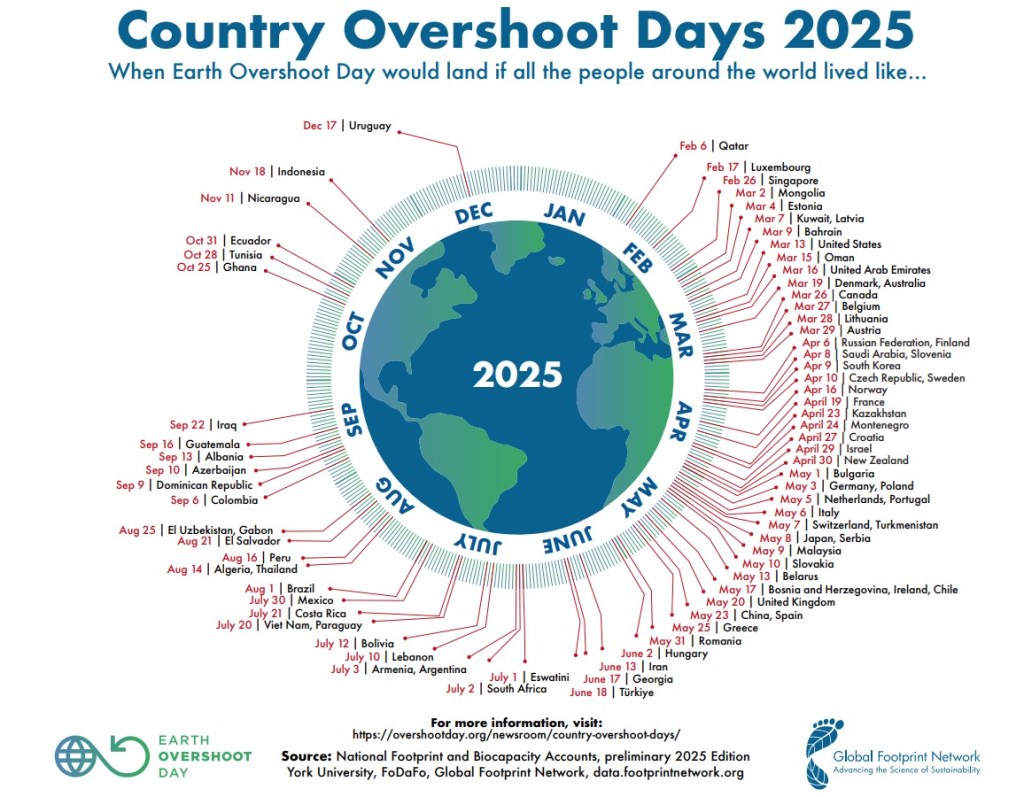
Every year the Global Footprint Network calculates the date by which humans will have consumed a year’s worth of the Earth’s resources. Further consumption after that date uses resources at a faster rate than by which they can be replenished – in other words for that remaining part of the year our consumption takes us beyond safe planetary boundaries.
This is a global calculation. Individual nations – and indeed individuals themselves – will be consuming at different rates. Specifically there are some nations who consume far more then others and will have consumed their share of the Earth’s resources much earlier than the global Earth overshoot day – eg Qatar, the USA, Belgium inter alia. Whilst there are other nations who consume far less and may not even consume their share of the Earth’s resources before the year’s end – eg Burundi and Bhutan.
Clearly those nations who consume over and above the global average need to reduce their consumption, but would be enough if they reduced their consumption to that average? Not really because those levels of consumption would only stay within the limits of our planetary boundaries if the poorer nations were content to continue to under consume. In reality those poorer nations should be able to benefit from the better living standards that accrue from having satisfactory levels of food, education, healthcare, sanitation, housing, transportation etc.
Consumption levels for the richer nations need to fall substantially if everyone is to have a good standard of living.
The following explanations, including reference to their current safe status or not, comes from the Stockholm Resilience Centre.
Climate change: Increased greenhouse gases and aerosols in Earth’s atmosphere trap heat that would otherwise escape into space. The climate change planetary boundary assesses the change in the ratio of incoming and outgoing energy of the Earth. More carbon dioxide in the atmosphere and more trapped radiation causes global temperatures to rise and alters climate patterns. This boundary is transgressed, and CO2 concentrations are rising.
Novel entities: Technological developments introduce novel synthetic chemicals into the environment, mobilise materials in wholly new ways, modify the genetics of living organisms, and otherwise intervene in evolutionary processes and change the functioning of the Earth system. The amount of synthetic substances released into the environment without adequate safety testing places novel entities in the high-risk zone.
Stratospheric ozone depletion: Ozone high in the atmosphere protects life on Earth from incoming ultraviolet radiation. The thinning of the ozone layer, primarily due to human-made chemicals, allows more harmful UV radiation to reach Earth’s surface. Total ozone is slowly recovering because of the international phasing-out of ozone-depleting substances since the late 1980s. Ozone depletion is therefore currently in the Safe Operating Space.
Atmospheric aerosol loading: Changes in airborne particles from human activities and natural sources influence the climate by altering temperature and precipitation patterns. Although large-scale air pollution already causes changes to monsoon systems, forest biomes and marine ecosystems, the global metric used in the planetary boundaries framework – interhemispheric difference in atmospheric aerosol loading – places this process just within the Safe Operating Space.
Ocean acidification: The acidity of ocean water increases (its pH decreases) as it absorbs atmospheric CO2. This process harms organisms that need calcium carbonate to make their shells or skeletons, impacting marine ecosystems, and it reduces the ocean’s efficiency in acting as a carbon sink. The 2025 Planetary Health Check showed that the Ocean Acidification boundary has been breached for the first time. Since the start of the industrial era, the ocean’s surface pH has fallen by around 0.1 units, a 30-40% increase in acidity, pushing marine ecosystems beyond safe limits and degrading the oceans’ ability to act as Earth’s stabiliser.
Modification of biogeochemical flows: Nutrient elements like nitrogen and phosphorus are crucial for supporting life and maintaining ecosystems. Industrial and agricultural processes disrupt natural cycles and modify the nutrient balance for living organisms. This boundary is transgressed, because both the global phosphorus flow into the ocean and the industrial fixation of nitrogen (converting stable nitrogen from the atmosphere into bioreactive forms) have disrupted global biogeochemical flows.
Freshwater change: The alteration of freshwater cycles, including rivers and soil moisture, impacts natural functions such as carbon sequestration and biodiversity, and can lead to shifts in precipitation levels. Human-induced disturbances of both blue water (e.g. rivers and lakes) and green water (i.e. soil moisture) have exceeded the planetary boundary.
Land system change: The transformation of natural landscapes, such as through deforestation and urbanization, disrupts habitats and biodiversity and diminishes ecological functions like carbon sequestration and moisture recycling. Globally, the remaining forest areas in tropical, boreal, and temperate biomes have fallen below safe levels.
Biosphere integrity: The diversity, extent, and health of living organisms and ecosystems affects the state of the planet by co-regulating the energy balance and chemical cycles on Earth. Disrupting biodiversity threatens this co-regulation and dynamic stability. Both the loss of genetic diversity and the decline in the functional integrity of the biosphere are outside safe levels.
On the one hand the Church of England is pressing ahead with its challenge of reaching net zero carbon emissions by 2030, which is seeing many church buildings (including schools and vicarages etc) being fitted with low energy light bulbs, insulation, solar panels and heat-pumps etc. And this is clearly very important and especially so if it also motivates people to do likewise in their own homes and places of work. (The number of regular worshippers is now just over a million).
On the other hand does the Church challenge individuals, industries and governments to address the systemic wrongs that perpetuate the climate and biodiversity crises and the social injustices that these cause?
As an analogy, I as an individual can be rigorous about placing my plastic in the recycling bin, but if most of that plastic ends up on beaches in Africa because the price of virgin plastic is cheaper than that of recycled plastic, the economic system has won.
I can try and raise this issue as an individual, but how much more effective would it be if the Church were there calling for change – using its cultural status and its position in Parliament to call for effective policies to incentivise recycling within the UK, to incentivise the use of recycled plastic and taxing the production of virgin plastic?
What if – for example- the Church of England were, say, to publicly back Greenpeace which has long been challenged the status quo vis a vis the pollution and global injustices arising from inadequate policies around plastics?

 The Green Tau