Green Tau: Ecosystems, Biodiversity and Sustainability 

24th July 2026

When ecosystems flourish they are rich with biodiversity. Conversely diminishing biodiversity causes ecosystems to fail. Currently biodiversity globally is in decline. In 2022 world leaders met to address this issue and the outcome was the Kunming-Montreal Global Biodiversity Framework (GBF). The headliner was that the national signatories undertook to restore for nature 30% of land and of sea by 2030 – abbreviated to 30by30. This is a huge undertaking – a highly necessary one – but perhaps not surprisingly it is something nations now struggle to meet. 

The whole planet is one large ecosystem in which water flows, plants grow, fish swim, birds fly, carbon  circulates, rocks erode etc etc. Is this a thriving ecosystem? Nine key measures  have been identified by which to assess  the  health of the earth’s ecosystem – and are known as planetary boundaries. One of these boundaries measures fresh water. If we consumer such water at a slower rate than it is replenished by the earth’s ecosystem, we can be assessed as living within the limits of that planetary boundary. If we consume fresh water at a faster rate, then we are assessed as living beyond the limit of that boundary. Not only is this (and we have indeed exceeded this planetary boundary) damaging to the earth’s ecosystem it is also threatens our survival too (or rather the survival of the most vulnerable people). 

The other eight boundaries are – climate change, biosphere integrity (which assesses both biodiversity levels and the rate at which we extract resources such as timber, cereals etc), landuse change (balance between natural and human use), nutrients (particularly nitrogen and phosphorus), ocean acidification, aerosols in the atmosphere, ozone depletion, pollution of novel entities (manmade compounds such as plastics). Of these nine planetary boundaries, we are now living beyond the safe limits of seven – only with respect to ozone depletion and aerosol levels in the atmosphere, are we living within safe limits.

What we also know is that these nine areas are interconnected. Accelerating climate change adversely impacts biodiversity and freshwater systems. Out of balance landuse impacts both climate change and biodiversity. And so on. 

However we have so often seen ourselves as humans as being above and outside these ecosystems. We are the ones who instead control  and manipulate ecosystems to maximise our gains. We are the ones who determine what is good for humans and what is not, who select what should grow and what should be uprooted, who take without giving back. It is this failure to see ourselves as part of and dependent on the multiple layers of ecosystems, that has brought us to situation where we are living outside the safe boundaries of the planet.

Another way of viewing this is by looking at the date of Earth Overshoot Day. This day marks the point in the calendar when we have used up a year’s worth of the planets renewable resources (eg freshwater, clean air, fish, timber ……..) This year Earth Overshoot Day is July 30th. After that we are living in the red. This means for example, vis a vis freshwater, that we will be drawing on our capital of fresh water – water taken from aquifers that cannot be replaced. This means that some people will live with inadequate water supplies, and their crops and livestock will die. This means that wild animals, birds and insects will die.

If this were a financial  issue, we would be obliged to pull in our horns, to spend less and save more. But as we don’t pay – financially for many of these goods and services – there doesn’t seem to be any formalised way in which the global community is addressing this debt crisis. We should also note that this debt is not being shared equally. A large number of the people from the poorest and most remote  communities  are bearing the bulk of the pain, whilst a far small number of people are continuing to live ever increasing lives of wealth – lives, in effect, of decadence. Where do I fit in? It could be as a middle class white western person be in the latter group.

To return to the 30by30 target, it seems obvious that it cannot be tackled in isolation but needs to be part of lifestyle revolution that recognises and works with the understanding that all ecosystems are interdependent and that humans are just one feature of each ecosystem of which they are a part.  I don’t think this observation makes the challenge any easier but it would ensure a greater likelihood that any policies of reform would actually work.

I don’t know of any country that is taking a wholistic approach. Here in the UK the likelihood that we will restore biodiversity to safe, sustainable levels by 2030 seems highly unlikely. Not least because it is not being approached as part of a national ecosystem. 

For example, to restore 30% of land such that nature can flourish, cannot happen without also looking at landuse – how much land can we safely use to graze livestock and grow fodder, as well as growing enough grain, fruit and vegetables to feed our population? If – as we would – have to reduce us the amount of land used to produce meat and dairy products, will we also look at our diets? Will we switch to a diet rich in plants and low in meat and dairy? 

Again will we at the same time look at how we use water? Changing how we use the land could have a positive impact on our use of fresh water supplies. But we should at the same time look at how water is used by industries, and especially by data centres. Conversely will we note that restoring nature across wide tracts of land will improve water retention by the land, improve flood resilience, reduce loss of water via evaporation during heat waves etc? Will we note that restoring nature across wide tracts of land will improve access to green spaces which we know improves mental and physical wellbeing?  Will we note that plant rich diets will significantly improve people’s health? 

It is surely within the capacity of human kind to restore a right relationship with the planet’s ecosystems such that not just our lives but the lives of those with whom we share this planet, can flourish sustainably?

Counting on 2026 … day 14

27th January

“Biosphere Integrity refers to the capacity of ecosystems across the planet to support life and maintain the overall health and stability of the Earth system. This depends on the health, diversity, and interactions of the organisms that make up these ecosystems.” (1) 

This is a safety boundary that we – because of human activity – have passed. We are living in the danger zone that means crises are inevitable. We experience this through rapidly declining numbers of pollinators (essential for growing crops); increasing soil infertility; declining ability of the environment to absorb carbon dioxide; declining ability of ecosystems to absorb rain so limiting flooding; loss of species removing opportunities to benefit from them for food, medicines, building materials etc; increasing loss of green and blue spaces that maintain our physical and mental wellbeing. 

Human activities that are causing the loss of biodiversity integrity include:-

  • Deforestation 
  • Changing land uses including  the expansion of urban structures 
  • Increased intensification of agricultural 
  • Expansion of agricultural land use
  • Industrialised fishing
  • Expansion of mining activities including deep sea mining
  • Expansion of industrial processes increasing pollution
  • Expansion of activities producing greenhouse gases – eg use of fossil fuels and livestock farming
  • Increased production of novel entities and the spread of invasive, non-indigenous species
  1. https://www.planetaryhealthcheck.org/boundary/change-in-biosphere-integrity/

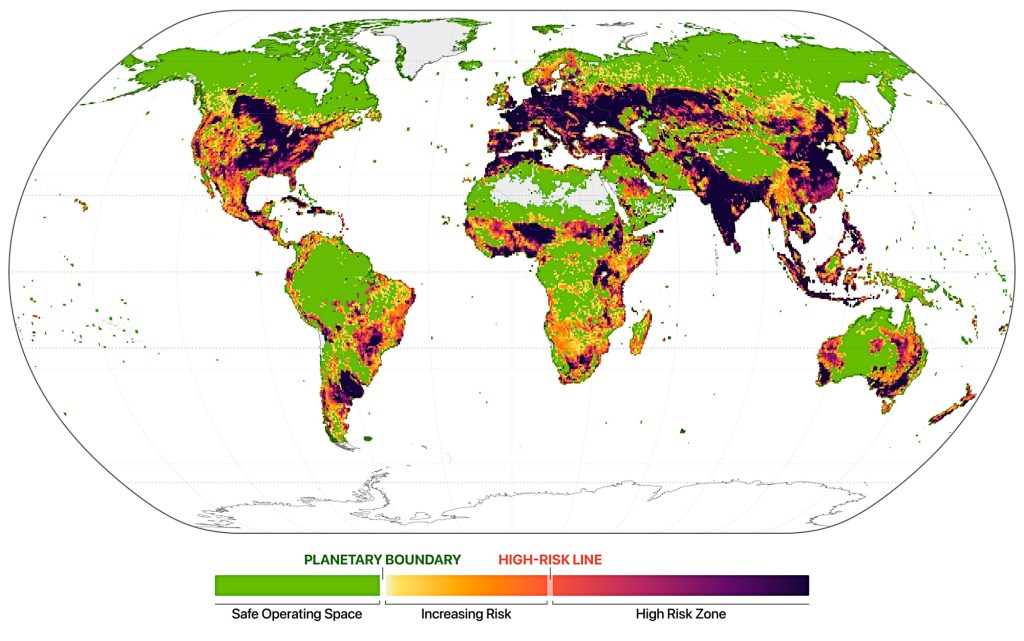
Global risk map of the Change in Biosphere Integrity, based on the functional integrity (HANPP) control variable. Transgression is based on the HANPP control variable. All values shown on the map refer to the year 2010. Based on data from Kastner et al. 2022.

Most boundary transgressions occur in large, continuous regions with high land-use intensity. In contrast, areas in regions without transgressions, such as the Amazon, the Congo Basin, and boreal forests, are primarily natural or semi-natural.

Third Sunday After Epiphany

25th January 2026

Reflection with readings below

Two of our readings have the prophecy that ‘the people who walked/ sat in darkness have seen a great light’. A prophecy of salvation or of awakening(which might be the same thing). It speaks of change – significant change – for the people. It may even be talking of systemic change – ie that they way in which things happen, the way in which they are done, is completely changed from top to bottom, from root to branch. And that surely is likely, because Jesus’s gospel is one of complete change. Certainly it was a complete change for the four fishermen who join Jesus in sharing the gospel.

When we look around the world today the need for change is obvious but it is hard to know where to start. 

We have war and violence and the threat of war and violence. Arming the opposing sides doesn’t end the violence. But maybe solidarity – presenting a unified diplomatic front, enacting boycotts etc – does.

We can discern the roots of war and conflict in water shortages, in food shortages, in the impact of climate change that makes environments inhabitable – but also in corruption, misinformation and the abuse of power. 

The Earth does have enough resources to feed the world population but it needs resources to be diverted from livestock to humans – ie growing protein rich plants for humans to eat not for captive animals. It needs changes in income distribution so that everyone can afford to buy the food – and we need income redistribution to prevent a small number of individuals cornering the vast proportion of the world’s wealth.

As regards fresh water we are in a crisis, globally we are using fresh water faster than it can be replenished by the natural systems of convection and precipitation. In scientific parlance we have breached a planetary boundary vis a vis fresh water. We need to limit consumption – which again goes back to changing what we eat and the way we farm, but also to the technologies we use – AI is greedy consumer of water – the clothes we wear cotton in particular consumes vast quantities of water, whilst the processing of fabrics is also water intensive. We compound many problems by prematurely discarding what we have bought. 

Another planetary boundary we have crossed is that of biodiversity. In its diminished state it does not support the ecosystems that we rely on. And another boundary crossed is the amount of greenhouse gases we are pumping out into the atmosphere and which are causing the increasing incidence of extreme weather events. 

If this all seems impossible to address, you’re not alone! But let us hear the message that Jesus brought: “Repent, for the kingdom of heaven has come near.” Jesus took the message to the people around him, telling them parables, healing those who were sick, paying attention to what people needed, teaching them of the power of loving one another. 

To follow Jesus can mean to completely uproot and transform our lives as did the fishermen. Or it can mean to completely transform our lives and stay put as it did for for Mary and Martha and Lazarus, or for the man called Legion, or for Peter’s mother-in-law. Transforming our lives in situ is probably a life’s work: how in each situation can we be more loving, how in each part of the day can we be open to God’s presence, how can we support each other in the fellowship of the Spirit? But we can. We have the resources – our Christian communities, our prayer life, reading the Bible and learning from the insights of others, from the strength and comfort of God, from the example of Jesus, from gaining knowledge of the natural world, of the possibilities of diplomacy and alternative economics, of new and old technologies, of the power of love and hope.

A different world is possible, the kingdom of heaven is near at hand.

Isaiah 9:1-4

There will be no gloom for those who were in anguish. In the former time he brought into contempt the land of Zebulun and the land of Naphtali, but in the latter time he will make glorious the way of the sea, the land beyond the Jordan, Galilee of the nations.

The people who walked in darkness
have seen a great light; 

those who lived in a land of deep darkness–
on them light has shined. 

You have multiplied the nation,
you have increased its joy; 

they rejoice before you
as with joy at the harvest,
as people exult when dividing plunder. 

For the yoke of their burden,
and the bar across their shoulders,
the rod of their oppressor,
you have broken as on the day of Midian. 

Psalm 27:1, 5-13

1 The Lord is my light and my salvation;
whom then shall I fear? *
the Lord is the strength of my life;
of whom then shall I be afraid?

5 One thing have I asked of the Lord;
one thing I seek; *
that I may dwell in the house of the Lord all the days of my life;

6 To behold the fair beauty of the Lord *
and to seek him in his temple.

7 For in the day of trouble he shall keep me safe in his shelter; *
he shall hide me in the secrecy of his dwelling
and set me high upon a rock.

8 Even now he lifts up my head *
above my enemies round about me.

9 Therefore I will offer in his dwelling an oblation
with sounds of great gladness; *
I will sing and make music to the Lord.

10 Hearken to my voice, O Lord, when I call; *
have mercy on me and answer me.

11 You speak in my heart and say, “Seek my face.” *
Your face, Lord, will I seek.

12 Hide not your face from me, *
nor turn away your servant in displeasure.

13 You have been my helper;
cast me not away; *
do not forsake me, O God of my salvation.

1 Corinthians 1:10-18

Now I appeal to you, brothers and sisters, by the name of our Lord Jesus Christ, that all of you be in agreement and that there be no divisions among you, but that you be united in the same mind and the same purpose. For it has been reported to me by Chloe’s people that there are quarrels among you, my brothers and sisters. What I mean is that each of you says, “I belong to Paul,” or “I belong to Apollos,” or “I belong to Cephas,” or “I belong to Christ.” Has Christ been divided? Was Paul crucified for you? Or were you baptised in the name of Paul? I thank God that I baptised none of you except Crispus and Gaius, so that no one can say that you were baptised in my name. (I did baptise also the household of Stephanas; beyond that, I do not know whether I baptised anyone else.) For Christ did not send me to baptise but to proclaim the gospel, and not with eloquent wisdom, so that the cross of Christ might not be emptied of its power. 

For the message about the cross is foolishness to those who are perishing, but to us who are being saved it is the power of God. 

Matthew 4:12-23

When Jesus heard that John had been arrested, he withdrew to Galilee. He left Nazareth and made his home in Capernaum by the sea, in the territory of Zebulun and Naphtali, so that what had been spoken through the prophet Isaiah might be fulfilled: 

“Land of Zebulun, land of Naphtali,
on the road by the sea, across the Jordan, Galilee of the Gentiles— 

the people who sat in darkness
have seen a great light, 

and for those who sat in the region and shadow of death
light has dawned.” 

From that time Jesus began to proclaim, “Repent, for the kingdom of heaven has come near.”

As he walked by the Sea of Galilee, he saw two brothers, Simon, who is called Peter, and Andrew his brother, casting a net into the sea—for they were fishermen. And he said to them, “Follow me, and I will make you fish for people.” Immediately they left their nets and followed him. As he went from there, he saw two other brothers, James son of Zebedee and his brother John, in the boat with their father Zebedee, mending their nets, and he called them. Immediately they left the boat and their father, and followed him.

Jesus went throughout Galilee, teaching in their synagogues and proclaiming the good news of the kingdom and curing every disease and every sickness among the people.

Counting on 2026 … day 13

22nd January

In restoring a sustainable balance vis a vis land use across the globe, whilst most attention is focused on ending deforestation and promoting reforestation, restoring wetlands is also important.  Whilst wetlands (including peatlands, marshes, floodplains and mangrove swamps) may only cover 5-8% of the Earth’s surface, they are critical as absorbers of carbon dioxide, as defences against erosion, and as preventers of excess flooding. They are also areas that have been drained and used for other purposes.

“Wetlands are critically important ecosystems that support biodiversity, climate mitigation and adaptation, food production, freshwater availability, recreation, wellbeing, and so much more. Yet we are losing our wetlands three times faster than forests.” (1)  

In the UK the Fen Lands have been drained so that the peat rich soils can be used as high grade farm land but with the disadvantage that as the land dries out, so it shrinks,  becoming increasingly at risk of flooding,  and with the effect of destabilising the foundations of roads and infrastructure across the region.

Elsewhere in the UK peatlands have suffered from the effects of burning and grouse shooting, overstocking with livestock, planting for commercial forestry, extraction for peat compost, and pollution. (2) Overall some 80% of the UK’s peatlands have been degraded.

One way of restoring peatlands and maintaining their agricultural use, is through paludiculture. Here lowland peatland is rewetted and used to grow crops that thrive in wet conditions such as Norfolk Reed used for thatching; bulrushes (typha) used as a building material, as a bioenergy crop and in clothing; sphagnum moss which can be used as a peat substitute as well as for biomecidal and industrial chemical uses; food crops such as celery, bilberries and cranberries, watercress, sweet grass grains, rice etc. (3) 

  1. https://www.stockholmresilience.org/research/research-news/2022-02-02-we-need-to-talk-about-wetlands-and-how-to-save-them.html
  2. https://www.iucn-uk-peatlandprogramme.org/about-peatlands/peatland-damage
  3. https://naturalengland.blog.gov.uk/2022/09/30/paludiculture-the-future-of-farming-on-peat-soils/ and https://www.paludiculture.org.uk/

Counting on 2026 … day 12

21st January

One of the issues with the loss of a sustainable balance in land use (as highlighted by transgressing this planetary boundary) is the loss of soil fertility – and in some cases the loss of the soil itself, being washed or blown away. One solution is to restore the fertility and structure of the soil of the soil and to adopt farming methods that healthy soil. Regenerative farming is a widely used term to describe this process. This is a broad term and can mean many things in different situations. Unlike organic farming, it doesn’t come with any form of certification.  Nevertheless, any methods that improve soil fertility are to be encouraged. 

Generally regenerative farming will encompass some or all of the following principles:-

  • limiting soil disturbance
  • maintaining soil cover
  • fostering agricultural diversity and rotations
  • keeping living roots in the soil
  • integrating livestock and arable systems (1) 

What regenerative farming does not address is altering the balance of land use to one that is more sustainable – and which as outlined in the previous entry – should include restoring tree cover, as well as restoring peatlands.

  1. https://www.wildlifetrusts.org/blog/vicki-hird/what-regenerative-farming

Counting on 2026 … day 6

14th  January 

Atmospheric aerosol loading is another planetary boundary that we should avoid crossing. The global concentration of aerosol particles has more than doubled since pre-industrial times. The effect that excessive aerosol concentration could have in human health and the climate that established the need for a safe limit.

What are these particles? – salt condensed from ocean waters, fine sand from desert dust storms, ice crystals over the poles and ash from fires as well as volcanic eruptions, carbon and sulphur dioxide from fossil fuel power statist and industrial smoke stacks, hydrocarbons from combustion engines and stratospheric vapour crystals from aircraft. (1)

It is another boundary where we are currently within the safe limits and in fact the concentration of aerosol particles in the atmosphere is declining as we are across the globe tackling and reducing air pollution, providing alternatives to open cookings fires, ending crop the burning of stubble after crop harvesting, reducing pollution levels from road vehicles and from commercial cargo ships. Taking action to stay within planetary boundaries is good for the planet and for our wellbeing! (2( 

  1. https://www.esa.int/Applications/Observing_the_Earth/Space_for_our_climate/Aerosols
  2. https://www.planetaryhealthcheck.org/boundary/increase-in-atmospheric-aerosol-loading/

Counting on 2026 … day 5

13th  January 

Stratospheric ozone depletion is one planetary boundary* where we did cross into the danger zone and through concerted global action, pulled back from into the safe limits of the boundary. Regulations curbing what chemicals could be used, for example, in fridges and aerosols, had a real effect!

“”In the face of a triple planetary crisis – climate, nature and pollution – the Montreal Protocol is one of the best examples we have that showcases the positive and powerful outcome of multilateralism,”

Meg Seki, Executive Secretary of UNEP’s Ozone Secretariat. (1)

(1) https://www.unep.org/news-and-stories/story/rebuilding-ozone-layer-how-world-came-together-ultimate-repair-job Do read this full article and/or watch the YouTube clip.

* NB What are the planetary boundaries? https://greentau.org/2025/10/22/counting-on-170/

Counting on 2026 … day 2

8th January 

How do we protect and preserve fresh water supplies – part 3 

Using less water! 

This is something for businesses and farmers and domestic consumers to respond too – and feels particularly pertinent as decisions are made about AI and data centres generally (see tomorrow’s blog).

In the UK at our continued rate of water consumption there will be a daily  shortfall of 5 billion litres (about a third of current consumption) by 2050. This takes into account the need to extract less water from rivers, aquifers etc where it negatively impacts the natural environment, a growing population, the need to cope with increasingly frequent droughts, the impact of climate change (eg changing rainfall patterns) and increased use by businesses. (1) 

Per capita household water consumption in the UK is already falling, from an average of 169.53 litres per day in 2005/2006 to an average of 139.47 litres in 2023/2024. (2) However there is clearly a need for consumption levels to fall further. A survey across Europe in 2020 varied daily domestic consumption varied from 300 litres in Switzerland to 100 litres in Belgium and even less in Estonia and Slovakia. (3) In some instances the difference maybe due to a lower volume toilet flush, or the frequency and duration and rate of flow of showers, or the frequency of use and water efficiency of appliances such as washing machines. 

Websites with water saving tips

This earlier blog is about saving and reusing grey water around the house – https://greentau.org/2025/07/10/counting-on-day-106-3/

And this one about showering less and more efficiently – https://greentau.org/2025/02/13/counting-on-day-31-3/

  1. https://commonslibrary.parliament.uk/research-briefings/cbp-10248/
  2. https://oifdata.defra.gov.uk/themes/natural-resources/E8/
  3. https://smartwatermagazine.com/news/locken/water-ranking-europe-2020

Counting on … day 1

7th January 2026

How do we protect and preserve fresh water supplies – part 2

Land use changes, especially things such as deforestation and urbanisation, have aggravated the problem – 

“Deforestation, agriculture, and urban expansion have greatly changed the way land stores and moves water. When forests are cleared or soils are sealed under concrete, they lose their ability to hold green water — the moisture that plants rely on. This weakens local rainfall, increases runoff, and can intensify both floods and droughts. Changes to land systems also affect regional weather patterns, such as monsoons, and create feedback loops that further influence the climate.” (1)

Reducing or indeed eliminating such land use changes is clearly beneficial for the wellbeing of the planet. We can go further by reversing the changes by both protecting and increasing land uses that capture and store – eg through reforestation,  restoring peatlands and wetlands, re-wriggling  rivers (ie allowing them to flow freely and more slowly across a greater expanse of the flood plain, re-establishing water meadows, limiting the extraction of water to protect lakes and aquifers etc.

These nature based solutions not only protect supplies of fresh water, they also protect and enhance biodiversity and reduce the risk of flooding, creating a better environment for us to enjoy.

(1) https://www.planetaryhealthcheck.org/boundary/freshwater-change/

Counting on … day 207

18th December 2025

How do we see the impact of exceeding the planetary boundaries for fresh water?

“Climate change has become the main global driver of freshwater disruption. A warmer atmosphere holds more moisture and changes how and where rain falls, leading to more intense floods in some regions and severe droughts in others. These shifts are transforming long-established rainfall and river patterns, creating new and unpredictable hydrological conditions that put pressure on both ecosystems and human societies.” (1)

A disruption in rainfall patterns can mean either more or less rain than usual, or more rainfall but less often so that rainfall is more intense. This can lead to the drying out of wetlands, the lowering of lake and river levels and the disruption of the ecosystems those water features supported. In the Amazon basin we are seeing river levels drop significantly impacting local communities and their livelihoods and destabilisation of the rainforest such that trees, plants and creatures are lost.

Disruption means loss of soil moisture. Not only does this impact plant growth and thus a whole food chains, it also makes landscapes more vulnerable to droughts and wildfires. The UK saw a record number of wildfires this year.

Excessive amounts of rainfall over a prolonged period, or concentrated into a short time frame, causes extreme flooding that disrupts habitats, destroys infrastructure, displaces people, erodes soils and causes devastating landslides. We have seen many examples of this in the recent Asian super typhoons. 

Disruption to normal rainfall patterns leads to water scarcity. A lack of rain depletes water supplies, whilst infrequent intense rainfall runs quickly of the land, again failing to restore water stocks in reservoirs and rivers. Warmer winters diminishes the replenishment of glaciers, and increase the rate at which they melt. Together this reduces the flow of water into rivers during summer periods aggravating water scarcity.  Both in Iran and in South Africa, whole communities are face a complete lack of drinking water as droughts combine with atypical rainfall patterns. 

  1. https://www.planetaryhealthcheck.org/boundary/freshwater-change/