11th August 2025
I am taking a couple of week’s break to read and reflect, exploring new ideas and revisiting old ones.

Reflections and actions during COP26 and going on
11th August 2025
I am taking a couple of week’s break to read and reflect, exploring new ideas and revisiting old ones.
8th August 2025
We live in a time of global shortages as well as global overconsumption, so living with enough may involve re-examining what ‘enough’ looks like.
Whilst I can get all that my family needs, such as foods, clothes, shelter, medicine etc, there are other people who cannot either access or afford these essentials. Should I reduce the amount I think I need, to make more available for others?
Isn’t that the dilemma of Earth Overshoot Day? Here in the west in consuming what we ‘need’ for our comfortable lifestyles, we are doing so at the expense of other people, often those living in the global south.
If for example, eating meat on a regular basis means we are ‘using’ agricultural land that could otherwise be used to grow food to better feed others or that could be better used to restore biodiversity and/ or store carbon, then should we not significantly reduce our consumption of meat?
Enough becomes eating less meat.
As well as meat, we might consider reducing our western levels of consumption of electronic and electrical goods which use large proportions of limited resources such as lithium and copper. These limited resources might be better used to meet the more pressing needs of others? (Or being left in the ground so as not to damage the environment).
Enough becomes consuming fewer electrical goods.
And might we also consider how much plastic we consume? Plastic use becomes yet one more reason for companies to justify extracting more carbon-emitting oil from the ground. Plastic waste causes widespread pollution damaging both our own health and the environments of others across the globe.
Enough becomes consuming less plastic – especially single use items and plastic packaging.
There are many such ways in which we can re-examine what enough looks like.
7th August 2025
According to the Book of Acts (Acts 2:42-47), one of the features that attracted people to the first Christians was their willingness to share what they had with each other, to hold their belongings in common.
Living simply, sustainably, and joyfully within the limits enough, would logically involve sharing and holding possessions in common. This enables things to be shared. It also means that fewer possessions are needed overall which makes for better use of limited resources.
Some people share the use of a communal car or subscribe to a car sharing scheme. (1)
Libraries provide a collection of books (as well as dvds, audio tapes etc) which are held in common for everyone to use. And there are also toy libraries and Libraries of Things as well as street sharing schemes, that allow a community to own things such as electric drills, lawn mowers, wallpaper strippers, that the whole community can use.
Churches are places kept open for the use by anyone in the community. Church/village/community halls are large gathering spaces that anyone can use (for a fee and terms and conditions will apply).
Roads are communal spaces where anyone can drive, cycle or walk (again terms and conditions apply).
Green spaces and parks are publicly (or sometimes privately) owned which are kept open for the whole community to enjoy. Ditto public sports centres and swimming pools (fees and conditions may apply) – few of us could afford, either in terms of finance or space, to build and own a swimming pool for our own use, but having a public one kept for common use makes real sense.
In Cambridgeshire there is a village owned heat pump to which householders can opt to connect! (2)
The more we can hold and use in common the better.
6th August 2025
The principles of the Franciscan Third Order says with regard to living simply that we ‘avoid luxury and waste, and regard our possessions as being held in trust for God’ and be ‘concerned more for the generosity that gives all, rather than for the value of poverty in itself.’
Being willing to cheerfully let go of possessions rather then clinging onto them and being gladly generous, is a positive way of living more sustainably within the limits of the Earth’s resources. It would also develop characteristics that would be attractive to others, encouraging others to want to live a life of simplicity rather than one that accumulates more and more possessions.
5th August 2025
Living simply, living with enough, at a personal level is working out (either in advance or ‘on the hoof’) what resources I need to meet my and my family’s needs. There would then, likely, be a surplus I could share with others – eg fruit from the garden, money, un-needed clothes, books – or simply not consume – eg water, electricity, air flights etc. Sharing with others I can do through charity shops and free cycle, through charities, through gifts to others.
4th August 2025
It is an old slogan but still pertinent: “Reduce, Reuse, Recycle”. If we are to live sustainably within the Earth’s finite resources, if we are to live simply – with joy in enough – then reducing what we consume is a good starting point. Ditto reusing what we have.
And recycling as the last resort.
That said, I do recycle cardboard boxes rather then hoarding them for future use. During Covid whilst so many things were being bought on line, people were hanging onto the boxes, which led to a shortage of recycled card with which to make new boxes. I guess there would be logic in having. Reusable boxes – as for example, with Riverford vegetables boxes.
1st August 2025
The third aim of the Third Order of St Franciscan addresses the issue of wealth, income and advantage so as to focus on living simply.
“The first Christians surrendered completely to our Lord and recklessly gave all that they had, offering the world a new vision of a society in which a fresh attitude was taken towards material possessions. This vision was renewed by Saint Francis when he chose Lady Poverty as his bride, desiring that all barriers set up by privilege based on wealth should be overcome by love. This is the inspiration for the third aim of the Society, to live simply.
“Although we possess property and earn money to support ourselves and our families, we show ourselves to be true followers of Christ and of Saint Francis by our readiness to live simply and to share with others. We recognise that some of our members may be called to a literal following of Saint Francis in a life of extreme simplicity. All of us, however, accept that we avoid luxury and waste, and regard our possessions as being held in trust for God.
Personal spending is limited to what is necessary for our health and well-being and that of our dependents. We aim to stay free from all attachment to wealth, keeping ourselves constantly aware of the poverty in the world and its claim on us. We are concerned more for the generosity that gives all, rather than the value of poverty in itself. In this way we reflect in spirit the acceptance of Jesus’ challenge to sell all, give to the poor, and follow him.” (1)
Living simply is about sharing what we do have, avoiding luxury and attachment to wealth, and using/ spending what we do have in a way that we would happily declare to God, aligning our use of resources according to the will of God – including environmental issues.
31st July 2025
Tomorrow sees the start of Amazon Free August. Like Plastic Free July, the aim is to encourage us to focus on how what we consume impacts both the environment and social wellbeing. Amazon is deeply unethical on many grounds – not least because it encourages us to buy more and more stuff, but also because of its poor track records on paying taxes and treating its workforce fairly.
It is possible to be a consumer without relying on Amazon:- https://www.ethicalconsumer.org/ethical-campaigns/boycott-amazon/shopping-without-amazon
A further thought that covers all online shopping, are we happy with the way that on line shopping is changing the landscape – with increasing numbers of large warehouses and diminished numbers of high street shops – and how that change has a knock on effect for where people work, for socialising and social cohesion?
30th July 2025
Wealth too plays a part in what is ‘enough’. I’m in my sixties, my husband a decade older. We live comfortably on his pension – but we can do so because we own the house we live in; we have never not had enough and so benefit from good health; we both get joy from walking, swimming and cycling; we both have had good educations and appreciate the enjoyment of reading and writing; we have over the years accumulated good quality clothes and shoes and so have little need to spend on what we wear; we have good networks of friends and socialise through activity groups; we have strong family relationships; we are both active church goers. Not all of these are the direct benefits of wealth but wealth has certainly helped shape of lives and health and wellbeing and allows us to do things that bring us joy for free.
Other people of a similar age may not have these benefits nor feel the security net that wealth brings. For them an income that allows for joy in enough would be more than I and my husband need.
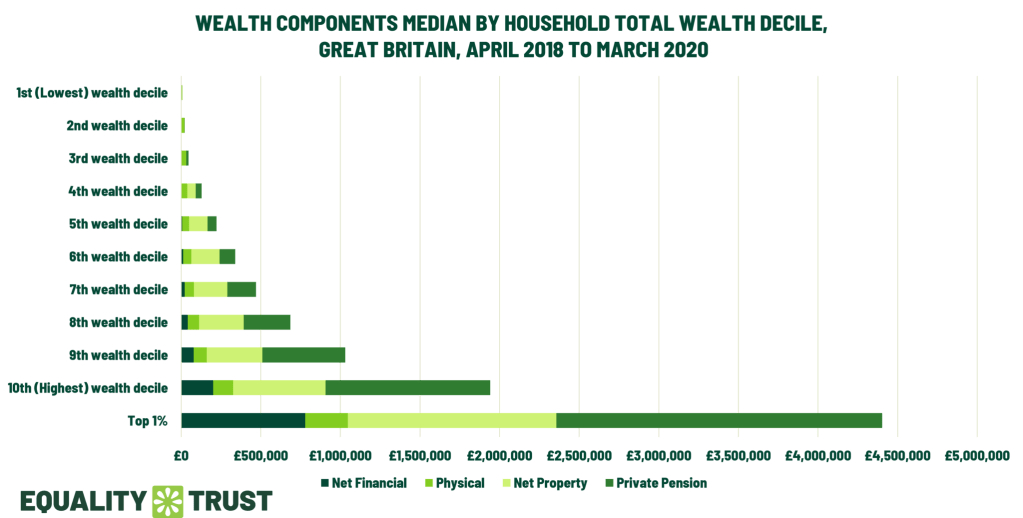
The bar chart below shows how disproportionately wealth is spread and the considerable contribution that stems from having property (and that will increase the closer one lives to London or other property hot spots) and having a private pension.
29th July 2025
If there is a minimum level of pay for a dignified standard of living, is there a maximum level of pay that optimises happiness?
Research from Raisin (a financial organisation that provides a platform for savings and investment products) in its report ‘Does money buy happiness?’ suggests a figure of about £35,000 pa.(1)
Whilst BBC’s Money Box programme suggests that, whilst a higher income can equal greater happiness, there is a cut off point at £120,000 beyond which the gain seems negligible. (2)
(1) https://www.raisin.co.uk/newsroom/does-money-buy-happiness/
 The Green Tau