
Proper 22, 18th Sunday after Trinity 

8th October 2023

Reflection (readings are below)

The Ten Commandments in Godly Play are named as the Ten Good Ways as this comes across as being less dictatorial and more about wise guidance or wisdom. I too renamed my Rule of Life – I am a Franciscan tertiary – My Way of Life. The former felt too rigid, too black and white, and given human frailty, guilt inducing. 

Perhaps in all these things, it is not the prescription that is so important as the outcome, the fruits, they deliver. If the Ten Commandments lead us to live in a good way, then they fulfil their purpose what ever their name.

The Ten Commandments – God’s commandments – did introduce the people to a new and better way of living. Their former life had been lived in slavery. They had been not people but property owned by the Egyptian rulers. But God has rescued – released – them from slavery. Now they were God’s people. Where as before they had been subject to the rules of human masters, now they were invited to commit themselves to living according to God’s rules, God’s ways – ways that would ensure their wellbeing and fulfilment. And so far in the story of Exodus, we have heard how God had protected them from the Egyptian army, had provided them with bread and meat – as much as they needed- and with fresh water. 

Nevertheless, the people’s experience of encountering God was filled with fear and awe – and within that spectrum, respect. God wasn’t saying that living a good life was easy or effortless, rather that to live life well required focus, dedication, discipline and effort, but that equally it brought its own rewards. This is picked up in Psalm 19. The psalmist reminds us that all of the natural world recognises and in its own way praises God – and we should do likewise. And furthermore that the law of God is something to delight in and stick too because it is good for us. It rewards us with lives of sweet delight!

Paul writing to the Philippians knows and proclaims that there is nothing better in life than knowing Jesus as Lord. Paul is determined to know and follow Jesus as completely and as closely as possible. Nothing is of more value, can bring him greater benefit or joy, than the way of Jesus. 

Today’s gospel has a parable that must have made for very uncomfortable listening for the religious authorities of the day. And perhaps therefore we should not be too glib in thinking that the days when the religious leaders – and not just the leaders but those who worked within the system – got God’s message so wrong, have past. I am sure in our hearts we know we in the church have got things wrong,     and when in the future we look back, we may be surprised how blinkered we were. 

What the owner of the vineyard is asking for, is the harvest that the vines have produced. The harvest God seeks are the fruits of the kingdom – the positives outcomes from living a way of life built upon the corner stone of Jesus’s teachings.

Looking back over the previous chapters of Matthew’s gospel, we have that way shown to us in the  Beatitudes. We have the exhortation to be salty, to be a light shining forth from the lamp stand. We are reminded of the enduring value the law and the prophets which can be summed up  as “in everything do to others as you would have them do to you”. We are told to love not just our neighbours but our enemies too. We are told not to seek retaliation, not to serve two masters, not to store up wealth. We are told to be not just hearers but doers too! And the fruits we will see can be amazing – the blind see, the lame walk, the dead are raised, and the poor receive good news. The kingdom will be like a tree where every bird has a place to roost. It will  be exemplified by flourishing and bounty – five loaves will feed 5000!

Are we as Christians, following in the way of Jesus? Are we seeking to live according to God’s Good Ways? Are we shaping our lives according to the value of the kingdom of God? Are we being generous in returning to God and God’s creation the fruitfulness of the kingdom? Are we seeing lives being changed in ways that amaze us, or are we still seeing lives subject to the unjust rules of human making?

Earlier this week it was reported that in Gaza, soldiers shoot at the legs of protestors, often aiming to shatter their ankle bones. Many inhabitants are to be seen with crutches, having lost the use of their feet. Now we have seen this lack of peace escalate explosively – Lord forgive us.

Of the 2 billion instances of blindness in the world, half are preventable or treatable, and disproportionately more of these cases are in the poorer nations of Africa. 

Yet in 2022 it was reported that ‘the ranks of the global ‘ultra high net worth’ (UHNW) individuals swelled by 46,000 last year to a record 218,200 as the world’s richest people benefited from “almost an explosion of wealth” during the recovery from the pandemic.” 

In the UK 100,000 households live in temporary accommodation including 130,000 children. The distribution of food parcels by food banks has doubled over the last five years, and some 6.7 million households are affected by fuel poverty.  

This year Oxfam reported on their analysis  that the richest 1% of Britons hold more wealth than 70 per cent of Britons, while the four richest Britons have more wealth than 20 million Britons”.

It seems as if the workers in the vineyard are still reluctant to hand over the riches of the harvest. 

Exodus 20:1-4, 7-9, 12-20

Then God spoke all these words:

I am the Lord your God, who brought you out of the land of Egypt, out of the house of slavery; you shall have no other gods before me.

You shall not make for yourself an idol, whether in the form of anything that is in heaven above, or that is on the earth beneath, or that is in the water under the earth.

You shall not make wrongful use of the name of the Lord your God, for the Lord will not acquit anyone who misuses his name.

Remember the sabbath day, and keep it holy. For six days you shall labour and do all your work.

Honour your father and your mother, so that your days may be long in the land that the Lord your God is giving you.

You shall not murder.

You shall not commit adultery.

You shall not steal.

You shall not bear false witness against your neighbour.

You shall not covet your neighbour’s house; you shall not covet your neighbour’s wife, or male or female slave, or ox, or donkey, or anything that belongs to your neighbour.

When all the people witnessed the thunder and lightning, the sound of the trumpet, and the mountain smoking, they were afraid and trembled and stood at a distance, and said to Moses, “You speak to us, and we will listen; but do not let God speak to us, or we will die.” Moses said to the people, “Do not be afraid; for God has come only to test you and to put the fear of him upon you so that you do not sin.”

Psalm 19

1 The heavens declare the glory of God, *
and the firmament shows his handiwork.

2 One day tells its tale to another, *
and one night imparts knowledge to another.

3 Although they have no words or language, *
and their voices are not heard,

4 Their sound has gone out into all lands, *
and their message to the ends of the world.

5 In the deep has he set a pavilion for the sun; *
it comes forth like a bridegroom out of his chamber;
it rejoices like a champion to run its course.

6 It goes forth from the uttermost edge of the heavens
and runs about to the end of it again; *
nothing is hidden from its burning heat.

7 The law of the Lord is perfect
and revives the soul; *
the testimony of the Lord is sure
and gives wisdom to the innocent.

8 The statutes of the Lord are just
and rejoice the heart; *
the commandment of the Lord is clear
and gives light to the eyes.

9 The fear of the Lord is clean
and endures for ever; *
the judgments of the Lord are true
and righteous altogether.

10 More to be desired are they than gold,
more than much fine gold, *
sweeter far than honey,
than honey in the comb.

11 By them also is your servant enlightened, *
and in keeping them there is great reward.

12 Who can tell how often he offends? *
cleanse me from my secret faults.

13 Above all, keep your servant from presumptuous sins;
let them not get dominion over me; *
then shall I be whole and sound,
and innocent of a great offence.

14 Let the words of my mouth and the meditation of my
heart be acceptable in your sight, *
O Lord, my strength and my redeemer.

Philippians 3:4b-14

If anyone else has reason to be confident in the flesh, I have more: circumcised on the eighth day, a member of the people of Israel, of the tribe of Benjamin, a Hebrew born of Hebrews; as to the law, a Pharisee; as to zeal, a persecutor of the church; as to righteousness under the law, blameless.

Yet whatever gains I had, these I have come to regard as loss because of Christ. More than that, I regard everything as loss because of the surpassing value of knowing Christ Jesus my Lord. For his sake I have suffered the loss of all things, and I regard them as rubbish, in order that I may gain Christ and be found in him, not having a righteousness of my own that comes from the law, but one that comes through faith in Christ, the righteousness from God based on faith. I want to know Christ and the power of his resurrection and the sharing of his sufferings by becoming like him in his death, if somehow I may attain the resurrection from the dead.

Not that I have already obtained this or have already reached the goal; but I press on to make it my own, because Christ Jesus has made me his own. Beloved, I do not consider that I have made it my own; but this one thing I do: forgetting what lies behind and straining forward to what lies ahead, I press on toward the goal for the prize of the heavenly call of God in Christ Jesus.

Matthew 21:33-46

Jesus said, “Listen to another parable. There was a landowner who planted a vineyard, put a fence around it, dug a wine press in it, and built a watchtower. Then he leased it to tenants and went to another country. When the harvest time had come, he sent his slaves to the tenants to collect his produce. But the tenants seized his slaves and beat one, killed another, and stoned another. Again he sent other slaves, more than the first; and they treated them in the same way. Finally he sent his son to them, saying, ‘They will respect my son.’ But when the tenants saw the son, they said to themselves, ‘This is the heir; come, let us kill him and get his inheritance.’ So they seized him, threw him out of the vineyard, and killed him. Now when the owner of the vineyard comes, what will he do to those tenants?” They said to him, “He will put those wretches to a miserable death, and lease the vineyard to other tenants who will give him the produce at the harvest time.”

Jesus said to them, “Have you never read in the scriptures:

‘The stone that the builders rejected
has become the cornerstone;

this was the Lord’s doing,
and it is amazing in our eyes’?

Therefore I tell you, the kingdom of God will be taken away from you and given to a people that produces the fruits of the kingdom. The one who falls on this stone will be broken to pieces; and it will crush anyone on whom it falls.”

When the chief priests and the Pharisees heard his parables, they realised that he was speaking about them. They wanted to arrest him, but they feared the crowds, because they regarded him as a prophet.
Counting on … day 1.188

6th October 2023

Grass or rather grass lands as grass is seldom just grass but a collection of different plants inc,using grasses, is often overlooked when thinking about biodiversity. Perhaps cause grass sounds rather boring. But grasses come in different sorts and heights and colours.  Mixed with companion plants they create a variety of meadows and grasslands. This variety is created by and supports a diversity of wildlife. The height of the grass and the selection of companion plants at be determined by who is grazing the land. Land grazed by sheep will have a different range of plants from land grazed by cattle.   And then depending on what grasses and plants thrive, so a variety of different insects are accommodated and with them a further variety of birds and small animals. 

In gardens we can maintain different areas of grass at different levels and see how the variety of other plants and wildlife varies.

https://www.plantlife.org.uk/our-work/incredible-grasslands/

Green Tau: issue 81

Oil and Money – a slippery mix

5th October 2023

In 2019 the Oil & Money conference was renamed the Energy Intelligence Forum. Reuters at the time reported “One of the world’s leading oil and gas conferences, Oil & Money, will change its name to the Energy Intelligence Forum to reflect the world’s shift to cleaner energy in the fight against climate change, its organisers said on Tuesday.”

The Forum in relation to its remit says “We are proud that the conference has been a platform for open and unbiased debate for the energy industry since 1979, …The world needs energy, but the energy industry must find ways to meet those needs in a more sustainable way. The mission of the Energy Intelligence Forum will be to provide a place where energy leaders can come together to debate, collaborate and find low-carbon solutions for the world’s energy challenges.” (1)

However looking at their web site for this year’s conference, whilst one of the main issues being addressed is the effect of climate change on the energy business, it is not with a view to finding low carbon solutions. Rather the objective would seem to be maintaining the profitability of those supplying fossil fuels. Speakers are almost universally from the oil industry or have close links.

Some of the particular topics of discussion includes the following agenda items (my numbering):

i. “Climate Divisions and COP – Can The World Move Forward Together (and What Happens If It Doesn’t?)

“The Western world has driven much of the climate agenda to date, but will a more assertive East and Global South change the debate? Is the COP process still relevant or has technology and country-level policy come to the fore? Who will pay for the transition and how?” 

ii. “Building the Future- Constructing Tomorrow’s Energy System Today

“How will the world construct an energy system that can deliver reliable, affordable and clean energy in the next 30 years? What might look the same and what will have to evolve as we think about energy sources as varied as fossil fuels, renewables and nuclear power? Is there enough industrial capacity and raw materials to realise our grand ambitions?” 

iii.  “The  Changing Face of ESG* – Will Net Zero Remain the Standard?

“How are public and private capital looking at exposure to carbon, and what does this mean for companies in the energy business? Will “net zero” remain the touchstone for climate-focused investors or will it be replaced by other metrics? How will ideas about sustainable approaches to investment change, as we move through a rocky energy transition?”

(*ESG – environmental, social and governance) 

iv. “Winning Energy Strategies – How Best to Navigate Climate, Supply Security and Shareholder Returns

“How can oil and gas companies best navigate the competing priorities of supply security, transition, shareholder demands and portfolio limits? Can companies move faster through the transition than consumers? Should they get more involved in shifting demand? What do shareholders and stakeholders want from incumbent energy players?”

v.“The Geopolitics of the New Energy Economy – The emerging contests, opportunities and risks of the low-carbon transition

“The low-carbon transition is reshaping global geopolitics as nations jostle for position in the energy economy. How will tensions between the US and China, and between producers and consumers, play out? Will demand for minerals, metals and other materials create new tensions? What happens to countries that are left behind? What other sources of instability could arise, like migration?” (2)

These are all important topics which ought to be discussed with a broad spectrum of participants including those from the fields of renewable energy, climate science and biodiversity, as well as participants from across the globe.  It is important to consider the role and importance of non-western countries in determining the climate agenda. Especially so when we are considering who is going to pay for the costs of transitioning. Climate justice campaigners have long called for the greater burden to be born by the richer countries both  to reimburse those most affected by the adverse affects of the crisis and to create a level playing field for the future.

‘Constructing tomorrow’s energy system today’ is what all countries should have been doing for the last 50 years. Here governments have been most remiss leaving these decisions to those in the industry with the most power (the fossil fuel producers) rather than evening out the power balance to enable smaller, newer, renewable producers to have a viable voice. Too often governments have only listened to the voices of the big oil producers rather than listening to climate scientists and those developing alternative energies. 

It is important that ‘net zero’ remains the standard for that is the only coherent target that provides a pathway to reducing carbon emissions to a safer level. It must remain a constant, unchangeable standard if it is both to be effective  vis a vis the climate crisis, and to provide fairness and stability in a global economy where everyone is looking for the competitive edge. We have just recently seen in the UK that, arbitrarily and at short notice, changing the cut off date for ending the production of cars with petrol engines, is as destabilising for manufacturers as it is for customers – and thus also for investors. Equally we have seen that when the government does not gear its energy subsidies towards net zero, that we end up, in the UK certainly, with government money further subsidising new oil whilst failing to boost wind farm construction.

‘Can companies move faster through the transition than consumers?’ One hopes so, otherwise we consumers are forced to buy unsustainable products. In fact companies are not always keeping up with customers – and again this may be due to lack of government support or encouragement. Recently it has been reported that the cost of insuring electric vehicles has rocketed because the infrastructure for the repair of damaged vehicles and batteries is not yet to scale. This  means that the costs for repairs are higher and therefore the cost of insurance cover too is higher. In the area of solar panels and heat pumps, the rate of manufacture and supply is way behind customer demand. Many customers have a long wait or are forced into buying a less climate friendly alternative. In an ideal world energy companies would be pioneering and investing in these industries. Octopus Energy – which is in the business of selling rather than producing energy –  by comparison, is currently promoting the sale of domestic heat pumps, starting from £500 for a complete installation.

Where fossil fuel companies are gambling – and perhaps their gamble looks safe given the power of the companies and the lack of government intervention – is that they are continuing to invest heavily in new oil and gas projects where the fuel won’t come on line for 5 to 10 years and for which the pay back period is going to be even longer. Will there still be a strong market for fossil fuels in 20 or 30 years time? Worryingly for the environment, they, at present, seem to be successfully making that case with shareholders that that will be so.

The Geopolitics of the low-carbon transition is relevant not just with regard to fossil fuels, but also in the growing markets for minerals such as lithium and cobalt for the manufacture of batteries. This gives countries with these raw materials the opportunities for increased wealth or more likely, increased exploitation. Just as large oil companies have been able to manipulate and control supply and demand for fossil fuels, so equally powerful mineral companies are able to so the same. Invariably this is at the expense of the environment and of the local workforce and of the rights of indigenous people. The size of the multi national companies and their control over what are becoming key raw materials, seems to prevent any effective global policing of welfare, environmental and safety standards. 

And as the agenda blurb suggests, there is a real risk that the shift in geopolitics will lead to  conflict between countries or between rival groups within countries. On the last day of the conference one agenda item in particular highlights the close link between the power of large industries, economic power and conflict.

“The New Geopolitics – The Messy Shift Toward a Multipolar World and the New Middle East

“How has the conflict in Ukraine accelerated the geopolitical and economic shifts away from a unipolar world and toward a multipolar order? What does the rise of China mean for US dominance? How will large emerging countries like Saudi Arabia, India and Brazil assert their own independent path, while balancing their traditional alliances. What does this mean for energy companies and commodities which flourished over the past 20 years of steady globalisation?” (2)

Should such self serving conferences as the Energy Intelligence Forum be held without reference to or inclusion of other groups representing the interests of the environment, sustainable development, fair trade, and global well being? The decisions made at the Forum will potentially have major impact on the lives of everyone – and everything – in the world.

A final word from Laudate Deum, Pope Francis’s most recent encyclical, paragraph 23:

 “It is chilling to realise that the capacities expanded by technology “have given those with the knowledge and especially the economic resources to use them, an impressive dominance over the whole of humanity and the entire world. Never has humanity had such power over itself, yet nothing ensures that it will be used wisely, particularly when we consider how it is currently being used… In whose hands does all this power lie, or will it eventually end up? It is extremely risky for a small part of humanity to have it”. [Laudate Si  104: AAS 107 (2015), 888-889.]”

(1)https://www.energyintel.com/0000017b-8742-d2d1-affb-f74a076d0001

(2) https://www.energyintelligenceforum.com/2023/agenda

Counting on … day 1.187

5th October 2023

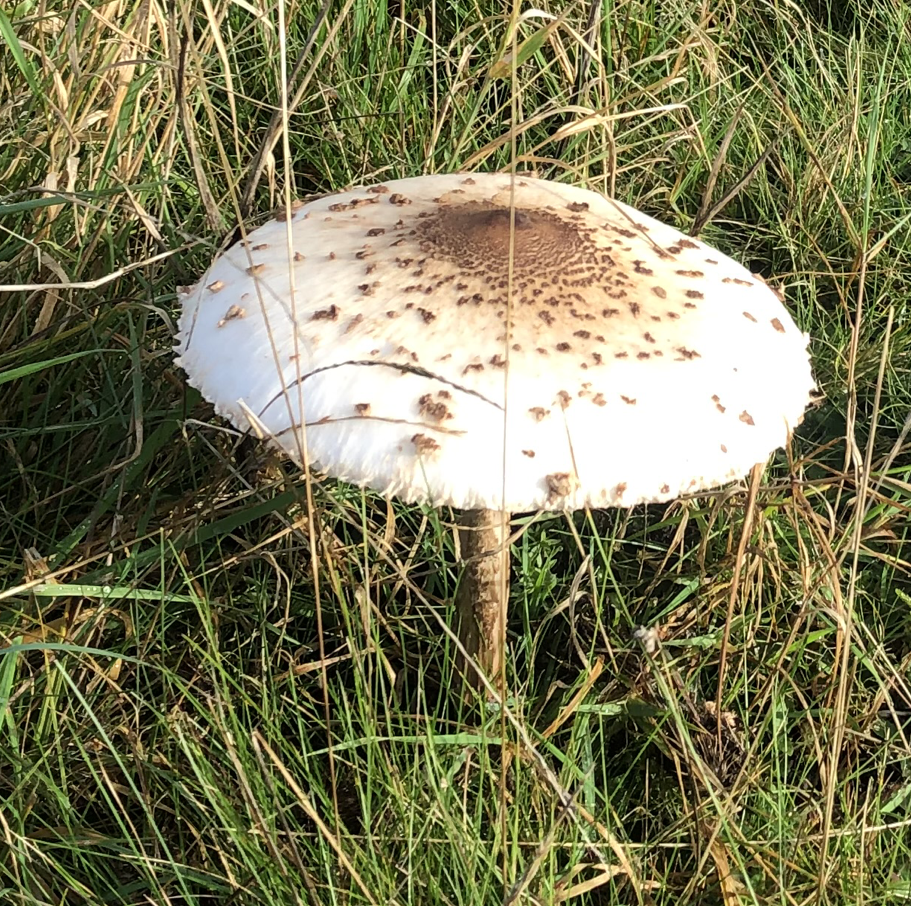
I came across a tip from the RSPB yesterday that cutting grass in early autumn will enable the fungi to grow and fruit. And today I noticed in Richmond Park where the still green bracken had been cut back, that some beautiful parasol mushrooms had popped up!

 I last cut the front lawn in July so I will now set about doing this again. It will also benefit the crocus bulbs that are planted here.

Counting on … day 1.186

4th October 2023

Today is the Feast of St Francis. He is well known for his insight that all of creation is interconnected and equal in the sight of God. Thus he spoke of brother Sun and sister Mother Earth.  Not surprisingly St Francis is names the patron saint of the environment. St Francis was equally concerned about peace making, calling for peace whether that was between neighbours or between the saracens and the crusaders.  

Caring for the environment and peace making go hand in hand. Failure to care for the environment leads to conflict; conflict damages the environment. 

To be an environmentalist is to be a peacemaker.

 Counting on … day 1.185

3rd October 2023

One approach to help us improve biodiversity might be to pursue “the 3-30-300 rule”: that everyone should have sight of three trees, every neighbourhood should have 30% canopy cover, and everyone should live within 300 metres of a park or green space. This concept is the work of a group crammed Creat Streets and last month they published a report on Greening Up our streets – https://www.createstreets.com/wp-content/uploads/2023/09/Greening_Up_Executive_Summary.pdf

The report is full of facts illustrating the health and well-being effects of green urban areas, and outlines policies and ideas that would promote the greening of our streets. Such greening also has  benefits in tackling the climate crisis and in mitigating some of the effects of climate change.

Counting on … day 1.184

2nd October 2023

It is now 9 months since the Biodiversity COP15 that took place in Montreal. Its call to “take urgent action to halt and reverse biodiversity loss” by 2030 was a closely fought but positive outcome. One of  the targets sets the goal that by 2030 at least 30% of habitats should be protected, which is significantly more than what is currently protected – 17% of land and 10% of marine areas, across the globe. (1) 

To achieve will involve not just governments, but businesses, local authorities, farmers and landowners, and we, the public, through out support of wildlife charities and projects.

(1) https://www.theguardian.com/environment/2022/dec/20/cop15-montreal-did-it-deliver-for-natural-world-aoe?utm_term=64256bb9d4f54d3271076a78f8c14e49&utm_campaign=DownToEarth&utm_source=esp&utm_medium=Email&CMP=greenlight_email

A Tale of Two Futures

Talk given at Climate Fair, Norwich: 30th September 2023

Earlier this year in my blog – the greentau – I imagined what the future might be like.  By 2033 we should be at least half way to net zero. 

Will we have been successful? What will have changed? What will daily life be like? 

The first tale.

In many ways life in 2033 is not that different from how it is in 2023. 

I still live in the same house, with the same husband and even the same – now rather elderly – cat. 

We have recently replaced the solar panels on our roof and are now not just self sufficient for energy    but regularly put electricity back into the grid. 

Talking of solar panels, every house in our street now has them, as does the local school and our church – and as you have probably guessed, very few buildings have gas boilers now-a-days.

Other changes in our street include more trees, which provide welcome shade during heat waves, 

and fewer cars. Some families have hung into their old electric cars but most journeys are now made by cycle or public transport. 

We have a fully integrated national train and bus service that runs on the Swiss-style pulse model,      and all communities of 300 + people have an hourly bus service throughout the day, alongside which many rural areas also benefit from a demand responsive  minibus service.  All town centres are now traffic free and all main roads have dedicated cycle tracks wide enough for cargo and family bikes. 

All bus services are free and for rail travel half price rail cards are popular, especially with families as children travel free. 

The increase in cycling has made us fitter and healthier and eased the burden on the NHS.  You will be pleased to hear that we do still have a national health service! There were some dodgy moments    when it looked like the system might collapse, but with the influence of  a people’s assembly,  the whole health and welfare system has being overhauled. There is a focus on preventative care and long term investment  – improving the health of children (physical, mental and educational) will have profound benefits for our society and save money  but the savings may take 20 to 30 years to kick in. 

It has been surprising how much addressing the climate crisis has simultaneously improved people’s wellbeing. All school and institutional meals are now plant based, and I hope you are not surprised to hear  that meat-free dishes now comprise over 50% of all restaurant menus. Vegan cooking is now mainstream  although at the time the All Vegan Bake Off series in 2024 seemed radical. The change in our diets has not only improved our health but has changed the appearance of the rural landscape – much more leafy!

The UK is now self sufficient in wheat, and an increasing area of land is used for growing  fruits and vegetables. There has been a horticultural revolution with small robots and drones undertaking many    of the back breaking tasks,  and with more glasshouses and hydroponic irrigation,  growing seasons have been extended whilst at the same time reducing the demand for water. Work in this sector is now well paid and popular. 

Orchards have multiplied and now encompass new fruits such as olives and pistachios, peaches and almonds,  and are often intercropped  with shade loving plants. The increase in tree cover is, perhaps  the biggest change that you would notice. Not only have we seen orchards expand, but many areas have been rewilded with wide hedgerows, copses and new woodlands. The latest nature report has shown an increase in biodiversity in the UK. It is a revival that required dedication and persistence,   but is now reaping rewards. Nightingales can often be heard – but not necessarily in Berkeley Square! – and a new generation of children are listening out for the cuckoos in spring. Walks and trips to wildlife hides are increasingly popular as there is so much to see!

The High Street is still our main shopping area but it does look more attractive with trees and well-stocked planters. If you want a few herbs, it’s a case of pick your own. With fewer cars, there is less demand for car parking.  Many car parks have been transformed  into green spaces and recreation grounds, with features as diverse as climbing walls and outdoor chessboards. These planted areas double up as SuDS  – sustainable drainage systems  – absorbing excess water during spells of heavy rain.  

There are new shops in the High Street, such as Splash – a bike-wash and  coffee shop where customers enjoy coffee and cake whilst their bike is cleaned,  oiled  and  pumped up. There’s a branch of Repairs are Us, where virtuallly any domestic item can be repaired. And next to the charity shop, there’s Tailor Tricks where they  will readjust or alter any misfitting clothes.  At the other end of the market, we have made to measure fashion outlets such ‘Just for Me’. Video loops show the latest catwalk fashions, whilst on the shelves fabric swatches and accessories entice you to try something new. Interactive screens show you how you would look in these new clothes, and once you have made your choice, the workshop sets to and within a few days – sometimes just hours –  your made to measure outfit is ready to wear!

Of course there are more cycle shops – and more cycle accessory shops. The pet shops are thriving too    as we are increasingly aware of the value of pets for our mental wellbeing. Another growth area has been in indoor plants as we increasingly enjoy filling our homes with living things – and just as dog walking was a growing business in the 20s,  so now there is a growth in companies offering plant care services. No more half dead plants lurking on windowsills when you return from holiday!

Most high streets now have their own coffee roastery, micro brewery,  bakery and  plant based delicatessen. Cheeses and ice creams made from nuts are a popular indulgence.  Across the country  local authorities have made a real effort to promote localism with preferential rates for local businesses. Localism boosts local employment opportunities, improves community cohesion, shortens supply chains,  reduces transport and commuting costs, and provide more    reliable services   during extreme weather events.

Ten years on things have changed but it is not a totally different world nor is it a life lacking in comfort. If anything we have a healthier and happier lives. 

That’s the positive story. Keep it in mind as I read the second of my two tales. 

In many ways life in 2033 is not that different from in 2023. I still live in the same house, with the same husband and even the same – now rather elderly – cat. 

We had hoped to replace our equally elderly solar panels,  but  production of these is so limited  that there is an 18 month waiting list. Similarly we are still waiting to upgrade our storage batteries. Like many people we still have to rely on our gas boiler for heating but this is expensive and as far as possible we opt instead for extra layers of clothing. I have finally  persuaded Paul to wear leggings under his trousers – assuring him that they are not long john’s in another guise!

What you will notice on the streets is the sparsity of combustion engines – not because they have been phased out but because they are now too expensive to run. Instead many people use secondhand electric cars,  which is fine until they break down, blocking the road. Of course for those with money, there are always new electric cars,  and like the old petrol models,  each new  range is bigger, wider and heavier than the last. The roads are just as congested as before  and parking is at even more of a premium. With congested roads  and a lack of investment in public transport and  cycling infrastructure, average journey times are increasing! This is prompting some people to return to home working – which was not part of the government’s plan!

Due to a lack of investment in renewable energy, electricity costs are continuing to escalate and power outages are frequent  for those who cannot afford  the guaranteed 24/7   tariffs. 

In many part of the country – both urban and rural – there are homes which are no longer connected to the grid,  as their occupants cannot afford  the unit costs or the standing charges. Instead such households  use candles for lighting and camping stoves for a minimal amount of cooking. Heating is by body heat only, helped by fleece onesies, duvets and layers of jumpers. 

Schools open early and close late so that children can 

  1. be some where warm, 
  2. get a hot meal  (the government was forced into providing all primary pupils with free school lunches in 2024), and 
  3. have lighting by which  to do their homework,  and power to recharge their laptops. 

As energy prices have risen so has the cost of travel. The government has been forced to provide low paid workers (not just those on a minimum wage but teachers  and nurses too) with free bus passes     to enable them to get to work!  This was first introduced in London  by Sadiq Khan  in 2024. 

People no longer  travel as frequently or as far as we did in 2023. 

Health and social care continues to be an issue. We now have a two tier health service: as good as you can afford if you can go private; second rate if you rely on the NHS. Life expectancy rates continue to drop. For those in the most deprived areas, male life expectancy is now 69 years, and for females 75 years. However even for those in the least deprived areas,  life expectancy has plateaued at 83 and 86 years respectively. Major factors here are the high cost of living that makes good food and warm homes a luxury, on top of which are the adverse affects of the weather. We regularly have heat waves in the summer when temperatures exceed 44C. These can last from  just a few days to extended periods of a fortnight or more. And they usually end with a cataclysmic downpour. High temperatures, particularly when they combine with high night time temperatures,  have continued to cause fatalities amongst the young, the elderly, and those  with underlying health issues. It is not unusual for excess deaths during the summer months  to number more than 100 people  a day.  

Flooding is a recurring problem. It is not just from short spells of torrential rain which come summer and winter alike,  but also from rising sea levels. A sea level rise of 15cm doesn’t sound  much but when that is added to a high tide, and strong winds, which effectively heap up the waves, which are then funnelled into  river estuaries, it can be experienced as 75cm. The increasing frequency and height of flooding in Norfolk,  has seen the permanent closure of the railway line to Lowestoft,  and many homes locally  have become uninsurable.

Floods and heatwaves are not only affect human life but also wildlife, pets, livestock  and crops. Some farmers have stopped growing potatoes because the summers are too dry.  Whilst others have switched from  growing wheat to growing drought resistant sorghum and millet instead. Sugar beet too is increasingly hard to grow. 

And everyone is noticing the rising cost in food prices and food shortages. It is not just the UK that is facing difficulties. The climate crisis is affecting crops across the world. Coffee is no longer grown in Kenya and Ethiopia, sheep are no longer farmed in Australia and wheat no longer comes from the American prairies. 

The climate crisis  is felt not just in rising food prices but also in conflict and migration. The war in Ukraine may have prompted a reassessment of gas supplies, but not  of water. Since then  we have seen conflict along the length of the Tigris and the Euphrates, and the Nile, as nations previously reliant on these waters compete to control this valuable resource. Similar conflicts are also taking place along the Congo river where they are compounded by the desire to protect the oil now coming on tap from that same region.  All these areas of water shortages and armed conflict have produced an ever growing flow of people into Europe. Most aspire to reach  Northern Europe where water security appears more certain. 

The UK is now a much more divided nation. On the one extreme, there are those who have no regular income, and who are reliant on food banks, second hand clothes and warm hubs. For them, home is usually a single room, with no provision of either kitchen or bathroom, as these have become luxuries –  people’s cooked meals come from soup kitchens, and their laundering and washing happens in the equivalent wash and shower hub at the local amenity centre. It feels as if we are returning to the Victorian model of boarding houses and public baths. 

At the other end of the spectrum, are those with jobs and investment incomes who can afford what ever they want and who can live lives completely separated from any crisis. In between is a spectrum of those who can afford food,  and/ or accommodation, and /or heating, and/ or transport, and/or leisure activities. Some of us can afford most of these, but some struggle to afford just one. 

There is an ever increasing number of people who are choosing to forgo parenthood just so that they can afford to live.

Yet we are still asking ourselves,  if there is, perhaps, just enough time to keep global temperatures 

below a 3C increase. It seems to be human nature   to always have hope   despite the odds!

Two very different but equally possible futures. 

I have done a lot of speaking! 

While I catch my breath, have a chat with your neighbour. 

What are makes you most hopeful about the future? 

What worries you most about the future? 

Have about 5 minutes and then if you wish, we can here back from different people? 

Do we have a choice about our future?

Changing the way we live our daily lives and changing the way businesses and governments respond to the climate crisis can be as challenging as stopping and turning round an ocean liner. Making choices about our own daily lives is possibly the easier part – in so far as there are things in my control that I can change. I can choose to turn the thermostat down; I can buy electricity from a green supplier; I can choose not to fly; I can choose to stick to a vegan diet etc. 

But these on their own won’t reduce the cost of energy; they won’t alter oil companies investment plant; they won’t transform the public transport system; they won’t revolutionise farming practices; they won’t systematically insulate every home; or rewild flood plains.

My own individual actions will not prevent rising global temperatures. To transition as a nation and globally, we need businesses, large organisations, trade bodies and government draw up plans, to implement policies and to legislate for change. 

I am here on behalf of Christian Climate Action which is a nation-wide community of climate activists. We not only come from different parts of the country, we also come from different denominations. 

Whilst in our own ways (depending on circumstances and opportunities) we have all responded to the climate crisis by making changes to our individual lifestyles, what unites us is the awareness that that in itself is not enough. That what we need  to do, is to press for systemic change in the way businesses and organisations are run, in the way that local and national authorities respond to the emergency, and in the way that money is invested. 

We are motivated by God’s call that we should care for the earth,  

that we should love our neighbours, 

that we should speak the truth and call out injustice. 

We are inspired by Jesus Christ and guided by the Holy Spirit. 

Following the examples of  Jesus and the prophets, we carry out acts of public witness, non violent protest and civil disobedience, seeking to advance the values of  the kingdom of God.

Recently I had ago at composing a concise descriptor for Climate activism and concluded that the aim of climate activism is  ‘A just transition to a fossil free future.’

So as a Christian Climate activist, what actions have I taken? 

Some are regular actions, repeated week after week in the hope that, like a constant drip of water can erode stone, they will effect change. So every Wednesday I kneel with a banner outside  Shell’s London  headquarters. This silent vigil reflects my concern for the environment and the damage that Shell continues to cause through the production and promotion of fossil fuels. I hope that as well as bringing the power of prayer to the situation, that my presence will prick the conscience of Shell employees arriving for work and of passers-by. 

I spend a further two hours with other CCA supporters outside Parliament. Again our witness is one of silent prayer and presence. As we sit or kneel, we are passed by a constant stream of people going back and forth for work, tourists, school children and students (visiting parliament), the occasional member of the clergy and the occasional member of  Parliament. Wednesday is a busy day as it is Prime Minister’s Questions and various other protest groups also gather – anti brexiters, activists for Armenian, rights, anti ULEZ campaigners, people protesting on behalf of lack of school funding, and so on.

 On Ash Wednesday I took part in a progressive act of worship, with lament and ashing, along the streets in and around Parliament Square. Our lament was against  the Government’s decision to approve the West Cumbrian Coal Mine. 

A few days later, as an act of penitence, I knelt before the altar in Southwark Cathedral. My son cut off my hair and my husband read out a statement that decried the church’s continuing investment in and profiting from fossil fuels. This was part of a weekend of cathedral actions organised by CCA across the country in Catholic and Anglican dioceses which had not them divested from fossil fuels. 

With a happier heart I went in July  to support CCA’s presence at General Synod when the Church of England’s National Investment Body affirmed their decision to divest from fossil fuels. Southwark diocese, and many others, followed suit.

Together with  CCA  and XR I joined a day of action with members of an indigenous community from Sarawak who were protesting the destruction of their forest heritage. 

For the Big One in April, CCA with other faith groups organised  a ‘No Faith in Fossil Fuels’ service at St John’s Waterloo where I was a steward – the attendance was twice the capacity of the church and  afterwards  a 1000 strong band of  pilgrims marched to Parliament Square. Over the weekend CCA maintain a faith hub opposite Westminster Abbey with daily worship, prayers and communion – all out on the street.

I have twice taken action outside the ExCel centre, for Shell’s AGM and for the bi annual Arms Fair. 

Earlier this month I led a walk of prayer along the Thames as part of a CCA weekend of pilgrimages for the planet. 

Last Saturday I was a protest of one in my local high street, marking Loss and Damage Day.  

Next month I will be kneeling in prayer with CCA outside the Oil and Money Conference and in November I will taking action with CCA  in Swindon to persuade the National Trust to drop Barclays as it bank.  Barclays is one of the largest European investors in fossil fuels and that surely is at odds  with the National Trust status as a protector  of the natural environment!

The actions I take are ones that

 a) aim to persuade those in positions to authority and influence to adopt climate friendly practices,

 b) stand up for the rights of those adversely affected by climate change, 

c) that pricks the conscience  of passers-by prompting them to take notice 

and d) speak truthfully of our human failing to live according to God’s kingdom.

I’m going to pause now and invite you to talk with your neighbour about which actions to tackle the climate crisis you feel are most effective,  and then, what actions you yourself would be willing to undertake. 

Have about 5 minutes and then if you wish, we can hear back from different people? 

Does anyone have any questions? 

Thank you for inviting me to speak to you today on behalf of CCA.

Proper 21, 17th Sunday After Trinity

1st October 2023

Reflection (readings are below)

Why do the people complain to Moses and not ask/ pray to God? Are they still at the learning stage and don’t yet know God? 

It seems that they have not yet learnt that God is with them. 

Later the Psalmist, will be able to write ‘Hear my teaching, O my people’. By the time the Psalmist is writing, God’s people have journeyed through the wilderness experiencing God’s presence in all aspects of their daily life. They will have been immersed in a time and space when they were ready and able to learn God’s teaching. 

In Philippians we have a wonderful early creed that describes the nature and character of Jesus. Jesus is God-with-us in a unique way. Through our faith in Jesus, God is at work in us, enabling us ‘both to will and to work for his good pleasure’.

Both the Old Testament readings and the epistle are telling us that the source of instruction that we need to enable us to lead good and fulfilled lives, should come from God. God should be the source of authority in our lives – for us as individuals and as a people. If we believe that God is the origin of all that has been created, then it would seem logical that God would be the best source of information – the best authority – to show us how we can live most harmoniously, most profitably with creation. Here I use the word profitably to mean not financial greed but beneficial wellbeing. And that would be well-being not just for some individuals but for everyone, for the whole ecosystem.

Today’s gospel reading is also about authority. More specifically, what is the authority by which Jesus acts? What is the authority that allows him speak of what God wills? What is the authority that allows him to teach others? What is the authority that allows him to heal and to forgive sins? What is the authority that allows him to challenge existing traditions and laws, to contradict what is said by those in positions of power? 

Does his authority come from his band of followers, or from  family business, or from sponsors, or from a self confident egotism, or maybe – just maybe – from God? 

Perhaps, in all honesty, the chief priests and elders are not entirely sure that they know the answer. The miracles and healings might suggest divine links, but how could that be squared with his pointed assertions that they, the public figures of the Law and guardians of God’s Temple, are wrong – that they have become entrapped in a false system that equates their human decisions with those of God? I can imagine it would be hard for them to see through the miasma of centuries old human-made traditions.

When we look at our own social, religious,  and business structures, can we be sure that we can always distinguish between human preferences and God’s will, between what is expedient and what God desires? 

Licensing new oil wells that will profit shareholders who vote for you, may seem expedient if you are after votes. But is spending money on such destructive projects that could otherwise be invested in climate friendly renewable energy projects, really what God desires? Surely what God desires is that the actions we choose should care for and benefit the planet, should provide for the wellbeing of the poor and the vulnerable in creation?

The people in Exodus quite rightly ask for clean drinking water. Water is essential for life. People need clean water to drink. Birds and animals need clean water to drink. Plants need water to grow. Aquatic creatures need clean water in which to live  – if the water becomes polluted, they die. Why then is it that we allow companies to make profits out of selling water whilst at the same time polluting streams, rivers and, ultimately, seas  on and in which so many plants and animal species depend? Why is it that farmers can profit from industrial-scale methods of production that release herbicides and pesticides and farm sewage into those same streams, rivers and oceans, without hindrance or reparations? Why is that industrialists can profit from producing aluminium and copper and lithium whilst polluting whole river systems? Or that oil companies can profit from extracting oil whilst polluting both rivers and oceans?

Surely what God desires are clean, biodiverse rich, flourishing streams and rivers, seas and deltas? Surely what God desires is that no one should make profits at the expense of anyone else’s (human or wildlife) wellbeing? That being so, by what authority do businesses and governments promote means of production and extraction and profiteering that kill off wildlife, damage ecosystems, and endanger the lives of millions of people across the world?

Conversely by what authority do climate activists, social reformers, naturalists and ecologist, call for an end of such practices? What motivates their actions? To win votes? For egotist reward? For fun? Or because they cannot stand back, and say and/ do nothing about what seems to be clearly unrighteous? 

Exodus 17:1-7

From the wilderness of Sin the whole congregation of the Israelites journeyed by stages, as the Lord commanded. They camped at Rephidim, but there was no water for the people to drink. The people quarrelled with Moses, and said, “Give us water to drink.” Moses said to them, “Why do you quarrel with me? Why do you test the Lord?” But the people thirsted there for water; and the people complained against Moses and said, “Why did you bring us out of Egypt, to kill us and our children and livestock with thirst?” So Moses cried out to the Lord, “What shall I do with this people? They are almost ready to stone me.” The Lord said to Moses, “Go on ahead of the people, and take some of the elders of Israel with you; take in your hand the staff with which you struck the Nile, and go. I will be standing there in front of you on the rock at Horeb. Strike the rock, and water will come out of it, so that the people may drink.” Moses did so, in the sight of the elders of Israel. He called the place Massah and Meribah, because the Israelites quarrelled and tested the Lord, saying, “Is the Lord among us or not?”

Psalm 78:1-4, 12-16

1 Hear my teaching, O my people; *
incline your ears to the words of my mouth.

2 I will open my mouth in a parable; *
I will declare the mysteries of ancient times.

3 That which we have heard and known,
and what our forefathers have told us, *
we will not hide from their children.

4 We will recount to generations to come
the praiseworthy deeds and the power of the Lord, *
and the wonderful works he has done.

12 He worked marvels in the sight of their forefathers, *
in the land of Egypt, in the field of Zoan.

13 He split open the sea and let them pass through; *
he made the waters stand up like walls.

14 He led them with a cloud by day, *
and all the night through with a glow of fire.

15 He split the hard rocks in the wilderness *
and gave them drink as from the great deep.

16 He brought streams out of the cliff, *
and the waters gushed out like rivers.

Philippians 2:1-13

If then there is any encouragement in Christ, any consolation from love, any sharing in the Spirit, any compassion and sympathy, make my joy complete: be of the same mind, having the same love, being in full accord and of one mind. Do nothing from selfish ambition or conceit, but in humility regard others as better than yourselves. Let each of you look not to your own interests, but to the interests of others. 

Let the same mind be in you that was in Christ Jesus,

who, though he was in the form of God,
did not regard equality with God
as something to be exploited,

but emptied himself,
taking the form of a slave,
being born in human likeness.

And being found in human form,
he humbled himself
and became obedient to the point of death–
even death on a cross.

Therefore God also highly exalted him
and gave him the name
that is above every name,

so that at the name of Jesus
every knee should bend,
in heaven and on earth and under the earth,

and every tongue should confess
that Jesus Christ is Lord,
to the glory of God the Father.

Therefore, my beloved, just as you have always obeyed me, not only in my presence, but much more now in my absence, work out your own salvation with fear and trembling; for it is God who is at work in you, enabling you both to will and to work for his good pleasure.

Matthew 21:23-32

When Jesus entered the temple, the chief priests and the elders of the people came to him as he was teaching, and said, “By what authority are you doing these things, and who gave you this authority?” Jesus said to them, “I will also ask you one question; if you tell me the answer, then I will also tell you by what authority I do these things. Did the baptism of John come from heaven, or was it of human origin?” And they argued with one another, “If we say, ‘From heaven,’ he will say to us, ‘Why then did you not believe him?’ But if we say, ‘Of human origin,’ we are afraid of the crowd; for all regard John as a prophet.” So they answered Jesus, “We do not know.” And he said to them, “Neither will I tell you by what authority I am doing these things.

“What do you think? A man had two sons; he went to the first and said, ‘Son, go and work in the vineyard today.’ He answered, ‘I will not’; but later he changed his mind and went. The father went to the second and said the same; and he answered, ‘I go, sir’; but he did not go. Which of the two did the will of his father?” They said, “The first.” Jesus said to them, “Truly I tell you, the tax collectors and the prostitutes are going into the kingdom of God ahead of you. For John came to you in the way of righteousness and you did not believe him, but the tax collectors and the prostitutes believed him; and even after you saw it, you did not change your minds and believe him.

Green Tau: Restore nature now! How?

29th September 2023

The annual State of Nature report was issued 27th September, revealing that 1 in 6 species in the UK is threatened with extinction. On average the abundance of land and freshwater species in England has declined by 32% since 1970.

The National Biodiversity network  noted: “The State of Nature report also found that out of the assessed habitats which are important for wildlife, only one in seven (14%) were found to be in a good condition and only one in fourteen (7%) woodlands and a quarter (25%) of peatlands were assessed to be in a good ecological state. Due to habitat damage from fishing gear, none of the seafloor around the UK was found in good condition…Despite recent moves towards more nature-friendly land and sea use, as yet only a fifth of farmland is now in agri-environment schemes with only some of that helping nature, just 44% of woodland is certified as sustainably managed and only half of fish stocks are sustainably harvested. While all three measures have improved markedly over the past 20 years, there is still a very long way to go.” (1)

Beccy Speight, the RSPB’s chief executive, said: “The UK’s wildlife is better studied than in any other country in the world and what the data tells us should make us sit up and listen. What is clear is that progress to protect our species and habitats has not been sufficient and yet we know we urgently need to restore nature to tackle the climate crisis and build resilience.

“We know that conservation works and how to restore ecosystems and save species. We need to move far faster as a society towards nature-friendly land and sea use, otherwise the UK’s nature and wider environment will continue to decline and degrade, with huge implications for our own way of life. It’s only through working together that we can help nature recover.” (2)

The Soil Association’s head of Farming Policy Gareth Morgan yesterday said: “It is deeply concerning to see this detailed report on the state of nature in the UK but sadly it does not come as a huge shock. Farmland makes up 70% of Britain and we can’t fix the decline in nature without a transformation in food and farming. Many farmers are working with nature and many more are keen to do so. But we remain too dependent on over-intensive, chemical-reliant methods such as industrial livestock systems fed on imported soy. The evidence shows some success for recovery in small protected areas but we cannot ignore what happens in the rest of our countryside where we need a renewed focus on producing good food in harmony with nature.” (3)

Just as switching from fossil fuels to renewable energy sources will be key to achieving net zero for carbon emissions, so it would seem that switching from what might be termed industrial farming to regenerative farming will be key to achieving the restoration of nature. 

(1) https://nbn.org.uk/news/state-of-nature-2023/

(2) https://www.theguardian.com/environment/2023/sep/27/species-risk-extinction-great-britain-wildlife-state-of-nature-report?CMP=Share_iOSApp_Other

(3)https://www.soilassociation.org/news/2023/september/27/state-of-nature-we-can-save-wildlife-by-transforming-farming/

Previous issues of Green Tau have explored biodiversity –