Green Tau: issue 84

20th November 2023

The Diocese of Chichester votes against divestment 

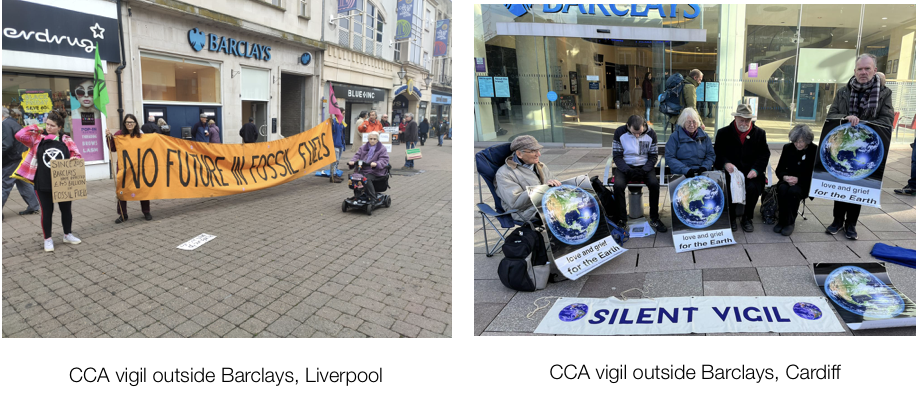
On Saturday 18th November I joined a group of CCA people holding a vigil as members arrived for Chichester Diocese’s Synod which was to vote on whether or not to remain invested in fossil fuels. We were then invited in to observe the debate. What follows is based on the notes I made as people spoke.  

The motion came from the Chichester Diocese Fund and Board of Finance (incorporated) and was as follows:- 

 “1. ETHICAL INVESTMENT Mrs Lesley Lynn (Chair) to move that “This Synod re-affirms that care for God’s creation is foundational to the Christian gospel and central to the church’s mission and, recognising

(a) the importance of working towards a future which does not depend on fossil fuels;

(b) the need to both develop alternative energy supplies and reduce the demand for energy before freedom from fossil fuels can be achieved; and

(c) the central role that large energy companies have to play in developing alternative energy supplies, agrees that it will continue to invest in Shell and BP only while those companies have a clear strategy aligned with the Paris Agreement goal to limit the increase of average global temperature to 1.5 degrees Celsius above pre-industrial levels.”

The first part of the motion states a positive green view of the Church’s values and calling. From this (a) and (b) are logical ambitions,  and by inference so is (c) – which it is certainly not! There is a lot of published material that shows that fossil fuel companies like Shell and BP are part of the climate crisis problem; not the solution. 

Yet Lesley was forthright in her views that continuing to investing in  fossil fuels was a responsible solution to the climate crisis. Her main argument was that to address the climate crisis we must reduce energy consumption. At the same time she believed fossil fuels were essential to our daily lives for energy and transport. To reduce the availability of fossil fuel energy would be detrimental and would  further impoverish the poor through higher prices. 

This view ignores the facts that renewable energy is cheaper to produce; that the prices of both fossil, fuel and renewable energy are distorted by government subsidies and policies which favour fossil fuels over renewables; and that renewable energy can and will increasingly support our daily living needs as we transition to net zero.

A speaker against the motion, reminded us of the plea from the Churches of the South, who are calling on us, their brothers and sisters in the west, to divest because they are suffering unbearably from the effects of the climate crisis. 

The actions the Church – in this case the Diocese of Chichester – carry with them a message that is heard far and wide, that proclaims our values. Divesting speaks of justice for those in the global south – as well as for the poor in our own communities. Divesting also speaks of care for the environment which is a message many young people and the unchurched in our society want to hear.

Lesley presented the argument that staying invested gave the Diocese a voice in the boardrooms and AGMs of Shell and BP, and thus the means to effect changes in the ways these companies addressed climate issues. She noted that the Church of England nationally no longer had this agency. A speaker against the motion pointed out that the National Investment Body NIBs had taken this view up until this year but has concluded that the rate of progress was too slow – given the urgency of the climate crisis – and that both Shell and BP had in fact changed direction and showed no intention of transitioning at a rate fast enough to be of benefit.

The motion put forward by Lesley asserted that large energy companies had a central role to play in developing alternative energy supplies. No evidence was given in support of this. In fact with regards to Shell and BP this is certainly not the case. 

Global Witness examined Shell’s spending on wind and solar for 2021 and found it equated to just 1.5% of their capital expenditure. In March 2022 Shell announced it would spend £20-25bn over the next ten years in the UK energy system – a figure which shrinks when considered in relation to their annual profits for that year alone of £32bn.  Further, of this proposed spend in the UK, only 75% would be on low and zero-carbon products and services, which while including offshore wind, hydrogen, also includes carbon capture utilisation and storage (CCUS) and electric mobility. 

A smiliar picture exists with BP. Between 2016 and  2022  BP spent $3.2bn on clean energy compared with $84bn on oil and gas exploration and development. Since then Bernard Looney the CEO has been replaced as he was felt to be leaning too much in favour of green policies.  

In terms of investing in renewable energy, Lesley said that if the Diocese did divest, they would not  reinvest that money in renewables as the Diocese already had a sufficient spread of renewable in their portfolio. 

The motion put forward by Lesley also had the proviso that investment would continue only so long as ‘those companies have a clear strategy aligned with the Paris Agreement goal to limit the increase of average global temperature to 1.5 degrees Celsius above pre-industrial levels.’ 

One research body that assesses the compliance status of companies is the The Transition Pathway Initiative Centre. This is the research body used by the Church of England. It finds that both Shell and BP are not compliant. However Lesley does not agree with their formulations and prefers instead those of the World Benchmarking Alliance. However even their benchmarking does not actually confirm that Shell and BP are Paris Aligned, just that there are relatively more ecological/ ethical than other oil companies, ranking 11th and 12th respectively. Lesley did add that as well as investments in Shell and BP, the Diocese has investments in Total (which ranks third on the World Benchmarking Alliance) and the Diversified Energy Company. (This latter, apparently buys old oil wells and revamps the infrastructure so as to reduce the emissions linked to the extraction process. This sounds like a positive but it does nothing to reduce the much larger emissions from when the oil is used).

Another speaker against the motion suggested that as the Church was capable of making ethical investment decisions not to invest in tobacco, arms, drugs or the sex trade, why could it not equally make the decision not to invest in  fossil fuels? In reply, Lesley differentiated between them saying that if overnight all arms or drugs disappeared,  the world would be a happier, safer place. But if oil disappeared overnight we would all be stranded. 

Bringing the debate back to ethics and values was important, for the motion was linking investment decisions to the Christian calling to care for creation. Nothing in the debate supporting the motion suggested how continuing to invest in Shell and BP would achieve this. At a recent conference ‘Church Investment in Climate Solutions: Financing a  Liveable Future’ (organised by Operation Noah and FaithInvest) the importance of having a clear investment policy that reflects faith values was emphasised. With such a clear policy, churches and faith groups are then equipped to go to their financial advisers and say these are the values we want our portfolio to reflect. 

This is where I feel the Diocese of Chichester has failed. It has a adopted an ethical investment policy that is illogical, claiming in the one hand to care for creation whilst at the same time investing in companies whose main product is one that is destroying the planet. Further, having included  provisos within its policy to limit the adverse effects of its investments on the climate, it is continuing to invest in companies that clearly do not meet the stated criteria.

The vote sadly went in favour of continuing investment in Shell and BP: 

For 62 against 32 abstention 9.

Saturday was a sad day for the Diocese of Chichester, for the wider church, for Christian witness and for the wellbeing of creation. 

Counting on … day 1.219

20th November 2023

The authors of the State of Climate Action 2023 report advise that world needs to:

  • Retire about 240 average-sized coal-fired power plants a year, every year between now and 2030.
  • Construct the equivalent of three New Yorks’ worth of public transport systems in cities around the world each year this decade.
  • Halt deforestation, which is happening to an area the size of 15 football pitches every minute, this decade.
  • Increase the rate of growth of solar and wind power from its current high of 14% a year to 24% a year.
  • Cut meat consumption from ruminants such as cows and sheep to about two servings a week in the US, Europe and other high-consuming countries by 2030.” (1)

We may feel we have little control over deforestation, especially that which happens outside the UK, but indirectly we do. Many of the products we consume every day come directly or indirectly from forested land that has been cleared to allow for commercial production of sugar, palm oil and soya beans. 

Palm oil is an interesting crop as it finds itself in many products ranging from toothpaste to margarine, laundry liquid to biscuits. When listed as an ingredient, it may appear as palm but can as easily appear as palm- , stear- , laur- , or  glyc-. Reducing our consumption of palm oil, or seeking products made from sustainably produced palm oil, does take some research – Ethical Consumer has a useful guide – https://www.ethicalconsumer.org/palm-oil/palm-oil-free-list

Processed soya beans may feed directly into our shopping basket as tofu, tempeh or as soya milk (and other similar dairy replacements).  This accounts for a very small portion of global soya production – less than 6%. Most of the global output of soya beans (77%) is used as animal feed. By eating less meat and dairy produce we can reduce the demand for soya beans and hence deforestation! 

For more information on palm oil and how to avoid its damaging production – https://greentau.org/2021/12/15/green-tau-issue-27/

For more information on the dangers of sugar plantations – https://www.nhm.ac.uk/discover/sugar-a-killer-crop.html, https://www.theguardian.com/global-development/2020/jun/18/a-shame-for-the-world-ugandas-fragile-forest-ecosystem-destroyed-for-sugar?CMP=Share_iOSApp_Other

For more information on soya beans and deforestation- https://www.theguardian.com/environment/2023/oct/06/top-grain-traders-helped-scupper-ban-on-soya-from-deforested-land?CMP=Share_iOSApp_Other , https://ourworldindata.org/soy

(1) https://www.theguardian.com/environment/2023/nov/14/world-behind-on-almost-every-policy-required-to-cut-carbon-emissions-research-finds?CMP=Share_iOSApp_Other

Proper 28, 19th November 2023

Reflection (readings are below)

On Thursday I took part in an interfaith service praying for climate justice – we gathered beneath the statue of Robert Clive outside the Foreign Office, as we reflected on how our actions have a global impact. 

One, a rabbi, told us a story that when God first created Adam, God took him on a tour of all the trees in the garden of Eden, showing both how beautiful and how useful they all were. And then God told Adam that all this had been created for him – for humanity. ‘Make certain’, said God, ‘that you do not ruin and destroy all this, for there is no one to mend it after you!’ 

We are not children, said the rabbi, that someone else will tidy up our mess. We are adults and have to take responsibility to mend what we have damaged. 

Today’s readings have the theme of judgment. The prophet Zephaniah talks of the impending ‘day of reckoning’. A  day when our pluses and minuses, successes and failures, are weighed up.

And in today’s Gospel Jesus tells a parable in which a master judges whether his servants have been trustworthy custodians of what he gave them.

In just under two week COP28 will get underway. One of the key agenda items is to address the outcome of the global stocktake – an assessment of progress that has been made by the nations against the targets in the Paris agreement. The report itself was published in September with the conclusion that  although progress had been made, it was nowhere near enough, and that achieving net-zero emissions required “systems transformation” across all sectors and contexts, including scaling up renewable energy and phasing out fossil-fuel projects.

It feels as if we are fast approaching a day of reckoning. How will we be judged? Will it be shown that we have taken sufficient care of the earth God has given us? 

To return to Zephaniah, it will not be enough that we ourselves have gained wealth, built ourselves comfortable homes and vineyards. Judgement of the earth will be more subtle – it is not a question have we got enough wealth, a safe home and a fruitful vine – that is just to be complacent – but have we ensured that the earth’s wealth has been fairly shared with our neighbours? Have we ensured that it has been garnered in such a way as to not to destroy the earth – and all the trees – that God has given us? 

The jury is out.

The words of UN Secretary-General António Guterres’ opening remarks to the Climate Ambition Summit in September, sounds as forceful as those of Zephaniah. “…and our task is urgent. Humanity has opened the gates of hell. Horrendous heat is having horrendous effects.  Distraught farmers watching crops carried away by floods; sweltering temperatures spawning disease; and thousands are fleeing in fear as historic fires rage.

Climate action is dwarfed by the scale of the challenge… But, the future is not fixed.  It is for leaders like you to write it…We must make up time lost to foot-dragging, arm-twisting and the naked greed of entrenched interests raking in billions from fossil fuels.”

So while we have time, we must take action. The Psalm reminds us that God is our refuge, our port of call for help. We must ask God “ to teach us to number our days that we may apply our hearts to wisdom.” If we trust in God, we should allow God to shape our actions, to guide our thoughts and to inflame our hearts with love. 

We must not be complacent, but rather we must, in the words from Thessalonians, be awake and sober. We must put on ‘the breastplate of faith and love, and for a helmet the hope of salvation’ and that salvation comes through Jesus. A few weeks ago we reflected on the Beatitudes and the teachings that Jesus gives to us his apprentices, that we should love without counting the cost, be truthful without counting the cost, be faithful without counting the cost and stand up for what is right without counting the cost.

If we and all people of faith can accept our responsibility to care for the earth and for our neighbours, then, in the words of the Hindu swami at Thursday’s Interfaith service, we, the people of faith, will be a fighting force for good, a force that can change the world.

António Guterres closed his speech saying, “The future of humanity is in your hands.  One summit will not change the world.  But, today can be a powerful moment to generate momentum, that we build on over the coming months.”

Zephaniah 1:7,12-18

Be silent before the Lord God!
For the day of the Lord is at hand;

the Lord has prepared a sacrifice,
he has consecrated his guests.

At that time I will search Jerusalem with lamps,
and I will punish the people

who rest complacently on their dregs,
those who say in their hearts,

“The Lord will not do good,
nor will he do harm.”

Their wealth shall be plundered,
and their houses laid waste.

Though they build houses,
they shall not inhabit them;

though they plant vineyards,
they shall not drink wine from them.

The great day of the Lord is near,
near and hastening fast;

the sound of the day of the Lord is bitter,
the warrior cries aloud there.

That day will be a day of wrath,
a day of distress and anguish,

a day of ruin and devastation,
a day of darkness and gloom,

a day of clouds and thick darkness,
a day of trumpet blast and battle cry

against the fortified cities
and against the lofty battlements.

I will bring such distress upon people
that they shall walk like the blind;
because they have sinned against the Lord,

their blood shall be poured out like dust,
and their flesh like dung.

Neither their silver nor their gold
will be able to save them
on the day of the Lord’s wrath;

in the fire of his passion
the whole earth shall be consumed;

for a full, a terrible end
he will make of all the inhabitants of the earth.

Psalm 90:1-8, 12

1 Lord, you have been our refuge *
from one generation to another.

2 Before the mountains were brought forth,
or the land and the earth were born, *
from age to age you are God.

3 You turn us back to the dust and say, *
“Go back, O child of earth.”

4 For a thousand years in your sight are like yesterday when it is past *
and like a watch in the night.

5 You sweep us away like a dream; *
we fade away suddenly like the grass.

6 In the morning it is green and flourishes; *
in the evening it is dried up and withered.

7 For we consume away in your displeasure; *
we are afraid because of your wrathful indignation.

8 Our iniquities you have set before you, *
and our secret sins in the light of your countenance.

12 So teach us to number our days *
that we may apply our hearts to wisdom.

1 Thessalonians 5:1-11

Now concerning the times and the seasons, brothers and sisters, you do not need to have anything written to you. For you yourselves know very well that the day of the Lord will come like a thief in the night. When they say, “There is peace and security,” then sudden destruction will come upon them, as labor pains come upon a pregnant woman, and there will be no escape! But you, beloved, are not in darkness, for that day to surprise you like a thief; for you are all children of light and children of the day; we are not of the night or of darkness. So then let us not fall asleep as others do, but let us keep awake and be sober; for those who sleep sleep at night, and those who are drunk get drunk at night. But since we belong to the day, let us be sober, and put on the breastplate of faith and love, and for a helmet the hope of salvation. For God has destined us not for wrath but for obtaining salvation through our Lord Jesus Christ, who died for us, so that whether we are awake or asleep we may live with him. Therefore encourage one another and build up each other, as indeed you are doing.

Matthew 25:14-30

Jesus said, “It is as if a man, going on a journey, summoned his slaves and entrusted his property to them; to one he gave five talents, to another two, to another one, to each according to his ability. Then he went away. The one who had received the five talents went off at once and traded with them, and made five more talents. In the same way, the one who had the two talents made two more talents. But the one who had received the one talent went off and dug a hole in the ground and hid his master’s money. After a long time the master of those slaves came and settled accounts with them. Then the one who had received the five talents came forward, bringing five more talents, saying, ‘Master, you handed over to me five talents; see, I have made five more talents.’ His master said to him, ‘Well done, good and trustworthy slave; you have been trustworthy in a few things, I will put you in charge of many things; enter into the joy of your master.’ And the one with the two talents also came forward, saying, ‘Master, you handed over to me two talents; see, I have made two more talents.’ His master said to him, ‘Well done, good and trustworthy slave; you have been trustworthy in a few things, I will put you in charge of many things; enter into the joy of your master.’ Then the one who had received the one talent also came forward, saying, ‘Master, I knew that you were a harsh man, reaping where you did not sow, and gathering where you did not scatter seed; so I was afraid, and I went and hid your talent in the ground. Here you have what is yours.’ But his master replied, ‘You wicked and lazy slave! You knew, did you, that I reap where I did not sow, and gather where I did not scatter? Then you ought to have invested my money with the bankers, and on my return I would have received what was my own with interest. So take the talent from him, and give it to the one with the ten talents. For to all those who have, more will be given, and they will have an abundance; but from those who have nothing, even what they have will be taken away. As for this worthless slave, throw him into the outer darkness, where there will be weeping and gnashing of teeth.’”

Counting on … day 1.218

17th November 2023

In September of this year, the Sycamore Gap Tree was, through criminal action, chopped down. Previously a 400 year old oak was felled in Northamptonshire to make way for road improvements. A 600 year old oak was felled in Peterborough because it was damaging nearby buildings. A 250 year old wild pear tree was felled In Warwickshire to make way for HS2. 

Should we treasure trees as much as we treasure buildings? Are they not an as important part of the landscape? 

The Woodlands Trust is pressing “the UK, Scottish, Welsh and Northern Irish Governments to protect our most important trees by:

  • Legally protected heritage status for some of our most ancient and important trees
  • Strong, consistent policy protection for old trees  
  • More support for land managers to care for ancient and veteran trees”

If you would like to add your name to their petition, here is the link –

https://campaigns.woodlandtrust.org.uk/page/99702/petition/2

The Woodlands Trust also has ideas for home made Christmas gifts – https://www.woodlandtrust.org.uk/blog/2023/10/homemade-christmas-gifts/?utm_campaign=3328841_E23COM041_Newsletter_Dynamic&utm_medium=email&utm_source=E23COM044&utm_content=Christmas-Crafting&dm_i=2D76,1ZCJT,6HXEUF,71JUC,1

Counting on … day 1.217

16th November 2023  

The lead author of the study into the health (or rather threatened health) of our woodlands, published in  ‘Forestry: An International Journal of Forest Research’, is Dr Eleanor Tew, head of forest planning at Forestry England and visiting researcher at the University of Cambridge. Whilst the threat of a collapse of our woodland ecosystems is possible, it is not inevitable. “We do have time to make a difference, and there is a lot we can do to make our forests more resilient,” said Tew, who described the paper as a “call for action”… The forestry industry has to plan in advance …. an average conifer in a plantation can take up to 60 years to reach maturity, and a broadleaf up to 150 years. “Forestry has always been about planning for the long-term, and we’re at a time of huge change,” said Tew. Solutions [could] include increasing the diversity of tree species within a wood, planting trees of different ages, promoting natural regeneration and managing deer populations.”(1)

The Forestry Journal published advice from ConFor the forestry’s  industry wide body  to improve tree planting:-

  • a coordinated UK-wide approach to the 30,000-hectare target, currently not in place;
  • planting targets to be clearly linked to delivering other policy objectives – mitigating climate change, supporting biodiversity and delivering rural jobs and growth;
  • clear targets to use more home-grown wood – the UK is the second highest global net importer of wood after China, and using more wood will lock up more carbon (2)

Growing timber for domestic use – eg construction, furniture making etc seems logical. Maybe we can help by specifying such products if we are making such purchases. 

(1) https://www.theguardian.com/environment/2023/nov/08/uk-forests-face-catastrophic-ecosystem-collapse-within-50-years-study-says-aoe?CMP=Share_iOSApp_Other

(2) https://www.forestryjournal.co.uk/news/18834822.confor-calls-urgent-action-tackle-uk-tree-planting-failure/

Counting on … day 1.216

15th November 2023

At a time when there may be fewer jobs in UK-based mining and steel making, there are opportunities for more people to work in the forestry industry. 

At a recent Forestry Conference, Chris Williams the CEO of the Royal Forestry Society commented that a “Lack of woodland management is a major cause of biodiversity loss in the UK. We have a skills shortage. Between 2021 and 2025, 10 per cent of forestry workers will retire.” 

The Forestry Journal goes on to report on possible solutions that were discussed:- 

“What can we do?  Increase the number of forestry courses. Include forestry/agroforestry modules within land-management courses. Run courses where they are easier to reach (London/Birmingham). Offer a graduate conversion course, a PGCF (a postgraduate certificate in forestry?) and work with the EFRA committee and the agricultural sector. Adapt: create new pathways into the industry for the neurodiverse, care leavers and ex-military personnel: promote the positives: improve pay.”

“The RFS offers career roadshows, blogs celebrating women in forestry, careers advice. They develop pathways into industry with universities and participate in the Forestry Skills Forum. “The Green Tree badge initiative hopes to engage one million children (via school, Scouts, Guides, or family) in activities that raise awareness of forestry. If you don’t reach that eight-year-old, you won’t reach the 18 -year-old. Make it easier to find the sector and for people to get on board.” (1) 

  1. (https://www.forestryjournal.co.uk/features/forestry-journal-features/23914844.forestry-conference-2023-focuses-industry-skill-shortages/)

Green Tau: issue 83

Oil, profits and how to bring about change

14th November 2023

Following on from last week’s Green Tau, it seems that Shell – and other oil and gas companies – have no intention of cutting back on the amount of fossil fuels that they plan to extract and sell. If this becomes a reality, then the planet faces a grim future with rising temperatures and increasingly violent weather patterns that will make large parts of the earth uninhabitable. 

Is there anything that can be done to deflect and reverse this scenario? At present so many systems seem designed to perpetuate the profitability and financial attractiveness of fossil fuels. 

For example,  most buildings are heated via gas fired boilers, most vehicles are powered by petrol. Swopping to a different system of heating and powering vehicles is expensive, with the need for investment in new distribution networks, new manufacturing plants, newly trained staff both to make and maintain the new equipment – plus, of course, the need for customers to have sufficient resources to make the switch. 

Whilst at the same time, oil and gas companies are huge, having grown over many decades into international corporations, dominating our economies and therefore command great influence in the financial worlds – far more so than say a new, still small renewables company. 

There is also the inertia that comes from years practice. Customers, financiers, governments etc have been used to working with the oil and gas industry for so long, that change feels counter intuitive and difficult. The longer we have done something one way, the harder it is for us to imagine there being any other way.

Nevertheless there are ways of changing the system.

Government Action –

1. Remove government subsidies. Many governments, not just here in the UK, subsidise the fossil fuel industries, in part to keep their own economies competitive. But these subsidies are large and distort the market price of fossil energy. Recently 25,000 plus climate protestors in the Netherlands blockaded a motor way for ten days to persuade their government to review its continued payment of subsidies to the Dutch fossil fuel industry. (This is something we too should campaign for).

2. Increase subsidies to support renewable energy and so tip the markets away from fossil fuels. If governments can be persuaded to eliminate fossil fuel subsidies, it would be appropriate to equally ask that that money be diverted to both subsidise renewables, and to support those in our society who are suffering from fuel poverty.

3. Enforce stringent windfall taxes to recoup the money that the fossil fuel industry earns purely because of war and other global uncertainties. These events, because they lead to higher prices for oil and gas but have no effect on the cost of production, enable companies to receive increased profits at zero cost. Such windfall tax revenues should then be used to reimburse those vulnerable communities that have lost most because of the climate crisis.

4. Ban advertising for fossil fuels. Over recent years cigarette advertising has been banned to encourage consumers to make  more healthy choices and to reduce the cost to the NHS of the health issues caused by cigarette smoke. Fossil fuels cause even more damage to health and an even greater costs to society as jobs, homes, infrastructure, farming etc suffer from the adverse effects of the climate crisis.

5. By the same logic there should be a ban preventing fossil fuel companies from sponsoring sporting and cultural events. Such sponsorship has the additional concern that it portrays the sponsors as worthy upholders of what we value as a society – where as in fact their businesses are destroying what we hold dear.

6. Agree and impose a global tax on aviation fuel. At present aviation fuel – unlike petrol and diesel is not taxed. It would be too easy for airlines to avoid the tax if introduced state by state, by refuelling at airports where no tax was imposed.

7. Pro-active government advertising to encourage consumers to reduce consumption of fossil fuels.  Plus Government support to enable consumers to switch to green energy suppliers, to replace gas boilers with heat pumps, to replace car journeys with active travel (walking, cycling) or with public transport etc. 

8. Government legislation to ban internal flights where railways can provide the same connections. The EU is already gradually introducing legislation to achieve this in Europe.

9. Pro active  messaging from the government to show that they are committed to a speedy switch to renewable energy – certainty on the direction and speed of travel is important for the financial markets and those investing in green technologies. 

10. Legislation to require all businesses and organisations to have a net zero transition plan that encompasses scope 1, 2 and 3 emissions. Government support, to enable small concerns to undertake this, would be necessary. 

Businesses and organisations 

1. Pro-actively engaging in drawing up and implementing net zero transition plans to reduce their consumption of fossil fuels and their green house gas emissions.

2. Refusing to promote or advertise fossil fuels companies and products. The Guardian newspaper for example does not carry adverts for airlines. 

3. Cutting ties with companies that support the fossil fuel industries, such as banks, and insurance companies.

4. Supporting, developing and/or investing in renewable energy and zero carbon products. Seeking out alternative materials that can substitute for fossil fuels.

5. Giving support to activist groups seeking to persuade more reluctant organisations to adopt climate friendly policies.

Consumers

1.Wherever we can (depending on our financial position) to opt not to buy fossil fuel products – eg by switching to green energy suppliers, reducing petrol consumption by, for example, walking or cycling, using public transport, car sharing, using an electric car, by not flying, by replacing boilers with heat pumps etc, and by cutting back or avoiding products made from oil – such as plastics but also vinyl products, polyester etc. (For a comprehensive and amazing list see https://www.energy.gov/sites/prod/files/2019/11/f68/Products%20Made%20From%20Oil%20and%20Natural%20Gas%20Infographic.pdf)

2. Use our voting power  to elect a government that is pro the wellbeing of the climate and environment and anti the damaging actions of the fossil fuel industry. This applies to local as well as national elections. In between elections, email your representatives if you feel they are not sufficiently supporting the well-being of the environment.

3. Target all companies with ties to the fossil fuel industry such  as banking and insurance, to urge them to cut their ties and support instead the renewable energy sector.

4. We can as individuals and as campaign groups be vocal in telling the truth about emissions from the fossil fuel industry and so counter their green washing.

5. Switch our bank, pensions, insurance etc to companies who are not supporting the fossil fuel industry.

Counting on … day 1.215

14th November 2023

To address both the climate and biodiversity crises, the government has a target, set in the Environment Act, for increasing tree increasing tree and woodland cover to 16.5% of total land area in England by 2050. (Sadly this is less than the 17.5% increase originally laid down in the 2021 legislation). 

However as the Woodlands Trust points out, there must be a focus on quality as well as quantity:- 

“ We need an ambitious target which ensures woods are:

  • best for wildlife: at least 300,000 ha of all new trees and woods must be native to provide havens for hundreds of woodland species by 2050
  • well connected: expanding our existing woodland patches will connect and increase habitat sizes and boost their benefits.” (1)

There is therefore an urgency to the need for quality tree planting and, as importantly, for maintenance. The Guardian highlighted a recent report from ‘Forestry: An International Journal of Forest Research’ which warned that “UK forests are heading for “catastrophic ecosystem collapse” within the next 50 years due to multiple threats including disease, extreme weather and wildfires … with trees dying on a large scale.” (2)

We as individuals can help in a couple of small ways –

  1. By using the online Tree Alert tool to report possible tree pests and diseases. 
  2. By ensuring our boots are clean before walking in a new woodland to avoid spreading disease.
  3. By sponsoring trees through groups such as The Woodlands Trust, the Wildlife Trust, Trees for Life, the NHS Forest, or the National Forest (planting trees in the former industrial areas of the Midlands)

https://treesforlife.org.uk/support/plant-a-tree/

https://www.woodlandtrust.org.uk/support-us/give/dedications/

https://www.wildlifetrusts.org/adopt-species/adopt-tree-or-habitat

https://www.nationalforest.org/

(1) (https://www.woodlandtrust.org.uk/protecting-trees-and-woods/campaign-with-us/tree-target/)

(2) https://www.theguardian.com/environment/2023/nov/08/uk-forests-face-catastrophic-ecosystem-collapse-within-50-years-study-says-aoe?CMP=Share_iOSApp_Other

Counting on … day 1.214

13th November 2023

Earlier this month I wrote about plans for switching from coal fired to electric fired furnaces for producing steel. It is an essential move in terms of reducing green house gas emissions, but it comes with complications – the electric furnaces need a smaller workforce so new jobs needed in other parts of the economy; the electric furnaces use recycled metal rather than raw ore which is a good thing in terms of reducing unsustainable consumption of raw materials but does need us now to have better systems for collecting and recycling unwanted metal; and a reduction in demand for coal:

“Electric arc furnaces require only 9kg of coking coal a tonne of steel against 780kg for a tonne of blast furnace steel, according to the lobby group UK Steel. British blast furnaces produced 4.8m tonnes of steel in 2022, suggesting they may have used 3.7m tonnes of coking coal. Based on UK Steel’s figures, producing the same amount of steel in electric arc furnaces would require only 43,000 tonnes of coal, or about 1.7% of the Cumbrian mine’s output.” (1)

This must call into question whether there is any sense of continuing with the creation of the West Cumbrian coal mine. But equally it points to the need to develop other parts of our economy to create employment and to use the skills that people have.

 (1) https://www.theguardian.com/business/2023/nov/07/fresh-calls-to-scrap-cumbrian-coalmine-amid-steel-industrys-green-push

Proper 27, 3rd Sunday before Advent

12th November 2023

Reflection (readings are below)

Amos is asking his audience if they are sure that want the Day of the Lord to come soon? Do they really want to be exposed to  God’s judgement? For that surely is part and parcel of the Day of the Lord? If it is a day of honest judgement, might it be more than we bargain for? Might it be like meeting a bear when you have just escaped from a lion? Or like reaching the safety of your home, only to put your hand on a scorpion? 

Earlier this week I was at conference considering how faith groups go about investing their financial resources. Would their choices of investment reflect well on the groups? How, for example, would they feel if they had to reveal to their congregations or supporters, where – in what companies and industries – they had invested their money? Would their investments reflect their commitment to God’s way, to the coming of the kingdom of God, or would they reflect the mercenary views of the ‘world’?

It seemed a good question to ask of ourselves. How would we feel explaining which bank we used, which pension provider, or which companies we invested with? How would we feel if we had to explain how we spent our money each week? 

So yesterday I was Christian Climate Action outside the Steam Museum in Swindon where the National Trust was holding its AGM. We and all the NT supporters recognise the good that they do to protect and enhance the natural environment, and to make it accessible to more and more people. A few years ago they divested from fossil fuels. Why then, we asked, are you banking with Barclays one of the worst in terms of their financing of fossil fuel projects? Is this in keeping with your values?

Amos then goes on to ask his audience if they are sure they know what God wants from them. Are they sure that what God wants are offerings of burnt incense or some songs of praise? Rather, says Amos, what God wants are deeds of justice and righteousness, deeds that will be ongoing – rolling – like a never ending stream. That will be the basis on which God will judge us.

If we look at the state of the world – the ongoing fighting in Ukraine, in North Sudan, in Yemen, in Gaza – do we feel ready to be judged? 

If we consider that in 2022 3.8 million people in the UK – including 1 million children – experienced destitution (struggling to afford to meet their most basic physical needs to stay warm, dry, clean and fed) – do we feel ready to be judged? 

If we look at global greenhouse gas emissions which are still rising, reaching a record high of  36.8 giga tonnes in 2022, whilst continuing to expand fossil fuel production- do we feel ready to be judged?

Jesus tells his audience a parable about judgement. Ten bridesmaids are tasked with doing what is expected of bridesmaids – that they be ready to light the way for the bridegroom when ever he arrives. Five take the task seriously, whilst five choose hope their work to date has been sufficient. 

Keeping lamps alight is like maintaining justice and wellbeing. It requires constant attention and resourcing. And that is our calling – our vocation – as Christians. To work constantly to maintain justice, to care for creation, to love our neighbours as ourselves – this is how we serve the kingdom of God. This is how we love God. 

Amos 5:18-24

Thus says the Lord, the God of hosts, the Lord:

Alas for you who desire the day of the Lord!
Why do you want the day of the Lord?

It is darkness, not light;
as if someone fled from a lion,
and was met by a bear;

or went into the house and rested a hand against the wall,
and was bitten by a snake.

Is not the day of the Lord darkness, not light,
and gloom with no brightness in it?

I hate, I despise your festivals,
and I take no delight in your solemn assemblies.

Even though you offer me your burnt offerings and grain offerings,
I will not accept them;

and the offerings of well-being of your fatted animals
I will not look upon.

Take away from me the noise of your songs;
I will not listen to the melody of your harps.

But let justice roll down like waters,
and righteousness like an everflowing stream.

Psalm 70

1 Be pleased, O God, to deliver me; *
O Lord, make haste to help me.

2 Let those who seek my life be ashamed
and altogether dismayed; *
let those who take pleasure in my misfortune
draw back and be disgraced.

3 Let those who say to me “Aha!” and gloat over me turn back, *
because they are ashamed.

4 Let all who seek you rejoice and be glad in you; *
let those who love your salvation say for ever,
“Great is the Lord!”

5 But as for me, I am poor and needy; *
come to me speedily, O God.

6 You are my helper and my deliverer; *
O Lord, do not tarry.

1 Thessalonians 4:13-18

We do not want you to be uninformed, brothers and sisters, about those who have died, so that you may not grieve as others do who have no hope. For since we believe that Jesus died and rose again, even so, through Jesus, God will bring with him those who have died. For this we declare to you by the word of the Lord, that we who are alive, who are left until the coming of the Lord, will by no means precede those who have died. For the Lord himself, with a cry of command, with the archangel’s call and with the sound of God’s trumpet, will descend from heaven, and the dead in Christ will rise first. Then we who are alive, who are left, will be caught up in the clouds together with them to meet the Lord in the air; and so we will be with the Lord forever. Therefore encourage one another with these words.

Matthew 25:1-13

Jesus said, “Then the kingdom of heaven will be like this. Ten bridesmaids took their lamps and went to meet the bridegroom. Five of them were foolish, and five were wise. When the foolish took their lamps, they took no oil with them; but the wise took flasks of oil with their lamps. As the bridegroom was delayed, all of them became drowsy and slept. But at midnight there was a shout, ‘Look! Here is the bridegroom! Come out to meet him.’ Then all those bridesmaids got up and trimmed their lamps. The foolish said to the wise, ‘Give us some of your oil, for our lamps are going out.’ But the wise replied, ‘No! there will not be enough for you and for us; you had better go to the dealers and buy some for yourselves.’ And while they went to buy it, the bridegroom came, and those who were ready went with him into the wedding banquet; and the door was shut. Later the other bridesmaids came also, saying, ‘Lord, lord, open to us.’ But he replied, ‘Truly I tell you, I do not know you.’ Keep awake therefore, for you know neither the day nor the hour.”