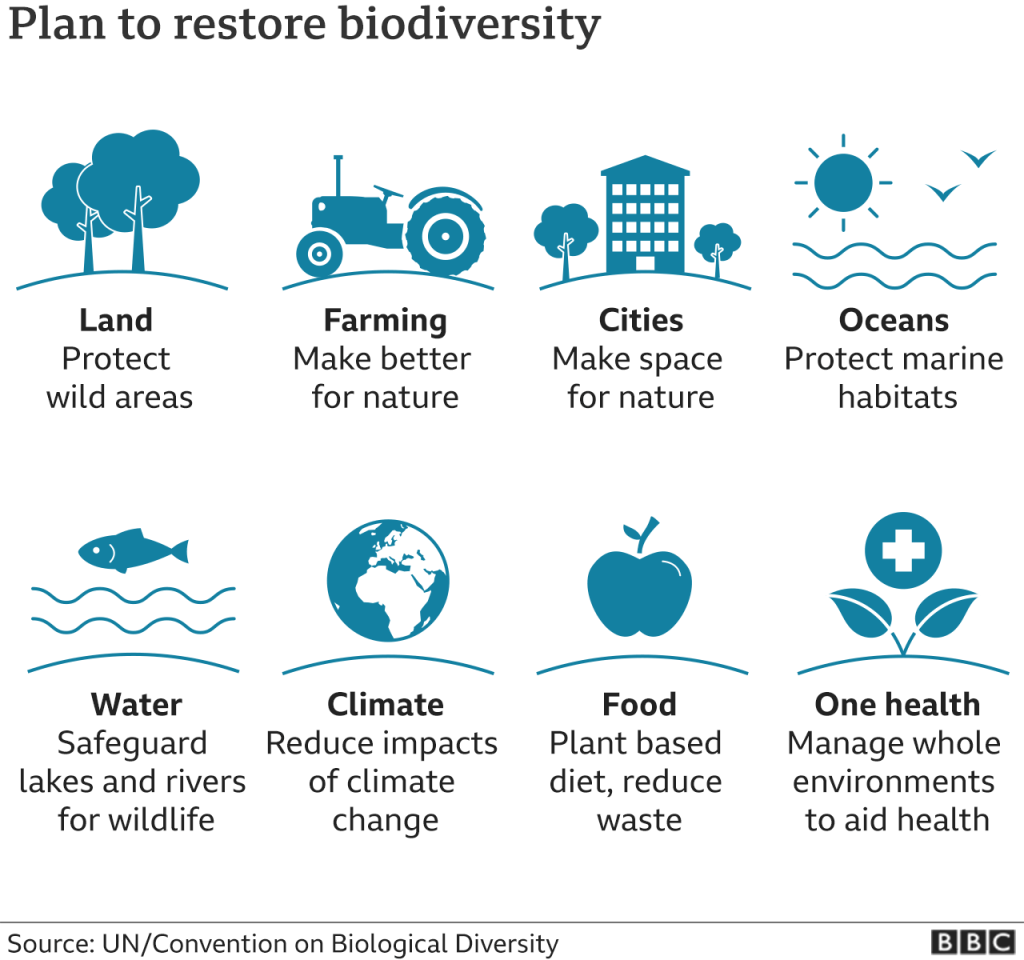
One approach to help us improve biodiversity might be to pursue “the 3-30-300 rule”: that everyone should have sight of three trees, every neighbourhood should have 30% canopy cover, and everyone should live within 300 metres of a park or green space. This concept is the work of a group crammed Creat Streets and last month they published a report on Greening Up our streets – https://www.createstreets.com/wp-content/uploads/2023/09/Greening_Up_Executive_Summary.pdf
The report is full of facts illustrating the health and well-being effects of green urban areas, and outlines policies and ideas that would promote the greening of our streets. Such greening also has benefits in tackling the climate crisis and in mitigating some of the effects of climate change.
The annual State of Nature report was issued 27th September, revealing that 1 in 6 species in the UK is threatened with extinction. On average the abundance of land and freshwater species in England has declined by 32% since 1970.
The National Biodiversity network noted: “The State of Nature report also found that out of the assessed habitats which are important for wildlife, only one in seven (14%) were found to be in a good condition and only one in fourteen (7%) woodlands and a quarter (25%) of peatlands were assessed to be in a good ecological state. Due to habitat damage from fishing gear, none of the seafloor around the UK was found in good condition…Despite recent moves towards more nature-friendly land and sea use, as yet only a fifth of farmland is now in agri-environment schemes with only some of that helping nature, just 44% of woodland is certified as sustainably managed and only half of fish stocks are sustainably harvested. While all three measures have improved markedly over the past 20 years, there is still a very long way to go.” (1)
Beccy Speight, the RSPB’s chief executive, said: “The UK’s wildlife is better studied than in any other country in the world and what the data tells us should make us sit up and listen. What is clear is that progress to protect our species and habitats has not been sufficient and yet we know we urgently need to restore nature to tackle the climate crisis and build resilience.
“We know that conservation works and how to restore ecosystems and save species. We need to move far faster as a society towards nature-friendly land and sea use, otherwise the UK’s nature and wider environment will continue to decline and degrade, with huge implications for our own way of life. It’s only through working together that we can help nature recover.” (2)
The Soil Association’s head of Farming Policy Gareth Morgan yesterday said: “It is deeply concerning to see this detailed report on the state of nature in the UK but sadly it does not come as a huge shock. Farmland makes up 70% of Britain and we can’t fix the decline in nature without a transformation in food and farming. Many farmers are working with nature and many more are keen to do so. But we remain too dependent on over-intensive, chemical-reliant methods such as industrial livestock systems fed on imported soy. The evidence shows some success for recovery in small protected areas but we cannot ignore what happens in the rest of our countryside where we need a renewed focus on producing good food in harmony with nature.” (3)
Just as switching from fossil fuels to renewable energy sources will be key to achieving net zero for carbon emissions, so it would seem that switching from what might be termed industrial farming to regenerative farming will be key to achieving the restoration of nature.
It is not just butterflies that are declining in number but all insects. If you can go that far back, do you remember how in the 1970s car windscreens would have to be washed after each journey to remove the insects splattered across the glass? That is no longer a problem for drivers and that is not just because of more aerodynamically designed vehicles. A study carried out by Bug Life and Kent Wildlife Trust in 2022 reported a 60% declines in insect numbers since 2002. This is worrying because many plants rely on insects for pollination and because other creatures – especially birds – rely on insects for food. What might be causing the decline? The use of pesticides and herbicides on crops and in gardens; climate change; habitat loss and fragmentation.
Can we be part of the solution? As gardeners we can create insect friendly habitats; we can support wild life organisations; we can opt for organic produce; we can ask our local council not to use pesticides and herbicides; we can campaign for government action.
‘Mutilating the tree of life’ said the Guardian’s headline. It was reporting on a study that found that at least 73 species groups (genera) have become extinct since 1500. Without human impact the extinction rate would probably have been just two such groups. Prof Ceballos, who led the research said “By losing all these genera, we are losing the foundations of the planet to have life in general and human life in particular. If you have a wall made of bricks, if you lose some, it won’t collapse but it won’t be as strong. If you lose many bricks, eventually it will collapse. The combination of the gases in the atmosphere that allows us to have life on the planet depends on plants, animals and organisms…”
The biodiversity crisis is as much a threat to the wellbeing of life on earth as the climate crisis. Both need to be addressed of either crisis is to be averted.
Sometimes it is difficult to tell whether a beautiful rural landscape is the ‘natural’ one as being in its primordial state, or whether it is a ‘natural’ one this is the fusion of human activity in harmony with nature. The two may look very different eg moorlands covered with forests versus moorlands covered with grass and sheep; or low-lying land that is marshy or low-lying land that has been drained and cultivated for arable crops.
The following comments come from the Natural History Museum.
“’What we repeatedly see in our models is that agriculture is one of the main drivers of strong biodiversity declines,’ says Katia. ‘Even when we consider different human pressures, such as human population density and road development, we always find that the most shocking biodiversity declines are across agricultural sites.
‘That is the key point, the fact is that we need to find a way to slow down agricultural expansion.’
The continued spread and intensification of farming and development in the UK over the last 200 years has meant that most landscapes have not escaped some form of human influence.
In the high alpine meadows of Switzerland there is a rich biodiversity of flowering plants and insects (various bees, flies, grasshoppers, ants) spiders, butterflies and moths – far more than I have seen in the UK. Is this richness a result of the alpine dairy farming? Quite probably so. Without the cows, the vegetation is tends to shrub and forest, which though totally natural is less biodiverse rich. Away from the steep slope, dairy farming is more intense and doesn’t support the same richness of plant and insect life. Even on the alpine slopes, repeated cutting of grass for silage reduces the biodiversity.
Our human presence can have a positive effect on the natural environment.
The two way relationship between urban and rural is also about enhancing the presence of nature and its natural processes in urban areas. Planting trees, maintaining biodiverse rich green and blue spaces, making gardens nature friendly, creating wildlife corridors, establishing green edges to roads and pavements, planting more trees, etc.
The relationship between urban and rural areas and the protection and enhancement of green landscapes and biodiversity is two way in both directions. Yes those in urban areas need to address their lifestyle and ecological impact to protect both urban and rural environments, but those in rural areas also need to be able to do the same. Yet living ecologically in rural areas can be harder than in urban areas.
In London, people have access to what is – generally – a good public transport network. This is not a given in rural areas – and not even in some urban areas outside London.
In London, people have access to milk deliveries, refill stores, markets, charity/ second hand shops – all without the need to drive a car. Indeed in many parts of London people do live within 15 minutes of their local shops, medical centre, post office, schools, cinema, gym, green space, railway station etc.
If we want everyone to be able to live ecologically, protecting and enhancing the environment, then it is important that everyone has access to the necessary services and infrastructure to do so whether they live in rural or urban areas.
Becky Speight comments in the current. RSPB magazine that we may think we are at a crossroads where we can either address the climate crisis or the biodiversity crisis, but in fact we can have both and! She writes that this future “is one where we work far more closely with nature, to mitigate and adapt to the worst effects of global warming; to help species adapt to the changes already locked into the system; and to recreate and reimagine our lives and homes as vibrant , lush, functioning and joyous places. The future could be better than today”! And chiming in with the WWT, there is much emphasis on the importance of using water to create climate resilient, biodiverse rich habitats.
Plastic packaging is seen as a plus because it enables food to be harvested and shipped over a longer distance/ timespan than might otherwise be possible. This enables perishable crops such as strawberries, lettuces, cucumbers etc to be grown in southern Spain and sold in supermarkets throughout the UK. But this can further distance us as consumers from the people who grow our food. Currently there is two concerns about farming practices in Spain.