
18th December 2023
Taking action in the National Gallery
The National Gallery began when in 1824 the British Government bought, on behalf of the nation, 38 paintings from the heirs of the late John Julius Angerstein, a business man and art collector. Thus it is that the National Gallery’s collection is owned by the government on behalf of the British public. Its constitution states “The Gallery’s aim is to care for the collection, to enhance it for future generations, primarily by acquisition, and to study it, while encouraging access to the pictures for the education and enjoyment of the widest possible public now and in the future.”
It goes on to describe it audience as:
- Frequent and occasional visitors to the Gallery in London
- Those who see its pictures while they are on loan elsewhere, both inside and outside the UK, and those who know the collection through publications, multimedia and TV
- Those who live nearby as well as those who live further away in the United Kingdom and overseas
- Every age group – from children to pensioners
- The socially excluded and the privileged; the uninformed and the specialist; and those with special needs
- The worldwide community of museums and galleries
- Most importantly: future generations
And further on adds:
“Allow the public to use the collection as their own by maintaining free admission, during the most convenient possible hours, to as much as possible of the permanent collection” (3) (3) https://www.nationalgallery.org.uk/about-us/organisation/constitution
The National Gallery certainly aims takes seriously its particular role of caring for a collection of art works that belongs to the British people, and making it fully accessible to them.
Like many museums and art galleries, the National Gallery undertakes a responsibility to facilitate and enhance the educational use of the collection for the benefit of people of all ages and backgrounds. It hosts exhibitions, school visits, workshops and talks, tours, musical events, sketching sessions etc as well as producing many publications relating to the collection. It makes full use of digital technology and the further opportunities that that affords.
Chris Michaels, the director of digital, communications and technology at the National Gallery, spoke at ‘greenloop 22’ – a visitor attractions conference focusing on sustainability – spoke about the practical steps the National Gallery is taking to respond to the climate crisis – such as making positive choices about which electricity supplier to use. He also spoke of ways in which the Gallery could go beyond such operational steps.
“It concerns thinking about how we, as storytelling institutions, can start to think about the future and make sure that the stories we tell live in that future the right way. To me, very simply, art finds new relevance in this time of crisis.”
He expanded on this with examples. “If you look at Canaletto now, if climate change progresses at the speed it is now, and if we don’t make things better, this Venice will disappear beneath the waters for good.
“If we think about artists even as recent as Monet, painting in the late 19th century, there is a picture he famously painted from when he was staying at the Savoy in London. The hazy skies in the picture were also products of climate change, even at that time. This landscape, too, will vanish as London potentially disappears beneath the waters.”
He concluded, “Climate change and the climate crisis, for museums, becomes a storytelling frame to understand the new relationship between art history and our futures. Those hazy skies and their meaning are something I keep coming back to in terms of the way they change our understanding of the past and of the future.” (2)
This September the first UK Museum COP was held at Tate Modern. It issued the following statement: “As leaders of the UK museums, we feel a responsibility to speak out about the current climate and biodiversity crisis and call upon UK politicians and businesses to accelerate action to mitigate this crisis before it is too late. We are already around or beyond crucial tipping points: global temperatures are higher than they have ever been since humans emerged as a species, and extinctions are occurring at around a thousand times the normal rate. There is an existential threat to the world we have become accustomed to.
“Museums are institutions with a long-term view. Many have collections relating to the Earth’s five previous mass extinction events, and we are now in the midst of the sixth, the Anthropocene. UK museum leaders feel they have an ethical obligation to take action to alleviate that damage.”
They went on “We will [u]se relevant collections, programmes and exhibitions to engage audiences with the climate crisis and inspire them to take positive action …” (3)
Clearly there is a growing awareness of the role that museums and art galleries can take in advancing the debate about climate change and in shaping how the public responds to this crisis. But is this growing awareness leading to action at a fast enough pace to be of use? Or are they likely to be overtaken by events?
In some instances they already have. The National Gallery, the Royal Academy, the Courtauld, and the Kelvingrove Art Gallery have all been targeted by Just Stop Oil activists have used popular paintings to make the point that very little – in proportion to the scale of the emergency – is being done to address the climate crisis. Their actions seek both to raise awareness in the wider public, and to call upon the art galleries themselves to demand action from the Government. Similar actions have also been carried by climate activists in France, Germany, Austria, Italy, Spain,Norway, Canada, and Australia.
What would happen if rather than closing down these actions, museums and art galleries choose to work with activists as they seek to press for responsible climate action? Several museums in Germany have done just this, working with the group Letzte Generation (Last Generation). At the Hamburger Kunsthalle, activists took over the foyer for a non-violent resistance, reading essays and conversing with visitors. Similar essays actions took place at the Ludwig Museum in Cologne, the Museum of Ethnology in Leipzig, the Zeppelin Museum in Friedrichshafen, the Rostock art gallery, the European Hansemuseum in Lübeck and the Museum for Communication in Nuremberg. (4)
Works of art, as well as have great value in inspiring thoughts and new ideas, often have spiritual values too. Indeed many were created for religious purposes to aid and encourage worship.
Last week I took part in an action at the National Gallery with others from Christian Climate Action. We gathered in front of a painting of ‘The Madonna and child with saints Jerome and Dominic’ by Filippino Lippi, where we unrolled a copy of the picture which had been digitally altered to show flood waters that half submerged the characters. This we held as a statement was read out describing how for many Christmas is not a time of joy, because their lives are threatened by the effects of climate change. As we knelt prayerfully we sang a version of Silent Night – the acoustics were wonderful.
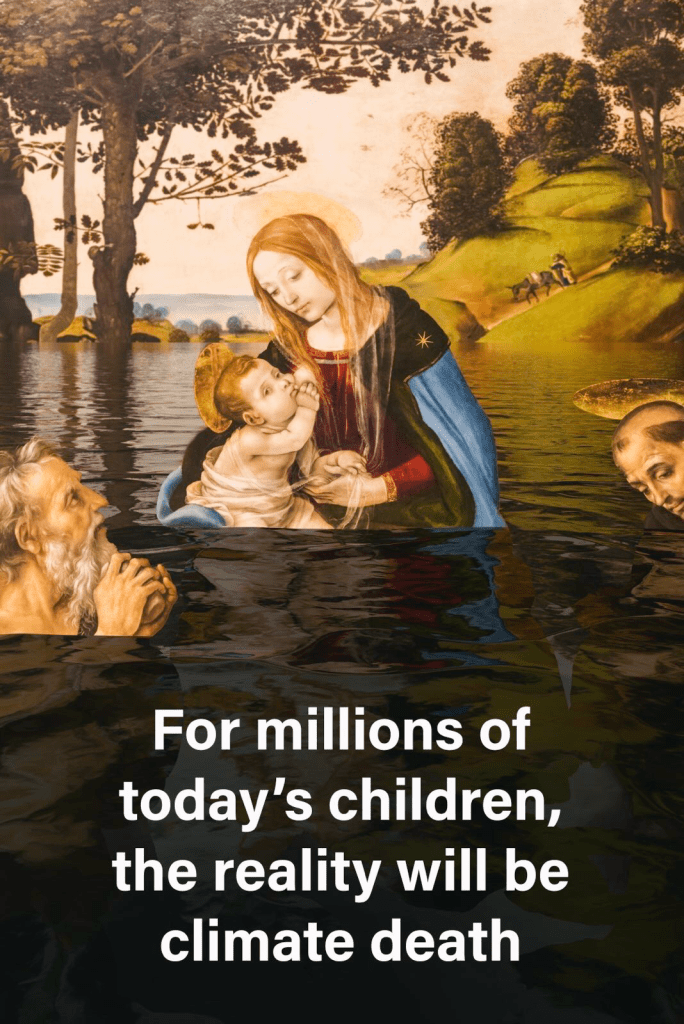
Sadly security staff quickly cleared that section of the gallery and visitors were not able to participate in the event.
If you would like to see images from the event visit https://christianclimateaction.org/2023/12/15/protest-climate-change-inaction-at-virgin-and-child-painting/
Whilst here is the statement that was read out:
“Why did members of Christian Climate Action gather prayerfully beside a nativity painting at London’s National Gallery, with a different picture to reveal?
“As Christians we celebrate the birth of Jesus, born in poverty as a refugee, to show us the way of love and peace, and justice which is love in action. Christmas is still for the children. But today, world leaders are failing them. As governments profit from weapons and from fossil fuels, babies are born into climate chaos as well as war. In this painting, the baby – like his mother but unlike Jesus and Mary – is white, but we remember those brown and black babies born in the Global South still waiting for climate reparations and most at risk of unliveable heat, hunger, drought, flooding and displacement. We honour those born into poverty here in the UK as inequality widens, and all the world’s children whose future is at risk while the adults in charge pursue yet more oil and gas. We grieve that after 28 COPs, world emissions in 2023 have reached a record high to match all the heat records broken month after month.
“Only with change for good can the young find hope. Christmas lights can’t dispel their darkness. Along with inflatable Santas, magical snowmen and red-nosed reindeer, art like this is hollow and fake. The altered image we held beside Lippi’s painting shows the terrifying reality children face. Sentiment, tradition and festivity won’t save us. The science is clear that new gas, oil or coal will accelerate climate breakdown. We can’t serve God unless we serve that truth. Unless we work for life, justice and peace – with love.
“One billion children – almost half of the world’s child population – live in countries that are climate-vulnerable. A third of the world’s child population is impacted by both the climate crisis and poverty.
“According to UNICEF, extreme weather has internally displaced at least 43 million children in the last six years – the equivalent of 20,000 children a day being forced to abandon their homes and schools.”
(1) https://www.nationalgallery.org.uk/about-us/organisation/constitution
(2) https://blooloop.com/museum/in-depth/museums-climate-crisis-technology/

 The Green Tau