
Earth Overshoot Day
24th July 2025
Leviticus 25 explains that the land should have a sabbath rest every seventh year. In that year no crops would be sown and the people would live off the surplus of previous years. Farmers over the millennia have learnt that you cannot constantly expect the land to keep on producing crops year on year without fail. The land either needs to lay fallow (rest), or it needs to be sown with a restorative crop such as nitrogen fixing beans or clover, or it needs the input of artificial fertilisers (although we are now becoming aware that relying on artificial fertilisers may be a quick fix and not a long term solution), so that it may recuperate its productivity. It is a lesson we are sometimes reluctant to heed. The Dust Bowl disaster of 1930s in the USA destroyed vast acres of farm land because farming practices did not maintain the fertility of the soil.
It is not just soil that has to be maintained. Water systems too. If we drain more water out than is replenished by precipitation or the melting of glaciers (themselves replenished by winter snow) water supplies will diminish. The Aral Sea – an inland lake – was once the fourth largest area of fresh water in the world, but has now been reduced to nothing because more water has been extracted year on year – to irrigate local cotton crops – than the rate at which water flows were refilling the lake.
It’s hard to imagine, but we also need to maintain the atmosphere. The Earth’s atmosphere is a delicate mix of various gases, which in the right proportions maintain our climate at one with which we are comfortable. If we put too much of certain gases into the atmosphere it can upset that balance. Too much carbon dioxide, methane and other greenhouse gases, and the atmosphere traps more of heat within the Earth’s atmospheric envelope; global temperatures rise and the climate becomes more extreme and uncomfortable. We are experiencing this every year with floods, heat waves, wildfires and intense storms.
Ideally what we consume from the natural world – crops, timber, drinking water, clean air, energy – is balanced by the earth’s ability to regenerate. Prior to 1970 that was the case. Since then we have been using up the earth’s renewable resources at a rate faster than they are replenished. Scientists each year calculate that point when we pass from credit to deficit. This is called Earth Overshoot Day. This year the predicted date is 24th July. Seven months into the year and we have already – globally – consumed as much as the earth can replenish in one year!
Surely this state of affairs can not continue? What can we do about it and why aren’t we doing it?
Since 1970, Earth Overshoot Day has been falling earlier and earlier each year. Only in 2020 did it reverse: the reduction in world wide consumption came about because Covid gave the earth a three week reprieve. Consuming less has to be the answer which means consuming more carefully and more sustainably.
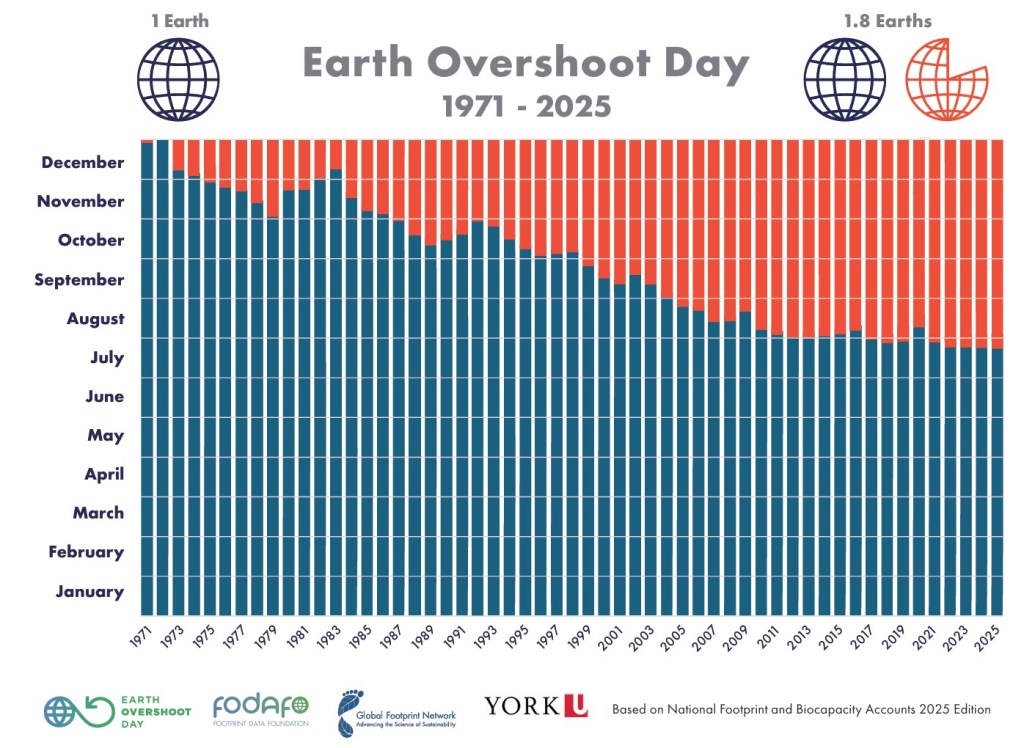
If we could do that in 2020 whilst coping with a pandemic, surely we could do it every year? What we must do is make sure that it is not the poor – who already lack a sufficiency – who are the ones who get to consume less; rather it must be the richer over consumers who need to change their lifestyles. And here is another caveat, to live more sustainably and fairly, will need a fundamental change in economic and political systems.
The Earth Overshoot website has details of various ways in which the global community could do this. https://www.overshootday.org/ Meantime we as individuals can make changes to our own lives and patterns of consumption. And we can ask or push for our churches, places of work, sports clubs, local authorities, museums, retailers, and government, to make similar reductions in consumption. We need change to happen at all levels.
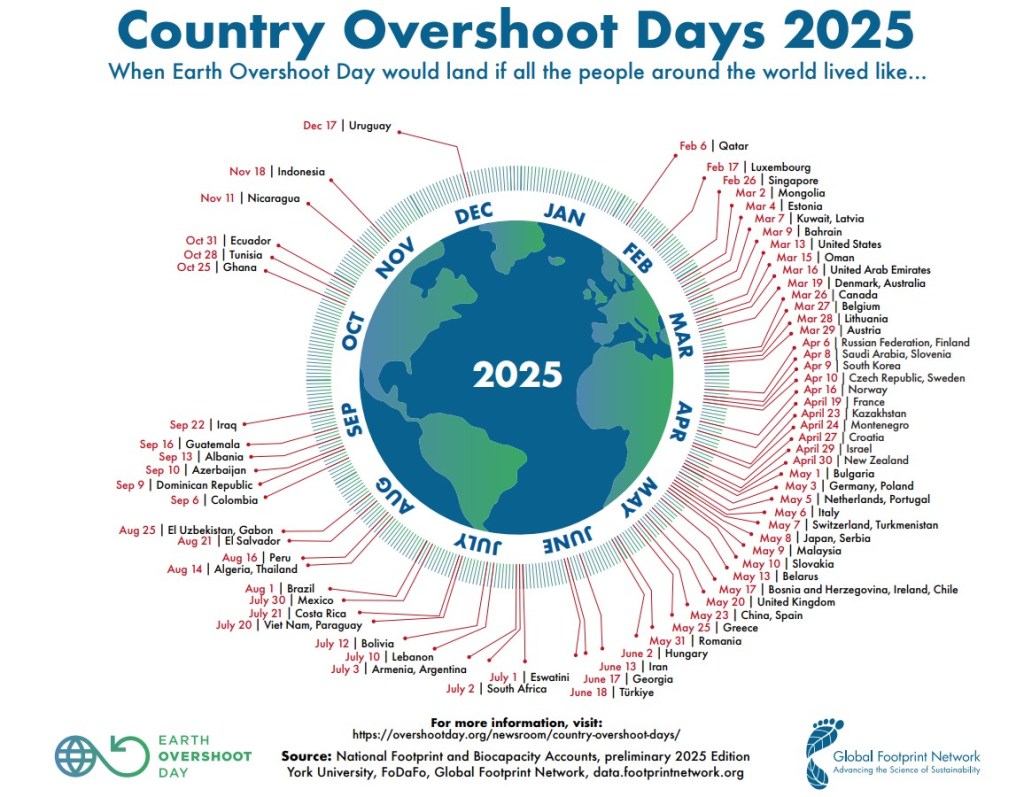
24th July is 2025’s Earth Overshoot Day at the global level. That date is the average of each nation’s own Overshoot Day. The overshoot dates for individual nations in the diagram below range from 17th December for Uruguay (ie Uruguay pretty much balances its books, consuming only slightly more than it can regenerate in a year) to 6th February for Qatar. What this diagram does not show are the many poorer nations who do not even use up their equivalent of one year’s resources each year – The UK’s Overshoot Day was 20th May. We would need three United Kingdom’s to satisfy our current consumption levels; in reality we consume resources of other countries to make up the shortfall. Reducing the Earth Overshoot problem requires cooperation and understanding at a global as a well as at local levels. The Earth is a shared life-support system.

 The Green Tau