
1st December 2025
“Biogeochemical cycles are the pathways through which chemical elements move and are recycled through both the living and nonliving components of Earth’s systems. The term “biogeochemical” combines “bio” (living organisms), “geo” (Earth’s geological aspects like rocks, air, and water), and “chemical” (elements and compounds). These interconnected processes ensure the continuous availability of elements essential for sustaining life on our planet. Through these cycles, elements like carbon, nitrogen, and water are exchanged between the atmosphere, oceans, land, and all forms of life.” (1)
Biogeochemical cycles include the water cycle (water from the oceans evaporates, is carried up into the atmosphere, moves with the wind, forms clouds and fall as rain creating rivers that flow back into the seas) , the carbon cycle (carbon dioxide from the atmosphere is absorbed by plants via photosynthesis, the plants are eaten by creatures building up their bodies; when either plants or creatures die, the carbon in their body is realised by the processes of decay and returns to the atmosphere); nitrogen cycles (relying on specialised plants such as peas and beans, as well as bacteria in the soil,, that can capture nitrogen from the atmosphere as well as in the case of bacteria and fungi, return nitrogen from decaying bodies back into the soil: nitrogen is important for promoting growth in plants) etc
These cycles are important for ensuring the health of all living things. If the cycles are disrupted it leads to environmental problems. So if humans use synthetic nitrogen and phosphorus fertilisers to boost plant growth, the runoff into the soil and water causes an imbalance in the local ecosystems. Too much of these chemicals produces algal blooms that damaging other life forms, rivers become dead and soils loose their fertility.
Widespread use of phosphorus and nitrogen based fertilisers to boost crop yields – including grass and crops grown to feed livestock – has exceeded safe planetary boundaries severely damaged clean water supplies, the health of our soils and biodiversity. Agricultural practices need to change!
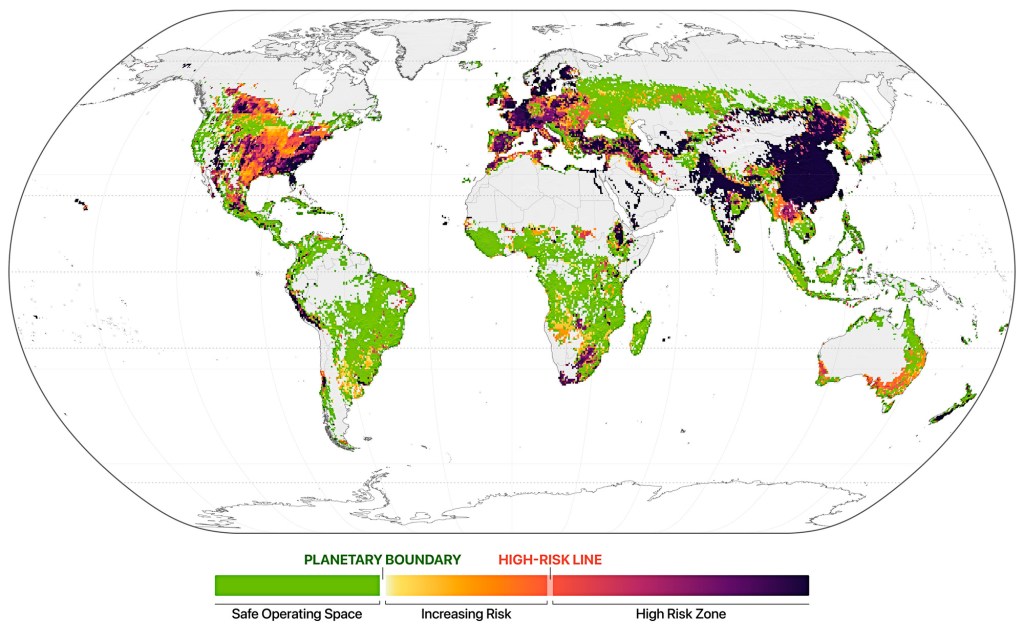
“Nitrogen use in agriculture has exceeded safe ecological limits in several regions of the world, particularly in parts of Asia and Europe, indicating significant environmental risks.
The regional boundary status is calculated based on agricultural nitrogen surplus in the year 2020 and estimates of regional surplus boundaries. Values range from within the Safe Operating Space (green; no exceedance of regional surplus boundaries) to the Zone of Increasing Risk (orange), and extend to the High-risk zone (red/purple). Based on data from model runs with IMAGE-GNM, using the methodology of Schulte-Uebbing et al. (2022).” (2)
- https://biologyinsights.com/what-are-biogeochemical-cycles-and-why-are-they-important/
- https://www.planetaryhealthcheck.org/boundary/modification-of-biogeochemical-flows/

 The Green Tau