
Psalm 121 asks where does our help comes from? Not from hills say the Psalmist. Those are the high places where the Cananite gods and goddesses were worshipped. No our help comes from God!
In his letter to the Romans St Paul is writing to a Christian community that is a mix of those who have come to believe in Jesus as the fulfilment and expansion of the very Jewish faith that they have grown up with. Others will be those who have grown up within the culture of worshipping the gods and goddesses of the Greek and Roman tradition, and who have now adopted a completely different faith – that of following Jesus.
But what underpins their faith? From what Paul is writing, it seems as if some want to read the scriptures as telling them that strict adherence to the old laws is essential, and that this is the only know that they are righteous. And it may have been just a much the non-Jewish believers who wanted the certainty that a rigid set of rules would give. No more thinking: just follow the rules: job done.
Paul however takes the story of Abraham to help them their understand the scriptures from a new – Christian – perspective . Look, says Paul, Abraham’s relationship with God wasn’t established or maintained through him doing X number of good works or performing particular rituals – and it certainly wasn’t about following the law because Abraham predates that. No Abraham’s relationship with God was established through faith, through his implicit trust in God.
Paul is saying to the Christians in Rome that they must read the Jewish scriptures – remember at this stage the Gospels had yet to be written – through a new lens which is Jesus Christ. And whether they have been brought up as Jews or as followers of Greek and Roman gods, it is not following the law that will grow their relationship with God, but faith. This is a radical but inescapable truth that Paul is urging them to understand.
So we come to today’s Gospel reading. What is going on here? It sounds as if Jesus is answering a different set of questions to the ones that Nicodemus is asking! Or is it that Jesus is answering the questions that Nicodemus ought to have asked?
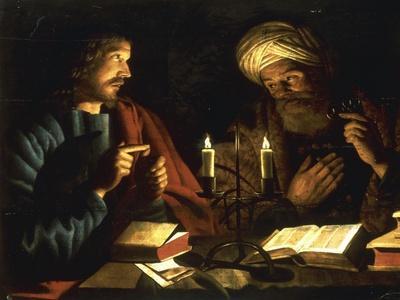
This sense of the two protagonists debating together is captured in a picture by the 17th century artist, Crijn Henricksz Volmarijn. Here by the aid of candlelight Jesus and Nicodemus sit together with several books on the table in front of them. Jesus is using his fingers to enumerate the points he is making.
The open books in front of Nicodemus are the Jewish scriptures which he had grown up with. The painter shows him with a pair of spectacles which he is holding in his hand. These glasses are the painter’s way of telling us that Nicodemus has always read the scriptures through the lens of his pharisaical learning. But as he is listening to Jesus, he has taken the glasses off because Jesus is giving him a different way of understanding the scriptures. Now at last Nicodemus is beginning to grasp what Jesus is saying.
The book in front of Jesus is only partly open. It represents the Gospel – the new scripture – that has yet to be written but which Jesus – who is the Word – is proclaiming through what he says and does. Jesus is inviting Nicodemus to read the scriptures differently, to see the world around him in a different light, and therefore to start living differently, to begin life anew! “You must be born again, you must be born from above.”
And isn’t that what Jesus also asks of us?
Especially during Lent when we are invited to hear and read the scriptures anew, alert to how Jesus wants us to hear his word, ready to step away from where we were going wrong, and to begin afresh following the new ways of the radical Jesus.
I’m both part of Green Christian and of Christian Climate Action, and it is through prayer, the study of scripture and theological reflection that we are constantly trying to focus on where Jesus is leading us and what he is asking us to do.
Recently we have had some conversations about the two creation stories in Genesis, and how are the Hebrew word translated as dominion might be understood. In the past the story has been read as sanctioning human rule over and exploitation of all natural resources, plants and creatures. A more contemporary understanding would be that humanity is tasked with relating to natural resources, plants and creatures in the same way that God himself exercises dominion over all creation. This developing theology is one that embraces that of St Francis of Assisi who held that all creatures, all parts of the natural world from sun to rain, from moon to fire, should be treated as brother and sister, to the more recent thinking of Pope Francis who called this earth our common home. From this viewpoint humanity is seen as an integral and interdependent part of creation – and not as a separate and superior species.
We can see afresh that our human self assurance and greed have led us to exploit fossil fuels such that their carbon emissions dioxide have increased to such an extent that the earth’s climates has been irreversibly changed (at least for the next millennia). Human activities are now causing overheating, extreme weather conditions, floods and wild fires, and are harming – and killing – our fellow brothers and sisters, human and creaturely.
As followers of Jesus, we are called to love all our neighbours. And so Christian Climate Action has been calling on the Government not to licence the development of the Rosebank oil field in the North Sea.
We have been calling on oil companies such as Equinor and Shell to transition into renewable energy companies.
We have been calling on banks such as Barclays, to stop funding new oil and gas projects.
We have successfully campaigned in calling upon the Church of England’s dioceses and their National Investment Bodies (NIBs) to divest from fossil fuels.
We have successfully campaigned in calling upon organisations such as Oxfam and Christian Aid to switch away from banking with Barclays. And we continue to campaign calling on other institutions such as our dioceses and the National Trust, to likewise shift to ethical banks.
We take to heart the command in Genesis 2 to cherish and protect the earth. Across the world, biodiversity – natural wildlife in all its richness and beauty – is rapidly diminishing, pushed out of existence by human urbanisation, industrialised farming, and the impacts of climate change. An international consensus has led to the development of the Kunming-Montreal Biodiversity Framework.
This framework sets out how we can reverse the rapid loss of biodiversity across the world and protect the natural ecosystems – clean air, fresh water, fertile soils, a sufficient number and variety of pollinators etc – on which life depends. Each participating nation, including the UK, has committed to restore and protected for nature 30% of their land and seas by 2030.
This clearly is in line with God’s words of instruction in Genesis.
In response to this Christian Climate Action is in dialogue with the Church Commissioners over the scope they have to restore for nature up to 30% of the land that they control.
In light of the increasing ecological crisis that the earth faces, Christian Climate Action has produced a vision document entitled ‘Stop Crucifying Creation.’ The document was drawn together after much prayer and reflection, as we looked again at what God is calling us to do in the face of the damage we humans are causing.
It is a call to the Church to discover afresh its roots – that lively and compelling faith demonstrated by the early churches that St Paul wrote to.
It is a call to the Church to embrace anew the courage it has shown at other critical points in history, and to reclaim its prophetic role in speaking truth to power – whether that is calling on oil companies to cease burning the planet, or calling on water companies to stop polluting the rivers, or calling on the Government to take urgent action in addressing the climate and nature crisis, or calling on world leaders to seek peace and dialogue rather than a knee jerk reaction towards aggression and conflict.
Truly we are being called to see the world and the scriptures anew, to be as ones born again as we follow in the steps of the radical Jesus, loving whole heartedly our neighbours whoever and wherever they are.
Amen.
Psalm 121
Levavi oculos
1 I lift up my eyes to the hills; *
from where is my help to come?
2 My help comes from the Lord, *
the maker of heaven and earth.
3 He will not let your foot be moved *
and he who watches over you will not fall asleep.
4 Behold, he who keeps watch over Israel *
shall neither slumber nor sleep;
5 The Lord himself watches over you; *
the Lord is your shade at your right hand,
6 So that the sun shall not strike you by day, *
nor the moon by night.
7 The Lord shall preserve you from all evil; *
it is he who shall keep you safe.
8 The Lord shall watch over your going out and your coming in, *
from this time forth for evermore.
The Epistle
Romans 4:1-5, 13-17
What then are we to say was gained by Abraham, our ancestor according to the flesh? For if Abraham was justified by works, he has something to boast about, but not before God. For what does the scripture say? “Abraham believed God, and it was reckoned to him as righteousness.” Now to one who works, wages are not reckoned as a gift but as something due. But to one who without works trusts him who justifies the ungodly, such faith is reckoned as righteousness.
For the promise that he would inherit the world did not come to Abraham or to his descendants through the law but through the righteousness of faith. If it is the adherents of the law who are to be the heirs, faith is null and the promise is void. For the law brings wrath; but where there is no law, neither is there violation.
For this reason it depends on faith, in order that the promise may rest on grace and be guaranteed to all his descendants, not only to the adherents of the law but also to those who share the faith of Abraham (for he is the father of all of us, as it is written, “I have made you the father of many nations”) —in the presence of the God in whom he believed, who gives life to the dead and calls into existence the things that do not exist.
The Gospel
John 3:1-17
There was a Pharisee named Nicodemus, a leader of the Jews. He came to Jesus by night and said to him, “Rabbi, we know that you are a teacher who has come from God; for no one can do these signs that you do apart from the presence of God.” Jesus answered him, “Very truly, I tell you, no one can see the kingdom of God without being born from above.” Nicodemus said to him, “How can anyone be born after having grown old? Can one enter a second time into the mother’s womb and be born?” Jesus answered, “Very truly, I tell you, no one can enter the kingdom of God without being born of water and Spirit. What is born of the flesh is flesh, and what is born of the Spirit is spirit. Do not be astonished that I said to you, ‘You must be born from above.’ The wind blows where it chooses, and you hear the sound of it, but you do not know where it comes from or where it goes. So it is with everyone who is born of the Spirit.” Nicodemus said to him, “How can these things be?” Jesus answered him, “Are you a teacher of Israel, and yet you do not understand these things?
“Very truly, I tell you, we speak of what we know and testify to what we have seen; yet you do not receive our testimony. If I have told you about earthly things and you do not believe, how can you believe if I tell you about heavenly things? No one has ascended into heaven except the one who descended from heaven, the Son of Man. And just as Moses lifted up the serpent in the wilderness, so must the Son of Man be lifted up, that whoever believes in him may have eternal life.
“For God so loved the world that he gave his only Son, so that everyone who believes in him may not perish but may have eternal life.
“Indeed, God did not send the Son into the world to condemn the world, but in order that the world might be saved through him.”

 The Green Tau