Counting on…. Day 1.157

23rd August 2023

If we need to slow down agricultural expansion, do we know what caused its expansion?  There is I’m sure no one answer but a multiplicity of interconnecting reasons. 

  • Population growth. Globally we now need to feed over 8 billion people, up from 6 billion in 1999, and 3 billion in 1960. Yet researchers tell us that we could feed 10 billion people without exceeding the planet’s environmental boundaries  (https://www.nature.com/articles/s41893-019-0465-1)
  • Income growth – as people become richer they choose to eat more expensive foods which are often  more resource expensive too – eg imported tropical fruits, sugar based foods, and especially meat
  • Developments in agriculture that allow more intensive production such as pig breeds that can reach a slaughter weight in 4 months; high protein feed made from soy beans that rapidly fatten chickens; high yielding grains that combine with fertilisers and pesticides to increase harvests. 
  • Financial rewards that encourage rain forests to be cleared to make way for sugar plantations, soy crops and cattle ranching. 
  • Irrigation and airfreight that allow crops such as asparagus, avocados and blueberries to be grown in the southern hemisphere and imported as out of season alternatives for the northern hemisphere. 
  • Social changes that have made chicken a staple rather than a special treat, that have reduced the popularity of foods – in the UK – such as cabbage and runner beans, replacing them with courgettes and peppers. 
  • Social changes that mean less food is home produced, that less food is preserved at home (eg jam/ chutney/ sauerkraut),  that less food is home grown.
  • Increasing quantities of food going to waste – caused by social changes and increasingly long supply chains.

Counting on … day 1.155

22nd August 2023

Recently the government ordered that cartoon murals in the centres where asylum seekers are taken, be painted over. In a come back to that callous and unnecessary action, a petition has been set up asking for the murals to be reinstated, as well as a scheme to send welcoming postcards to the 9000 plus children seeking asylum.

https://findothers.com/tools/postcards-for-refugee-children

https://www.theguardian.com/uk-news/2023/aug/22/asylum-seeker-children-cartoons-postcards-murals-painted-over?CMP=Share_iOSApp_Other

Counting on …. Day 1.154

21st August 2023

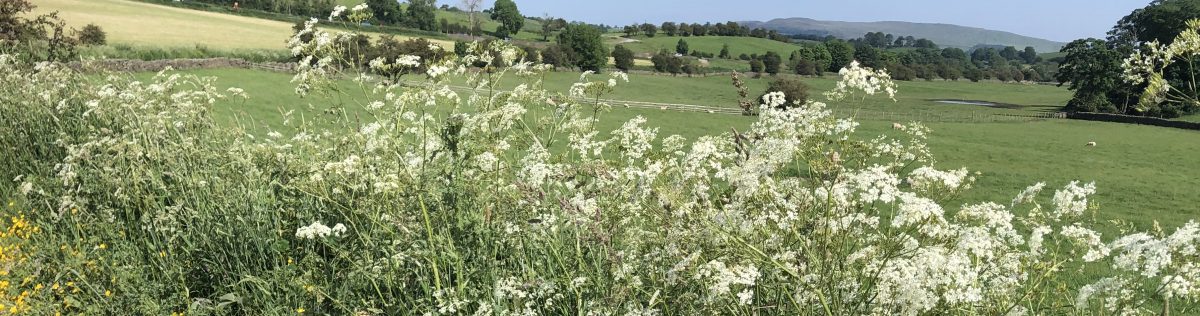
Sometimes it is difficult to tell whether a beautiful rural landscape is the ‘natural’ one as being in its primordial state, or whether it is a ‘natural’ one this is the fusion of human activity in harmony with nature. The two may look very different eg moorlands covered with forests versus moorlands covered with grass and sheep; or low-lying land that is marshy or low-lying land that has been drained and cultivated for arable crops.

The following comments come from the Natural History Museum.

 “’What we repeatedly see in our models is that agriculture is one of the main drivers of strong biodiversity declines,’ says Katia. ‘Even when we consider different human pressures, such as human population density and road development, we always find that the most shocking biodiversity declines are across agricultural sites.

‘That is the key point, the fact is that we need to find a way to slow down agricultural expansion.’

The continued spread and intensification of farming and development in the UK over the last 200 years has meant that most landscapes have not escaped some form of human influence.

The fact that this started such a long time ago means that in some cases we think of these altered landscapes as being their natural state, when in reality they were already heavily depleted of their wildlife’”. https://www.nhm.ac.uk/discover/news/2020/september/uk-has-led-the-world-in-destroying-the-natural-environment.html

14th Sunday after Trinity, Proper 15

20th August 2023

Reflection (readings below)

Who will, or who is, God saving? That certainly seems to be the subject of today’s readings. Is just the Jew or the foreigner as well? Is it just those the Christians who believe in God as revealed by Jesus Christ, or is it the Jews too – who were the first to believe in God? Did Jesus come just to save those Jews described as the lost sheep of Israel, or those Gentiles who believe in his power to heal, too? And what of the Pharisees? Does their blindness, their failure to recognise Jesus for who he is, exclude them from being saved? Are they not also some of the lost sheep of Israel?

The passage from Isaiah suggests that salvation comes to those who ‘maintain justice and do what is right’, although the afterthought is that such salvation is for those foreigners who love God and live according to his covenant, his ways. God is God for all people, and there is a beautiful image of God gathering in all these people – a God with wide and open arms?

Paul, in his letter to the Romans, seems to be saying that in the past (pre Jesus) the Jews had been saved because of their relationship with God through the mosaic covenant but that now they are in an in between situation having not believed in Jesus, and yet have not been rejected by God. Indeed Paul is confident that this situation will be reversed such that both those who believe in Jesus now and those who do not as yet believe, will all be saved. All will be shown mercy – loving acceptance- by God.

Then in Matthew’s Gospel we hear of a discourse between Jesus and a Canaanite woman: who has Jesus come to save? Just those of the House of Israel, ie the Jews, or Gentiles too? Paying closer attention, is it any or all Jews Jesus has come to save, or just those who are lost? To be lost is not to know where one is or to know where one should be going. To be lost is to know one’s vulnerability and to know one’s need for someone to guide you. The Canaanite woman knows she is as is as lost as the lost of the house of Israel and she knows she needs help. And Jesus responds to that. 

That is how we are all saved: by realising and accepting our own helplessness and knowing that our way to healing, to salvation, is through following the guidance, the example, of Jesus. Jesus shows us how to live in harmony with God’s will and therefore in harmony with the rest of creation, in a life of justice and righteousness.

But what of animals and birds, fish and plants? Are they not equally part of God’s creation and worthy of being saved? Or is their salvation automatic rather than something to be sought? Or is their salvation tied to that of  we humans? Certainly it would seem that our human inability to live in harmony with each other and with the rest of creation, is the cause of much suffering – the depletion of the soils so that they cannot sustain plant life, the poisoning of the waters so that they cannot support life, the overloading of the atmosphere with greenhouse gases causing the planet to overheat, the expansion of human habitation (including industrial and agricultural land use) so that millions of species have become extinct. Yes, it would seem that the salvation of the whole of creation is linked to the salvation of humankind. We need all to realise and understanding our failure to do what is just and right, our fallenness – or lostness – that needs the wisdom of God to brings us back into the right way of living, back into harmony with God.

As today’s psalm says: “Let [God’s] ways be known upon earth, your saving health among all nations…[so that] the earth has brought forth her increase; may God, our own God, give us his blessing. May God give us his blessing, and may all the ends of the earth stand in awe of him.”

Isaiah 56:1,6-8

Thus says the Lord:
Maintain justice, and do what is right,

for soon my salvation will come,
and my deliverance be revealed.

And the foreigners who join themselves to the Lord,
to minister to him, to love the name of the Lord,
and to be his servants,

all who keep the sabbath, and do not profane it,
and hold fast my covenant–

these I will bring to my holy mountain,
and make them joyful in my house of prayer;

their burnt offerings and their sacrifices
will be accepted on my altar;

for my house shall be called a house of prayer
for all peoples.

Thus says the Lord God,
who gathers the outcasts of Israel,

I will gather others to them
besides those already gathered.

Psalm 67

1 May God be merciful to us and bless us, *
show us the light of his countenance and come to us.

2 Let your ways be known upon earth, *
your saving health among all nations.

3 Let the peoples praise you, O God; *
let all the peoples praise you.

4 Let the nations be glad and sing for joy, *
for you judge the peoples with equity
and guide all the nations upon earth.

5 Let the peoples praise you, O God; *
let all the peoples praise you.

6 The earth has brought forth her increase; *
may God, our own God, give us his blessing.

7 May God give us his blessing, *
and may all the ends of the earth stand in awe of him.

Romans 11:1-2a, 29-32

I ask, then, has God rejected his people? By no means! I myself am an Israelite, a descendant of Abraham, a member of the tribe of Benjamin. God has not rejected his people whom he foreknew.

For the gifts and the calling of God are irrevocable. Just as you were once disobedient to God but have now received mercy because of their disobedience, so they have now been disobedient in order that, by the mercy shown to you, they too may now receive mercy. For God has imprisoned all in disobedience so that he may be merciful to all.

Matthew 15: 21-28

Jesus left that place and went away to the district of Tyre and Sidon. Just then a Canaanite woman from that region came out and started shouting, “Have mercy on me, Lord, Son of David; my daughter is tormented by a demon.” But he did not answer her at all. And his disciples came and urged him, saying, “Send her away, for she keeps shouting after us.” He answered, “I was sent only to the lost sheep of the house of Israel.” But she came and knelt before him, saying, “Lord, help me.” He answered, “It is not fair to take the children’s food and throw it to the dogs.” She said, “Yes, Lord, yet even the dogs eat the crumbs that fall from their masters’ table.” Then Jesus answered her, “Woman, great is your faith! Let it be done for you as you wish.” And her daughter was healed instantly.
Counting on …. Day 1.153

19th August 2023

Balancing the needs of the planet, the needs of indigenous peoples for sustainable livelihoods, and the pressures of developing countries who see industrialisation as the way forwards, how can places like the Amazon rain forest survive? The Amazon is “home to an estimated 400 billion trees belonging to 16,000 different species, more than 1,300 species of birds, tens of thousands of species of plant, and 20% of the world’s freshwater resources. It is also estimated to contain more than 120bn tonnes of carbon, making it a vital carbon sink. But over the past half-century, the advance of cattle ranching, logging, mining, soy farming and oil exploration has devastated huge swathes of the region, pushing it towards what scientists fear could be an irreversible tipping point that would cause the forest to die off.” 

The recent Amazon summit at Belém tried to address some of these issues, including how the rainforest can be protected whilst providing for the indigenous people so that there wellbeing  and living standards can be improved. “The rainforest is neither a void that needs occupying nor a treasure trove to be looted. It is a flowerbed of possibilities that must be cultivated,” said Lula da Silva, the Brazilian President. 

https://www.theguardian.com/environment/2023/aug/08/brazilian-president-lula-pledges-new-amazon-dream-at-rainforest-summit?CMP=Share_iOSApp_Other

Counting on …. Day 1.152

18th August 2023

In the high alpine meadows of Switzerland there is a rich biodiversity of flowering plants and insects (various bees, flies, grasshoppers, ants) spiders, butterflies and moths – far more than I have seen in the UK. Is this richness a result of the alpine dairy farming? Quite probably so. Without the cows, the vegetation is tends to shrub and forest, which though totally natural is less biodiverse rich. Away from the steep slope, dairy farming is more intense and doesn’t support the same richness of plant and insect life. Even on the alpine slopes, repeated cutting of grass for silage reduces the biodiversity.  

Our human presence can have a positive effect on the natural environment.

Counting on … day 1.151

17th August 2023

Focusing in enhancing nature and its natural processes can often provide the solutions to our human-made problems. The following comments come from the RSPB.

“ “When nature itself is restored and supported in adapting to the pressures of climate change, high-quality nature-based solutions can help protect homes, businesses and livelihoods, and deliver for climate. The next five years will be crucial, and we urge the Government to ensure that nature’s role in underpinning our response to climate change is embedded into ambitious delivery and implementation of the National Adaptation Programme.” Nature is amazing. It has the power to store carbon, help prevent flooding, and safeguard communities’ way of life. And all this while creating amazing havens for wildlife, which people can enjoy.”” 

Counting on … day 1.150

16th August 2023

The two way relationship between urban and rural is also about enhancing the presence of nature and its natural processes in urban areas. Planting trees, maintaining biodiverse rich green and blue spaces,  making gardens nature friendly, creating wildlife corridors, establishing green edges to roads and pavements, planting more trees, etc.

Further reading – https://www.britishecologicalsociety.org/new-report-highlights-the-benefits-of-bringing-nature-into-our-cities-2/

https://www.nhm.ac.uk/discover/why-we-need-green-spaces-in-cities.html

https://greentau.org/tag/gardens/

Counting on …. Day 1.149

15th August 2023

The relationship between urban and rural areas and the protection and enhancement of green landscapes and biodiversity is two way in both directions. Yes those in urban areas need to address their lifestyle and ecological impact to protect both urban and rural environments, but those in rural areas also need to be able to do the same. Yet living ecologically in rural areas can be harder than in urban areas. 

In London, people have access to what is – generally – a good public transport network. This is not a given in rural areas – and not even in some urban areas outside London. 

In London, people have access to milk deliveries, refill stores, markets, charity/ second hand shops – all without the need to drive a car. Indeed in many parts of London people do live within 15 minutes of their local shops, medical centre, post office, schools, cinema, gym, green space, railway station etc.

If we want everyone to be able to live ecologically, protecting and enhancing the environment, then it is important that everyone has access to the necessary services and infrastructure to do so whether they live in rural or urban areas.

Counting on…day 1.148

14th August 2023

People sometimes think of protecting the environment as being about protecting rural landscapes, keeping them remote and unspoilt. But in reality we cannot separate what we do in urban areas from what do in rural areas or what we do in rural areas from what we do in urban areas,  if we wish to care for the environment. Everything is interconnected. The pollution from our urban areas affects the air and soil in rural areas. Pollution from farming affects air and water ways. The carbon emissions from urban areas contributes to the global heating that affects everyone, everywhere. If we want to keep our landscapes green and rich in biodiversity, then we need to cut back on the amount of energy we use to heat our buildings, to cut back our use of  motorised transport, to make more efficient use of water and other resources, to cut back our use of plastics, and ensure that what we recycle forms a closed loop. And do so wherever we live and work.