Green Tau: issue 96

13th October 2024

The biodiversity crisis and the Church

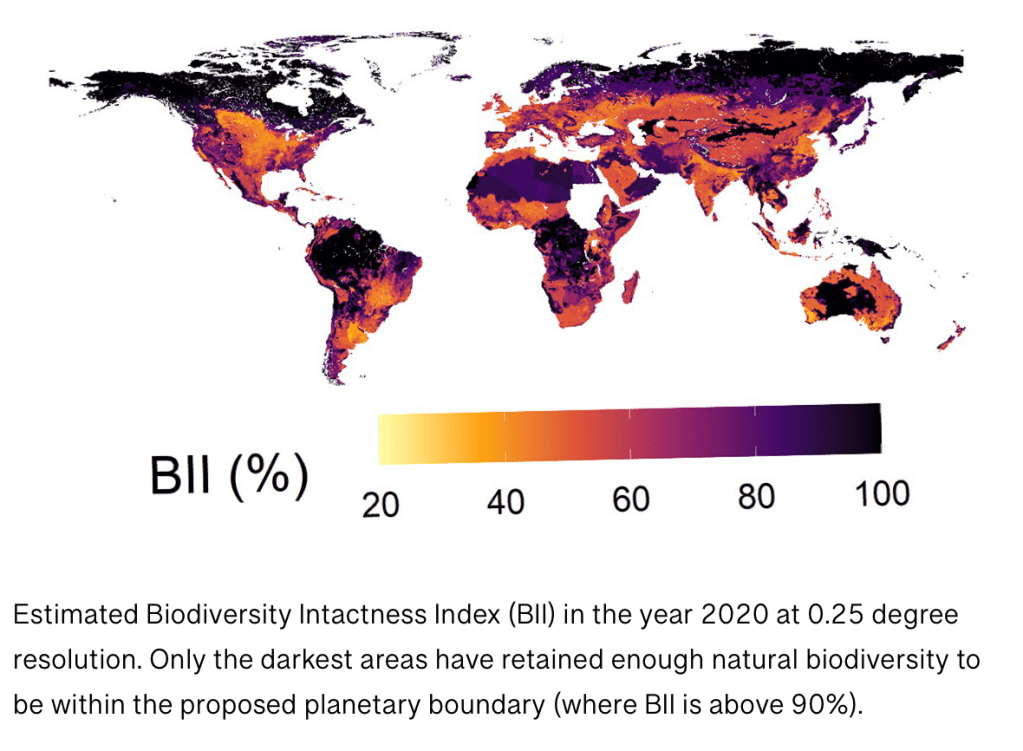
Globally we have been loosing vast amounts of the rich biodiversity which God gave us – both with the extinction of individual species and with the loss of numbers within species. The Natural History Museum has produced the Biodiversity Intactness Index (BII) which “measures biodiversity change using abundance data on plants, fungi and animals worldwide. The Index shows how local terrestrial biodiversity responds to human pressures such as land use change and intensification.” A BII of less than 90% is considered to be detrimental to planetary wellbeing. Sadly large amounts of the globe, including Europe, fall below this level. (1) For the UK the BIK is 53%.

The UK’s State of Nature Report 2023 noted that species studied had declined on average by 19% since 1970; that 16% of species were threatened with extinction – including 43% of birds, 31% of amphibians and reptiles, and 28% of fungi and lichen – and that 151 of the 10,008 species assessed had already become extinct since 1500.(2)

This year’s Big Butterfly Count Big Butterfly Count revealed the lowest numbers on record. (3)

Biodiversity loss in the UK – as well as globally – is real and alarming. 

Why is the of concern? 

Agricultural production is dependent on healthy soils but this relies on a multitude of organisms that live in the soil. If these become depleted in both number and diversity, the health of the soil suffers – and this is not something that can be repaired by the addition of artificial fertilisers.

Many crops are dependent on pollinators, typically insects. If these decline in number and diversity, yields decline. 

Agricultural yields can be adversely affected by flooding. Declining areas of wetlands, of peat moors, of woodlands, and of natural river courses and floodplains, increased the risk and extent of flooding.

Food security is also threatened if we become reliant on only a few commercial species. A virus or a change in climate can wipe out crops. Future losses can be avoided if scientists can access wild plants that have more resilient characteristics. But what if those wild alternatives are no longer there? 

Air quality too is affected by the decline in biodiversity. Trees in particular, but other plants too, are important natural absorbers of pollutants both in the air and in the water. 

The lack of anyone species can cause a cascading affect where other dependent species also decline. Declining numbers of insects lead to declining numbers of species of birds and bats. Biodiversity decline can accelerate at speed.

Biodiversity loss affects us as spiritual beings. Our lives are diminished as biodiversity is diminished. I have never heard a nightingale sing – that is a loss. I am lucky that as a child I did hear cuckoos, and even now as an adult, I do hear sky larks because they are still resident in Richmond Park. If I did not have green spaces to walk in, my mental health would suffer. 

God too suffers from the loss of biodiversity. By their very nature, the flora and fauna of this world praises God in an endless wordless song. As they decline, so does this profound worship. 

The nations of the world have been rightly concerned at the rapid loss of biodiversity globally and the impact that was – and increasingly would have – on human life and wellbeing. In 2022 the United Nations Biodiversity Conference (COP15) agreed the Kunming-Montreal Global Biodiversity Framework (GBF). This set out to halt and reverse nature loss, including putting 30 per cent of the planet and 30 per cent of degraded ecosystems under protection by 2030. This is often summarised as the 30:30 target.  (4) 

The UK government was party to this UN Conference and undertook the commitment to achieving this 30:30 target. However it is a tough target and progress to date has been slow and patchy. 

Earlier this year  Restore Nature Now organised a march in London in which between 60,000 and 100,000 people took part, representing  a wide range for groups including the RSPB, the National Trust, the Wildlife Trusts, the Climate Coalition, WWF-UK, the WWT, the Woodland Trust, the Wildlife and Countryside Link, Rewilding Britain, Extinction Rebellion and Christian Climate Action. 

Their demand was for more and greater action by the government. (5)

Last weekend another march took place organised by the group, Wild Card. A scroll was unrolled before the vast edifice of St Paul’s Cathedral, revealing 95 theses as to why as Christians and therefore as a Church, we should care about biodiversity and the well-being of the natural world. Just as Martin Luther’s 95 theses were put forward to stimulate theological debate, so too are these theses. (6) 

Hymns were sung and speeches given, highlighting the plight of biodiversity and calling on the Church to show leadership in addressing the crisis. In particular the call was made that the Church Commissioners, as stewards of extensive land holdings (105,000 hectares) , should undertake to rewild 30% by 2030. (7)

Wild Card defines rewilding thus: “To rewild the land and water is to allow untamed life to return to ecosystems and landscapes, such that they are once again sustained by the natural processes that created them in the first place. In restoring these processes, humans are often intimately involved. Be it from rewetting bogs to reintroducing missing species, humans are very much invited to the rewilding party.” (8) Rewilding goes beyond goes simply protecting the biodiversity we still have and seeks to restore the biodiversity of our environment back towards 90% BII needed for a sustainable future. 

Of course rewilding church land will have a profound effect on what we harvest – less meat and milk, more diverse horticultural and sylvocultural products; less cereal crops for animal feed, more meadows, fenlands and heaths; less livestock, more wild birds and animals; less mono-species plantations, more mixed broadleaf woodlands; less factory farming, more blue and green spaces for spiritual and mental re-creation, and more green jobs. There will be tough decisions to make and we all need to be part of the discussion: what changes in the lifestyles we live are we prepared to make. As Christians we are called throughout our life time to repent and believe, we are called embrace ‘metanoia’ – to see things differently, to change direction, to transform our relationships.

(1) https://www.nhm.ac.uk/our-science/services/data/biodiversity-intactness-index.html

(2) https://stateofnature.org.uk/

(3) https://butterfly-conservation.org/news-and-blog/uk-butterfly-emergency-declared

(4) https://www.cbd.int/gbf

(5) https://www.restorenaturenow.com/aims

(6) https://wildcard.land/campaigns/rewild-the-church/95-wild-theses
(7) https://wildcard.land/campaigns/rewild-the-church

(8) https://wildcard.land/about/about-wildcard

Proper 23, 20th Sunday after Trinity

13th October 2024

‘Seek the Lord and live’, ‘Seek good and not evil, that you may live’ and ‘teach us to number our days – ie to live that we may apply our hearts to wisdom’

‘The word of God is living and active, sharper than any two-edged sword … it is able to judge the thoughts and intentions of the heart.’

Life – a good life – is the life we live embracing God’s wisdom, adhering to God’s word. This is the message of our readings today. Oh that we would adhere to them!

Yet it is not just as individuals that we must so act, but as communities, as nations, and as the whole living world. If someone mistreats the poor, not only do the poor suffer but ultimately everyone in the community suffers. This is why Amos talks of people not living in the house they have built or enjoying the harvest of what they have grown. This is why the psalmist speaks of God’s people in the plural. And this is why we see suffering in the world today whether it is the civil war in Sudan, the escalating violence in the Middle East, the floods many parts of the world from Bosnia to Florida to Bangladesh, or the rioting in this country. The growing gap between rich and poor which is a result of injustice and inequality, the exploitation of the Earth’s resources where we take more than can be sustained, mean that ultimately we all suffer.

Nevertheless as individuals can we ever say ‘I have done enough, I have done as much as is necessary’? 

Being faithful means continuing always to strive to do good, to do what is God’s will – but not seek a reward but through love. In today’s gospel the young man is focused rewards rather than love. He is motivated by what he hopes to gain. Jesus shows him that this motivation is always going to hit a brick wall, whereas if he can find his way through the love of God, then he will find himself already in God’s Kingdom.

And God’s love will tell us to rest and pause, will tell us not to burn ourselves out. God’s love will tell us to support one another, to ensure that our sisters and brothers don’t overwork, don’t over fixate, don’t think that they can solves all the world’s problems – for only God can do that!

Amos 5:6-7,10-15

Seek the Lord and live,
or he will break out against the house of Joseph like fire,
and it will devour Bethel, with no one to quench it.

Ah, you that turn justice to wormwood,
and bring righteousness to the ground!

They hate the one who reproves in the gate,
and they abhor the one who speaks the truth.

Therefore, because you trample on the poor
and take from them levies of grain,

you have built houses of hewn stone,
but you shall not live in them;

you have planted pleasant vineyards,
but you shall not drink their wine.

For I know how many are your transgressions,
and how great are your sins—

you who afflict the righteous, who take a bribe,
and push aside the needy in the gate.

Therefore the prudent will keep silent in such a time;
for it is an evil time.

Seek good and not evil,
that you may live;

and so the Lord, the God of hosts, will be with you,
just as you have said.

Hate evil and love good,
and establish justice in the gate;

it may be that the Lord, the God of hosts,
will be gracious to the remnant of Joseph.

Psalm 90:12-17

12 So teach us to number our days *
that we may apply our hearts to wisdom.

13 Return, O Lord; how long will you tarry? *
be gracious to your servants.

14 Satisfy us by your loving-kindness in the morning; *
so shall we rejoice and be glad all the days of our life.

15 Make us glad by the measure of the days that you afflicted us *
and the years in which we suffered adversity.

16 Show your servants your works *
and your splendour to their children.

17 May the graciousness of the Lord our God be upon us; *
prosper the work of our hands;
prosper our handiwork.

Hebrews 4:12-16

The word of God is living and active, sharper than any two-edged sword, piercing until it divides soul from spirit, joints from marrow; it is able to judge the thoughts and intentions of the heart. And before him no creature is hidden, but all are naked and laid bare to the eyes of the one to whom we must render an account.

Since, then, we have a great high priest who has passed through the heavens, Jesus, the Son of God, let us hold fast to our confession. For we do not have a high priest who is unable to sympathise with our weaknesses, but we have one who in every respect has been tested as we are, yet without sin. Let us therefore approach the throne of grace with boldness, so that we may receive mercy and find grace to help in time of need.

Mark 10:17-31

As Jesus was setting out on a journey, a man ran up and knelt before him, and asked him, “Good Teacher, what must I do to inherit eternal life?” Jesus said to him, “Why do you call me good? No one is good but God alone. You know the commandments: ‘You shall not murder; You shall not commit adultery; You shall not steal; You shall not bear false witness; You shall not defraud; Honour your father and mother.’” He said to him, “Teacher, I have kept all these since my youth.” Jesus, looking at him, loved him and said, “You lack one thing; go, sell what you own, and give the money to the poor, and you will have treasure in heaven; then come, follow me.” When he heard this, he was shocked and went away grieving, for he had many possessions.

Then Jesus looked around and said to his disciples, “How hard it will be for those who have wealth to enter the kingdom of God!” And the disciples were perplexed at these words. But Jesus said to them again, “Children, how hard it is to enter the kingdom of God! It is easier for a camel to go through the eye of a needle than for someone who is rich to enter the kingdom of God.” They were greatly astounded and said to one another, “Then who can be saved?” Jesus looked at them and said, “For mortals it is impossible, but not for God; for God all things are possible.”

Peter began to say to him, “Look, we have left everything and followed you.” Jesus said, “Truly I tell you, there is no one who has left house or brothers or sisters or mother or father or children or fields, for my sake and for the sake of the good news, who will not receive a hundredfold now in this age—houses, brothers and sisters, mothers and children, and fields with persecutions—and in the age to come eternal life. But many who are first will be last, and the last will be first.”

The Joys and Sorrows of Civilisation 

12th October 2024

There shall come forth a shoot from the stump of Jesse, and a branch from his roots shall bear fruit. Isaiah 11:1

You Lord, are the source of all good things: 

We praise you.

You call us to tend and care for your creation: 

May we strive to do your will.

You have made us as brothers and sisters with all that lives: 

May we live together in peace.

A reading:  So Paul stood up and with a gesture began to speak: ‘You Israelites, and others who fear God, listen. The God of this people Israel chose our ancestors ….. he made David their king. In his testimony about him he said, “I have found David, son of Jesse, to be a man after my heart, who will carry out all my wishes.” Of this man’s posterity God has brought to Israel a Saviour, Jesus, as he promised. Acts 13: 16, 17a, 22b,23

Reflection 

Roots secure us to the past, ensure that we are part of the continuity of creation; shoots  and branches  take our lives forward into the as yet unformed future. Without the next generation there will be no ongoing continuity. The gospels of Luke and Matthew both locate Jesus within a human family tree;  the prologue of John’s gospel locates him as co existent with the beginning of all creation. Later in John’s  gospel, Jesus affirms his coexistence with the Father and the ongoing coexistence, through him, of all believers, all God’s children. 

For gifts of past generations

We thank you God:

For the gift of fire for cooking and heating

For the gift of clean water and sewers

We thank you God:

For the domestication of cattle and horses,

Cats and dogs, sheep and pigs, 

Hens and geese

We thank you God:

For the gift of gardening and arable cultivation,

sowing and reaping, 

growing and harvesting

We thank you God:

For the gift of healing and caring, 

of medicine and surgery

For the understanding of the intricacies of mind and body 

We thank you God:

For the gift of story telling and drama, 

of art and observation 

means of sharing grief and joy.

We thank you God:

For the gift of learning and research, 

of teaching and sharing

We thank you God:

For the gift of exploration and endeavour, of travel and communication 

We thank you God:

For the gift of worship, of self realisation and of the knowledge of God.

We thank you God:

But what shall we pass on to generations to come?

Do we offer gifts or burdens?

Merciful God forgive and inspire us.

Clean air or choking smog?

Merciful God forgive and inspire us.

Living water or dying oceans?

Merciful God forgive and inspire us.

Renewables or fossil fuels?

Merciful God forgive and inspire us.

Biodiversity or widespread extinction?

 Merciful God forgive and inspire us.

Fertile soils or inhospitable dust?

Merciful God forgive and inspire us.

Balmy summers or wild fires?

Merciful God forgive and inspire us.

Snow capped mountains or drowned coastlines?

Merciful God forgive and inspire us.

Homes for all  or camps for migrants?

Merciful God forgive and inspire us.

May we be wise guardians of what we have received 

Skilful custodians of what we consume

Generous donors of what we hand on

That the future of creation will be bright and beautiful, 

fair and just.

Amen

Counting on … day 190

11th October 2024

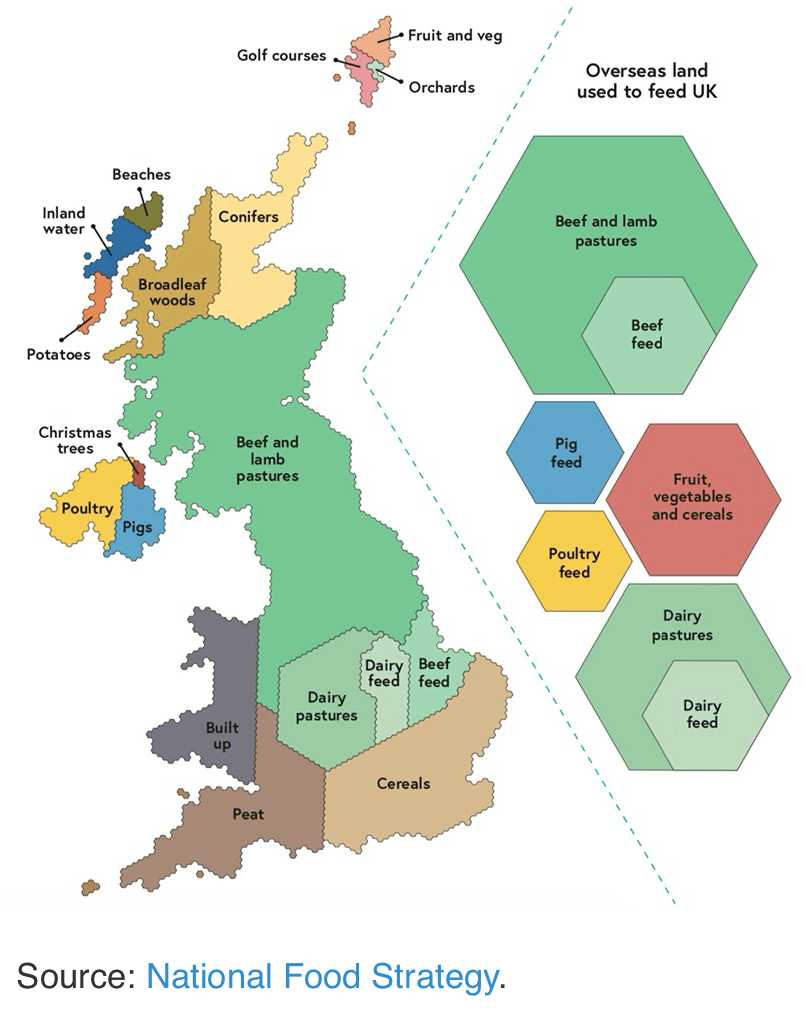
The left hand half of this diagram shows the amount of land used in the UK for different purposes – from providing grazing for beef cattle and sheep (the largest single use) to land cultivated as orchards (smallest alongside land used for growing Christmas tree!). 

The right hand half shows overseas land that we rely on (effectively use) to produce food stuffs that we import – and again land for beef and lamb production is the largest. 

Even just halving our meat consumption, would free up huge amounts of land that could be better used for rewilded biodiverse rich landscapes, as well as having space for increased horticultural production of a wide range of fruits and vegetables. 

Counting on … day 189

10th October 2024

Restoring biodiversity and protecting 30% of the UK is going to need a widespread reworking of farming practices and objectives. This will mean taking some land out of food production – eg to create peat bogs or woodlands – but on the other hand if we view land as the means of supporting not just food production but primarily as the means of supporting life, this makes sense. Should we be paying a life support tax to finance this? 

Restoring biodiversity will also mean reducing the intensity with which the land is farmed for food – widening existing, and planting new, hedges, cultivating the borders of fields as wild flower meadows, creating ponds and rewiggling rivers, reducing stocking levels (and reducing the total number of livestock to a proportionate level given that for every animal more land has to be used to grow feed crops), changing crop planting patterns to reduce the need for fertilisers that then pollute waterways etc. 

All this will mean a change in the way we eat. We need to switch to diets that are largely plant-based and dependent on locally grown crops. Diets that will in fact be both tasty and healthy.

Counting on … day 188

9th October 2024

“The Natural History Museum’s Biodiversity Intactness Index (BII) estimates how much of a region’s natural biodiversity is still left on average. The BII measures biodiversity change using abundance data on plants, fungi and animals worldwide. The Index shows how local terrestrial biodiversity responds to human pressures such as land use change and intensification.” https://www.nhm.ac.uk/our-science/services/data/biodiversity-intactness-index.html

Clearly we should be worried that the BII for the UK is less than 50, but equally concerned about the lack of biodiversity elsewhere across wide swathes of the Earth.

Counting on … day 186

7th October 2024

We often think of the Yorkshire moors and the fells of the Lake District as being naturally wild areas. But in fact they are areas shaped by human intervention and in particular by livestock grazing, and sometimes this is depressing localised biodiversity. For example over stocking with sheep can lead to a lack of plant diversity including a lack of tree saplings, with a detrimental impact on insects and birds, and the increased risk of flooding and landslides.

However things could be different as Rewild Britain explains in their web site –

https://www.rewildingbritain.org.uk/why-rewild/what-is-rewilding/an-introduction-to-rewilding/rewilding-the-uplands

And as can be seen in on the ground examples such as the rewilding of Ennerdale – https://www.wildennerdale.co.uk/

Proper 22, 19th Sunday after Trinity

6th October 2024

Reflection with readings below

What is the role of humans, of men and women? For what purpose have we been created? What is our role, our calling, towards each other, and towards other creatures? 

The writings of Genesis tell us that all creatures including humans were created to protect and tend the earth – and in particular to protect and tend the Garden of Eden planted by God. In this task we – humans and creatures – have been created to help each other to live and work in harmony, fulfilling the will of God. That is the purpose for which we have been created. 

Humans were created by God as male and female, men and women, to be partners – partners who will love and support each other so closely and intimately that they be comes as two halves of one. 

Psalm 8 looks at the vastness of the cosmos in all its glory and majesty, complexity and beauty, and asks what is a mere human in comparison? And yet says the Psalmist we are most highly, indeed supremely valued and treasured by God! Further the Psalmist describes how God has placed the creatures of the field, of the air and of the seas, under our feet  – but for what purpose? To celebrate the glory and majesty of God’s name! 

So humans have been created both to protect and tend the earth in partnership with all other creatures, and to praise God’s name through our relationship with those creatures. 

The writer of Hebrews also takes note of the glory and majesty that is attached to God – indeed the writer quotes from Psalm 8 – and sees that glory and majesty reflected in Christ. And that the reflection of God’s glory and majesty reveals that creation is sustained through the power of his works.

This leads the writer of Hebrews to suggest that the Psalmist’s words refer not to all humans but to that unique human in whom all things are made perfect. Look around, the state of the world where it is subjected to the dominion of most humans is a not a place of perfection. But where it is subject to the dominion of Jesus Christ, a different story can be told. And indeed when we talk of the salvation of the world – its healing and restoration – we are anticipating that state of being that will exist when the power and glory of Jesus has been fully established here on earth. And that is the salvation that makes us as brothers and sisters of Christ and so thus the Psalmist will not be wrong in describing humans as crowned with God’s glory and honour. 

The final paragraph from today’s gospel tells us what we should be like as humans. Rather than being self important, wanting to be in charge, wanting to be seen as the person with power, we should be child-like – accepting our dependency on God our parent, looking with awe and wonder at the world around us, sharing joy, being open to new ideas. To be child-like is to be as Adam and Eve were in the Garden of Eden – enjoying being part of creation rather than attempting to over-ride it, to live within the earth’s boundaries.

Genesis 2:18-24

The Lord God said, “It is not good that the man should be alone; I will make him a helper as his partner.” So out of the ground the Lord God formed every animal of the field and every bird of the air, and brought them to the man to see what he would call them; and whatever the man called every living creature, that was its name. The man gave names to all cattle, and to the birds of the air, and to every animal of the field; but for the man there was not found a helper as his partner. So the Lord God caused a deep sleep to fall upon the man, and he slept; then he took one of his ribs and closed up its place with flesh. And the rib that the Lord God had taken from the man he made into a woman and brought her to the man. Then the man said,

“This at last is bone of my bones
and flesh of my flesh;

this one shall be called Woman,
for out of Man this one was taken.”

Therefore a man leaves his father and his mother and clings to his wife, and they become one flesh.

Psalm 8

O Lord, our Sovereign,
    how majestic is your name in all the earth!

You have set your glory above the heavens.

    Out of the mouths of babes and infants
you have founded a bulwark because of your foes,
    to silence the enemy and the avenger.

When I look at your heavens, the work of your fingers,
    the moon and the stars that you have established;

what are human beings that you are mindful of them,
    mortals that you care for them?

Yet you have made them a little lower than God,
    and crowned them with glory and honour.

You have given them dominion over the works of your hands;
    you have put all things under their feet,

all sheep and oxen,
    and also the beasts of the field,

the birds of the air, and the fish of the sea,
    whatever passes along the paths of the seas.

O Lord, our Sovereign,
    how majestic is your name in all the earth!

Hebrews 1:1-4; 2:5-12

Long ago God spoke to our ancestors in many and various ways by the prophets, but in these last days he has spoken to us by a Son, whom he appointed heir of all things, through whom he also created the worlds. He is the reflection of God’s glory and the exact imprint of God’s very being, and he sustains all things by his powerful word. When he had made purification for sins, he sat down at the right hand of the Majesty on high, having become as much superior to angels as the name he has inherited is more excellent than theirs.

Now God did not subject the coming world, about which we are speaking, to angels. But someone has testified somewhere,

“What are human beings that you are mindful of them,
or mortals, that you care for them?

You have made them for a little while lower than the angels;
you have crowned them with glory and honour,
subjecting all things under their feet.”

Now in subjecting all things to them, God left nothing outside their control. As it is, we do not yet see everything in subjection to them, but we do see Jesus, who for a little while was made lower than the angels, now crowned with glory and honour because of the suffering of death, so that by the grace of God he might taste death for everyone.

It was fitting that God, for whom and through whom all things exist, in bringing many children to glory, should make the pioneer of their salvation perfect through sufferings. For the one who sanctifies and those who are sanctified all have one Father. For this reason Jesus is not ashamed to call them brothers and sisters, saying,

“I will proclaim your name to my brothers and sisters,
in the midst of the congregation I will praise you.”

Mark 10:2-16

Some Pharisees came, and to test Jesus they asked, “Is it lawful for a man to divorce his wife?” He answered them, “What did Moses command you?” They said, “Moses allowed a man to write a certificate of dismissal and to divorce her.” But Jesus said to them, “Because of your hardness of heart he wrote this commandment for you. But from the beginning of creation, ‘God made them male and female.’ ‘For this reason a man shall leave his father and mother and be joined to his wife, and the two shall become one flesh.’ So they are no longer two, but one flesh. Therefore what God has joined together, let no one separate.”

Then in the house the disciples asked him again about this matter. He said to them, “Whoever divorces his wife and marries another commits adultery against her; and if she divorces her husband and marries another, she commits adultery.”

People were bringing little children to him in order that he might touch them; and the disciples spoke sternly to them. But when Jesus saw this, he was indignant and said to them, “Let the little children come to me; do not stop them; for it is to such as these that the kingdom of God belongs. Truly I tell you, whoever does not receive the kingdom of God as a little child will never enter it.” And he took them up in his arms, laid his hands on them, and blessed them.

The blessings of creation

5th October 2024

The Spirit of God has made me, and the breath of the Almighty gives me life. Job  33:4

You Lord, are the source of all good things: 

We praise you.

You call us to tend and care for your creation: 

May we strive to do your will.

You have made us as brothers and sisters with all that lives: 

May we live together in peace.

A reading:

Where were you when I laid the foundation of the earth?
    Tell me, if you have understanding.

Who determined its measurements—surely you know!
    Or who stretched the line upon it?

On what were its bases sunk,
    or who laid its cornerstone

when the morning stars sang together
    and all the heavenly beings shouted for joy? Job 38:4-7 


Lord,  we should not cease to be amazed at the wonder of creation, 

the diversity of colour, shape and size,

the ingenious adaptations of plants and animals,

the interconnectedness of all living things.

Response:

Then Job answered the Lord: ‘See, I am of small account; what shall I answer you?
    I lay my hand on my mouth. I have spoken once, and I will not answer;
    twice, but will proceed no further.’ Job 40:3-5


Lord, we should not forget the immense timespan of creation,  

the geological age that have gone before us,  

and the ages yet to come. 

Forgive us when we exaggerate our importance, 

when we claim knowledge we do not have

and when we exceed our competence.

A further reading:

But ask the animals, and they will teach you;
    the birds of the air, and they will tell you;

ask the plants of the earth, and they will teach you;
    and the fish of the sea will declare to you.

Who among all these does not know
    that the hand of the Lord has done this?

In his hand is the life of every living thing
    and the breath of every human being. Job 12:7-10, 13

Lord, teach us wisdom. 

Give us humility to learn from others, 

patience to observe what is true,

and contrition to make amends for our mistakes.

Show us how to find joy in simple things, 

contentment with less, 

and  delight in companionship with all creation. 

A final reading:

May the glory of the Lord endure for ever;
    may the Lord rejoice in his works—

who looks on the earth and it trembles,
    who touches the mountains and they smoke.

I will sing to the Lord as long as I live;
    I will sing praise to my God while I have being.

May my meditation be pleasing to him,
    for I rejoice in the Lord. Psalm 104: 31-34

Lord, may your creation flourish, 

may we ever be thrilled by what we see, 

uplifted  by what we experience, 

and delighted by what we can offer you. 

The Grace.

Counting on … day 185

4th October 2024

Rewiggling rivers – allowing them to follow their natural winding tendency – and allowing them to spill out into their local floodplain, has the same affect as a rain garden but in a larger scale. This Rewilding benefits biodiversity and reduces unpredictable flood risks. The following is from Thames21:-

“ Reintroducing a more natural system that creates space for increased water flow means less flooding and reduces the pressure on London’s struggling drainage system. Improvements like installing reed beds not only create new habitats for wildlife, but help to trap pollutants before they flow downstream. 

“Removing barriers and concrete channels, and creating beautiful new wetland areas brings rivers back into the heart of communities; makes them more biodiverse and improves the wellbeing levels of people who visit them. Those living near the river restoration projects across London report a better community spirit as the amount of shared space, and opportunities for volunteering and community action, have increased.”(1) 

We should be encouraged that so much work is happening and so be encouraged to press for and support the so much more that could be done!

(1) https://www.thames21.org.uk/joinacampaign/londonriversweek2023/rewilding-londons-rivers/