Lent – justice and righteousness

2nd March 2024

The earth is the LORD’s, and the fullness thereof, the world and all who dwell therein. Psalm 24:1

You Lord, are the source of all good things:

We praise you.

You call us to tend and care for your creation:

May we strive to do your will.

You have made us as brothers and sisters with all that lives:

May we live together in peace.

A Reading from Deuteronomy 24: 14-15

You shall not withhold the wages of poor and needy labourers, whether other Israelites or aliens who reside in your land in one of your towns. You shall pay them their wages daily before sunset, because they are poor and their livelihood depends on them; otherwise they might cry to the Lord against you, and you would incur guilt. 

Response:

Wages that do not meet the rent,

Pay that does not feed the family?

Let justice roll on like a river, 

righteousness like a never-failing stream!


Debts that cripple, 

Interest rates that grow exponentially?

Let justice roll on like a river, 

righteousness like a never-failing stream!


Money for factories but not for schools

For plantations but not for hospitals?

Let justice roll on like a river, 

righteousness like a never-failing stream!


An absence of workers’ rights, 

Child labour and slavery?

Let justice roll on like a river, 

righteousness like a never-failing stream!


Destruction of forests and habitats,

Loss of native wildlife ?

Let justice roll on like a river, 

righteousness like a never-failing stream! (Response from Amos 5:24)

You have been told, O mortal, what is good; and what does the Lord require of you but to do justice, and to love kindness, and to walk humbly with your God? Micah 6:8

Intercessions:

We pray for those who own sugar and palm oil, coffee and cocoa plantations:

That they may seek justice for workers and wildlife, for soils and habitats. 


We pray for agriculturalists and scientists:

That their work developing ecological and practical farming methods may flourish.


We pray for investors and entrepreneurs:

That their work developing new and sustainable markets may grow.


We pray for those who raise funds and awareness for justice, and those who campaign and lobby:

That they may succeed in changing both hearts and minds and government policies.


We pray for those who monitor progress and certify just business operations:

That their work will ensure and expand fair trade.


We pray for ourselves and all consumers:

That our hearts and purses will be open to the goals of fair trade.

Amen.


With gratitude we celebrate all that the Fair Trade movement has achieved, 

For lives transformed, for land restored and communities strengthened.

Gracious and ever generous God, 

We thank you for the gift and wonder of creation,

For the plants, animals and peoples

that reveal the munificence of your love.

Amen. 

NB the Fair Trade Fortnight runs from 4th – 17th March 2024

Counting on … day 57

1st March 2024

Carbon footprint means the amount of carbon dioxide released into the atmosphere by an action.

This could be:

  • an individual activity – eg driving one mile in a car 
  • growing or producing a particular product – eg the carbon footprint of a pint of milk 
  • the sum of products and activities a person uses in a year
  • or similarly the sum of products and activities an organisation or company, industry or nation uses in a year.

A carbon footprint is measured in tonnes of carbon dioxide.

 Counting on … day 56

29th February 2024

The Fourth Carbon Budget covers the years 2023 to 2027. Each Budget is created well in advance to allow organisations and companies to plan the necessary changes that the Budget will require. The Fourth Carbon Budget was approved by the Government 2011. The Budget proposals included the following sectors: international aviation and shipping, agriculture, surface and other transport, energy and power  supplies, industry, no residential (offices, shops etc). 

The Climate Change Committee regularly reviews and reports to Parliament its assessment as to whether the plans and legislation put in place by the government, the plans and progress being made by businesses, and the uptake of lifestyle changes being made by the population, are on track to meet the Budget targets.  

However drawing up a budget is often much harder easier than implementing one. 

In its last report made in June 2023, the Climate Change Committee reported: 

“A lack of urgency. While the policy framework has continued to develop over the past year, this is not happening at the required pace for future targets…

“Despite some positive steps to provide households with advice on reducing energy use in the last year, a coherent public engagement strategy on climate action is long overdue…

“Expansion of fossil fuel production is not in line with Net Zero. As well as pushing forward strongly with new low-carbon industries, Net Zero also makes it necessary to move away from high-carbon developments…

“The need for a framework to manage airport capacity. There has been continued airport expansion in recent years, counter to our assessment that there should be no net airport expansion across the UK.”

For more information see –https://www.theccc.org.uk/publication/2023-progress-report-to-parliament/

In other words there is much to be done at all levels if we are to meet the Fourth Carbon Budget.

Counting on …day 55

28th February 2024

The UK’s Third Carbon Budget

Hot of the press comes an update for yesterday’s item. The Climate Change Committee published today their letter to Graham Stuart MP Minister of State for Energy Security and Net Zero: 

 “We are pleased to review your final figures showing that the UK’s Third Carbon Budget, covering the period 2018 to 2022, was successfully met with emissions 391 MtCO2e and 15% below the level of the budget (2,544 MtCO2e). ”

The letter goes on to emphasise the importance of increasing – not decreasing – the urgency and energy with which the net zero target is pursued: “Future carbon budgets will require an increase in the pace and breadth of decarbonisation. It is essential that an ambitious path of emissions reduction is maintained towards Net Zero.”

The letter also notes that “There has been good progress in the decarbonisation of electricity supply, driven by a faster than expected phase-out of coal. Industrial emissions also fell due to reduced output. However, most of the surplus in the Third Carbon Budget was due to predominantly external factors. In most other sectors, such as transport and buildings, the UK is not on track and progress will need to accelerate rapidly.” 

To read the full letter – https://www.theccc.org.uk/wp-content/uploads/2023/09/Advice-on-the-Third-Carbon-Budget-carry-over.pdf

Counting on … day 54

27th February 2024

Climate Change Committee 

In the UK the Climate Change Act (2008) was brought in to address the climate crisis. The Act created the Climate Change Committee as an independent body to advise the government. The Committee produces draft carbon budgets covering 5 year periods with each budget reducing step by step the UK’s emissions towards net zero. As of 2019 these budgets are aimed at achieving net zero by 2050.

The diagram below shows how this is intended to happen. The Third budget should achieve a reduction in UK emissions to 2544 million tonnes by 2022, a 38% reduction compared with 1990 levels. Whether this has been achieved has yet to be reported. It should be details in the CCC 2024 Progress Report (still awaiting publication).

Counting on … day 53

26th February 2024

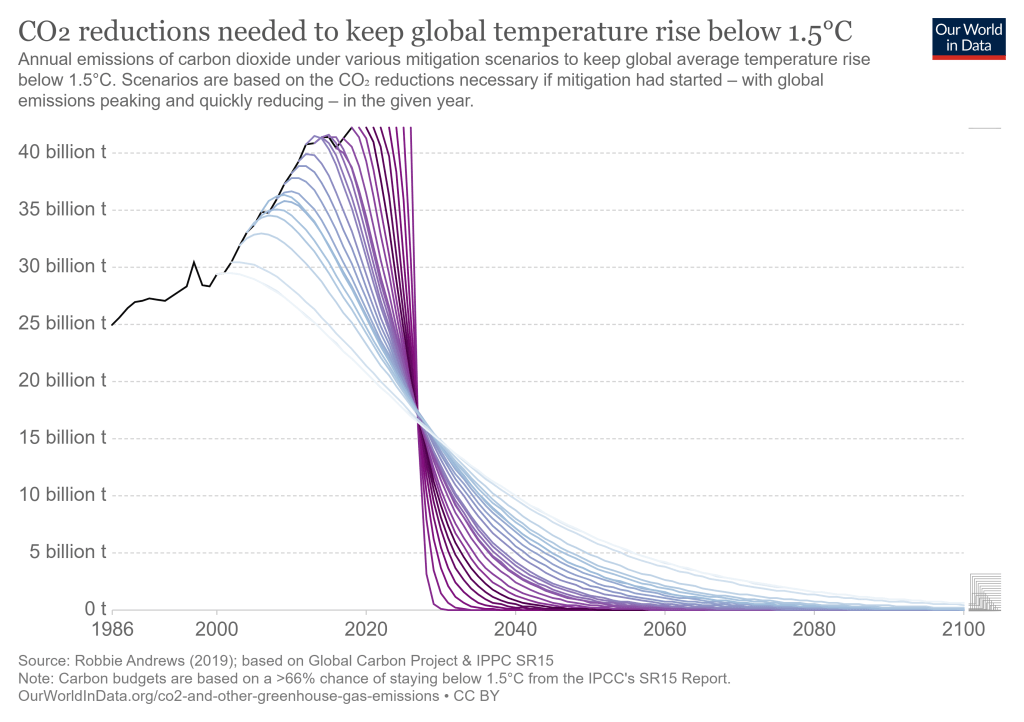
To keep the world within the desired 1.5C of warming, the carbon dioxide concentration in the atmosphere has to be kept below 500ppm. To achieve this the ambition agreed at COPxx in Paris in 2015 is to reduce global carbon emissions by 45% by 2030 and to net zero by 2050. 

In 2015 global carbon dioxide emissions were just over 35 billion tonnes, in 2019 emissions reached 37 billion tonnes, and having dropped back to 35 billion tonnes in 2020 during covid, emissions are again back up at 37 billion tonnes (2022).

Each year that passes without meeting these targets means that to achieve the 2030 and 2050 targets becomes even more difficult as we have to cut back emissions even more steeply. This is vividly shown in the graph below. 

Second Sunday in Lent

25th February 2024

Reflection – readings follow on below

Stories of covenants feature large in the lectionary during these first weeks of Lent. Last week we heard of the covenant between God and people that was illuminated by the presence of a rainbow. This week we have a story from Genesis about a covenant between God and Abram. It is a covenant that relates not just to Abram but to his descendants too. This covenant is made visible in the promise of a son for Abraham and  Sarah.

Last week we also had the story of Jesus’s baptism, when the heavens were torn open and God’s Spirit engulfs Jesus (imaged by a dove) and God’s voice declares ‘This is my Son!’ This is the Son that completes the covenant made with Abraham. God is God to his people in the most unique way possible!

Covenants establish relationships. The superabundance of covenants in the Bible witnesses to God’s overwhelming desire to build relationships with his people, and with all that he has created. These are relationships about flourishing and fruitfulness. From the beginning when God sees the bare earth and desires that it be green and filled with trees and plants, we can see God’s vision for the world. When God creates all manner of creatures to inhabit and till and nurture the earth, we see God’s vision for the world as a place in which all living things – plants and creatures – live and work in harmony with, and dependent on, each other. These are the relationships that God wishes to reinforce through the various covenants.

In today’s Psalm we hear of God’s love for the poor, of God’s alertness in hearing their cry. The Psalmist goes on to laud the fact that God is worshipped, and the poor are fed. The grammar is ambiguous: is God feeding the poor directly or is it that, because God is worshipped, those who worship are inspired to feed the poor? The Psalmist notes both that we worship God as King, and take on the role of God’s servants. 

To follow on with the teaching that Paul is presenting, our worship of God and service to God as King, comes not through obeying laws but through faith – and I would want to add – through love.

And that faith and worship is expressed not just in feeding the poor but also in healing the sick, comforting the sad, freeing the imprisoned, caring for creation, restoring justice etc. 

However as we know from the experiences of  the saints and  prophets, expressing our faith and worship in that way may not be easy, nor painless nor free of suffering. We sadly live in an a world where many of us are imperfect, and where such activities may be thwarted or penalised or countered because they impinge on someone else’s profits, or someone else’s wealth or on positions of power. As Jesus explains in the gospel reading, we may have to ‘deny ourselves and take up the cross if we are to follow him’. 

For those who want to play it safe, and conform to the way of this world, may find their have lost their lives – or at least lost their life’s integrity. Whilst those who are willing to sacrifice their lives – or to sacrifice the lifestyle that the world says is desirable and even essential – and follow the ways of Jesus, will find their life has immeasurable value. 

Lent is the time when we focus on realigning our lives so that we can and do worship and serve the living, loving, God, following the ways of Jesus.

Genesis 17:1-7, 15-16

When Abram was ninety-nine years old, the Lord appeared to Abram, and said to him, “I am God Almighty; walk before me, and be blameless. And I will make my covenant between me and you, and will make you exceedingly numerous.” Then Abram fell on his face; and God said to him, “As for me, this is my covenant with you: You shall be the ancestor of a multitude of nations. No longer shall your name be Abram, but your name shall be Abraham; for I have made you the ancestor of a multitude of nations. I will make you exceedingly fruitful; and I will make nations of you, and kings shall come from you. I will establish my covenant between me and you, and your offspring after you throughout their generations, for an everlasting covenant, to be God to you and to your offspring after you.

God said to Abraham, “As for Sarai your wife, you shall not call her Sarai, but Sarah shall be her name. I will bless her, and moreover I will give you a son by her. I will bless her, and she shall give rise to nations; kings of peoples shall come from her.”

Psalm 22:22-30

22 Praise the Lord, you that fear him; *
stand in awe of him, O offspring of Israel;
all you of Jacob’s line, give glory.

23 For he does not despise nor abhor the poor in their poverty;
neither does he hide his face from them; *
but when they cry to him he hears them.

24 My praise is of him in the great assembly; *
I will perform my vows in the presence of those who worship him.

25 The poor shall eat and be satisfied,
and those who seek the Lord shall praise him: *
“May your heart live for ever!”

26 All the ends of the earth shall remember and turn to the Lord, *
and all the families of the nations shall bow before him.

27 For kingship belongs to the Lord; *
he rules over the nations.

28 To him alone all who sleep in the earth bow down in worship; *
all who go down to the dust fall before him.

29 My soul shall live for him;
my descendants shall serve him; *
they shall be known as the Lord’s for ever.

30 They shall come and make known to a people yet unborn *
the saving deeds that he has done.

Romans 4:13-25

For the promise that he would inherit the world did not come to Abraham or to his descendants through the law but through the righteousness of faith. If it is the adherents of the law who are to be the heirs, faith is null and the promise is void. For the law brings wrath; but where there is no law, neither is there violation.

For this reason it depends on faith, in order that the promise may rest on grace and be guaranteed to all his descendants, not only to the adherents of the law but also to those who share the faith of Abraham (for he is the father of all of us, as it is written, “I have made you the father of many nations”) —in the presence of the God in whom he believed, who gives life to the dead and calls into existence the things that do not exist. Hoping against hope, he believed that he would become “the father of many nations,” according to what was said, “So numerous shall your descendants be.” He did not weaken in faith when he considered his own body, which was already as good as dead (for he was about a hundred years old), or when he considered the barrenness of Sarah’s womb. No distrust made him waver concerning the promise of God, but he grew strong in his faith as he gave glory to God, being fully convinced that God was able to do what he had promised. Therefore his faith “was reckoned to him as righteousness.” Now the words, “it was reckoned to him,” were written not for his sake alone, but for ours also. It will be reckoned to us who believe in him who raised Jesus our Lord from the dead, who was handed over to death for our trespasses and was raised for our justification.

Mark 8:31-38

Jesus began to teach his disciples that the Son of Man must undergo great suffering, and be rejected by the elders, the chief priests, and the scribes, and be killed, and after three days rise again. He said all this quite openly. And Peter took him aside and began to rebuke him. But turning and looking at his disciples, he rebuked Peter and said, “Get behind me, Satan! For you are setting your mind not on divine things but on human things.”

He called the crowd with his disciples, and said to them, “If any want to become my followers, let them deny themselves and take up their cross and follow me. For those who want to save their life will lose it, and those who lose their life for my sake, and for the sake of the gospel, will save it. For what will it profit them to gain the whole world and forfeit their life? Indeed, what can they give in return for their life? Those who are ashamed of me and of my words in this adulterous and sinful generation, of them the Son of Man will also be ashamed when he comes in the glory of his Father with the holy angels.”

Lent – choice & tipping points

24th February 2024

The desert and the parched land will be glad; the wilderness will rejoice and blossom like the crocus Isaiah 35:1

You Lord, are the source of all good things:

We praise you.

You call us to tend and care for your creation:

May we strive to do your will.

You have made us as brothers and sisters with all that lives: 

May we live together in peace.


A reading from Deuteronomy 30:16a, 19  I command you this day to love the Lord your God and to keep his commands, decrees, and regulations by walking in his ways…. Today I have given you the choice between life and death, between blessings and curses. Now I call on heaven and earth to witness the choice you make. Oh, that you would choose life, so that you and your descendants might live! 

A litany of tipping points

Adam, Eve and the fruit that was good to eat:

Eat  and be self-determined?

Not eat and be God-determined?

– A tipping point.

Moses, Pharaoh and a river of blood:

Let the people, these troublemakers go?

Follow the call of this troublemaking God?

 – a tipping point.

A people, a rule of life, and a golden calf:

Accept the short-termism of humanity and give up;
Plead God for mercy and start over afresh?

– a tipping point.

Exile, return and rebuild a new future:

Same old temple, same old rule-bound exclusivity;

New heart, new faith, an openness to others?

 – a tipping point?


Repent, good news, healings and miracles:

A charade, a charlatan, a feel good non entity;

Revelation, reformation, real life born afresh?

 – a tipping point?


Rebellion, deception, execution:

Confrontation, subjugation, might is right;

Confraternity, transformation, God is right?

 – a tipping point?


Empty tomb, close encounters and reunions:

Disbelief, cynicism and a hasty coverup;

Joy, mystery and real life resurrection?

 – a tipping point?


Tipping points are many and varied. 

Some good, some bad.

Help us life, affirming God, 

to see the tipping points we face, 

to see the hazards to avoid, 

the new routes to ride.


Help us, life affirming God, 

to heed the words of your present day prophets, 

the pleas of your children across the globe,  

and the anguished cries of the earth.

Inspire our hearts and empower our actions, 

that we may be a tipping point for good.


Help us, life affirming God, 

to see again in the life and resurrection of Jesus, 

the example we should follow, 

to know once more that Christ’s gospel 

will continue to transform the world.

Amen. 

day 10 No Faith in Fossil Fuels’ Vigil

23rd February 2024

The day was crisp and dry as I walked over Westminster Bridge. Even at 6.30 it was already light. The night shift looked warm and cheerful – Ben has the technique of keeping in warm inside the depths of a sleeping bag down to a fine art!

It looks like it will be a beautiful day. The sky is turning blue and the sun is gilding the pale stone of the  buildings opposite. Today Brethren Seagull are less focused on feeding and rather more on gliding effortlessly on their perfectly arched wings. Perhaps they too are relish the sunlight. 

Maybe it’s the lack of rain but there are more birds around. Several crows fly past, black fingered wings against the blue sky. Then my eye is caught by flashes of white and three magpies swoop round and settle themselves – diplomatically – on top of the Foreign Office. 

The pigeons too are favouring the dry weather. One with a very distinctive white ruff I have definitely seen earlier in the week. They peck at microscopic crumbs with which the pavement is apparently littered. 

Today is a day for praising God for the beauty of creation.

As the morning passes so the growing patch of sunlight progresses across the Square. St Margaret’s church has a sundial on one side and a clock on another, yet bizarrely the sundial seems to be half an hour slow!

Today I feel like a tourist – or maybe a flaneur – someone with time to spend just watching. I’m enjoying  watching the different people walk past. Those going to work, students, holiday makers, police officers and runners: these make up the normal stock in trade. But then there are others – delightful dogs and those walking dogs, runners of different speeds, and – today -lots of Scout leaders! They come thick and fast, with different coloured scarves neatly rolled and fastened round their necks, as well as different coloured lanyards. Often they are wearing a collection of lanyards  – much as soldier might wear campaign medals. Some have come from north of the Border and proudly swing past in their kilts. I think there is a service for them in Westminster Abbey. 

Maybe it’s the sunshine or maybe because we have been here for so many days, but several staff members and police offices give us  a cheery ‘Good Morning’ as they go in or out of the Parliamentary gates. 

Today is a day for praising God for the kindness of human.

8pm and I’m back for a final hour. For the first time during the vigil the train is late – about 5 minutes . The Square is in evening mode. Cars chase round the circuit, effortlessly outnumbering buses and taxies. People are walking past in two or threes,  chatting and laughing. No longer are they head down forging  past on their way to work. 

I’m only there for an hour but overlap with four others. The comradeship of the vigil has been special. People have come from far and wide – Bristol and Cheltenham, Liverpool and Sheffield, Scotland and all points of  London – and from different groups: Christian Aid and Cafod, Green Christian and Laudate Si, from Just Money and Tearfund, from local churches and of course from CCA.

Today is a day for praising God for friends.

Counting on … day 52

23rd February 2024

Keeping the temperature rise – global warming – within 1.5C necessitates constraining the carbon dioxide (and other greenhouse gas) emissions we release into the atmosphere. The diagram below shows the correlation between global temperatures and carbon dioxide concentrations in the atmosphere. 

Keeping global warming within this window involves both reducing the amount of greenhouse gases we emit and enhancing processes that absorb such gas emissions. An example of the first would be reducing – or even cutting out entirely – the burning of fossil fuels; an example of the second would be reinstating woodlands and wetlands.