Windows of Opportunity 

21st December 2023

Universal basic services

“The concept of universal basic services (UBS) is based on the premise that the first job of good government is to make sure everyone’s basic needs are met. This is often best achieved through collective services rather than individual market transactions. The UBS framework sets out clear criteria that public services should be fulfilling:

  • Free or affordable access according to need, not ability to pay.
  • A mixed economy of provision, bound by a set of public interest obligations.
  • Guaranteed fair pay and conditions for service workers.
  • Environmental sustainability built into the design and delivery of services.
  • Devolved powers to the lowest appropriate level.

This framework provides a basis to reimagine the design and delivery of ECEC provision as a universal public service that can better meet the needs of children, parents and staff, while making a positive contribution to the economy, society, and environment in which it sits”. (1) 

“Why universal basic services?  The UK is wealthy, but for many people it is not prosperous. Our economy is failing to deliver for many people. Forces of anger and resentment have entered our politics, as a growing number of people are left behind.” (2) 

UCL suggests universal basic services should cover: 

  • Transport
  • Food
  • Information 
  • Local democracy 
  • Health and care
  • Shelter 

A report published by the Social Prosperity Network at the UCL Institute for Global Prosperity (IGP) in 2017 estimated the cost as being  £42bn  (2.3% of UK GDP) which it said could be funded through changes to the Personal Allowance making it fiscally neutral. It would bring most benefit to,those on the lowest incomes saving them £126 a week in living costs. (3) Equally it would contribute to a healthier, both physically and mentally, workforce.

Anna Coote writing for Taylor and Francis Online comments: “Proposals for UBS have been closely informed by the experience of public services in the UK, where government policies since the 1970s have chipped away at the postwar consensus and at the value of benefits in kind. Changes have been driven by a vision of economic success based on personal choice, private ownership, a small state, and a free market, blaming the jobless and poor for their own troubles and urging individuals to help themselves. Many services, including care for children and disabled adults, as well as housing and transport, have been outsourced to for-profit corporations, stripped down to the bare bones, abolished altogether, or left to the vagaries of voluntarism and philanthropy. Combined with cuts to the value of social security benefits, the effects have greatly exacerbated social and economic inequalities and left more than a million living in destitution.” She goes onto say “The case for UBS rests on two key principles: shared needs and collective responsibilities. It recognises that all human beings have the same set of basic needs that must be satisfied in order to survive and thrive, think for one’s self, and participate in society.” 

Coote also sees in the provision of universal basic services, the concept of sustainability as proposed in Kate Raworth’s theory of Doughnut Economics. “[T]he concept of UBS embodies an ethos of collective responsibility and a needs-based approach to human welfare, based on sufficiency. As such, it offers a robust framework for policy and practice that is closely aligned with the goal of living well within limits. It seeks to build solidarity and mutual support among people and groups in ways that cannot be achieved by systems based on market transactions alone. By encouraging an awareness of interdependence and developing practical experience of collective responsibility, UBS can help to create favourable conditions for society to “play a pivotal role in imposing limits” on individual freedom to consume more than is required to live a good life.” (4)

Universal basic services is good not just for the individual and society, but also for the environment.

(1) https://neweconomics.org/2023/11/a-fair-start-for-all?link_id=10&can_id=a3029987c1ac6171de26390e6aabf63f&source=email-news-from-nef-the-budget-property-taxes-childcare&email_referrer=email_2123509&email_subject=news-from-nef-the-budget-property-taxes-childcare

(2) https://www.ucl.ac.uk/bartlett/igp/research-projects/2023/jul/universal-basic-services

(3) https://www.ucl.ac.uk/bartlett/ideas/bartlett-review/future-welfare-universal-basic-services

(4) https://www.tandfonline.com/doi/full/10.1080/15487733.2020.1843854

Windows of Opportunity 

20th December 2023

Homes for all

As of January 2023, “at least 271,000 people are recorded as homeless in England, including 123,000 children. Shelter’s detailed analysis of official homelessness figures and responses to a Freedom of Information request shows that one in 208 people in England are without a home. Of these, 2,400 people are sleeping rough on any given night, 15,000 people are in hostels or supported accommodation and nearly 250,000 are living in temporary accommodation – most of whom are families.

“The number of people living in temporary accommodation has risen by an alarming 74% in the last 10 years – something the charity argues is driven by the chronic shortage of social homes, and an over-reliance on grossly expensive and unstable private renting.

“More than two-thirds of families (68%) living in temporary accommodation have been there for over a year, showing this type of accommodation is becoming less and less “temporary” as families cannot escape homelessness due to the severe lack of affordable homes. This is a situation made even worse by the three-year freeze on housing benefit, and cost of living crisis.” (1) 

Homelessness causes ill health (physical and mental), disrupts  education for children, makes it harder to find and maintain gainful employment, and inhibits the building of resilient communities. 

Rented accommodation can be as much of a problem as . “Wright, the chair of the Association of Chief Environmental Health Officers in England, spoke to the Guardian as part of a series shining a light on Britain’s private rental sector. He said landlords had been able to get away with renting out squalid homes because there was no legal minimum standard that private rented properties in England must meet, unlike in the social housing sector. This means it is not illegal for a landlord to rent out a property with the most serious health hazards, though they must have an energy safety certificate.”(2)

“There are now more tenants than at any point since the millennium; one in five of us in England and Wales is now a member of “generation rent”. The sector has never been more relevant, but its problems have also never been more obvious. Renters are handing over increasingly unsustainable portions of their pay in order to live in insecure tenancies, often in dangerous properties.

The government’s promised rental reform bill … aims to tackle some of these issues. Despite this, action on many problems, including no-fault evictions, may still take years to materialise.” (3) The article lists 5 reasons why renters are experiencing increasing problems.

Renting is increasingly unaffordable.

Buying a property is even more out of reach.

The UK is one of the most expensive places to rent.

Current laws make renting an option that lacks security.

The condition of many rentals is poor.

“But we should all be hopeful…. We have enough homes in this country — but the wrong people own them, and the wrong people make the wrong decisions about how much rent the rest of us should pay and what conditions we should put up with. Just as homes were taken out of public hands, they can be put back into them. Rotting window frames can be replaced. Mould can be cleared. Rents can be brought down. We have all the materials to do so — all that’s missing is political will. The government’s, and ours.

“We want to make it government policy to turn private rental properties — including those built by councils which have now fallen into the hands of private landlords — into retrofitted social homes, saving tenants millions of pounds in rent and energy bills, and the earth from millions of tonnes of carbon” (4) 

“The most recent government statistics, released in November 2023, showed there were 261,189 long-term empty properties in England. That figure represents a rise of 12,556 homes compared to 2022, up 5% annually and 16% since before the pandemic in 2019. The biggest was recorded in the South West – where there has been widespread concern about second homes – with the number of long-term empty homes rising 9% in just a year. Rebecca Moore, AEH director, said: “It beggars belief that while children are growing up sharing beds in temporary accommodation, our nation has over a quarter of a million homes sitting empty. To say this is a national disgrace is a profound understatement. Long-term empties are a huge missed opportunity to invest in green retrofit and create new jobs.” (5)

Shelter has drawn up the following manifesto ask for the next general election (Read the shorter executive summary [PDF, 7MB]

“Our manifesto asks party leaders to:

  • Build a new generation of social homes 
  • Make renting affordable   
  • Raise standards in rented homes  
  • Strengthen housing rights” (6)

(1) https://england.shelter.org.uk/media/press_release/at_least_271000_people_are_homeless_in_england_today

(2) https://www.theguardian.com/uk-news/2023/nov/13/loophole-adds-to-shameful-rental-conditions-in-england-says-housing-chief?CMP=Share_iOSApp_Other

(3) https://www.theguardian.com/society/2023/nov/13/five-charts-explain-state-uk-rental-sector?CMP=Share_iOSApp_Other

(4) https://neweconomics.org/2023/04/council-housing-gave-me-a-childhood

(5) https://www.bigissue.com/news/housing/how-many-empty-homes-are-there-in-the-uk/

(6) https://england.shelter.org.uk/support_us/campaigns/general_election

For more groups campaigning for homes for all – http://www.axethehousingact.org.uk/

Windows of Opportunity 

19th December 2023

Investing in the grid

“Advanced economies will need to lay at least 23 million kilometres of power lines by 2040 to meet their renewable energy goals, according to a recent report, and on a global level, 80m km of cable will be needed. “If we want clean electricity, we need not only clean methods of generation, but we need to build grids. It has been a blind spot of governments’ clean energy transition programmes of,” said Birol.

“Global demand for components such as high-voltage cables, pylons and converter station equipment threatens to outstrip manufacturing capacity, pushing British energy companies into an international race to secure supplies.

“Electricity demand in the UK is forecast to more than double by 2040 as fossil fuel heating systems and internal combustion engines are swapped for electric vehicles and heat pumps. Heavy industry must also switch away from fossil fuels in favour of clean power. To meet the demands of an electrified economy, the government wants to quadruple the UK’s offshore wind power capacity to 50 gigawatts by 2030, and solar farms and battery facilities storing power generated by wind and solar are expected to mushroom across the country.

“But for every pound spent on clean energy projects another pound must be spent on upgrading the power grids, according to Keith Anderson, head of Scottish Power. “There’s no point investing in renewables without investing in the grid. It’s like buying a new iPhone and not having a cable to go with it,” he said.” https://www.theguardian.com/business/2023/nov/25/race-to-get-uk-electricity-grid-ready-for-net-zero?CMP=Share_iOSApp_Other

 Windows of Opportunity 

18th December 2023

Community energy projects

“Are there public buildings in your community, like schools or sports clubs, that could have solar PV panels on the roof? Or do you have a natural resource nearby, like a river or a windy hilltop, that could be used to generate electricity with a hydro project or wind turbine?

That’s what community energy is all about: people coming together, taking action and using local resources to manage or generate energy for their community.” (1) 

“Community energy is about people and communities taking democratic control over their energy future, by understanding, generating, using, owning and saving energy in their communities, as well as working together across regions and nationally.

“The sector is ever growing, and includes a diverse range of projects, people and directions of work and activity. For a good introduction and summary on the diversity, size and benefits of the sector, we recommend starting with the latest State of the Sector Report. Key highlights from our 2022 State of the Sector Report include:

  • 217,489 people engaged in the sector 
  • £3.35m saved on energy bills from the latest activities in efficiency & fuel poverty *
  • 143,000 tCO2e saved in one year of work done by communities ” (2) 
  • Projects included in Community Energy England’s report include things such as car sharing  and  home insulation schemes as well as energy generation. At present UK legislation obliges community energy generation projects to sell their energy to the UK grid, where it is then sold on to household energy suppliers like Octopus or SSE. This means that prices remain tied to general energy costs, determined by fossil fuels. This legislative obstacle is being challengers by the campaign group Power to the People.  For more information on this see the Ethical Consumer report – https://www.ethicalconsumer.org/energy/what-community-energy

This Autumn the UK Government created a £10million Community Energy Fund for which urban and rural communities can compete to secure grants  for local renewable energy projects. (3)

(1) https://energysavingtrust.org.uk/how-community-energy-schemes-can-help-the-uk-reach-net-zero/

 (2) https://communityenergyengland.org/pages/who-we-are

A guide to getting started – https://communityenergyengland.org/files/document/672/1675676619_CES_CEEChecked-Top10toGettingStarted-Jan2023.pdf

(3) https://www.gov.uk/government/news/communities-at-the-heart-of-new-fund-to-boost-local-growth-and-energy-security

Green Tau: issue 85

18th December 2023

Taking action in the National Gallery 

The National Gallery began when in 1824 the British Government bought, on behalf of the nation, 38 paintings from the heirs of the late John Julius Angerstein, a business man and art collector. Thus it is that the National Gallery’s collection is owned by the government on behalf of the British public. Its constitution  states “The Gallery’s aim is to care for the collection, to enhance it for future generations, primarily by acquisition, and to study it, while encouraging access to the pictures for the education and enjoyment of the widest possible public now and in the future.” 

It goes on to describe it audience as:

  • Frequent and occasional visitors to the Gallery in London
  • Those who see its pictures while they are on loan elsewhere, both inside and outside the UK, and those who know the collection through publications, multimedia and TV
  • Those who live nearby as well as those who live further away in the United Kingdom and overseas
  • Every age group – from children to pensioners
  • The socially excluded and the privileged; the uninformed and the specialist; and those with special needs
  • The worldwide community of museums and galleries
  • Most importantly: future generations 

And further on adds: 

“Allow the public to use the collection as their own by maintaining free admission, during the most convenient possible hours, to as much as possible of the permanent collection” (3) (3) https://www.nationalgallery.org.uk/about-us/organisation/constitution

The National Gallery certainly aims takes seriously its particular role of caring for a collection of art works that belongs to the British people, and making it fully accessible to them. 

Like many museums and art galleries, the National Gallery undertakes a responsibility to facilitate and enhance the educational use of the collection for the benefit of people of all ages and backgrounds. It hosts exhibitions, school visits, workshops and talks, tours, musical events, sketching sessions etc as well as producing many publications relating to the collection. It makes full use of digital technology and the further opportunities that that affords.

Chris Michaels, the director of digital, communications and technology at the National Gallery, spoke at ‘greenloop 22’ – a visitor attractions conference focusing on sustainability – spoke about the practical steps the National Gallery is taking to respond to the climate crisis – such as making positive choices about which electricity supplier to use. He also spoke of ways in which the Gallery could go beyond such operational steps.  

“It concerns thinking about how we, as storytelling institutions, can start to think about the future and make sure that the stories we tell live in that future the right way. To me, very simply, art finds new relevance in this time of crisis.” 

He expanded on this with examples. “If you look at Canaletto now, if climate change progresses at the speed it is now, and if we don’t make things better, this Venice will disappear beneath the waters for good.

“If we think about artists even as recent as Monet, painting in the late 19th century, there is a picture he famously painted from when he was staying at the Savoy in London. The hazy skies in the picture were also products of climate change, even at that time. This landscape, too, will vanish as London potentially disappears beneath the waters.”

He concluded, “Climate change and the climate crisis, for museums, becomes a storytelling frame to understand the new relationship between art history and our futures. Those hazy skies and their meaning are something I keep coming back to in terms of the way they change our understanding of the past and of the future.” (2)

This September the first UK Museum COP was held at Tate Modern. It issued the following statement: “As leaders of the UK museums, we feel a responsibility to speak out about the current climate and biodiversity crisis and call upon UK politicians and businesses to accelerate action to mitigate this crisis before it is too late. We are already around or beyond crucial tipping points: global temperatures are higher than they have ever been since humans emerged as a species, and extinctions are occurring at around a thousand times the normal rate. There is an existential threat to the world we have become accustomed to.

“Museums are institutions with a long-term view. Many have collections relating to the Earth’s five previous mass extinction events, and we are now in the midst of the sixth, the Anthropocene. UK museum leaders feel they have an ethical obligation to take action to alleviate that damage.”

They went on “We will [u]se relevant collections, programmes and exhibitions to engage audiences with the climate crisis and inspire them to take positive action …” (3) 

Clearly there is a growing awareness of the role that museums and art galleries can take in advancing the debate about climate change and in shaping how the public responds to this crisis. But is this growing awareness leading to action at a fast enough pace to be of use? Or are they likely to be overtaken by events?

In some instances they already have. The National Gallery, the Royal Academy, the Courtauld, and the Kelvingrove Art Gallery have all been targeted by Just Stop Oil activists have used popular paintings to make the point that very little – in proportion to the scale of the emergency – is being done to address the climate crisis. Their actions seek both to raise awareness in the wider public, and to call upon the art galleries themselves to demand action from the Government.  Similar actions have also been carried by climate activists in France, Germany, Austria, Italy, Spain,Norway, Canada, and Australia.

What would happen if rather than closing down these actions, museums and art galleries choose to work with activists as they seek to press for responsible climate action? Several museums in Germany have done just this, working with the group Letzte Generation (Last Generation). At the Hamburger Kunsthalle, activists took over the foyer for a non-violent resistance, reading essays and conversing with visitors. Similar essays actions took place at the Ludwig Museum in Cologne, the Museum of Ethnology in Leipzig, the Zeppelin Museum in Friedrichshafen, the Rostock art gallery, the European Hansemuseum in Lübeck and the Museum for Communication in Nuremberg. (4) 

Works of art, as well as  have great value in inspiring thoughts and new ideas, often have spiritual values too. Indeed many were created for religious purposes to aid and encourage worship. 

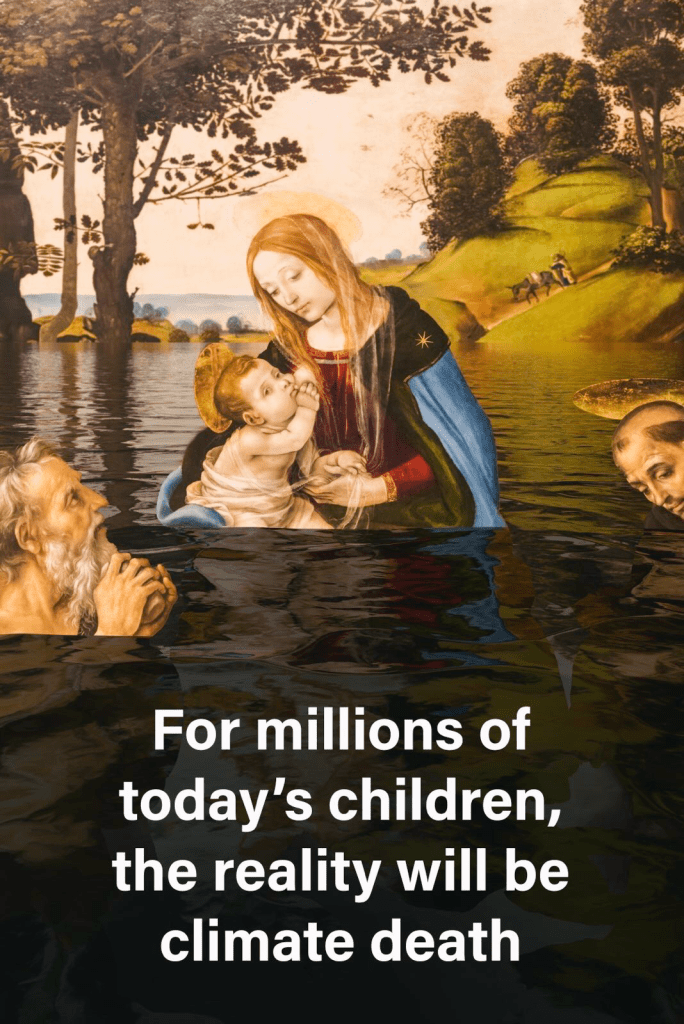
Last week I took part in an action at the National Gallery with others from Christian Climate Action. We gathered in front of a painting of ‘The Madonna and child with saints Jerome and Dominic’ by Filippino Lippi, where we unrolled a copy of the picture which had been digitally altered to show flood waters that half submerged the characters. This we held as a statement was read out describing how for  many Christmas is not a time of joy, because their lives are threatened by the effects of climate change. As we knelt prayerfully we sang a version of Silent Night – the acoustics were wonderful. 


Sadly security staff quickly cleared that section of the  gallery and visitors were not able to participate in the event.
If  you would like to see images from the event visit https://christianclimateaction.org/2023/12/15/protest-climate-change-inaction-at-virgin-and-child-painting/

Whilst here is the statement that was read out:

“Why did members of Christian Climate Action gather prayerfully beside a nativity painting at London’s National Gallery, with a different picture to reveal? 

“As Christians we celebrate the birth of Jesus, born in poverty as a refugee, to show us the way of love and peace, and justice which is love in action. Christmas is still for the children. But today, world leaders are failing them. As governments profit from weapons and from fossil fuels, babies are born into climate chaos as well as war. In this painting, the baby – like his mother but unlike Jesus and Mary – is white, but we remember those brown and black babies born in the Global South still waiting for climate reparations and most at risk of unliveable heat, hunger, drought, flooding and displacement. We honour those born into poverty here in the UK as inequality widens, and all the world’s children whose future is at risk while the adults in charge pursue yet more oil and gas. We grieve that after 28 COPs, world emissions in 2023 have reached a record high to match all the heat records broken month after month. 

“Only with change for good can the young find hope. Christmas lights can’t dispel their darkness. Along with inflatable Santas, magical snowmen and red-nosed reindeer, art like this is hollow and fake. The altered image we held beside Lippi’s painting shows the terrifying reality children face. Sentiment, tradition and festivity won’t save us. The science is clear that new gas, oil or coal will accelerate climate breakdown. We can’t serve God unless we serve that truth. Unless we work for life, justice and peace – with love.

“One billion children – almost half of the world’s child population – live in countries that are climate-vulnerable. A third of the world’s child population is impacted by both the climate crisis and poverty.

“According to UNICEF, extreme weather has internally displaced at least 43 million children in the last six years – the equivalent of 20,000 children a day being forced to abandon their homes and schools.”

(1) https://www.nationalgallery.org.uk/about-us/organisation/constitution

(2) https://blooloop.com/museum/in-depth/museums-climate-crisis-technology/

(3) https://fadmagazine.com/2023/11/07/u-k-museum-leaders-issue-first-ever-joint-commitment-to-tackle-climate-change/

(4) https://news.artnet.com/art-world/german-museums-take-a-new-tack-to-prevent-climate-activists-attacking-their-art-inviting-them-in-2307623

Windows of Opportunity 

17th December 2023

Treat water as a common good

“Governments must urgently stop subsidising the extraction and overuse of water through misdirected agricultural subsidies, and industries from mining to manufacturing must be made to overhaul their wasteful practices, according to the Global Commission on the Economics of Water. Nations must start to manage water as a global common good, because most countries are highly dependent on their neighbours for water supplies, and overuse, pollution and the climate crisis threaten water supplies globally.” (1)

“”However, water is not just a casualty but also a driver of the climate crisis,” reads the report. “Extreme water events cause an immediate loss of carbon uptake in nature. Droughts lead to fires and massive loss of biomass, carbon, and biodiversity. The loss of wetlands is depleting the planet’s greatest carbon store, while the drop in soil moisture is reducing the terrestrial and forest ecosystem’s ability to sequester carbon… We will fail on climate change if we fail on water,”” (2)

We forget how much water is used by mining and industry (17% of the world’s freshwater use) and by agriculture (70%) – whilst domestic/ municipal use accounts for 12%. By 2030 demand is likely to exceed supply by approximately 40%. This is clearly a problem, and as with so many cases of shortages, it is likely that the poorest in society and the poorest nations will bear the brunt of  distress. 

The matter is further compounded because the source of a water supply may lay outside the user’s borders. Water from the Swiss Alps, feeds the River Po in Italy; the glaciers in the Himalayas feed four great rivers – Brahmaputra, Ganges, Indus, and Tarim. Other countries rely on ‘green water’ where water held in the soil and released through transpiration from trees and other plants, then condenses and falls as rain further down wind. Changes in land use up wind – such as deforestation – can reduce rainfall. (2) Again this can make one country dependent on another for its water. This is one of the causes of the drought being experienced in the Amazon basin (3). 

These cross border issues have the potential for conflict as is already the case in the West Bank (4)

The Global Commission on the Economics of Water recommends seven steps that policymakers must take to avoid a water shortage by the end of the decade, including:

  • Manage water supplies as a common good by recognizing that water is critical to food security and all sustainable development goals;
  • Mobilize multiple stakeholders—public, private, civil society, and local community—to scale up investments in water through new
    modalities of public-private partnerships;
  • Cease underpricing water and target support for the poor;
  • Phase out water and agriculture subsidies that “generate excessive water consumption and other environmentally damaging practices”;
  • Establish Just Water Partnerships to enable investments in water access, resilience and sustainability in low- and middle-income countries;
  • Move forward on steps that can be taken this decade to “move the needle significantly,” including fortifying depleted freshwater systems, recycling industrial and urban wastewater, reusing water in the production of critical materials, and shifting agricultural systems to include less water-intensive crops and drought-resistant farming; and
  • Reshape multilateral governance of water by incorporating new water standards into trade agreements and prioritizing equality in water decision-making. (2)
  1. https://www.theguardian.com/environment/2023/mar/17/global-fresh-water-demand-outstrip-supply-by-2030?CMP=Share_iOSApp_Other
  2. https://www.commondreams.org/news/water-report-un-conference

(3) https://www.weforum.org/agenda/2022/08/green-water-climate-change-deforestation/

(4) see – https://theconversation.com/drought-in-the-amazon-understanding-the-causes-and-the-need-for-an-immediate-action-plan-to-save-the-biome-215650)

(5) see – https://www.theguardian.com/world/2023/may/17/how-israel-uses-water-to-control-west-bank-palestine?CMP=Share_iOSApp_Other

3rd Sunday of Advent

17th December 2023

Reflection (readings are below)

Are we as Christians, as activists for justice,  acorns that God is planting in the hope that the growth we start will become as an oak tree. A mature oak tree can provide a habitat for as many as 2300 species! (Woodlands Trust). Wouldn’t it be amazing if we could create communities that could be home to so many different species? Do the words of Isaiah provide a template for such a community? It would be a place (and a space) in which the broken hearted would find respite and healing, those trapped by unjust systems would find freedom, the oppressed would find hope and new life. It would be a place of justice and empathy and compassion. A place where each and everyone could develop their true potential as creatures of God’s making. And it would become a place of joy and celebration.

The community created would perhaps echo the images of those Christmas cards that show happy families, dinner tables decked for a feast, lights gleaming in every window, peaceful landscapes (usually rural and snow covered), sheep safely grazing, smiling posties with gifts for all, choirs filling the air with songs of praise. 

And such communities, such scenes of peace and joy are possible – if only we really want them, only if we have the will. 

Mary’s Magnificat tells us what we have to remove or change to create such as community. We will need to overcome conceit and self-importance, and rebalance power and opportunity so that they are equally distributed. We will need to encourage the lowly and the vulnerable, to appreciate their value. We will need to redistribute resources so that those with out and those with lots all have an enough.

As the discussion at COP28 come to an end, we are reminded of how much wealth there is in the world and how unequally it is distributed. We have heard how re-distributing wealth from the richer to the vulnerable nations could transform poverty, address the threat of climate change, and create vibrant economies. We have heard how redistributing subsidies from fossil fuels to renewable energy could lift so many out of poverty and stall the rise in global temperatures. We have heard how developing renewable energy and green industries can create new and sustainable jobs. 

This week’s gospel repeats last week’s message from Isaiah that we should make straight the path for the Lord, making smooth the way in for the  of God. 

Let us rejoice and pray without ceasing for the reality that God’s kingdom can come here on earth as in heaven. Let us pray and work for everything that can make the pathway smooth – whether that is in our individual actions by which we love our neighbours and our enemies, or our corporate actions as communities, or our activism in advocating for change by local and national authorities, institutions and  corporations – for in so doing we follow the example of John the Baptist in bearing witness to the will of God, in testifying to the light. 

Isaiah 61:1-4, 8-11

The spirit of the Lord God is upon me,
because the Lord has anointed me;

he has sent me to bring good news to the oppressed,
to bind up the brokenhearted,

to proclaim liberty to the captives,
and release to the prisoners;

to proclaim the year of the Lord’s favour,
and the day of vengeance of our God;
to comfort all who mourn;

to provide for those who mourn in Zion—
to give them a garland instead of ashes,

the oil of gladness instead of mourning,
the mantle of praise instead of a faint spirit.

They will be called oaks of righteousness,
the planting of the Lord, to display his glory.

They shall build up the ancient ruins,
they shall raise up the former devastations;

they shall repair the ruined cities,
the devastations of many generations.

For I the Lord love justice,
I hate robbery and wrongdoing;

I will faithfully give them their recompense,
and I will make an everlasting covenant with them.

Their descendants shall be known among the nations,
and their offspring among the peoples;

all who see them shall acknowledge
that they are a people whom the Lord has blessed.

I will greatly rejoice in the LORD,
my whole being shall exult in my God;

for he has clothed me with the garments of salvation,
he has covered me with the robe of righteousness,

as a bridegroom decks himself with a garland,
and as a bride adorns herself with her jewels.

For as the earth brings forth its shoots,
and as a garden causes what is sown in it to spring up,

so the Lord God will cause righteousness and praise
to spring up before all the nations.

The Song of Mary Magnificat

Luke 1:46-55

My soul proclaims the greatness of the Lord,

my spirit rejoices in God my Saviour; *
for he has looked with favour on his lowly servant.

From this day all generations will call me blessed: *
the Almighty has done great things for me, and holy is his Name.

He has mercy on those who fear him *
in every generation.

He has shown the strength of his arm, *
he has scattered the proud in their conceit.

He has cast down the mighty from their thrones, *
and has lifted up the lowly.

He has filled the hungry with good things, *
and the rich he has sent away empty.

He has come to the help of his servant Israel, *
for he has remembered his promise of mercy,

The promise he made to our fathers, *
to Abraham and his children for ever.

Glory to the Father, and to the Son, and to the Holy Spirit: *
as it was in the beginning, is now, and will be for ever. Amen.

1 Thessalonians 5:16-24

Rejoice always, pray without ceasing, give thanks in all circumstances; for this is the will of God in Christ Jesus for you. Do not quench the Spirit. Do not despise the words of prophets, but test everything; hold fast to what is good; abstain from every form of evil.

May the God of peace himself sanctify you entirely; and may your spirit and soul and body be kept sound and blameless at the coming of our Lord Jesus Christ. The one who calls you is faithful, and he will do this.

John 1:6-8,19-28

There was a man sent from God, whose name was John. He came as a witness to testify to the light, so that all might believe through him. He himself was not the light, but he came to testify to the light.

This is the testimony given by John when the Jews sent priests and Levites from Jerusalem to ask him, “Who are you?” He confessed and did not deny it, but confessed, “I am not the Messiah.” And they asked him, “What then? Are you Elijah?” He said, “I am not.” “Are you the prophet?” He answered, “No.” Then they said to him, “Who are you? Let us have an answer for those who sent us. What do you say about yourself?” He said, “I am the voice of one crying out in the wilderness, ‘Make straight the way of the Lord,’” as the prophet Isaiah said. Now they had been sent from the Pharisees. They asked him, “Why then are you baptising if you are neither the Messiah, nor Elijah, nor the prophet?” John answered them, “I baptise with water. Among you stands one whom you do not know, the one who is coming after me; I am not worthy to untie the thong of his sandal.” This took place in Bethany across the Jordan where John was baptising.

Windows of Opportunity 

16th December 2023

Use less water

“Water and climate change are inextricably linked. Climate change affects the world’s water in complex ways. From unpredictable rainfall patterns to shrinking ice sheets, rising sea levels, floods and droughts – most impacts of climate change come down to water ….Only 0.5 per cent of water on Earth is useable and available freshwater – and climate change is dangerously affecting that supply. Over the past twenty years, terrestrial water storage – including soil moisture, snow and ice – has dropped at a rate of 1 cm per year, with major ramifications for water security”   (1) 

“[I]n the world’s push to achieve a low-carbon economy, water is often forgotten. The focus for decarbonisation often lies on transportation, manufacturing, or other industrial processes, but water utilities are responsible for two percent of total annual global emissions — about as much as the shipping industry. Water cannot be excluded when designing policies to reduce emissions. Water utility companies must make efforts to decarbonise their activities, especially through the energy-intensive process of treating and processing wastewater.” (2)

In 2019 the head of Environment  Agency, Sir James Bevan said “We need water wastage to be as socially unacceptable as blowing smoke in the face of a baby or throwing your plastic bags into the sea ….   the average person’s daily water use of 140 litres could be cut to 100 litres in 20 years by more efficient use in homes and gardens.” (3)

Tips for using less water – https://www.theguardian.com/environment/2023/sep/05/how-to-use-less-water-15-tips-beef-burgers-megabutts-clothes?CMP=Share_iOSApp_Other

And also https://friendsoftheearth.uk/sustainable-living/13-best-ways-save-water

  1. https://www.un.org/en/climatechange/science/climate-issues/water
  2. https://www.weforum.org/agenda/2022/09/how-we-manage-our-water-systems-sustainable-impact/
  3. https://www.theguardian.com/environment/2019/mar/18/england-to-run-short-of-water-within-25-years-environment-agency?CMP=Share_iOSApp_Other

For interest, I now only shower once a week, instead washing in a basin every day – and then using that water to flush the loo.

Windows of Opportunity 

15th December 2023

Regenerative farming     

The World Economic Forum advocates for regenerative farming as “an agricultural technique that essentially focuses on the health of the soil more than other types of agriculture tend to do. Obviously, soil is effectively the base of any farm, and surprisingly, it can sequester quite a bit of our planet’s CO2. Therefore, treating it organically, with natural products and less human disturbance, is key.” (1) 

Scottish based Farming For a Better Climate describes regenerative farming as “an approach centred around improving and revitalising soil health. The group are focusing their work around the following principles:

  • Minimise soil disturbance – help support a healthy soil food web.
  • Maximise crop diversity – different crops bring different rooting depths and attributes,
  • supporting a range of biodiversity both above and below ground.
  • Provide constant soil cover – protect soils from wind and water erosion; reduces water loss.
  • Keep a living root in the system – root exudates benefit microbial populations, supporting soil health.
  • Integration of livestock – promoting species diversity from microbes to mammals and putting dung back into the system.” (2)

A report produced by the World Economic Forum in 2022 found “that if just an additional 20% of farmers adopted climate-smart , by 2030, the EU could reduce its annual agricultural GHG emissions by 6% and improve soil health over an area equivalent to 14% of EU’s agricultural land while improving livelihoods by between €1.9 €9.£ billion annually.” (3)

And not just in Europe. 

“By 2040, through just a 50% adoption of regenerative agriculture across Africa, farmers could see:

  • 30% reduction in soil erosion
  • Up to a 60% increase in water infiltration rates
  • 24% increase in nitrogen content
  • 20% increase in carbon content, or higher depending on the intervention – and not just topsoil (this is huge as soil is the second biggest storehouse of carbon, after oceans). The benefits are even greater when shrubs and grasses are promoted through agroforestry.”
  1. https://www.weforum.org/agenda/2021/03/regenerative-agriculture-revolutionize-farming-climate-cahnge/
  2. https://www.farmingforabetterclimate.org/
  3. https://www3.weforum.org/docs/WEF_Transforming_Food_Systems_with_Farmers_A_Pathway_for_the_EU_2022.pdf
  4. https://www.iucn.org/news/nature-based-solutions/202110/regenerative-agriculture-works-new-research-and-african-businesses-show-how

Windows of Opportunity 

14th December 2023

Cut down on meat and dairy

“[T]he climate impact of plant-based foods is typically 10 to 50 times smaller than that of animal products, it follows that switching from a largely meat-based diet to a vegetarian or vegan diet could help to reduce emissions…According to the analysis, a switch to veganism could save almost 8bn tonnes of CO2e a year by 2050, when compared to a “business-as-usual” scenario. (By comparison, all food production currently causes around 13.7bn tonnes of CO2e a year.) The second highest emissions savings would be delivered by a global shift to vegetarianism which, in the analysis, still includes around one serving of meat or fish a month. An adoption of this diet could save 6bn tonnes of CO2e a year by 2050, according to the analysis”. (1)

And change is possible: “As attendees break for meals between meetings, negotiations, and panel discussions, they may notice one striking difference between COP28 and past UN climate conferences: There won’t be much meat on the menu. After a months-long effort by the youth-led Food@COP coalition, the United Arab Emirates environment minister, Mariam Almheiri, announced last month that two-thirds of the food served at the event will be plant-based.”(2)

Universities are also moving to 100% plant based foods for campus catering. So far this includes the Universities of Warwick, Stirling, Cambridge, Birmingham, Kent, London Metropolitan, Queen Mary University of London, and University College London. This has in part been a response to the Plant-Based Universities campaign –  https://www.plantbaseduniversities.org/about-4

Local councils are also voting to adopt plant-based policies (eg to serve only plant-based food and drink at catered events and meetings – Oxford City Council, Oxfordshire County Council, Cambridge City Council, and Exeter City Council. (3) There is, however, a fight-back against this by livestock farming groups.  

(1) https://interactive.carbonbrief.org/what-is-the-climate-impact-of-eating-meat-and-dairy/

(2) https://www.vox.com/future-perfect/2023/11/30/23981529/cop28-meat-livestock-dairy-farming-plant-based-united-nations-dubai-uae

(3) https://smartercommunities.media/uk-councils-and-universities-adopt-a-plant-based-future/ See also – https://www.vegansociety.com/sites/default/files/uploads/downloads/Catering_For_Everyone_Report_2023_TVS.pdf