
Counting on … day 81

10th June 2025

Not only do fossil fuel companies promote their oil and gas as being cleaner on the basis of reduced scope 1 and 2 emissions, they also promote themselves as offering the consumer ‘low carbon products.’  For example this from Shell:-

“Shell Low Carbon Solutions offers products and solutions to help customers in heavy transport and industry reduce emissions and deliver more value. Learn about their low-carbon fuels, carbon credits, CCS, DAC, hydrogen, and how they work with partners in aviation…” (1)

But what are low-carbon fuels? For Shell, low carbon fuels include sustainable aviation fuel (SAF), biomethane which is also known as renewable natural gas (RNG) and renewable diesel known also  as HVO and HEFA.

SAF is a biofuel meaning that it is produced from plant or animal based materials rather than from fossil fuels. SAF is designed to as a ‘drop in’ fuel for aviation is it can be sued in airplanes without any alteration to the plane’s fuel systems and engines. SAF is seen as low carbon because the carbon dioxide emitted in use is what would have been what  as the plant/ animal material had absorbed in its life time. There is of course a carbon footprint in producing SAF which means it would cut emissions compared with tradition jet fuel by 80% rather than 100%.

However at the moment SAF only accounts for about 0.1% of total aviation fuel consumption.  Whilst scaling up production facilities is part of the issue, the bigger issue is availability of plant and animal material from which to make SAF. The bio materials used including waste material from farms and forestry work, solid municipal/ household waste (including food waste and packaging), used cooking fat, animal fat, corn/soy/rapeseed/palm oil, sugar cane and beet,  aide and other grains, grasses such as miscanthus, algae etc.(2) However the supply of such material is at present insufficient to match the demand for aviation fuel and this raises the conundrum that to supply enough plant and animal material, it would be necessary to set divert agricultural land away from growing food to growing aviation fuel.

The Royal Society has made estimates as to how much biomaterial would be needy to meet UK aviation fuel demand. “Used cooking oil in the UK can be utilised to provide 0.3 to 0.6% of the total amount of jet fuel required every year in the UK. The report also calculated that to meet the 12.3 million tonnes of jet fuel per year will require 42.4 million tonnes of rapeseed biomass per year and 68% of UK’s agricultural land. The report suggests that utilising Miscanthus for alcohol-to-jet in the UK will require 10.3 to 6.2 million hectares to meet UK fuel demand.” (3)

Clearly SAF is not in reality a sustainable option. If net zero is a real ambition, then reducing air miles will have to be a major part of the solution. 
  1. https://www.shell.com/business-customers/shell-low-carbon-solutions.html
  2. https://www.weforum.org/stories/2023/11/what-is-sustainable-aviation-fuel/

(3) https://iuk-business-connect.org.uk/perspectives/feedstocks-for-a-sustainable-aviation-fuel-industry/

Counting on … day 80

9th June 2025

Last week leading economists from the University of Oxford, the University of Cambridge and the London School of Economics and Political Science, wrote to the Prime Minister, the Chancellor of the Exchequer and the Secretary of State for Energy Security and Net Zero. 

That letter includes the following paragraph re energy security:-

“Maintaining UK fossil production, in contrast, makes little difference to UK energy security; the price of oil and gas is set by the international market, and security is not achieved by modest increases in domestic fossil fuel extraction, such as through the Rosebank oil field. The risks are economic as much as environmental. North Sea oil and gas carry relatively high marginal extraction costs. Such facilities could easily prove uneconomic were the oil and gas price to fall much below present levels as global demand for oil and gas wanes. The government may have to pick up the tab of decommissioning.” (1)

(1) https://www.smithschool.ox.ac.uk/sites/default/files/2025-06/PM_letter_No_trade_off_between_net_zero_and_economic_growth.pdf

Counting on … day 79

6th June 2025

North Sea oil and gas which, because they are traded on the international market, have their price determined by international rates are there subject to geo-political fluctuations. Even if North Sea oil and gas comes ashore in the UK, it does not offer any price advantages to British consumers. 

On the other hand energy from offshore sources of power – wind, wave and tidal –  offers the UK, with our extensive coast line, vast amounts of energy at an affordable cost (and with reference to earlier posts this week, the more renewable energy in the power generation mix the greater the opportunity of bringing down the wholesale price). Research from Plymouth University demonstrates the scale of the benefits to be gained from  offshore energy:-

  • the installed capacity of offshore wind has grown from 1 gigawatt in 2010, to over 10 gigawatts in 2020 – powering the equivalent of 4.5 million homes a year
  • by 2026 offshore wind is likely to provide almost 30 percent of the total UK electricity demand
  • the UK holds 35 percent of Europe’s wave energy resource and 50 percent of its tidal energy resource, with over 1 gigawatt of leased tidal stream sites and over 40 gigawatt hours of marine energy generated
  • wave and tidal energy technologies have the potential to provide at least 20 percent of the UK’s annual electricity demand. (1)

Renewable energy – despite what the fossil fuel industry says – is better able to ensure affordable and secure energy ongoing into the future, and in a way that also protects the environment.

  1. https://www.plymouth.ac.uk/research/institutes/sustainable-earth/sphere/our-energy-transition-the-supergen-offshore-renewable-energy-hub

Counting on … day 78

5th June 2025

Energy security 

Interestingly the International Energy Agency was set up in 1074 during the then oil crisis with a mandate to ensure oil security. Since then it has expanded that role to include the security of natural gas, electricity and renewable energy supply chains. These supply chains – as experienced in recent years – are at risk from conflicts, embargoes, adverse weather, terrorism, cyberattack, and failures of national and international grid systems. 

Amongst other measures, the IEA requires member countries to hold specific stock levels of oil to mitigate against disruption and spikes in cost. 180 million barrels of oil had to be released when Russia launched its invasion of Ukraine. That conflict and its impact on both oil prices  and the supply and cost of gas, shook many countries as they became acutely aware of their reliance on these energy sources. In response many countries have sought to increase access to locally produced renewable energy. 

Developing renewable energies – such as wind, solar and hydro – as well as developing large scale battery storage and enhancing the capacity of the grid are key components in ensuring a secure energy supply. This will become all the more important as the demand for electricity increases. The IEA reported this year that “[b]etween now and 2035, electricity demand is set to grow six times as fast as overall energy demand as a result of factors like the adoption of electric vehicles, air conditioning use, the digitalisation of the economy, the uptake of artificial intelligence and progress on expanding electricity access. Its share in final energy consumption is projected to double by 2050.” (1) 

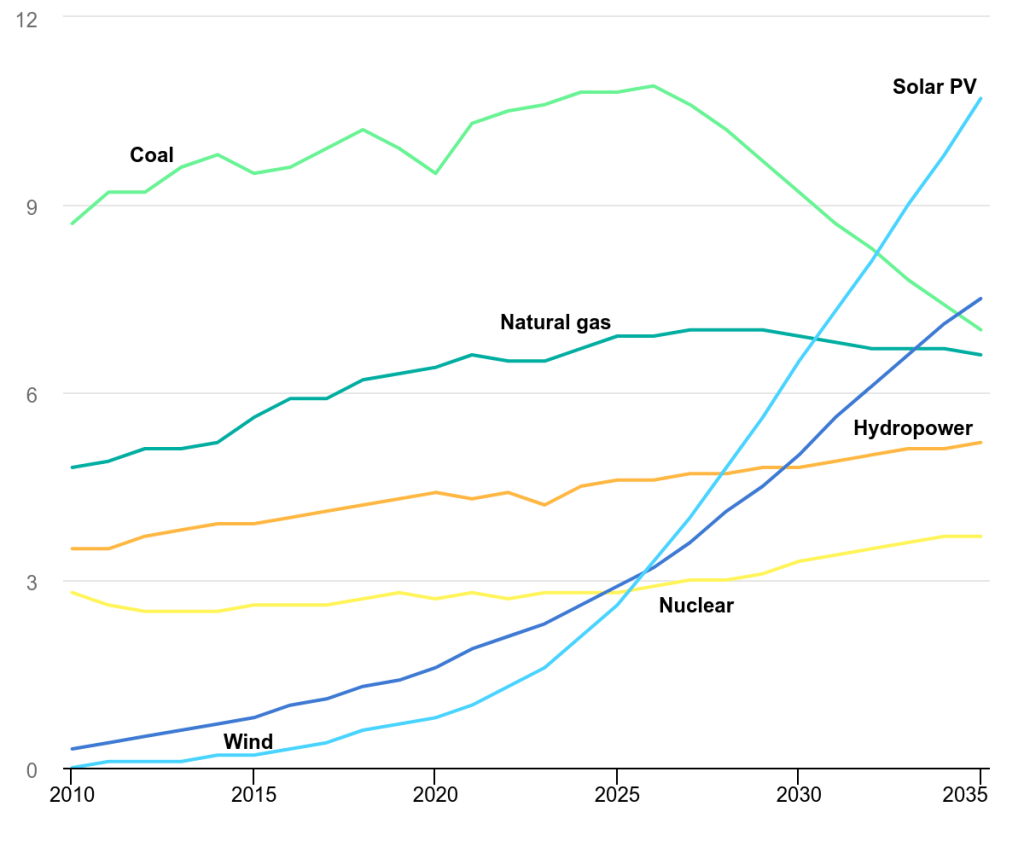
In the energy mix needed to secure this demand the IEA predicts that the use of gas will gradually decrease, whilst solar and wind will play a rapidly increasing role. Whilst oil and gas will be part of the global energy mix going forward, it will be so at a diminishing rate. Long term energy security lies with renewables, and faced with increasing demand for electricity, what is essential in making that increased volume  secure, is investment now in the renewables sector – generation, storage and grid capacity. 

  1. https://www.iea.org/topics/energy-security

Counting on … day 77

4th June 2025

Following on from yesterday, why then does the UK have some of the highest electricity costs?

Currently about 43% of the UK’s electricity ones from renewables but this is not reflected in the prices consumers pay. The wholesale price of electricty is largely determined by the price of gas – a commodity that has increased significantly in cost on recent years. 

The wholesale price of electricity is determined by half hourly bids made by each electricity generator. In response to these bids, electricity is fed into the grid to meet current demand, starting with electricty from the  generator with the lowest bid, and working the way up through the bids until the demand for that half hour has been met. Typically the lower bids are submitted by renewable generators as their’s is the cheapest to produce. However the price ultimately paid to all the generators supplying electricty is set at the price bid by the generator who supplies the final chunk of electricity needed to meet demand. Where the grid is still dependent on non renewable generation, this final bid is typically comes from a gas powered station – and their bid reflect the price of gas. Hence even though our electricity supply is not wholly supplied by gas, it is gas that determines the cost of our electricity. This pricing mechanism is referred to as marginal cost pricing. (1)  

(1) https://commonslibrary.parliament.uk/why-is-cheap-renewable-electricity-so-expensive/

Counting on … day 76

3rd June 2025

Another claim is that fossil fuels offer a) cheaper energy and b) secure energy (to be discussed later this week). In a YouTube presentation of the Shell Energy Transition Strategy 2024, Wael Sawan promotes Shell as being affordable and reliable energy. (1) 

But do fossil fuels provide cheaper energy? According to a report by Our World in Data this is no longer true:- 

“Fossil fuels dominate the global power supply because, until very recently, electricity from fossil fuels was far cheaper than electricity from renewables. This has dramatically changed within the last decade. In most places in the world, power from new renewables is now cheaper than power from new fossil fuels.” (2)

Here in the UK the cost of generating electricty from renewable sources has similarly continued to fall, whilst the cost of generating from gas has increased.

“The British government’s assessments of the LCOE* of generation technologies since 2012 show striking reductions in the LCOE of wind turbines and solar PV panels over time, which fell to between £41 per megawatt hour (MWh) and £48/MWh respectively for new developments in 2023. In comparison, the cost of new conventional gas-fired generation (without carbon capture) rose from £103/MWh (including a carbon price of £25/MWh) in 2012 to £124/MWh (including a carbon price of £65/MWh) in 2023.”(3)

  1. https://youtu.be/jILf-8GpzDI?si=ga1m_bAQ4eeVytxh
  2. https://ourworldindata.org/cheap-renewables-growth
  3. https://www.imperial.ac.uk/grantham/publications/background-briefings/how-cost-effective-is-a-renewables-dominated-electricity-system-in-comparison-to-one-based-on-fossil-fuels/


*The ‘levelised cost of electricity’ (LCOE) provides a simple means of comparing different technologies for the production of electricity, taking account of capital costs and costs of operation, including maintenance and the purchase of any fuel needed.


Counting on … day 75

2nd June 2025

Oil and gas production accounts for approximately 87% of global energy-related greenhouse gas emissions. (1) Yet oil and gas companies present themselves as key players in the transition to net zero. The claims they make to justify the continued extraction and production of oil and gas are questionable. These are issues I am going to explore over the next few days.

One claim is that some sources of oil and gas are more climate friendly than others because they have a smaller – or sometimes it is phrased as cleaner – footprint. This may also be referred to as the (upstream) carbon intensity of the fossil fuel. The reduction being referenced is the reduction in scope 1 and 2 emissions – ie those carbon emissions arising from production, transport and processing of the oil and gas. It does not include the emissions released through the subsequent use of the oil and gas – the scope 3 emissions.

Fossil fuel companies can reduce scope 1 and 2 emissions by: “tackling methane emissions, eliminating all non-emergency flaring, electrifying upstream facilities with low-emissions electricity, equipping oil and gas processes with carbon capture utilisation and storage (CCUS), and expanding the use of low-emissions electrolysis hydrogen in refineries.” (2) Of these cutting methane emissions and flaring can achieve the biggest reductions in emissions.

The Oil and Gas Climate (OGCI) launched its upstream carbon intensity target in 2020. Its aim is to reduce member companies’ aggregate upstream carbon intensity from 23 kg of greenhouse gases per barrel of oil or gas in 2017 to 17 kg by 2025. (3) For comparison scope 3 emissions per barrel are typically 402kg. (4) 

By reducing the carbon intensity of their oil and gas production,  companies may argue that their’s is a better source of fuel. This claim is then used to justify expanding their production of fossil fuels. However they do not along side this make a similar or even greater reduction in production from other sites.

  1. https://www.instituteforenergyresearch.org/international-issues/2023-set-records-in-global-fossil-fuel-use-and-carbon-dioxide-emissions/
  2. https://www.iea.org/reports/emissions-from-oil-and-gas-operations-in-net-zero-transitions

(3) https://www.ogci.com/carbon-intensity-target

(4) https://www.scopegroup.com/dam/jcr:5066dd6f-613a-4ab9-a032-b32b97b28bb7/Scope ESG_IR Oil and Gas Industry.pdf

Counting on … day 74

30th May 2025

Individuals and households are also key contributors to community resilience. If individuals and/ or households are well prepared for a disaster – which could be having three day stock of non-perishable food, having a well equipped first aid kit, having a store of drinking water having a first aid qualification, having windup torches and radios, being proficient at simple carpentry and other repair skills – then the whole community can benefit. And the total can be more than the sum of the parts.

Counting on … day 73

29th May 2025

Community transport can be another plus for community resilience where it enables people to access local transport when public transport of not available or is unsuitable.  It may operate via a dedicated minibus which can be expensive to run or via volunteer drivers using their own car or a shared car. 

Boosting aces to active travel could be equally useful – with use of cargo bikes to move goods and people and the use of adapted cycles that can enable use by people with disabilities and people with young children, to get around without reliance on cars. 

Counting on … day 72

28th May 2025

Warm Spaces offer people somewhere warm to go in the colder months of the year – but they offer more than just warmth and have the potential to be key community hubs in the event so crisis, climatic or otherwise.

“Welcome Spaces are:

  • ▪Warm: Warm Welcome Spaces are heated and offer refreshments such as tea/coffee. Come in and feel the warmth.
  • ▪Welcoming: Warm Welcome Spaces are inclusive spaces where everyone can expect a warm welcome from staff and volunteers.
  • ▪Free: Warm Welcome Spaces are free to enter. It’s a great place to connect with your community and make new friends.
  • ▪Safe: Every Warm Welcome Space is a safe place to be. Lots of spaces can also signpost you to other local services that can support you.” (1)
  1. https://communitypeople.org.uk/help-for-people/warm-spaces