
Counting on … day 20

29th January 2025

Food waste occurs at all stages between field and the fork. 

At the field end, waste may occur because the crop has not grown to a saleable quality which could because of drought or excess water, frosts or excess heat, infestation by bugs or diseases. Food waste may occur  because of delays in harvesting (due to adverse weather) or a lack of workers or equipment. 

The increasing occurrence of adverse weather events caused by the climate crisis is going to be an issue for decades to come. Even if we can curtail carbon emissions, it will be  many decades before global temperatures will reduce to a level such that weather patterns will revert to what we would consider normal.

As regards harvesting, much of the work is done by people on short term insecure contracts earning minimal  wages. This is not good for them nor is it good for our food system. Maybe as consumers we should be willing to pay a fairer price for our food. But equally it maybe others in the supply chain need to be taking a smaller profit. The following Guardian article is interesting. But it is not just a UK issue. Similar problems happen in Spain where ‘cheap’  seasonal labour  is brought in from North Africa – https://www.ethicalconsumer.org/ethicalcampaigns/agricultural-workers-rights-almeria

“Employment tribunal hearings are due to begin this week to decide their claims for unlawful ­deduction of wages, unfair dismissal, discrimination and harassment against Haygrove, a business which runs five farms in the UK growing ­strawberries, cherries and other berries.

“It employs more than 1,000 ­people to pick fruit and uses the seasonal worker scheme, a visa programme introduced after Brexit when fruit was left rotting in the fields because there was no one to pick it. Haygrove disputes the claims.

“McAndrew said there was substantial evidence of “widespread exploitation” of people on the seasonal worker visa. Part of the reason is that growers are under extreme pressure from supermarkets to drive down prices, and seasonal workers are usually employed through third-party agencies.

“Research by the Landworkers’ Alliance into the fruit supply chain found that for a £2.30 punnet of strawberries, the farm received 50p, of which just 5p was profit, while workers received just 18p after deductions for tax, visa and accommodation.” (1)

(1) https://www.theguardian.com/global/2025/jan/26/protests-by-fruit-pickers-and-farmers-put-spotlight-on-price-of-cheap-food-in-uk?CMP=Share_iOSApp_Other

Counting on … day 19

28th January 2025

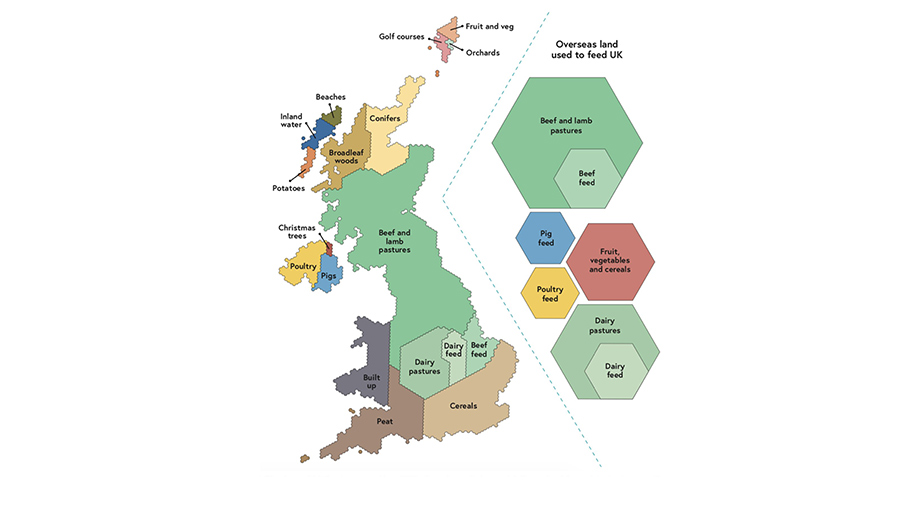
When we are thinking of food waste in terms of ensuring we use the Earth’s resources in a sustainable way, we might also want to consider how we use the limited amount of land we all share. Globally 77%of farm land is used to raise animals for meat and dairy products, yet this supplies only 18% of the world’s (human population) calories and 37% of their protein.

Here in the UK more than half our land is used to rear livestock for meat and dairy products. 

National Food Strategy landuse map

Counting on … day 18

27th January 2025

Last September the UN Climate Change News reported that “In 2022, a staggering 1.05 billion tons of food were wasted, while 783 million people went hungry and a third of the global population faced food insecurity…Food loss and waste account for 8-10% of annual global greenhouse gas emissions – nearly five times the total emissions from the aviation sector – and contribute to substantial biodiversity loss, using up almost a third of the world’s agricultural land.” (1) 

Reducing food waste is something we can all do that will help address the climate and biodiversity crises and improve global food security. 

Useful advice can be found here – https://www.ethicalconsumer.org/food-drink/climate-action-10-steps-reduce-food-waste

Counting on … day 17

23rd January 2025

Following on from yesterday, another approach would be to buy less. We probably think we have more stuff than we need so rather than buying something new, maybe question whether you actually need it or whether you have something already that would do. I recently needed some flip flops to walk along the path to the outdoor swimming pool – it’s about 50m of cold concrete – and then it occurred to me to use the old pair of sandals whose soles are wearing out. 

Equally we are often tempted by advertising to buy things we don’t need.

Counting on … day 16

22nd January 2025

If not buying things makes for better use of limited resources, then there is real advantage in borrowing and sharing. This can informally, via a street WhatsApp or via a Library of Things – https://www.libraryofthings.co.uk/

And also – https://www.ethicalconsumer.org/home-garden/library-things-directory

Counting on … day 15

21st January 2025

We can avoid waste by making use of second hand shops, charity shops, pre-loved web sites. If we have something we no longer need/ want that is more than likely someone else who would like it. These outlets enable us to pass the thing on rather than discarding it as waste.

 And by the same token, if we need something we can visit these outlets to buy what we need there rather than buying new – and thus avoiding using up more of the Earth’s limited resources.

Counting on … day 14

20th January 2025

One way of reducing waste, is to repair things. Darning a sock saves a pair going into landfill. Stitching up a hem or a seem to get some more wear out of a skirt or shirt. Sewing a patch on the knee or elbow will add more wear to a pair of trousers of jumper. Sewing a sheet sides to middle will do likewise. 

Re-heeling or soleing shoes where that is possible – sadly the design of many pairs of shoes don’t this as an option. 

Repair Cafes and repair shops can mend household items such as kettles and toasters. Do ensure that electrical repairs are done by someone appropriately qualified. 

Other repairs might simply involve glue, ‘Sugru’ a mouldable silicone substance that can mend a hole in a pot, refix a pan handle or strengthen that weak point on a recharging cable. Gaffer tape mends  a hundred things! Be imaginative. Be creative! Give things you use and love an extra lifespan. 

Counting on … day 13

17th January 2025

It is not just businesses that need to change, government also needs to use its power to change the system. “We need the Government to stop tinkering with measures that create tiny insignificant changes and tackle single use waste in the way they finally tackled smoking, helping to make our public spaces litter free as well as smoke free.  That requires putting in place systems which significantly disincentivise single-use and makes reuse a convenient and viable option for both businesses and consumers.” (1)

  1. https://www.refill.org.uk/about/what-is-reuse/

Counting on … day 12

16th January 2025

Changing how we consume, reuse and refill products to ensure a sustainable world requires more than just consumer action. It needs systemic change: “big brands and businesses need to be held responsible for cleaning up their act!  We need an end to corporates buying too much stock and then encouraging us to buy things we don’t need via sales and Black Friday. We need an end to corporates promoting more and more “seasons”, constantly trying to persuade us that things in our home are no longer in vogue, that our clothes and furnishings are out-of-fashion. It’s corporate behaviour that has created the single use system and we need to change that system – so it’s the corporates that need to change.” (1)

  1. https://www.refill.org.uk/about/what-is-reuse/

Counting on … day 11

15th January 2025

Reducing waste and the pressure we put on the Earth, we should also consider how many single use items we are discarding, including those that we put in the recycling bin. 

Plastic yogurt pots can be recycled but that still uses oil to produce the plastic (very little food packaging is made from recycled plastic) and energy to produce it. Could there be a more sustainable way of getting yogurt? One way might be for yogurt to be sold in reusable glass jars – as per milk. Another might be to make one’s own yogurt in reusable pots. 

The same is true of margerine tubs – might solid margerine (vegan butter) that comes wrapped in greaseproof paper be better?

And what about refilling and reusing wine bottles, beer bottles etc? We do it with milk and fruit juices. 

And what about avoiding single use coffee cups and plastic bottles of water? Tap water is free! And coffee tastes better in a proper cup.

Four different types of refull/ reuse consumer practice