Counting on … day 60

6th March 2024

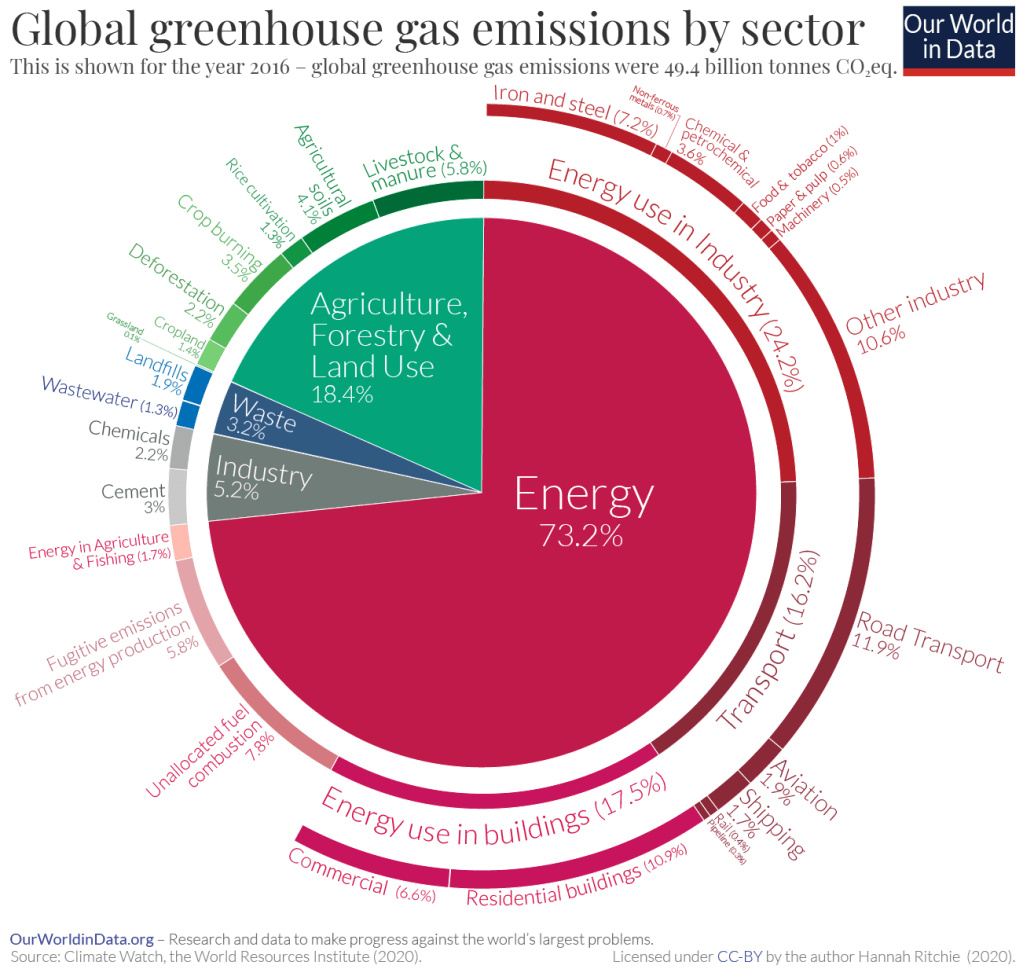
We can also look at carbon emissions by sector.

Not surprisingly energy is the biggest contributor. So much of the energy we use comes from fossil fuels  – which all emit carbon dioxide and other greenhouse gases. And this energy is used in so many different situations – transport, heating or cooling buildings, lighting and cooking, industrial and manufacturing processes, communication etc. 

More worryingly, carbon emissions from fossil fuels are still rising. The International Energy Agency Agency (IEA) reports that energy-related CO2 emissions were 36.3 Gt in 2021; 36.8 Gt in 2022; and 37.4 Gt in 2023. In each year the figure was reported as a new high! Until these emissions start to fall – and fall rapidly – humanity will not be able to avert a worsening climate crisis. 

For more information see – https://ourworldindata.org/ghg-emissions-by-sector

Counting on … day 59

5th March 2024

If we wish, we can calculate our individual – or household –  carbon footprint. Various groups offer online carbon footprint calculators. Some are very quick to work through but are more rough and ready.  More complex calculations will be more precise. We can use this information to identify areas of our lifestyle where we could make adjustments to achieve a more sustainable life style.

Suggested carbon footprint calculators: 

https://footprint.wwf.org.uk

https://www.carbonfootprint.com/calculator.aspx

Generally our carbon footprint is proportionate to our income. Of course it does depend what we buy. Spending £1000 on air travel will have a far higher carbon footprint that spending £1000 on planting a small woodland. Mike Berners Lee has produced a book, “How Bad Are Bananas? The Carbon Footprint of Everything.” This  details the carbon footprint of a wide range of products and  activities and can thus help us choose less carbon-costly lifestyles. 

A report produced by the Guardian in conjunction with Oxfam, the Stockholm Environment Institute and others, reported that “The richest 1% of humanity is responsible for more carbon emissions than the poorest 66%, with dire consequences for vulnerable communities and global efforts to tackle the climate emergency.” https://www.theguardian.com/environment/2023/nov/20/richest-1-account-for-more-carbon-emissions-than-poorest-66-report-says?CMP=Share_iOSApp_Other

Further articles –

Counting on …. Day 58

4th February 2024

To get a feel for the size or scope of carbon emissions, we can look at how much each nation produces. These figures represent the emissions produced in each country – including for items that are then exported – and does not include the emissions of goods produced in other countries (ie emissions attributed to imports). Nor do the national figures allow for international aviation and shipping so these are shown separately.

  • Global carbon footprint for 2022 – 37.14 giga tonnes;  varying from an average of 37.6 tonnes per person for someone living in Qatar, to 0.1 tonnes for someone living in Malawi, Rawanda or Sierra Leone*
  • UK carbon footprint for 2022 – 318 million tonnes; an average of 4.7 tonnes per person*
  • International aviation 2022 – 425 million tonnes 
  • International shipping 2022 – 625 million tonnes  

For more details see https://ourworldindata.org/co2-emissions

Counting on … day 57

1st March 2024

Carbon footprint means the amount of carbon dioxide released into the atmosphere by an action.

This could be:

  • an individual activity – eg driving one mile in a car 
  • growing or producing a particular product – eg the carbon footprint of a pint of milk 
  • the sum of products and activities a person uses in a year
  • or similarly the sum of products and activities an organisation or company, industry or nation uses in a year.

A carbon footprint is measured in tonnes of carbon dioxide.

 Counting on … day 56

29th February 2024

The Fourth Carbon Budget covers the years 2023 to 2027. Each Budget is created well in advance to allow organisations and companies to plan the necessary changes that the Budget will require. The Fourth Carbon Budget was approved by the Government 2011. The Budget proposals included the following sectors: international aviation and shipping, agriculture, surface and other transport, energy and power  supplies, industry, no residential (offices, shops etc). 

The Climate Change Committee regularly reviews and reports to Parliament its assessment as to whether the plans and legislation put in place by the government, the plans and progress being made by businesses, and the uptake of lifestyle changes being made by the population, are on track to meet the Budget targets.  

However drawing up a budget is often much harder easier than implementing one. 

In its last report made in June 2023, the Climate Change Committee reported: 

“A lack of urgency. While the policy framework has continued to develop over the past year, this is not happening at the required pace for future targets…

“Despite some positive steps to provide households with advice on reducing energy use in the last year, a coherent public engagement strategy on climate action is long overdue…

“Expansion of fossil fuel production is not in line with Net Zero. As well as pushing forward strongly with new low-carbon industries, Net Zero also makes it necessary to move away from high-carbon developments…

“The need for a framework to manage airport capacity. There has been continued airport expansion in recent years, counter to our assessment that there should be no net airport expansion across the UK.”

For more information see –https://www.theccc.org.uk/publication/2023-progress-report-to-parliament/

In other words there is much to be done at all levels if we are to meet the Fourth Carbon Budget.

Counting on …day 55

28th February 2024

The UK’s Third Carbon Budget

Hot of the press comes an update for yesterday’s item. The Climate Change Committee published today their letter to Graham Stuart MP Minister of State for Energy Security and Net Zero: 

 “We are pleased to review your final figures showing that the UK’s Third Carbon Budget, covering the period 2018 to 2022, was successfully met with emissions 391 MtCO2e and 15% below the level of the budget (2,544 MtCO2e). ”

The letter goes on to emphasise the importance of increasing – not decreasing – the urgency and energy with which the net zero target is pursued: “Future carbon budgets will require an increase in the pace and breadth of decarbonisation. It is essential that an ambitious path of emissions reduction is maintained towards Net Zero.”

The letter also notes that “There has been good progress in the decarbonisation of electricity supply, driven by a faster than expected phase-out of coal. Industrial emissions also fell due to reduced output. However, most of the surplus in the Third Carbon Budget was due to predominantly external factors. In most other sectors, such as transport and buildings, the UK is not on track and progress will need to accelerate rapidly.” 

To read the full letter – https://www.theccc.org.uk/wp-content/uploads/2023/09/Advice-on-the-Third-Carbon-Budget-carry-over.pdf

Counting on … day 54

27th February 2024

Climate Change Committee 

In the UK the Climate Change Act (2008) was brought in to address the climate crisis. The Act created the Climate Change Committee as an independent body to advise the government. The Committee produces draft carbon budgets covering 5 year periods with each budget reducing step by step the UK’s emissions towards net zero. As of 2019 these budgets are aimed at achieving net zero by 2050.

The diagram below shows how this is intended to happen. The Third budget should achieve a reduction in UK emissions to 2544 million tonnes by 2022, a 38% reduction compared with 1990 levels. Whether this has been achieved has yet to be reported. It should be details in the CCC 2024 Progress Report (still awaiting publication).

Counting on … day 53

26th February 2024

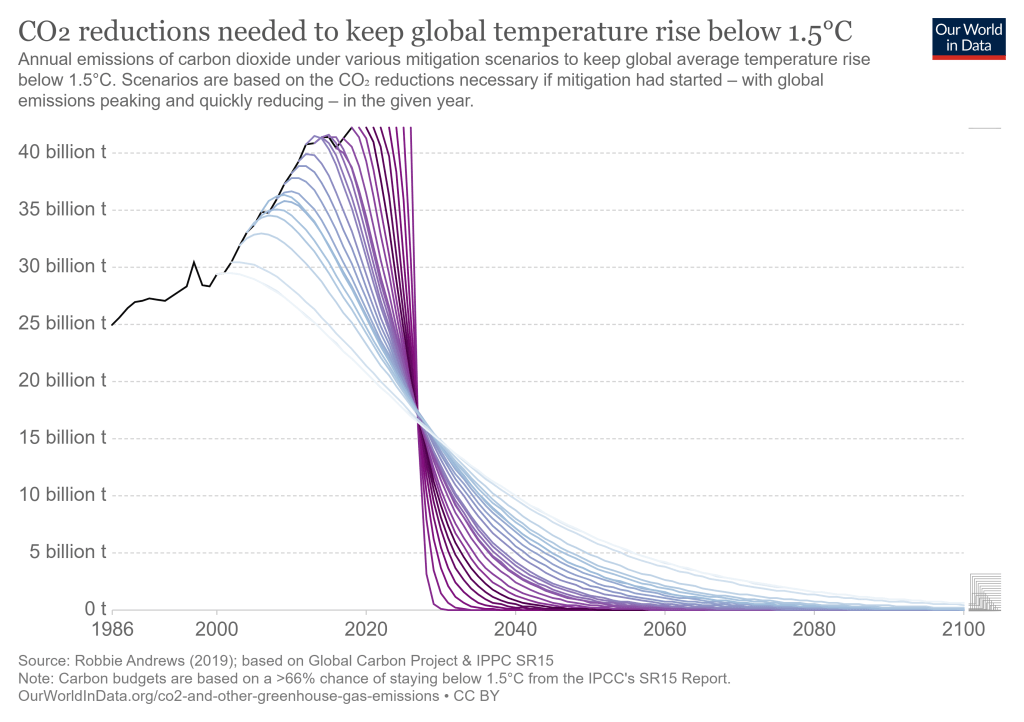
To keep the world within the desired 1.5C of warming, the carbon dioxide concentration in the atmosphere has to be kept below 500ppm. To achieve this the ambition agreed at COPxx in Paris in 2015 is to reduce global carbon emissions by 45% by 2030 and to net zero by 2050. 

In 2015 global carbon dioxide emissions were just over 35 billion tonnes, in 2019 emissions reached 37 billion tonnes, and having dropped back to 35 billion tonnes in 2020 during covid, emissions are again back up at 37 billion tonnes (2022).

Each year that passes without meeting these targets means that to achieve the 2030 and 2050 targets becomes even more difficult as we have to cut back emissions even more steeply. This is vividly shown in the graph below. 

Counting on … day 52

23rd February 2024

Keeping the temperature rise – global warming – within 1.5C necessitates constraining the carbon dioxide (and other greenhouse gas) emissions we release into the atmosphere. The diagram below shows the correlation between global temperatures and carbon dioxide concentrations in the atmosphere. 

Keeping global warming within this window involves both reducing the amount of greenhouse gases we emit and enhancing processes that absorb such gas emissions. An example of the first would be reducing – or even cutting out entirely – the burning of fossil fuels; an example of the second would be reinstating woodlands and wetlands. 

Counting on … day 51

22nd February 2024

Tipping points – “In climate science, a tipping point is a critical threshold that, when crossed, leads to large, accelerating and often irreversible changes in the climate system.” https://en.wikipedia.org/wiki/Tipping_points_in_the_climate_system

Likely tipping points if we reach 1.5c of warming include the loss of boreal permafrost in the artic regions. This would result in the release of large amounts of methane rapidly increasing the rate of global warming.
Another potential tipping point would be the die-out of mangroves and seagrass meadows in the tropics, reducing how much carbon dioxide is absorbed by the oceans and so fuelling further global warming.

Tipping points accelerate global warming.  

Further reading – https://www.theguardian.com/environment/2023/dec/06/earth-on-verge-of-five-catastrophic-tipping-points-scientists-warn?CMP=Share_iOSApp_Other