
Counting on … Day 4

4th January 2024

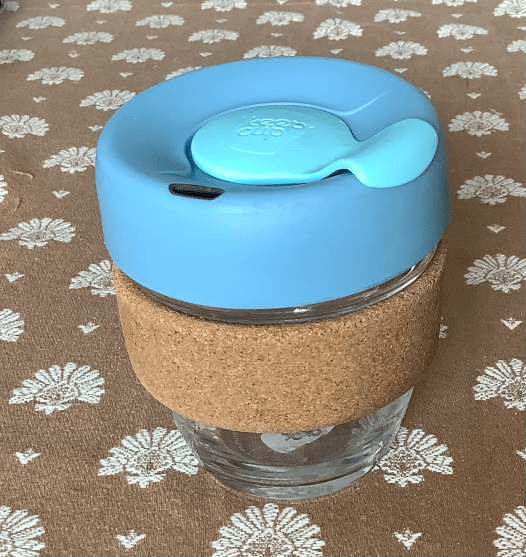
Keep a keep-cup handy

Reducing waste is good for a planet where we currently consume resources faster than they can be replaced. At current rates of consumption, the UK would need 2 and 1/2 planets’ worth of resources. (https://overshoot.footprintnetwork.org/how-many-earths-or-countries-do-we-need/

Using valuable paper and plastic to make a cup that will be in use for maybe 10 minutes whilst the beverage is drunk, and will then require further resources to recycle it, doesn’t make sense – especially as a few as 1 in 400 are actually recycled. Surely it is better to either sit in and have your coffee in a proper ceramic cup, or to use a portable, reusable cup.

“A single-use plastic cup has an impact ranging from 10g CO2e to 30g CO2e, this large range is due to differences in waste management and material selection.  …Over the lifetime of a reusable cup 10.3kg of CO2e could be saved compared to using single-use cups instead (assuming 500 uses / cups of coffee).” https://www.zerowastescotland.org.uk/resources/environmental-benefits-reusable-plastic

Carrying a keep-cup with you when out and about is an easy habit to form. You might equally develop the habit of carrying a reusable water bottle. You might opt for a refillable lunch box, spoon or fork combo if you like buying take out salads, cakes etc. The refill app lists places where you can readily get  refills for water bottles, sandwich boxes etc – https://www.refill.org.uk/

Further reading – https://www.wired.com/story/paper-cups-toxic/
https://www.theguardian.com/business/2023/oct/21/warnings-over-eco-coffee-cups-that-pose-risks-to-health-with-toxic-resin?CMP=Share_iOSApp_Other

Counting on … day 3

3rd January 2024

Avoid food waste

“If food waste were a country, it would be the third biggest polluter in the world. Globally, one third of the food we produce goes to waste, and according to WRAP, £3.5 billion worth of edible food is thrown away each year by UK households” – https://hubbub.org.uk/how-to-tackle-a-complex-issue-like-food-waste-and-turn-it-into-action

Food waste can happen at the farm especially if crops produce more than expected or reach harvesting time sooner or later than expected, which often means that the supermarkets are not ready for the produce. This is good reason for eating what is available which is more achievable when buying from a green grocer or via a veg box scheme. 

Food waste can happen at the shop/ supermarket when items are over stocked. Increasingly supermarkets are encouraged to divert this food to charities rather than letting it go to waste.

Food waste also happens in the home. This is best avoided by preparing and cooking only what you will eat (and so having a good feel for portion sizes), by saving and reusing left overs, and by buying only what you will use – a shopping list is a good way of avoiding overbuying.

For more tips – https://greentau.org/2021/08/09/eco-tips-4/

And – https://www.lovefoodhatewaste.com/

Counting on … Day 2

2nd January 2024

Eat seasonally. It is better to eat what is growing and what is currently available locally than to eat things grown out of season (either in hot houses or imported from abroad. It is also better to eat what is available – even if that means sprouts after Christmas because that’s what the farmer grew to supply the supermarkets, or the broccoli that is ready to be harvested now because the weather has been mild. Not eating what is available means it will go to waste. 

Eating seasonally is also good fun! It is a pleasure to look forward to the first asparagus in May, or the savoy cabbages in January, the first Discovery apples in July or the wild garlic leaves in April. There isn’t the same excitement to be had from always having strawberries to eat every day, or tomatoes (which are never as tasty in the winter as they are in the summer).

For a colourful chart –

Counting on … Day 2

2nd January 2024

Eat seasonally. It is better to eat what is growing and what is currently available locally than to eat things grown out of season (either in hot houses or imported from abroad. It is also better to eat what is available – even if that means sprouts after Christmas because that’s what the farmer grew to supply the supermarkets, or the broccoli that is ready to be harvested now because the weather has been mild. Not eating what is available means it will go to waste. 

Eating seasonally is also good fun! It is a pleasure to look forward to the first asparagus in May, or the savoy cabbages in January, the first Discovery apples in July or the wild garlic leaves in April. There isn’t the same excitement to be had from always having strawberries to eat every day, or tomatoes (which are never as tasty in the winter as they are in the summer).

For information on what is in season see – https://hubbub.org.uk/how-to-eat-seasonally-in-the-uk-a-month-by-month-guide

Counting on … Day 1

1st January 2024

Things we can do to address the climate and biodiversity crisis.

Cut out or cut back on meat in our diets and instead eat seasonal plant based meals. And with Veganuary, this is a good time to start – or at least to experiment. 

We are not always aware of the extent to which farm animals dominate the environment. Looking at the weight (mass) of mammals that inhabit the planet, a mere 4% are wild creatures (and that includes whales and elephants), 34% are humans and 62% are farm animals. This ratio is  unsustainable. Raising farm livestock requires large amounts of land for grazing and fodder crops, and water – all of which could be better used feeding the world and restoring biodiverse rich habitats. 

For masses of previous items – https://greentau.org/tag/vegan/

eco tip for swopping to a plant based diet – https://greentau.org/2021/10/12/eco-tips-11

Or sign up for the Veganuary email – https://veganuary.com/

/

Counting on …

29th December 2023

The climate and ecological crises that the world faces are of human making and it is we humans who will have change the way we live if we are to avert a worsening of events. Much will have to be done at the level of international cooperation, at the level of national and local governments, by businesses and organisations, but even at the smaller scale of local communities, households and individuals, there are things changes to be made that will collectively make a difference.
I have included many thoughts and ideas in my original Counting Down posts and in the Counting on posts, often recycling suggestions. And that is what I shall be repeating. January is typically the month for making New Year’s resolutions which is a good place to start if we are looking to adopt more sustainable, planet friendly lifestyles. So over the 31 days of January I shall be putting forward some suggestions and ideas in the hope they will enable and encourage us all.

Counting on … day 1.227

30th November 2023

Today is the start of COP28. This is the 28th United Nations Climate Change Conference. Held annually, this gathering of various parties (governments and others) is tasked with agreeing policies to limit the rise of  global temperatures, and to help countries adapt to the climate change that is already happening.

You can sign up for their daily newsletter  – ‘Top of the COP’ 

You can join in daily prayers by zoom with Green  Christian – https://greenchristian.org.uk/prayer-for-cop28/

I also recommend this link for daily prayers and reflections –

https://sites.google.com/view/praying-for-cop28/home

Counting on … day 1.226

29th November 2023

Recently I was chatting with a friend about the number of items which have since our youth become single use items (this is not to say I am either old nor that everything was so much better in the good old days!). But things like wet wipes did not exist – instead there would be a cloth or maybe even a damp flannel in plastic bag for a journey. A kitchen towel meant a hand towel: washable dish clothes and floor clothes were for wiping up spills. Hankies were cotton and washable and came with embroidered designs or printed patterns. And I even remember from my honeymoon having a paper envelope with my room number, in which I placed my cotton serviette at the end of the meal so that I could use it again at the next meal. 

Surely laundering is better than creating waste that is either burnt or ends up in landfill?

Counting on … day 1.224

27th November 2023

As responsible consumers, we may want to think not just about what we are buying but about the packaging too. Most packaging in single use – the plastic container, the cardboard box, the plastic wrap, the paper cup. Sometimes it is essential if we are to be able to take the product home, but more often it is a decorative feature that makes the product more attractive. And giving pleasure is not a bad thing. But maybe there are times when we should be saying ‘no thank you’ when something has an excess  of packaging. Or times when we should be writing to the manufacturer asking for less packaging or at least packaging that can – and will be – recycled. Or times when we should look for a refill option using reusable packaging. 

I often feel it is a pity that cardboard boxes can’t be reused more often before they are recycled: they are often so strong and sturdy and there must be a a carbon footprint involved in recycling them. 

Counting on … day 1.223

24th November 2023

Black Friday seems a good day to reflect on what it might mean to be a good consumer. Certainly shopping ethically – https://greentau.org/2023/11/07/counting-on-day-1-210/ – but maybe also consuming more slowly. How often do we need a new dress or new duvet set? Maybe consuming more locally so that we support the local economy – buying from the local bookshop not Amazon, the local green grocer not Tesco’s. Maybe for some of us it means consuming less. Maybe it means campaigning so that others can afford to consume more so as to live in comfort.

For more thoughts – “Sustainable production and consumption must therefore replace undifferentiated economic growth as the goal of 21st-century political economy. And making the case for this means challenging the belief that sustainable consumption will always involve sacrifice, rather than improve wellbeing.”

Read the full article here –

https://www.theguardian.com/environment/commentisfree/2023/nov/23/consumerism-planetary-ruin-life-community?CMP=Share_iOSApp_Other

Counting on … day 1.222

23rd November 2023

This Friday is Black Friday  – a widely advertised event that lasts at least for a week! – when retailers encourage us  spend more on so called ‘bargains’. It seems as if the whole purpose of human existence is to shop. But shopping for the sake of shopping – consumerism for the sake of consumerism – is highly destructive of the environment and undermines the essence of being human which is about relationship with our neighbours. 

The following extract comes from a pertinent  Guardian report: “It’s forecast that this month and next, a record £9.5bn will be blown on advertising, more than the UK government spends on prisons in a year. This is the philosophy of “spending like there’s no tomorrow” – literally, given the climate crisis. 

Black  Friday.” (1) 

But it doesn’t have to be this way and we can be part of the transformation. Make this Friday a Buy Nothing Day! Display a Buy Nothing poster on your garden gate, front window etc. For more info and posters visit http://buynothingday.co.uk/

  1. https://www.theguardian.com/commentisfree/2023/nov/21/the-guardian-view-on-festive-marketing-stop-spending-like-theres-no-tomorrow?CMP=Share_iOSApp_Other

This article from a few years ago focuses on the huge amount of waste that Black Friday and Cyber Monday produce – https://greentau.org/2021/11/29/green-tau-issue-24/