Peas and beans can also be used ground up as flour. (Again you can buy different flours from Hodmedod’s).
Pea and bean flour can be used to replace some of the wheat flour in things such as bread, cakes, pastry and pasta, adding more protein to these foods. Pea and bean flour can be used to replace egg in foods such as frittata, pancakes and Yorkshire puddings. (Experiment with vegan recipes for these).
Pea and bean flour can be used to thicken liquids and to make sauces. Mix with a little water as if it were corn flour and add in/into the hot liquid. (You can make these sauces in a microwave to to save energy).
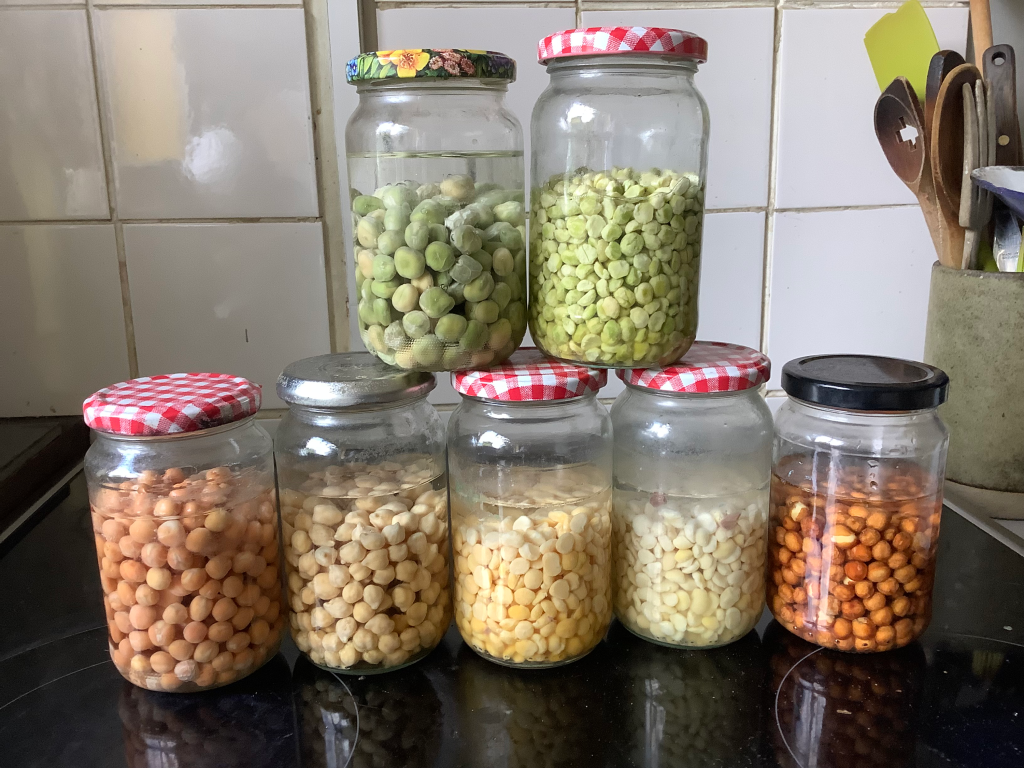
All these are UK grown and come from the retailer Hodmedod. They will provide the basis for a number of meals. For example –
Mushy peas and fried sweet potatoe
Risi bisi*
Ratatouille and wild rice
Hummus and toast
Dhal and rice
Vegetable lasagna
Tagine with millet
NB I weigh a daily portion of beans into a glass jar, add water and leave to soak. Then I place all the jars in a large pan, half fill with water and bring to the boil. Letting it simmer for 30 minutes before turning of the heat. This gives me 7 jars of ready cooked beans.
What often worries people when swopping to a plant-based diet is getting enough protein. We have been brought up understanding that we need protein and that meat, fish and dairy are all good sources of protein. The recommended daily protein consumption is 55.5 grams per person for adult men and 45 grams per person for adult women which ideally would be spread throughout the day. 100g of chicken or beef equates to about 30g of protein, 100g salmon about 25g, 1/2 litre of milk about 15g and 50g of cheese about 12g. As in addition a couple of slices of bread can contain 6g of protein, 100g of rice 10g it is not surprising that many people consume more than the recommended amount. https://www.nutrition.org.uk/healthy-sustainable-diets/protein/?level=Consumer
As well as bread and rice, protein can be found in beans, pulses and tofu – about 8g per 100g (cooked weight); nuts and seeds about 5g per 25g (a tablespoon of peanut butter is about 4g); in green vegetables such as cabbage and broccoli about 3g per 100g. Combining beans/ pulses/ peanut butter with grains such as rice/bread/pasta provides an optimal mix of amino acids present in protein. This makes simple dishes such as beans on toast, a peanut butter sandwich, hummus and pitta bread, rice and dhal an excellent source of nutrition.
A flat white coffee contains about 140ml of milk (about quarter of a pint) but the barista is likely to heat more milk than is necessary to create a perfect cup and the excess will be discarded. So one way of reducing your dairy consumption might be to swop to a non dairy milk for your coffee – eg an oat flat white (or latte or cappuccino). You may be surprised how palatable you find this – many people find the slight sweetness of oat milk enhances the coffee.
You can swop dairy milk for oat milk in baking, when making custard and white sauces, and in porridge.
As with milk so it is equally easy to replace dairy butter with a plant-based butter – these have a similar texture and taste to dairy butter. You can swop dairy for plant-based butter on bread, in baking and pastry making, for white sauces and risottos, in baked potatoes etc.
If agricultural expansion is to be reversed, it will need the combined efforts and cooperation of governments, farmers, consumers, commodity traders, financiers, retailers, and environmental scientists. One of the most important areas to change will be that of meat production.
‘Of all the world’s land surface, approximately 71% is ‘habitable land’; half of this land is used for agriculture. Currently, pastures used for grazing and land used to grow crops for animal feed account for 77% of agricultural land, thus comprising nearly 30% of the total land surface of the planet…If we combine pastures used for grazing with land used to grow crops for animal feed, livestock accounts for 77% of global farming land. While livestock takes up most of the world’s agricultural land it only produces 18% of the world’s calories and 37% of total protein.’ https://ourworldindata.org/global-land-for-agriculture
Across Europe governments are, to a greater or lesser extent, aiming to reduce meat production on farms and meat consumption amongst populations. The Irish government for example, is looking to reduce its dairy herd by 65000 animals per year over the next three years. The Dutch government is planning to reduce its cattle numbers for 30% by 2030. The Climate Change Committee in the UK has recommended livestock cuts of 20-50% for beef and lamb, whilst at the same time recommending a 20% reduction on meat and dairy in the UK diet.
Reducing cattle numbers will free up more land for plant crops and so feed more people and/ or rewilding which will boost biodiversity.
Over the next few days I will be looking at easy ways of adapting to a more focused plant based diet.
For further info in farming, land use and biodiversity see
If we need to slow down agricultural expansion, do we know what caused its expansion? There is I’m sure no one answer but a multiplicity of interconnecting reasons.
Population growth. Globally we now need to feed over 8 billion people, up from 6 billion in 1999, and 3 billion in 1960. Yet researchers tell us that we could feed 10 billion people without exceeding the planet’s environmental boundaries (https://www.nature.com/articles/s41893-019-0465-1)
Income growth – as people become richer they choose to eat more expensive foods which are often more resource expensive too – eg imported tropical fruits, sugar based foods, and especially meat
Developments in agriculture that allow more intensive production such as pig breeds that can reach a slaughter weight in 4 months; high protein feed made from soy beans that rapidly fatten chickens; high yielding grains that combine with fertilisers and pesticides to increase harvests.
Financial rewards that encourage rain forests to be cleared to make way for sugar plantations, soy crops and cattle ranching.
Irrigation and airfreight that allow crops such as asparagus, avocados and blueberries to be grown in the southern hemisphere and imported as out of season alternatives for the northern hemisphere.
Social changes that have made chicken a staple rather than a special treat, that have reduced the popularity of foods – in the UK – such as cabbage and runner beans, replacing them with courgettes and peppers.
Social changes that mean less food is home produced, that less food is preserved at home (eg jam/ chutney/ sauerkraut), that less food is home grown.
Increasing quantities of food going to waste – caused by social changes and increasingly long supply chains.
Recently the government ordered that cartoon murals in the centres where asylum seekers are taken, be painted over. In a come back to that callous and unnecessary action, a petition has been set up asking for the murals to be reinstated, as well as a scheme to send welcoming postcards to the 9000 plus children seeking asylum.
Sometimes it is difficult to tell whether a beautiful rural landscape is the ‘natural’ one as being in its primordial state, or whether it is a ‘natural’ one this is the fusion of human activity in harmony with nature. The two may look very different eg moorlands covered with forests versus moorlands covered with grass and sheep; or low-lying land that is marshy or low-lying land that has been drained and cultivated for arable crops.
The following comments come from the Natural History Museum.
“’What we repeatedly see in our models is that agriculture is one of the main drivers of strong biodiversity declines,’ says Katia. ‘Even when we consider different human pressures, such as human population density and road development, we always find that the most shocking biodiversity declines are across agricultural sites.
‘That is the key point, the fact is that we need to find a way to slow down agricultural expansion.’
The continued spread and intensification of farming and development in the UK over the last 200 years has meant that most landscapes have not escaped some form of human influence.
Balancing the needs of the planet, the needs of indigenous peoples for sustainable livelihoods, and the pressures of developing countries who see industrialisation as the way forwards, how can places like the Amazon rain forest survive? The Amazon is “home to an estimated 400 billion trees belonging to 16,000 different species, more than 1,300 species of birds, tens of thousands of species of plant, and 20% of the world’s freshwater resources. It is also estimated to contain more than 120bn tonnes of carbon, making it a vital carbon sink. But over the past half-century, the advance of cattle ranching, logging, mining, soy farming and oil exploration has devastated huge swathes of the region, pushing it towards what scientists fear could be an irreversible tipping point that would cause the forest to die off.”
The recent Amazon summit at Belém tried to address some of these issues, including how the rainforest can be protected whilst providing for the indigenous people so that there wellbeing and living standards can be improved. “The rainforest is neither a void that needs occupying nor a treasure trove to be looted. It is a flowerbed of possibilities that must be cultivated,” said Lula da Silva, the Brazilian President.
In the high alpine meadows of Switzerland there is a rich biodiversity of flowering plants and insects (various bees, flies, grasshoppers, ants) spiders, butterflies and moths – far more than I have seen in the UK. Is this richness a result of the alpine dairy farming? Quite probably so. Without the cows, the vegetation is tends to shrub and forest, which though totally natural is less biodiverse rich. Away from the steep slope, dairy farming is more intense and doesn’t support the same richness of plant and insect life. Even on the alpine slopes, repeated cutting of grass for silage reduces the biodiversity.
Our human presence can have a positive effect on the natural environment.

 The Green Tau