14th May 2023
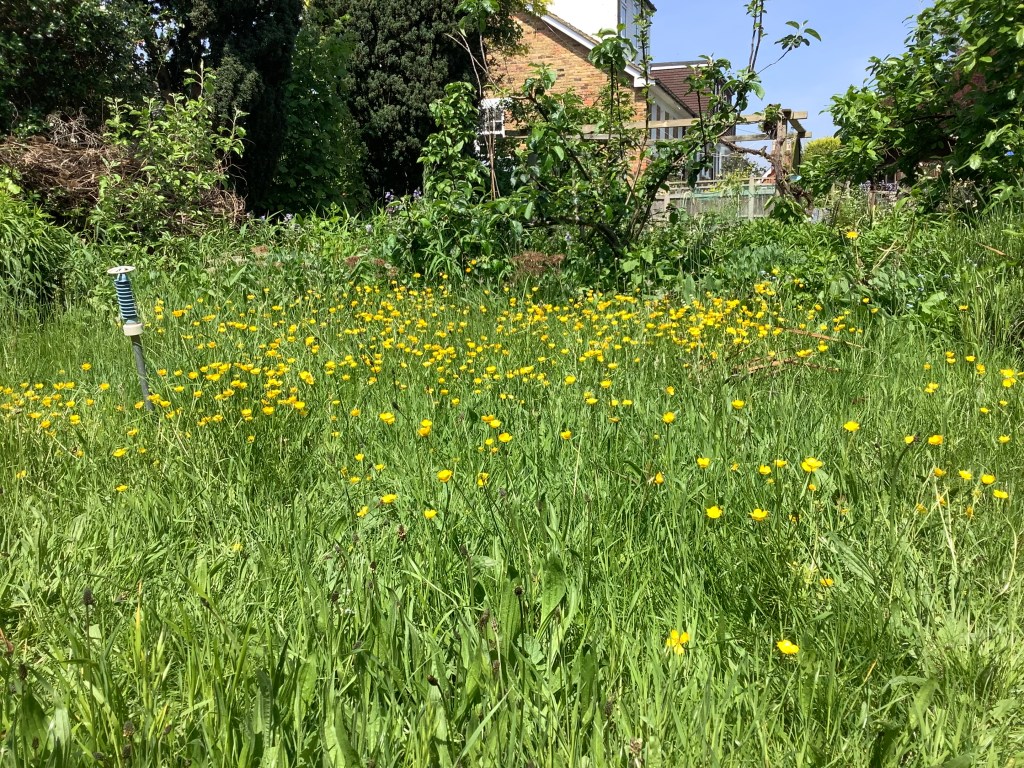
No Mow May over the years changes the plants that inhabit our lawn. This year is the year of the buttercup!

Reflections and actions during COP26 and going on
14th May 2023
No Mow May over the years changes the plants that inhabit our lawn. This year is the year of the buttercup!
13th May 2023
Using the model of a citizen’s assembly, the WWF, the RSPB and National Trust put together The People’s Plan for Nature – a vision for the future of nature, and the actions we must all take to protect and renew it.
The Plan, amongst other things, “…calls on individuals and communities to:
12th May 2023
Interesting comments from RSPB – “One of the latest experiments is planting wildflower strips and alleys of trees within fields. Research has already shown that planting wildflower strips helps bring beneficial insects into the fields, which is good for pollination and pest control. But this ten-year trial hopes to show the strips with trees can help in other ways too, such as:
10th May 2023
A report from Euro News – “The EU has approved plans for the Dutch government to buy out farmers. The scheme is part of the Netherlands’ plan to drastically slash nitrogen emissions, a major source of which is livestock farms. Farmers in the Netherlands have been staging protests over emissions reduction targets since October 2019 – The Dutch ruling coalition wants to cut emissions, predominantly nitrogen oxide and ammonia, by 50 per cent nationwide by 2030. Nearly €1.5 billion will be used to compensate farmers who voluntarily close farms located near nature reserves. Some 3,000 farms are expected to be eligible.” https://www.euronews.com/green/2023/05/03/dutch-farmers-could-be-paid-to-close-their-livestock-farms-under-new-scheme?utm_source=newsletter&utm_medium=green_newsletter&_ope=eyJndWlkIjoiMTJjMTk2MDNmOWI2YTEwZmZmMTQ0ODYyMWQ3NDJhNDcifQ==
The reduction in livestock numbers will also make a positive contribution to carbon emissions.
9th May 2023
This week is National Hedgerow Week. Hedgerows can be an excellent space where biodiversity thrives – both in terms of the range of plants that can be found there, and in terms of the number of birds, insects and small mammals that benefit from its ecosystem. Hedges can also serve as wild life corridors linking areas of rich biodiversity. Sadly many hedgers have been lost as increasing industrialisation of farming has led to the use of larger pieces of machinery (ploughs, sprayers, harvesters) which can only be used in large fields – ie combined smaller fields where the hedges have been removed.
Since gardens too can be home to hedges, I was particularly attracted to the idea of creating a hedge using home grown plants – a long term project which will see a hedge replace a row of raspberries reaching the end of their fruitful lifespan. And the National Hedgrewo Week website provides just the information for doing this – https://treegrowersguide.org.uk/
8th May 2023
Our vegetable patch is currently under a similar maintenance regimen to the lawns – limited intervention and just seeing which plants self seed and which perennials survive. One plant that self seeds freely is lamb’s lettuce which provide green salad leaves through most of the year. It is currently coming into flower but I am still picking bits for lunch. As it is going to seed, so other plants are coming on stream. Today’s salad included marjoram, salad burnet, sweet cecily, fennel, wild garlic, garlic mustard and the inner leaves of rainbow chard.

7th May 2023
Plant Life is again this year promoting its No Mow May campaign. Not mowing lawns during May allows more of the flowering plants and grasses in the lawn to bloom providing pollen, and nectar for numerous insects.
I cut our lawns perhaps twice a year, whilst at the same time encouraging/ transplanting flowering plants such as dandelions, buttercups, plantains etc to provide a long season of plants that can benefit wildlife. The dandelions, for example, provide nectar for bumble bees and later seeds for gold finches. Currently the front lawn is full Spanish bluebells – very colourful!
The long grass doesn’t stop us for sitting out, on either deck chairs or blankets, and enjoying sunny weather.
The long grass is possible also better able to cope with periods of drought.
6th May 2023
Changing systems can be an easy way to make a positive change. Here an example that aims to remove the existing system of tax havens which disadvantages the poor at the expense of the rich – https://www.theguardian.com/business/2023/apr/30/king-charles-urged-to-push-for-break-up-of-uks-network-of-satellite-tax-havens?CMP=Share_iOSApp_Other
5th May 2023
Government and the farming industry is part of a system that needs to change if we are to adapt to climate change and forestall a worsening of the current climate crisis. Nevertheless individuals can also be part of the process of change. We can buy less meat and dairy products and more – and more varied – plant based foods – ideally those that are locally grown and organic. We can support through donations and volunteering, habitat restoration and re-wilding schemes.
4th May 2023
The WWF reports that “The UK Government has a black hole in its plan to cut GHG emissions from farming and to absorb more carbon in forests and peatlands…
Analysis of new numbers released in a Freedom of Information request (FOI) from WWF against current government policy suggests that only around 40% of the cuts that the Net Zero Strategy says are needed by 2030 from farming and land are being delivered. Current policies for cutting emissions from land are far from on track, with peatland restoration rates and tree-planting falling well short of targets.
This means the UK Government and devolved nations need to double the ambition of their plans for reducing emissions from UK land and farming if they are going to be on track for hitting climate targets in 2030 and beyond.”
For more info – https://www.wwf.org.uk/press-release/foi-requests-reveals-black-hole-government-plans
 The Green Tau