
Counting on…1:019

19th January 2023

Eating seasonally avoids the need to import blueberries from Peru, grapes from South Africa, green beans from Kenya, avocados from Mexico -and such items usually come by air. Eating seasonally allows us to support local growers of produce and to enjoy a greater variety of fruit and vegetables. Seasonal produce is often only available for  a short time span which is why it may not be stocked by supermarkets who favour the simplicity of produce that is available all year round. Eating seasonally means we can look forward to certain delights – Seville oranges in January  Jerusalem artichokes in late winter, forced rhubarb (also late winter), watercress in the spring, asparagus in June, discovery apples in July, cob nuts in the autumn and so on.
Eating seasonally helps improve biodiversity and encourages the growing of heritage crops.
Counting on…1:018

18th January 2023

In September Oxfam runs a Second Hand September campaign, but you don’t have to wait till then to check out your local charity shops. January is often when people are having a clear out or passing on unwanted gifts. You may find just the things you were looking for – it will stop something going to landfill, support and worthy cause, and give you lots of pleasure!

As a follow on you might like to sign Transform Trade’s (previously known as Traidcraft) calling for a fashion watchdog to ensure better accountability in the fashion trade.

Counting on ….day 1:017

17th January 2023

Clothes and the fashion industry contributes about 10% of all global carbon emissions. These stem from the production of synthetic materials as well as the large footprint of growing cotton; shipping and manufacturing; and the trend towards fast fashion. People buy more clothes than ever but wear them less often. Barely worn clothes plus a large number of unworn clothes (those that have overnight become unfashionable) end up in landfill. With cheaply made clothes, replacement is cheaper than repair. As clothes are often made from a mixture of different material types, recycling is not straightforward and can be expensive. 

But change can and is happening. Buying clothes that are made to last, maintaining and repairing clothes, rewearing or swopping clothes, buying from vintage and second hand sources, altering and adapting clothes to new circumstance, all helps to reduce the carbon  – and environmental- footprint of what we wear. 

I still wear a skirt that was my mother’s, a kilt which was second hand when I had it as a child, and my wedding dress (for dances not weddings!)

For more information –

 https://www.bbc.com/future/article/20211105-how-carbon-might-go-out-of-fashion https://www.weforum.org/agenda/2020/01/fashion-industry-carbon-unsustainable-environment-pollution/

Counting on …. day 1:016

16th January 2023

The things we use around our homes, particularly appliances and electrical equipment, all come with a carbon footprint both in their manufacture and in their use. When we buy new ones we can get information as to how energy efficient they are in use. We can information from the Ethical  Consumer, Which guides etc as to how ethically they have been made ( for example the sourcing of raw materials,  pay and working conditions of employees etc), and about the longevity and repairability of the item. The longer lived an item is the better use it makes of resources.   When considering energy use of items, we may opt for a manual rather than an electric version – eg a hand worked coffee grinder, a hand whisk etc. 

For further thoughts – https://greentau.org/2021/09/10/the-green-tau-issue-16/

Counting on…day 1:014

14th January 2023

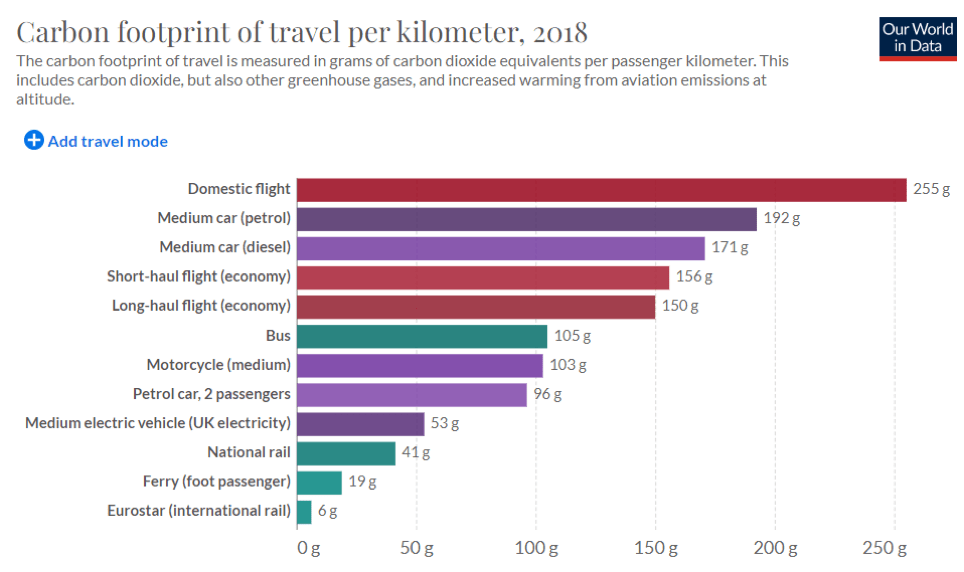
How we get from A to B has a significant impact on our carbon footprint. This chart shows the relative carbon footprint of different modes of transport.

For further details see their full report – https://ourworldindata.org/travel-carbon-footprint 

Additional thoughts – https://greentau.org/2021/08/21/green-tau-issue-13/

Counting on … day 1:013

13th January 2023

As we switch from being a fossil fuel society to renewable energy supplier, both we domestically and commercial energy suppliers will increasingly be producing and/ or using green electricity. You can already become part of this change – and thus be active in reducing your carbon footprint – by switching to a green energy supplier. Ethical Consumer recommends Ecotricity, Good Energy and Green Energy UK as the most sustainable green energy suppliers. 

Counting on … day 1:012

12th January 2023

Over recent months many of us have seen the cost of heating our homes increase. Reducing the carbon footprint of heating our homes wins on two fronts – financial and climate. 

Having installed solar panels, cavity wall and loft insulation, and double glazing, and by dint of wearing more layers and showering less, we are continuing to reduced our gas consumption and energy bills.

Whilst not everyone agrees with their tactics, most now see the wisdom of Insulate Britain’s call that the Government should ensure the proper insulation of the UK’s housing stock. This is also relevant during heat waves when better insulated buildings remain cooler longer.   

Further information https://greentau.org/2021/09/03/green-tau-issue-15/

Counting on … day 1:011

11th January 2023

Swopping from animal to plant based foods can make a considerable reduction to our carbon footprint. According to Exeter Council’s website:-

  • 1 vegetarian day per week (52 days a year) can save nearly 100kgs of CO2 per year.
  • 1 vegetarian week per month (12 weeks a year) can save nearly 153kgs of CO2 per year.
  • 1 vegan day per week (52 days a year) can save nearly 143kgs of CO2 per year.
  • 1 vegan week per month (12 weeks a year) can save nearly 231kgs of CO2 per year.

The BBC has an interesting calculator that compares the footprint of different types of food – https://www.bbc.co.uk/news/science-environment-46459714

Further information – 

Counting on … day 1: 010

10th January 2023

Over the next few days I want to highlight some of the ways in which we can respond as individuals to the ongoing ecological, climate and biodiversity crisis. 

The cause of the climate crisis is the excessive release of carbon dioxide and other green house gases into the atmosphere at a faster rate than the earth’s ability to absorb them. To limit further global temperature increases we need to reduce our carbon dioxide emissions. Calculating our individual carbon footprint does not of itself solve the problem but it does highlight for us areas where we could reduce it. 

There are various carbon footprint calculators available such as 

https://www.carbonindependent.org/

https://footprint.wwf.org.uk/#/

Counting on …. day 1.009

9th January 2023

Now all the Christmas cards are down, they are ready for recycling. They can go in with the paper and cardboard or you can repurpose them. Some pictures can be cut into gift tags for next Christmas.  Others – where there is no writing in them – can be cut up for notes and shopping lists. Or use them to make geometric baubles ready for next year.