
Counting on … day 1.058

28th February 2023 

Swopping to a cycle based city. 

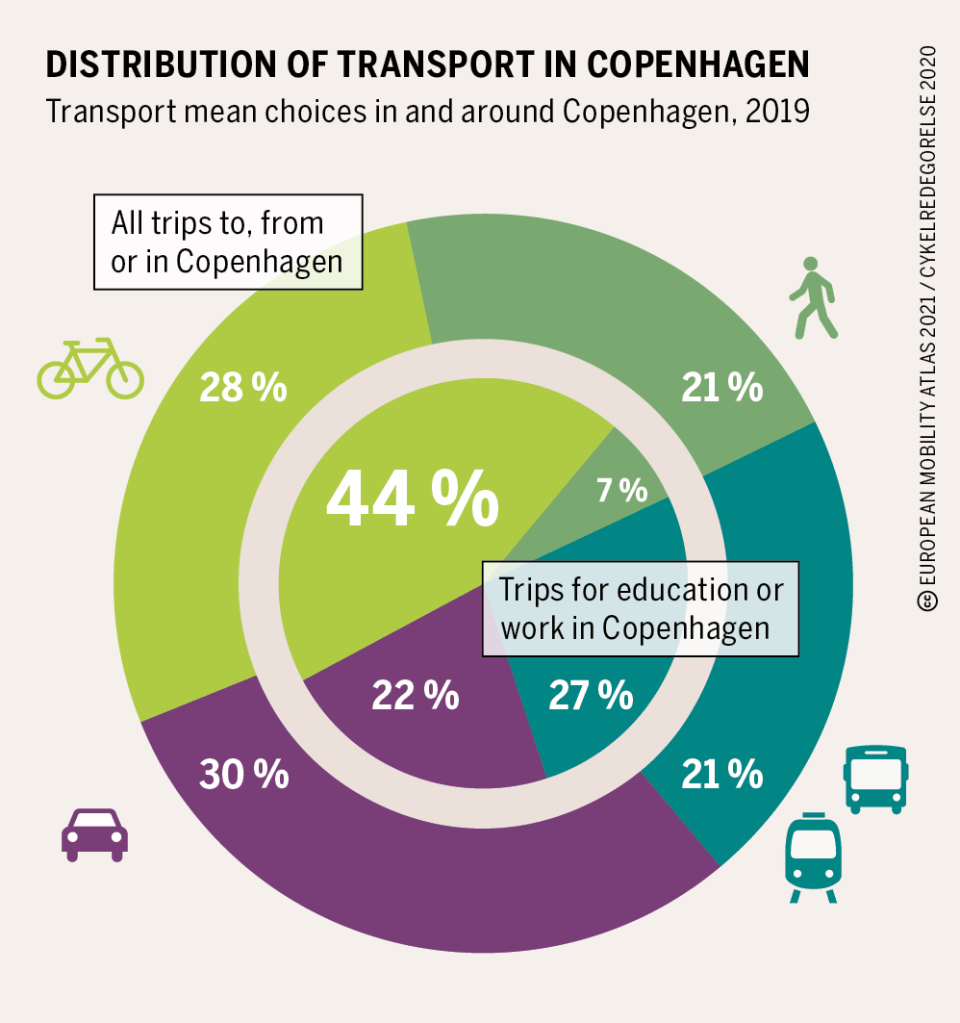
In Copenhagen the bicycle has become the most important means of transport.  The goal is for 50 percent of all trips to work and education in Copenhagen to be made by bike by 2025. In 2018, they reached 49 percent. Out of all trips made to, from and in the City of Copenhagen, 28 percent were in 2018 made by bicycle (32 percent by car, 21 percent walking and 19 percent public transport). In the inner city, bicycles outnumbered cars in 2016. 

The backbone of the city’s design for cycling is a network of protected bike lanes. In Denmark, unidirectional bike lanes are separated from both the pavements and the road by a kerb. Protected bike lanes are a must when the volume and speed of vehicle traffic is high.

https://eu.boell.org/en/cycling-copenhagen-the-making-of-a-bike-friendly-city
pastedGraphic.png

Counting on day … 1.057

27th February 2023

Low traffic neighbour hoods – “mini Holland”

‘When Waltham Forest Council received funding from Transport for London to create a low-traffic neighbourhood, local residents and campaigners worked hard to explain the benefits of low traffic neighbourhoods to the community.

At first some residents weren’t too keen on introducing low-traffic neighbourhoods and were worried that it would be difficult to access homes and businesses.

They also thought that it would lead to an increase in traffic on the main roads and might force traffic outside of schools.

However, they soon saw the improvement in the area, and counts on main roads in Waltham Forest have shown that traffic is now more spread out across the day and maximum peak hour flows are lower on the main roads.

Walthamstow Village is now one of London’s most advanced liveable-neighbourhood schemes and traffic levels have fallen by over 90% on some streets and by 56% on average. The scheme has made people think twice about using their car for shorter journeys and within a year, there was an increase in the number of people walking in the area, with residents walking 32 minutes and cycling on average nine minutes more per week. It’s now easier to cross the road and safer for cyclists and there’s a lot less air pollution.

Walthamstow Village has also become a great deal greener with new trees and ‘pocket parks’ that offer attractive planters, seating and community gardens’. https://www.livingstreets.org.uk/about-us/our-work-in-action/creating-low-traffic-neighbourhoods

A different world is possible!

Counting on day … 1.056

25th February 2023

School streets – a different world is possible!

“Bristol City Council is committed to making Bristol’s streets safer for everyone living, working and visiting the city. An area of priority are the streets outside our schools – we want to make the journey to school safer and healthier for children and their families, and help to make it a nice environment for everyone living and working there.

One of the ways we are doing this is through the introduction of School Streets, whereby the street or streets immediately outside the school entrance are closed to non-essential vehicles at school opening and closing times.

Only people walking, wheeling, cycling and scooting are permitted access to the School Street zone while the restriction is in place, with exemptions given to emergency vehicles and Blue Badge holders. In some cases, permits will be given to residents and businesses living or working within the zone – this varies from scheme to scheme and is decided on an individual basis.

Aims of the School Street scheme:

The aim of a School Street is to make it easier and safer for children and their parents to walk, wheel, cycle and scoot to school.

Reducing the use of private car journeys to and from school should lead to:

  • Less road danger from traffic
  • Less anti-social behaviour from inconsiderate parking and dangerous driving
  • More children walking, wheeling, cycling and scooting to school
  • Reduced congestion and local pollution from idling vehicles”

Counting on day … 1.054

23rd February 2023

Yesterday I joined a poignant observance of Ash Wednesday with others from Christian Climate Action. We held a service of ashing in Parliament Square, using coal dust as we confessed our – and those of society – in allowing our flagrant use of fossil fuels that has and is still causing so much damage to the world we live in – and its future. We called on the government to take action and in particular to overturn its approval for the new Cumbrian Coal Mine. Carrying coal, and to a slow drum beat, we took our lament and our prayers to the Home Office which had granted the Mine permission in December of last year, 

Finally we processed to the office of Javelin Global Commodities where we symbolically laid down the coal we had been carrying in our hands. We renewed our resolve to seek a different, better future.

Javelin is a significant partner of West Cumbria Mining, being  34 percent owned by U.S. coal miner Murray Energy, 28 percent owned by German utility E.ON and 38 percent owned by its principal traders, some of whom were previously at Goldman Sachs.Javelin is undertaking to purchase all of WCM’s production output and to sell the coal to steelmaking customers in the UK and Europe, as it “aims to ramp up its coal trading”

Counting on day 1.053

22nd February 2023

The Independent reports ‘St Michael with St Mary parish church in Melbourne, Derbyshire, is a fine example of 12th-century Norman ecclesiastical architecture, but one part of the building is distinctly modern. The sunshine that illuminates the church’s stained-glass windows is also shrinking its carbon footprint thanks to a 42-panel, 10kw array of solar panels on the roof.’ 

One of the first churches to install solar panels was St James Piccadilly, whilst more recently St John’s Waterloo has installed panels that will produce 30 kilowatts per hour in bright sunshine and over the course of a year could generate 28,597 kWh. 

A different world is possible!

NB I have put together a series of 40 mini reflections on water (a rerun of a series from a couple of years ago). These can be found in the menu under Lent Reflections, or here https://greentau.org/2023/02/11/lent-reflections-water/

Counting on …. day 1.049

18th February 2023

The Grimsby Telegraph reports ‘As part of its Towns Fund Deal, North Lincolnshire Council got £1.4m in government cash for the rollout of solar panels on at least 30 Scunthorpe schools and to create an affordable, zero-carbon energy system in North Lincolnshire. Four schools – Holme Valley Primary, Bottesford Junior, Fred Gough Secondary and Berkeley Primary – had panels already installed by the end of January, while two more, St Hugh’s School and Priory Lane Primary were poised to have them installed by February. Once set up, the six schools will save £97,880 a year in energy bills.’

A different world is possible.

Counting on … day 1.048

17th February 2023

The Metrocentre in Newcastle  has solar panels covering an area equivalent in size to 88 tennis courts on the roof and  on specially constructed solar car parking spaces.

The White Rose Shopping Centre near Leeds has solar panels that can generate  681,794 KWH of electricity a year.

A different world is possible!

Counting on …. day 1.047

16th February 2023

A different world is possible and we are seeing signs that it is already emerging.

The Wetlands Centre at Barnes is installing more solar panels on their site. They anticipate generating 60% extra energy over and above what they need. Where else might we see solar panels being installed? Shopping centres? Schools? Libraries? Hospitals? Railway stations? Churches?

Counting on … day 1.045

14th February 2023

St Valentine’s Day is associated with the coming of spring and the mating of birds – the two go together. One bird that is very much under threat is the swift because of an increasing lack of places where they can nest. If you have space why not install a swift box ready for when they arrive in May? The RSPB has instructions for making (or buying) a swift box and where to place it.

https://www.rspb.org.uk/get-involved/activities/nature-on-your-doorstep/garden-activities/create-a-high-home-for-swifts/

Other birds too are in need of nesting places – you can install different sorts of nest boxes, plant trees and hedges (as future nesting places) or  build a dead hedge, and so help encourage a resurgence of bird numbers. As you prune plants back and clear dead stalks, you can gather materials for building a dead hedge – https://greentau.org/2021/10/19/count-down-87/comment-page-1/