Counting on … day 1.163

1st September 

Another source of plant based protein is nuts. These can be enjoyed, plain or roasted, chopped or ground into flour. They can be used in these different forms when baking and cooking. For example ground nuts can be added to vegetables to make a pasta sauce or to a creamy soup, as well as enriching cakes and biscuits. Ground nuts can be used to coat vegetables for roasting.  Whole nuts can be added to casseroles, stir fry’s, cakes and deserts. Chopped nuts can be used in vegetable pies, nut roasts, stuffings, risottos, as well as cakes and deserts.

For more tips on swopping to a plant based diet – https://greentau.org/2021/10/12/eco-tips-11/

Counting on … day 1.162

31st August 2023

Seeds are also a good source of protein as well as various minerals and vitamins. Try chia seeds, linseed or – the wild version – camelina seeds, pumpkin, sunflower, poppy, sesame and hemp seeds. You can add seeds to muesli or porridge, salads and mix them into bread dough. 

You can use chia or linseeds as an egg replacement mixing one table spoon of seeds with 2 tablespoons of warm water, leaving it for a short time while the seeds thicken and produce a jelly-like texture.

You can use pumpkin or sunflowers seeds instead of pine nuts to make pesto. 

You can also add seeds to hummus either blitzing them with the chickpeas or adding them whole for a different texture.

Counting on …day 1.161

30th August 2023

Peas and beans can also be used ground up as flour. (Again you can buy different flours from Hodmedod’s).

Pea and bean flour can be used to replace some of the wheat flour in things such as bread, cakes, pastry and pasta, adding more protein to these foods. Pea and bean flour can be used to replace egg in foods such as frittata, pancakes and Yorkshire puddings. (Experiment with vegan recipes for these).

Pea and bean flour can be used to thicken liquids and to make sauces. Mix with a little water as if it were corn flour and add in/into the hot liquid. (You can make these sauces in a microwave to to save energy).

Counting on …day 1.160

29th August 2023 

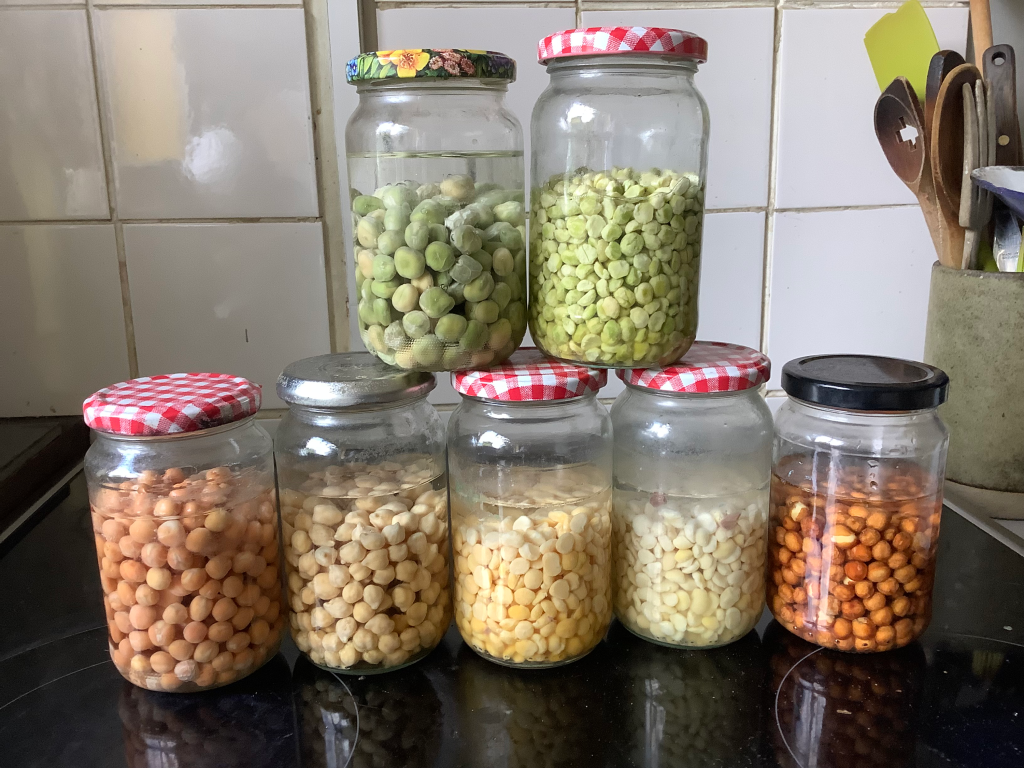
 Seven different times of pea and bean –

Top row: marrow fat peas, split wrinkled peas (these are the peas that didn’t quite make it to the freezing plant in time)

Bottom row: flamingo peas, chick peas, split yellow peas, split fava beans, red carlin peas.

All these are UK grown and come from the retailer Hodmedod. They will provide the basis for a number of meals. For example –

  1. Mushy peas and fried sweet potatoe
  2. Risi bisi*
  3. Ratatouille and wild rice
  4. Hummus and toast
  5. Dhal and rice
  6. Vegetable lasagna
  7. Tagine with millet 

NB I weigh a daily portion of beans into a glass jar, add water and leave to soak. Then I place all the jars in a large pan, half fill with water and bring to the boil. Letting it simmer for 30 minutes before turning of the heat. This gives me 7 jars of ready cooked beans.

*https://greentau.org/2022/06/29/counting-on-day-228/

Counting on … day 1.159

28th August 2023

What often worries people when swopping to a plant-based diet is getting enough protein. We have been brought up understanding that we need protein and that meat, fish and dairy are all good sources of protein. The recommended daily protein consumption is 55.5 grams per person for adult men and 45 grams per person for adult women which ideally would be spread throughout the day. 100g of chicken or beef equates to about 30g of protein, 100g salmon about 25g, 1/2 litre of milk about 15g and 50g of cheese about 12g. As in addition a couple of slices of bread can contain 6g of protein, 100g  of rice 10g it is not surprising that many people consume more than the recommended amount.  https://www.nutrition.org.uk/healthy-sustainable-diets/protein/?level=Consumer

As well as bread and rice, protein can be found in beans, pulses and tofu  – about 8g per 100g (cooked weight); nuts and seeds about 5g per 25g (a tablespoon of peanut butter is about 4g); in green vegetables such as cabbage and broccoli about 3g per 100g. Combining beans/ pulses/ peanut butter  with grains such as rice/bread/pasta provides an optimal mix of amino acids present in protein.  This makes simple dishes such as beans on toast, a peanut butter sandwich, hummus and pitta bread, rice and dhal an excellent source of nutrition. 

12th Sunday after Trinity, Proper 16

27th August 2023

Reflection (readings are below)

The story from Genesis is one of various people collaborating with God in opposing the evil designs of the Pharaoh and ultimately in saving Moses. Characters such as the Hebrew midwives, trust in the importance of doing what is right, what is righteous- which is of course, to do the will of God. Even the Pharaoh’s daughter who doesn’t know God,  does what is right and therefore does what is God’s will. 

It could well be that the Hebrew midwives, who felt so strongly that they had to what was right rather than what the Pharaoh commanded, would not have lived long enough to see the positive outcome of their actions in the shape of the Exodus. Maybe that is how it is for climate activists, for social justice activists, for peace activists: they all choose to act according to what is right and to oppose rules and social trends that are destructive or  evil in design. And likewise many may not see the long term positive outcomes of their actions. 

Psalm 124 reminds us that to do what is right is to have God on one’s side -that can be a timely reminder for those times when we feel that our faith in a better, God-shaped, future is wavering.

Paul in his writings often contrasts the way of the world (ie bad) with the  ways of God (good). I often find this puzzling as for me the ‘world’ encompasses nature, the intricate and wonderful workings of ecosystems, the beauty of plants and creatures, the awe and wonder of snow capped mountains and  rosy sunrises. When Paul writes about the ‘world’ I think he is looking at the human machinations that create system of oppression, of destruction, of greed and selfishness. II is therefore in contrast with this understanding of the world that Paul sees the many gifts of God – prophecy and perception, ministering and caring, teaching and nurturing, exhorting and encouraging, generous giving and sharing, dispassionate leadership, compassion and cheerfulness.

And it is all these gifts, combined and used collaboratively, that can create the world that God desires. Indeed that is the story that unfolds in the Book of Exodus.

So to today’s gospel. Who is Jesus? What does it means for us to understand Jesus to be the Messiah, the Son of the living God? Peter makes his declaration on the basis of what he has seen Jesus doing, on his experience of walking along side Jesus, of seeing how Jesus responds to the ways of the world. We have the writings of the Gospels, which we can study Jesus’s actions, and our prayer life with which to build companionship with Jesus, and the fellowship of others, to enable us to know Jesus as Peter did. In this way like Peter,  hopefully we too can find in Jesus the perfect lived example of God’s righteousness. 

Returning to Paul’s letter and his understanding of God’s diverse distribution of gifts functions best when brought together as parts of a body, can it be that as a community we may have people like Pater who clearly see who Jesus is,  and who can share that insight, and along side have people like the Hebrew midwives who understand what actions God wishes us to take. Combining these insights and through collaboration then we too can  produce result greater than we could imagine. 

Exodus 1:8-2:10

Now a new king arose over Egypt, who did not know Joseph. He said to his people, “Look, the Israelite people are more numerous and more powerful than we. Come, let us deal shrewdly with them, or they will increase and, in the event of war, join our enemies and fight against us and escape from the land.” Therefore they set taskmasters over them to oppress them with forced labour. They built supply cities, Pithom and Rameses, for Pharaoh. But the more they were oppressed, the more they multiplied and spread, so that the Egyptians came to dread the Israelites. The Egyptians became ruthless in imposing tasks on the Israelites, and made their lives bitter with hard service in mortar and brick and in every kind of field labour. They were ruthless in all the tasks that they imposed on them.

The king of Egypt said to the Hebrew midwives, one of whom was named Shiphrah and the other Puah, “When you act as midwives to the Hebrew women, and see them on the birthstool, if it is a boy, kill him; but if it is a girl, she shall live.” But the midwives feared God; they did not do as the king of Egypt commanded them, but they let the boys live. So the king of Egypt summoned the midwives and said to them, “Why have you done this, and allowed the boys to live?” The midwives said to Pharaoh, “Because the Hebrew women are not like the Egyptian women; for they are vigorous and give birth before the midwife comes to them.” So God dealt well with the midwives; and the people multiplied and became very strong. And because the midwives feared God, he gave them families. Then Pharaoh commanded all his people, “Every boy that is born to the Hebrews you shall throw into the Nile, but you shall let every girl live.”

Now a man from the house of Levi went and married a Levite woman. The woman conceived and bore a son; and when she saw that he was a fine baby, she hid him three months. When she could hide him no longer she got a papyrus basket for him, and plastered it with bitumen and pitch; she put the child in it and placed it among the reeds on the bank of the river. His sister stood at a distance, to see what would happen to him.

The daughter of Pharaoh came down to bathe at the river, while her attendants walked beside the river. She saw the basket among the reeds and sent her maid to bring it. When she opened it, she saw the child. He was crying, and she took pity on him, “This must be one of the Hebrews’ children,” she said. Then his sister said to Pharaoh’s daughter, “Shall I go and get you a nurse from the Hebrew women to nurse the child for you?” Pharaoh’s daughter said to her, “Yes.” So the girl went and called the child’s mother. Pharaoh’s daughter said to her, “Take this child and nurse it for me, and I will give you your wages.” So the woman took the child and nursed it. When the child grew up, she brought him to Pharaoh’s daughter, and she took him as her son. She named him Moses, “because,” she said, “I drew him out of the water.”

Psalm 124

1 If the Lord had not been on our side, *
let Israel now say;

2 If the Lord had not been on our side, *
when enemies rose up against us;

3 Then would they have swallowed us up alive *
in their fierce anger toward us;

4 Then would the waters have overwhelmed us *
and the torrent gone over us;

5 Then would the raging waters *
have gone right over us.

6 Blessed be the Lord! *
he has not given us over to be a prey for their teeth.

7 We have escaped like a bird from the snare of the fowler; *
the snare is broken, and we have escaped.

8 Our help is in the Name of the Lord, *
the maker of heaven and earth.

Romans  12:1-8

I appeal to you therefore, brothers and sisters, by the mercies of God, to present your bodies as a living sacrifice, holy and acceptable to God, which is your spiritual worship. Do not be conformed to this world, but be transformed by the renewing of your minds, so that you may discern what is the will of God– what is good and acceptable and perfect.

For by the grace given to me I say to everyone among you not to think of yourself more highly than you ought to think, but to think with sober judgment, each according to the measure of faith that God has assigned. For as in one body we have many members, and not all the members have the same function, so we, who are many, are one body in Christ, and individually we are members one of another. We have gifts that differ according to the grace given to us: prophecy, in proportion to faith; ministry, in ministering; the teacher, in teaching; the exhorter, in exhortation; the giver, in generosity; the leader, in diligence; the compassionate, in cheerfulness.

Matthew 16:13-20

When Jesus came into the district of Caesarea Philippi, he asked his disciples, “Who do people say that the Son of Man is?” And they said, “Some say John the Baptist, but others Elijah, and still others Jeremiah or one of the prophets.” He said to them, “But who do you say that I am?” Simon Peter answered, “You are the Messiah, the Son of the living God.” And Jesus answered him, “Blessed are you, Simon son of Jonah! For flesh and blood has not revealed this to you, but my Father in heaven. And I tell you, you are Peter, and on this rock I will build my church, and the gates of Hades will not prevail against it. I will give you the keys of the kingdom of heaven, and whatever you bind on earth will be bound in heaven, and whatever you loose on earth will be loosed in heaven.” Then he sternly ordered the disciples not to tell anyone that he was the Messiah.

Counting on … day 1.158

25th August 2023

A flat white coffee contains about 140ml of milk (about quarter of a pint) but the barista is likely to heat more milk than is necessary to create a perfect cup and the excess will be discarded. So one way of reducing your dairy consumption might be to swop to a non dairy milk for your coffee – eg an oat flat white (or latte or cappuccino). You may be surprised how palatable you find this – many people find the slight sweetness of oat milk enhances the coffee.

You can swop dairy milk for oat milk in baking, when making custard and white sauces, and in porridge. 

As with milk so it is equally easy to replace dairy butter with a plant-based butter  – these have a similar texture and taste to dairy butter. You can swop dairy for plant-based butter on bread, in baking and pastry making, for white sauces and risottos, in baked potatoes etc.

If we all went vegan what would happen to all the cows?  https://greentau.org/2022/09/23/the-green-tau-issue-53/

Counting on … day 1.157

24th August 2023

If agricultural expansion is to be reversed, it will need the combined efforts and cooperation of governments, farmers, consumers, commodity  traders, financiers, retailers, and environmental scientists. One of the most important areas to change will be that of meat production. 

‘Of all the world’s land surface, approximately 71% is ‘habitable land’; half of this land is used for agriculture. Currently, pastures used for grazing and land used to grow crops for animal feed account for 77% of agricultural land, thus comprising nearly 30% of the total land surface of the planet…If we combine pastures used for grazing with land used to grow crops for animal feed, livestock accounts for 77% of global farming land. While livestock takes up most of the world’s agricultural land it only produces 18% of the world’s calories and 37% of total protein.’ https://ourworldindata.org/global-land-for-agriculture

Across Europe governments are, to a greater or lesser extent, aiming to reduce meat production on farms and meat consumption amongst populations. The Irish government for example, is looking to reduce its dairy herd by 65000 animals per year over the next three years. The Dutch government is planning to reduce its cattle numbers for 30% by 2030. The Climate Change Committee in the UK has recommended livestock cuts  of 20-50% for  beef and lamb, whilst at the same time recommending a 20% reduction on meat and dairy in the UK diet.

Reducing cattle numbers will free up more land for plant crops and so feed more people and/ or rewilding which will boost biodiversity.

Over the next few days I will be looking at easy ways of adapting to a more focused plant based diet.

For further info in farming, land use and biodiversity see

Counting on…. Day 1.157

23rd August 2023

If we need to slow down agricultural expansion, do we know what caused its expansion?  There is I’m sure no one answer but a multiplicity of interconnecting reasons. 

  • Population growth. Globally we now need to feed over 8 billion people, up from 6 billion in 1999, and 3 billion in 1960. Yet researchers tell us that we could feed 10 billion people without exceeding the planet’s environmental boundaries  (https://www.nature.com/articles/s41893-019-0465-1)
  • Income growth – as people become richer they choose to eat more expensive foods which are often  more resource expensive too – eg imported tropical fruits, sugar based foods, and especially meat
  • Developments in agriculture that allow more intensive production such as pig breeds that can reach a slaughter weight in 4 months; high protein feed made from soy beans that rapidly fatten chickens; high yielding grains that combine with fertilisers and pesticides to increase harvests. 
  • Financial rewards that encourage rain forests to be cleared to make way for sugar plantations, soy crops and cattle ranching. 
  • Irrigation and airfreight that allow crops such as asparagus, avocados and blueberries to be grown in the southern hemisphere and imported as out of season alternatives for the northern hemisphere. 
  • Social changes that have made chicken a staple rather than a special treat, that have reduced the popularity of foods – in the UK – such as cabbage and runner beans, replacing them with courgettes and peppers. 
  • Social changes that mean less food is home produced, that less food is preserved at home (eg jam/ chutney/ sauerkraut),  that less food is home grown.
  • Increasing quantities of food going to waste – caused by social changes and increasingly long supply chains.

Counting on … day 1.155

22nd August 2023

Recently the government ordered that cartoon murals in the centres where asylum seekers are taken, be painted over. In a come back to that callous and unnecessary action, a petition has been set up asking for the murals to be reinstated, as well as a scheme to send welcoming postcards to the 9000 plus children seeking asylum.

https://findothers.com/tools/postcards-for-refugee-children

https://www.theguardian.com/uk-news/2023/aug/22/asylum-seeker-children-cartoons-postcards-murals-painted-over?CMP=Share_iOSApp_Other