Counting on 2026 …. Day 49

28th May

Caring for water is to be mindful of what goes down the drain. Waste water systems – drains, sewers etc – are not intended as general rubbish bins! 

They are not places for alien chemicals. Using only eco friendly laundry and washing up liquids makes sense. Nor are they places for wet wipes, paper towels or paper serviettes – these are design to be strong and absorbent and doing that means they  likely block the drain!

They are not places for oil and grease – wipe excess oil from pans etc using a paper and put that in your compost heap or food bin. Nor are they the place for paints, white spirit, varnish etc. Your local authority should have disposal facilities for these.

Drains are also not the place for waste food – this should go in your compost heap or food bin (the latter only should be used for items like meat, fish etc).

Counting on 2026 …. Day 48

27th May

As part of being resilient, we aim to keep at least three days’ supply of food and water in the house. 

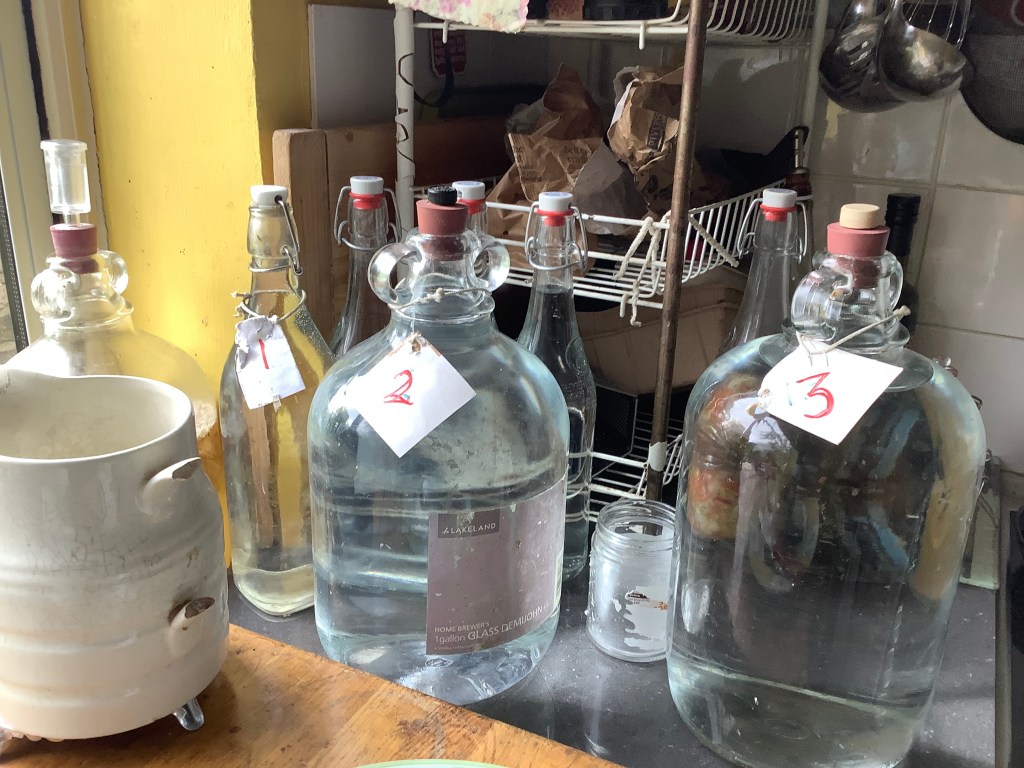
As part of these emergency supplies, I am loath to buy bottles of water which I would then have to replace when they reached their expired date – it would be expensive and would produce unnecessary waste. So instead we keep next to the sink a mixture of 1 litre kilner bottles and 4.5 litre Demi johns. These we use and refill on rotation (the bottles are numbered) to fill the kettle, make drinks, cook with and  wash up etc. The water in the bottles is thus seldom more than 24 hours old – and in this hot weather, we keep a couple of bottles in the fridge too.

Counting on 2026 …. Day 47

26th May

Water is a scarce and valuable resource that we need to protect and use respectfully and frugally.

That is why I shower and wash my hair once a week. The rest of the week I wash in a bowl of water – and then reuse that water for flushing the toilet. I’m sure I’m still clean and fresh smelling!

We only use the toilet flush for ‘number twos’ and use hand wash water (having used a bowl) to flush the toilet. 

For toilet cleaning I use hot water and citric acid followed by a dose of bicarbonate – the following burst of bubbles is very dramatic.  In this way I hope to reduce the adverse chemicals entering the drains as well as using cleaning materials that come in paper packaging.

Green Tau: issue 124

25th May 2026

Rivers of Spirit: Spirit of Rivers – a reflection

On the last day of the festival, the great day, while Jesus was standing there, he cried out, “Let anyone who is thirsty come to me, and let the one who believes in me drink. As the scripture has said, ‘Out of the believer’s heart shall flow rivers of living water.’” Now he said this about the Spirit, which believers in him were to receive; for as yet there was no Spirit, because Jesus was not yet glorified. John 7:37-39

The above is one of the alternative readings given for Pentecost which thinks of the Spirit not as wind or fire, but as a river of water. 

Last Friday I took part in a thought-provoking event at St John’s Waterloo entitled Rivers of Spirit: Spirit of Rivers – https://stjohnswaterloo.org/tag/rivers-of-life/

 We began by going down on to the foreshore of the Thames where, like children, we looked at all the treasures on the little beach – shells and pebbles, smooth-worn glass, ends of clay pipes, rounded stubs of brick, sticks and pieces of bone. We sang and we prayed as, with increasing reverence, we were drawn to the sound and the movement of the river, to the ebbing-flowing tide – drawn to the Thames living presence.

From that reconnection with the river, we were more open to hear the wisdom of the afternoon’s speakers. 

Bishop Martin himself quoted from the passage from John’s Gospel, and talked about the living nature of water through the example of the eel. 

Eels are amazing creatures. They are laid as eggs in the Sargasso Sea from where they voyage by ocean currents some 6500km to reach Europe. During this first couple of years they develop from egg to glass eel. They leave the sea and swim inland up various rivers including the Thames, where they continue to develop becoming elvers and then yellow eels and finally silver eels – this can span from  5 to 20 years. Now they are mature enough to make the return journey to the Sargasso to begin the whole cycle again. Eels in the past were numerous in our rivers and a source of food for many (and not just humans). But due to the effects of climate change, pollution, loss of habitat  including from obstacles such as weirs and dams, their numbers over the last 40 years have declined  by a staggering 95-98%. (1)

God’s Spirit, like rivers of living water, is there to cleanse and refresh us. But what if we harden our hearts and do not seek forgiveness and renewal?

The first two speakers, Al Barrett and John White spoke about the importance of creating communities. Al Barrett is the vicar of the Hodge Hill Church in east Birmingham. John White is the founder of the Hazelnut Community and author of the Rooted in Rubble articles from which I have recently quoted.

Al spoke about creating ‘bumping places’ – places where parishioners from many and diverse backgrounds can meet and get to know and trust each other. He spoke how during Covid they ‘rediscovered’ the green places in the parish including the common. Commons have existed for hundreds of years as spaces designated for use by the community –  the commoners – who would have rights to graze animals, gather firewood etc. Where Commons remain today they are often important as essential green spaces for  local people and as essential habitats for wildlife. 

And Al described how finally he managed to ‘discover’ the River Tame which was barricaded out of sight and inaccessible to the community through which it flowed. 

John  spoke about how the Hazelnut Community’s  garden brings people together in the garden and in the gardening. Gardens root us and place us in a right relationship with creation.

Debbie Colvin described to us our place – our home – within the Thames basin which stretches from the Cotswolds to the estuary, from the Chilterns and northwards  to the South Downs. Within this area rainwater drains down to the Thames, but not just via stream and rivers, but also percolating down into  the strata deep below our feet where the water moves and buffers, hydrating the ground, feeding into springs and wells. A slow and measured process whereby rain falling on the hills of Reigate may take 10-20,000 years before reaching Trafalgar Square. (Prior to the 1930s the fountains in Trafalgar Square were fed by artesian wells (2)).

Paul Powlesland spoke about his life’s journey that finds him as a self appointed river guardian for the River Roding  and as the founder of the River Roding Trust. His love and respect of this river sees him clearing rubbish, planting willow and Black Poplar saplings and defending the rights of the river and the communities that live nearby. Called to jury service, Paul made his oath not on a Bible but on the River Roding, making this river a sacred thing, a being worthy of worship. (3) Much of this river, the third longest in London, is degraded – desecrated – by sewage, rubbish and pollution. Paul’s approach is hands on and includes pressing the Thames Water Authority to do its job properly. (4)

Paul himself  lives off grid on a narrow boat which means his life is intrinsically connected to that of the river and the environment. His awareness of the drought that we are currently facing, is measured by how much water remains in the rainwater that provides him with water. 

What struck me about the issues raised by these speakers was –

  • how little value we, as society, place on water,  
  • our lack of concern/ interest as to where our water comes from and 
  • our lack of concern as to whether it will be there in sufficient quantity in the future (humankind is extracting fresh water at a faster rate than the rate at which natural processes allow for replenishment (5)) 
  • our lack of concern for the health and wellbeing of our rivers – and not just our rivers, but the springs and aquifers from which they come, and
  • our lack of concern for the other living communities that depend upon rivers and the river environment.

At the same time, the speakers brought to mind way we might change our relationship with rivers:

  • looking at / treating rivers as living needs and rights, and 
  • as beings that give generously of themselves to our benefit, and further,
  • that maybe we should treat rivers as sacred –
  • and not just rivers, but all water. In the past wells were often considered as holy places so why not also taps and reservoirs today?

And from this came thoughts about what we might do as local communities and as churches.

  • Create a map that shows local rivers, streams and wells. 
  • Arrange pilgrimages to walk along or between these
  • To spend time in prayer and celebration in these places, to wonder and to rejoice.
  • Work out – maybe add to the map – where our drinking water comes from, and where it goes when we have used it
  • Find about local riverine habitats and whether they are in good or declining health.
  • To engage with – or establish – means of safeguarding and caring for wellbeing of your local river/ stream etc  – and allowing yourselves to benefit from its contribution to your wellbeing.
  • Identify our local water sources as sacred.
  • Arrange water blessings for local rivers, streams and wells and wells
  • Provide blessings for taps, drains and water butts
  • Encourage people to value water – to treat it as sacred and not as something to be consumed rashly or without consideration 
  • Encourage people to think about being less wasteful in the use of water. At current levels of consumption, we are likely by 2055 to see a shortage of 5 billion litres per day (6)
  • Encourage people to be aware of water cycles – seasonal changes, periods of rainfall and periods of droughts, of tidal cycles where appropriate. 
  • Encourage people to do even small scale gardening (cress seeds grown on blotting paper) to appreciate the importance of water in keeping plants – and therefore us too – alive.
  1. https://www.thamesriverstrust.org.uk/thames-catchment-community-eels-project/life-cycle-of-an-eel/
  2. https://londontraveller.org/2013/07/16/the-fountains-of-trafalgar-square/
  3. https://www.theguardian.com/environment/2022/dec/05/river-roding-barrister-paul-powlesland-london-polluters-footpaths?CMP=Share_iOSApp_Other
  4. https://www.bigissue.com/news/environment/river-sewage-east-london-pollution/
  5. https://www.planetaryhealthcheck.org/boundary/freshwater-change/
  6. https://www.gov.uk/government/news/england-faces-5-billion-litre-public-water-shortage-by-2055-without-urgent-action

Prayers for Pentecost 

23rd May 2026

Now the Lord is the Spirit, and where the Spirit of the Lord is, there is freedom. 2 Corinthians 3:17

Holy Spirit, you are the breath of life:

reinvigorate us with new growth.

Holy Spirit, you are the inspiration for knowledge:

refresh us with your wisdom.

Holy Spirit, you are the wind of change:

redirect us to the right path.

And let this be to the glory of the kingdom of God.

A reading from Isaiah 32:14 -17  (The Message)

The royal palace is deserted,
    the bustling city quiet as a morgue,
The emptied parks and playgrounds
    taken over by wild animals,
    delighted with their new home.

Yes, weep and grieve until the Spirit is poured
    down on us from above
And the badlands desert grows crops
    and the fertile fields become forests.
Justice will move into the badlands desert.
    Right will build a home in the fertile field.
And where there’s Right, there’ll be Peace
    and the progeny of Right: quiet lives and endless trust.
My people will live in a peaceful neighbourhood—
    in safe houses, in quiet gardens.
The forest of your pride will be clear-cut,
    the city showing off your power levelled.
But you will enjoy a fortunate life,
    planting well-watered fields and gardens,
    with your farm animals grazing freely.

.

Pentecost Spirit, 

taking  breath over creation, 

drawing life out of chaos. 

Inspire us with a vision of the world as it could  be.

Fill our hearts with active love.

Pentecost Spirit, 

riding on the storm clouds of anger, 

turning the world upside down. 

Inspire us with a vision of the world as it could  be.

Fill our hearts with active love.

Pentecost Spirit, 

dividing the waters, 

cutting through the bonds of slavery.

Inspire us with a vision of the world as it could  be.

Fill our hearts with active love.

Pentecost Spirit, 

raising up whirl winds 

yet drawing us into the still centre of calm.

Inspire us with a vision of the world as it could  be.

Fill our hearts with active love.

Pentecost Spirit, 

that comes from we know not where, 

yet reveals to us all truth.

Inspire us with a vision of the world as it could  be.

Fill our hearts with active love.

Pentecost Spirit, 

a sudden gale that rocks the boat, 

yet challenges us to hang onto our faith.

Inspire us with a vision of the world as it could  be.

Fill our hearts with active love.

Pentecost Spirit, 

a gentle evening breeze,

that refreshes the soul when the day’s work is done.

Inspire us with a vision of the world as it could  be.

Fill our hearts with active love.

The Grace.
Green Tau issue 123

22nd May 2026

Where as agents of change are we most effective?

I believe it is a Christian calling to be an agent for change. Indeed it is a necessary part of bringing in the Kingdom of God here on Earth. But bringing an agent for change is not exclusively a Christian activity – people from all different backgrounds wish to see change that makes the world a better place.

This week I have been involved in three different situations where I have been endeavouring to spur action that will address the climate and biodiversity poly-crises. 

Parish Annual Church Meeting 

The first was the parish’s Annual Church Meeting (we are a team ministry with three churches).  Not a large turnout given we have an electoral role of over 200. The fact that we are again running a deficit of £15,000 did not unduly concern those present. Was this indifference, complacency or a feeling that it wasn’t problem that none of us as individuals could address?

I spoke under AOB about the urgency of the climate and biodiversity crises and proposed a PCC sub group to help us focus on this. I suggested a proviso that such a group should only be formed if at least two people from each church were willing to join – otherwise the group could be always fighting a loosing battle against indifference. It did spark conversation – and objections – with the conclusion that there wasn’t a sufficient desire for this policy. There was the sense that the issue wasn’t that important, and that equally the climate was too big and too complicated an issue for us to deal with.

Shell AGM

On Tuesday I went to the Shell AGM which is now held in a hotel at Heathrow Terminal 5 to prevent attendees from having to encounter protestors on their way into the meeting. Inside security was very intense – thorough bag and body checks – and during the meeting security guards were it o my on the doors but sat at each end of each row of chairs. Separated from us by a 6 foot wall, the Board sat on a raised  platform. After  brief speeches applauding Shell’s successes by the chairman Andrew Mackenzie and  CEO Wael Sawan, the three and half hours of the meeting were dedicated to questions from the floor. Most of these were critical of Shell, questioning their policy of expanding oil and gas production, their failure to make good the environmental damage of oil production in the Niger Delta, their response to staff welfare and to whistleblowers, their contribution to the ongoing climate crisis and to the demise of AMOC. (My question is included below). 

The Board’s response was largely that Shell is a good business that ensures a secure flow of energy at a competitive price, that meets consumer demand. They argued that their products were low carbon – having reduced the scope 1 and 2 emissions linked to their upstream production. They contended that their products were essential for both industry and for underpinning renewable energy systems – and that therefore it was essential that they increase production for the benefit of all. 

The Board members were clearly convinced that their views about the future, about the cause and urgency of climate crises, and the importance of fossil fuels, were correct. Like most of us, I guess they pick and choose which scientific reports they read, which scenarios they believe. But I hope that having heard all that we on the other side of the floor had to say, they might at least be prompted to re-examine the evidence.

Rosebank Die-in

On Wednesday I joined Christian Climate Action’s die-in outside the Treasury. For the last two plus years, CCA along with other groups have been campaigning to persuade the government not to license for production the Rosebank oilfield. Whilst the decision finally rests with the Department for Energy Security and Net Zero, the Treasury also has an interest in the decision – both because the project would be underpinned by subsidies from the government and because once operational, there would be tax revenue on any profits. 

The action was die-in which meant that a number of us lay on the pavement wrapped in shrouds (sheets). Banners proclaimed our demands and two activists explained the reason for the action, highlighting the impact that drilling Rosebank would have on the climate and in particular on people’s lives – or rather loss there of. The whole action was witnessed by members of the press. Subsequent press releases included mention on Christian Premier Radio and others. (1) 

So where as agents are we most effective? 

Is it by working for change within our local community? Although here people will argue that as individuals there actions will make no difference.

Is it by challenging the big businesses whose products are the cause so much of the world’s troubles?

Although here, the business leaders say that they are only responding to consumer demand.

Is it by challenging government departments who have the power to mandate change?

Although here ministers say they must respond to what the electorate (or rather that part of the electorate that is vocal) wants.

Perhaps the answer is to be found in the words of António Guterres, United Nations Secretary-General, that we must all do ‘Everything, everywhere, all at once’ if we are going to break the cycle of ‘It’s not for me to act’!

My Question 

I am one of the group from Christian Climate Action who hold a weekly vigil outside your headquarters. We spend the hour praying for the wellbeing of the planet we share, for the people and the different ecosystems, we pray for the people passing by, for the staff going in and out of the building, for the security staff, and in particular we pray for you who have the responsibility for running the business, for the shareholders and financiers, in the belief that a better business model is possible – one that protects the environment, works for the common good and ensures a sustainable future for generations to come.

Last year I asked how morally you felt able to pursue a business that was destroying the planet in which we depend for our survival. Your answer was along the lines that business is in essence amoral. Yet if business is both part of economy and part of society, morality surely has a role to play. Simply to pursue profits with no regard for the impact your business has on the health of the planet, on the sustainability of life, on the wellbeing of generations to come, is surely not good business.

What I really want to know is when you will stop extracting oil and gas, and rather develop safe and secure renewable energy?

  1. https://www.thecanary.co/uk/news/2026/05/20/christian-climate-protesters-rosebank/

Counting on 2026 …. Day 46

20th May

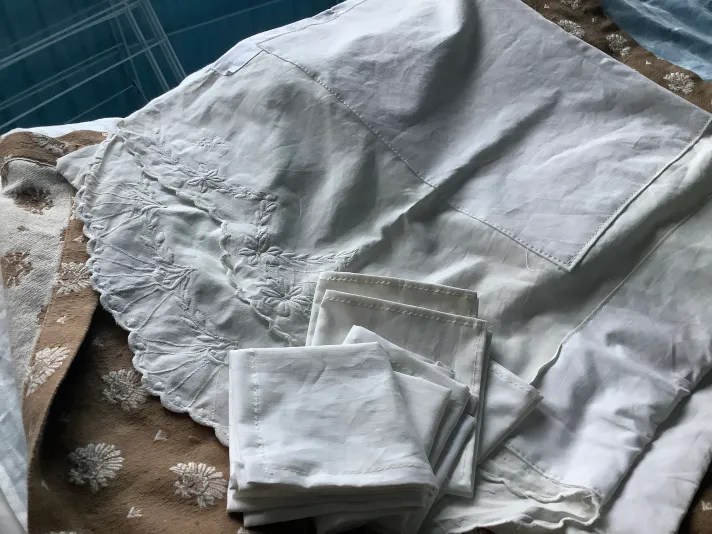
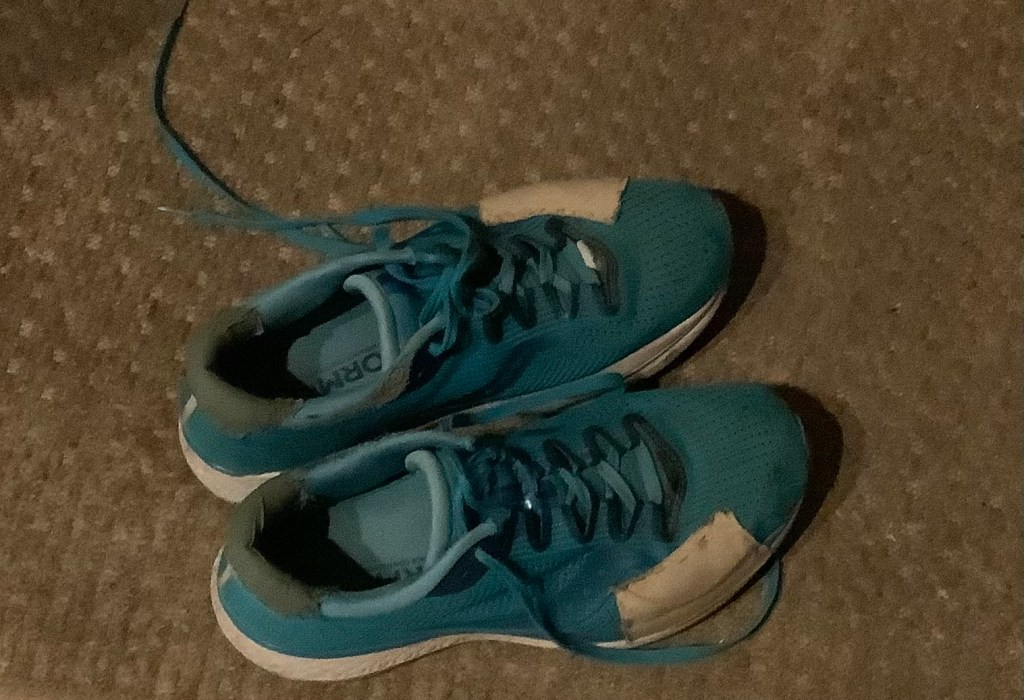
Having both a number of sheets and pillowcases that are wearing thin (even after turning the outsides into the middle) I have combined the two to make/ mend some new pillowcases, and used the left overs to make handkerchiefs. Possibly a bit excessive but it does give the cotton an extended life. 

For more on making repairs and mending – https://greentau.org/tag/repairs/

and https://greentau.org/tag/up-cycling/

Counting on 2026 …. Day 44

18th May

Living simply for me is, in part, about being self reliant such as being able to cook from scratch, growing food in fruit and vegetables, sew clothes etc. It is not that I don’t want to be part of the local economy – in fact being part of a community is highly important – and whilst I grow some vegetables I don’t grow enough to be self sufficient. Nor would I even contemplate growing all the cereal and other crops on which my diet depends. Nor would I contemplate rearing sheep for wool or growing flax for linens. Nor would I contemplate living without the valuable services provided by water and electricity suppliers, by the medical world, by the writers and publishers of books, by the manufactures of bikes and those who maintain the roads etc etc.

Yet I still value and make good use of my (sometimes limited) ability to make and mend clothes, knit jumpers, darn socks, grow spinach, make a greetings card, and do simple repairs around the house. 

Again I have been encouraged by words from the Hazelnut Community, that endorse and make theological sense of what I do.

“Creation, in the biblical imagination, is not a finished project. It is an unfolding reality in which human beings are invited to participate through acts of care, cultivation and creativity.

“When we bake bread, repair a broken tool, ferment vegetables, plant seeds or cook a meal for others, we are responding to the gifts of the earth and extending their life into the world.” (1) 

  1. https://substack.com/home/post/p-190602804

After the king’s speech

16th May 2026

You Lord are the bread of life;

feed us with your wisdom.

Our nourishment is to do God’s will;

guide us in all we do

Whenever we eat or drink

Let it be to the glory of the kingdom of God.

When you reap the harvest of your land, you shall not reap to the very edges of your field, or gather the gleanings of your harvest; you shall leave them for the poor and for the alien: I am the Lord your God. Leviticus 23:22

A reading from Luke 1: 49-53

The Mighty One has done great things for me,

    and holy is his name.

Her mercy is for those who fear him

    from generation to generation.

She has shown strength with his arm;

    he has scattered the proud in the thoughts of their hearts.

She has brought down the powerful from their thrones,

    and lifted up the lowly;

She has filled the hungry with good things,

    and sent the rich away empty.

A response based on verses from Psalm 68

Sing to God, sing praises to the one 

who has ascended to Heaven.

Rejoice aloud!

May your kingdom come 

on Earth as in Heaven.

Hear the words of our King:

To the orphaned, be as good parents.

To the widowed, be as loving siblings.

May your kingdom come 

on Earth as in Heaven.

Hear the words of our King:

For the homeless, provide a place of safety,

For the prisoner, a place of freedom.

May your kingdom come 

on Earth as in Heaven.

Hear the words of our King:

Where rain is scarce, ensure live-giving water,

Where the soil is depleted, refresh its wellbeing.

May your kingdom come 

on Earth as in Heaven.

Hear the words of our King:

For the poor, provide positions of value,

For the hungry, provide a place at the table .

May your kingdom come 

on Earth as in Heaven.

Hear the words of the King:

For all who seek wisdom, make known the Gospel

For all who seek peace, make known the love of God.

May your kingdom come 

on Earth as in Heaven.

Amen.