Counting on 2026 … day 7

15th  January 

Land system change – “The transformation of forests, grasslands, and other natural areas through land use and other human actions.” (1) Land system change is another of the nine planetary boundaries that marks whether life on Earth is sustainable.

Humans have long been transforming the landscapes,  from our earliest beginnings in agriculture when other plants including trees, were removed to make way for our own choice of plants. Clearings in forests made space for homes to be built, crops sown and animals corralled. And agriculture is still the biggest driver of land system (or land use) change. Whilst the ploughing up of grassland to sow crops, or the replacing of wildflower meadows with cultivated grass, or building houses on green fields, clearly constitutes land use change, it is in the clearing of forests that the most damage is done. Forests are key parts of the ecosystem that regulate rainfall and flooding, that hold soils intact, that provide shelter from both heat and winds, and which are home to a huge diversity and density of wildlife. When forests are lost, rainfall patterns change, soils dry up and maybe either washed or blown away, rivers dry up and vast quantities of carbon are no longer locked away. 

In many regions, deforestation begins with logging – often illegally – and which leads to roadways being created. Land that has been logged gives way to pasture and then cattle ranching, or the  growing of crops for animal food or for bio-energy. 

The safe limit for land system change is deemed to be when at least 75% of the Earth’s original forest cover remains unviolated. Humanity passed this limit in the 1990s  and original forest cover today stands at 60% (2) 

Land use changes impacts most of the other planetary boundaries: freshwater levels are negatively impacted by deforestation; switching from trees to crops increases the use of fertilisers and disrupts  biogeochemical boundaries; the increased use of pesticides increases the number of novel entities in the Earth’s systems; another side effect of the increased use of pesticides and fertilisers – and the burning of stubble etc –  is an increase in airborne particles; increasing  livestock farming increases the amount of methane and other greenhouse gases in the atmosphere; whilst at the same time agriculture often leads to a reduction in biodiversity and the diminution of a living spaces for wildlife.

And to compound this current agricultural practices do not produce enough food to ensure a healthy diet for a growing global population (something that could be achieved if different methods of farming were practiced and different diets followed).

Replacing damaging farming practices with more sustainable ones – and switching to more sustainable and healthier diets – is essential. Such transformative action needs to done in ways that are fair and just, benefitting small as well as large farmers, benefitting women as well as men, benefitting, developing as well as developed countries, benefitting poorer as well as wealthier consumers. 
  1. https://www.planetaryhealthcheck.org/boundary/land-system-change/

(2) https://news.mongabay.com/2024/12/land-use-change-impacting-seven-planetary-boundaries-solutions-urgent-say-scientists/

Counting on 2026 …. Day 37

6th May

The stress and strain of modern life or ‘disorientation’  “is shaped not only by personal choices, but by the systems of power and wealth that tell us what we need to be happy, systems that tell us we need to consume for a better life.”(1) 

Living simply is about choosing not to dance to the tune of advertisers, not blindly following tradition, not getting caught up in the system that says more – and bigger – is better. And therefore living simply may also be about challenging those systems and providing a counter story. 

For example is the purpose of education simply to get a job or is it to be more engaged with life?

Is the purpose of a job just to get a pension so that you can then stop working? Is it necessary to buy a yet bigger house/ bigger kitchen/ bigger car? Will it make you happier?

Living simply is making choices that you have thought through for yourself, choices that are appropriate for you, choices that don’t cost the earth. 

Of course it is possible that simple living itself will become a system!

(1) https://hazelnutcommunity.substack.com/p/the-life-we-miss-while-wanting-more?r=1r0y9l

Mindful Sauntering – between Heaven and Earth

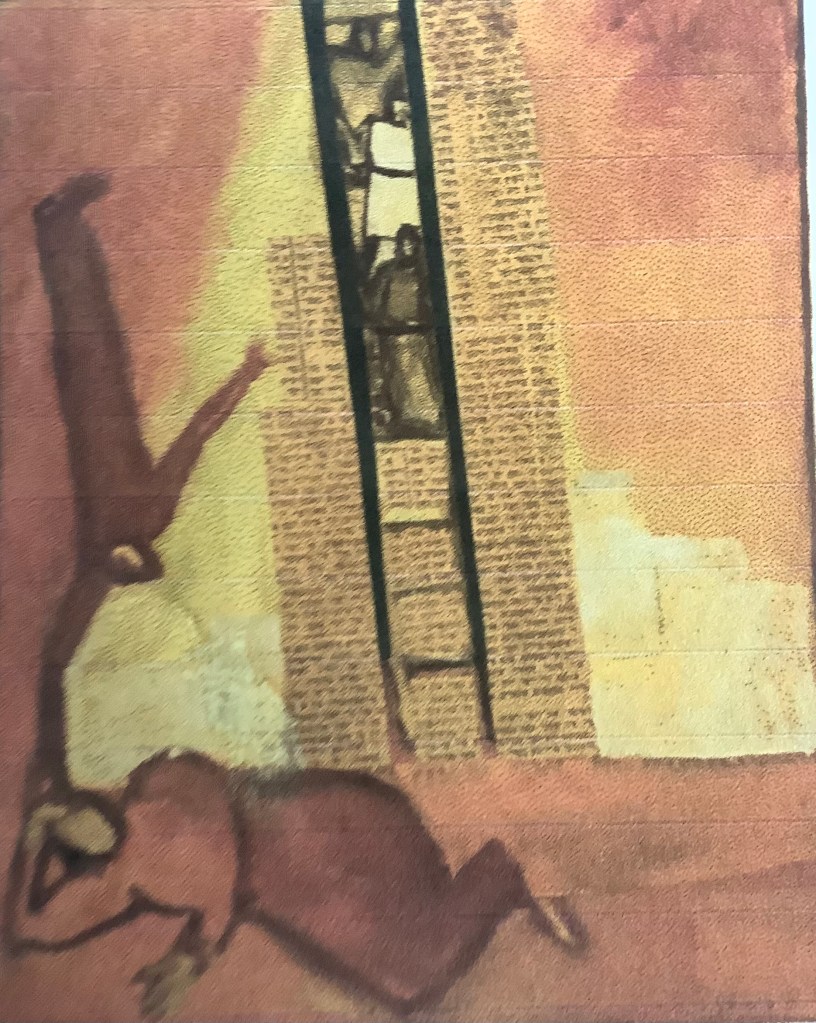
A collage variation of Chagall’s Jacob’s Ladder (source unknown)

And Jacob dreamed that there was a ladder set up on the earth, the top of it reaching to heaven; and the angels of God were ascending and descending on it. Genesis 28:12

Heaven and Earth are only three feet apart, but in thin places that distance is even smaller. A thin place is where the veil that separates Heaven and Earth is lifted and one is able to receive a glimpse of the glory of God. (Celtic tradition)

Nothing Is Far

BY ROBERT FRANCIS

Though I have never caught the word

Of God from any calling bird,

I hear all that the ancients heard.

Though I have seen no deity

Enter or leave a twilit tree,

I see all that the seers see.

A common stone can still reveal

Something not stone, not seen, yet real.

What may a common stone conceal?

Nothing is far that once was near.

Nothing is hid that once was clear.

Nothing was God that is not here.

Here is the bird, the tree, the stone.

Here in the sun I sit alone

Between the known and the unknown.

And Jesus said, ‘Very truly, I tell you, you will see heaven opened and the angels of God ascending and descending upon the Son of Man.’ John 1:51

Christ came down to raise us up, for Christ joins Earth with Heaven.

Lord Jesus Christ, through your life and death, you opened wide the way between Heaven and Earth, come close to us now that we may glimpse Heaven on Earth and so be inspired to lift our lives up to you. Amen.

Counting on 2026 …. Day 36

5th May

Over the next few days I shall be reflecting on some of the issues raised in the Hazelnut Community’s recent edition of Rooted in Rubble, about living simply – https://hazelnutcommunity.substack.com/p/the-life-we-miss-while-wanting-more?r=1r0y9l

“There is a profound difference between the pain of poverty and the choice of simplicity. Poverty is not freedom. It is constraint, often imposed and unjust, limiting choice and exhausting those who live within it. It must never be romanticised or reframed as virtue.” 

This is clearly an important point to highlight. I think it places a responsibility on those of us who have choices, to make choices that benefit the poor and those disadvantaged by our economic system. In other words we shouldn’t just withdraw from world in order to enjoy lives of simple living, but should create lives of simple living within or alongside the world so that we can also find ways of changing the world so that it does benefit the poor and estranged.

This might be by campaigning, writing to our MP, signing petitions. It might be by choosing to buy from or support companies that operate fairly and proactively in favour of the poor and vulnerable (explore for example, fair trade companies and B Corps). It might be by giving generously to, or otherwise supporting, organisations that seek to improve the wellbeing and opportunities of the poor and marginalised.

Living simply should not prevent us from, but actively prompt us to, better loving our neighbour!

Counting on 2026 …. Day 35

4th May

Joy in Enough is about not wanting more and more, or bigger and bigger. 

How many pairs of trainers do I need? How big a television do I need? How far do I need to travel for my holiday? 

If I have too much of everything, will I really be able to enjoy them all? If I choose the biggest thing will it really make me happier than the smaller version?

It is interesting to note that even now that we have separate bins for recycling for the waste we can recycle, why is it that dustbins – for what we can’t recycle – are still  getting larger and larger! How do we manage to produce so much waste each week?

In praise of May 

2nd May 2026

From the dew of heaven and the richness of the earth, may God always give you abundant harvests of grain and bountiful new wine. Genesis 27:28

The month of May owes its name to the Greek goddess of fertility, Maia. For many May is the month dedicated to the Virgin Mary, Queen of  May. It is certainly the month when spring growth is at its most abundant. 

Glory be to God for the May tree –

 the happy hawthorn:

Decked in  white blossom, 

she serves a feast for insects – alleluia! 

Glory be to God for the mayfly – 

ephemera vulgate:

Older even than dinosaurs, 

they surrenders their underwater life 

for one brief air born day of delight – Alleluia! 

Glory be to God for the maybug – 

the cockchafer:

Four years toiling as grub underground, 

she emerges 

a chestnut gilded member of the scarab family – alleluia!

Glory be to God for the may flower – 

the cuckoo flower, Cardamine pratensis:

Pink flowers veined with purple, a dainty plant 

that feeds the caterpillars of orange-tip 

and  green-veined white butterflies – Alleluia!

A reading: Genesis 1: 29-31 

And look! I have given you the seed-bearing plants throughout the earth and all the fruit trees for your food.  And I’ve given all the grass and plants to the animals and birds for their food.”  Then God looked over all that he had made, and it was excellent in every way. This ended the sixth day.

God of all creation,

May we cherish what you have created, 

respecting each plant and animal, 

bird and insect,

as both unique and irreplaceable.

May we honour with reverence 

what spreads out before our feet, 

what flies in the air above, 

slides through the water 

or creeps in the soil below.

May we temper our lives 

to make space for others, 

ceding priority to the vulnerable 

and encouraging the faint- hearted.

May we listen with our ears, 

see with our eyes 

and comprehend with wisdom 

the harmony of your Kingdom here in earth.

Amen.

The Grace 

Counting on 2026 …. Day 33

30th April

Living simply is also about not hanging on to things. 

I regularly take to charity shops things that we are not using anymore, things that we have in duplicate, things that are taking up space. This could a dress I bought but no longer wear, books I have read and won’t reread, toys the children have outgrown etc. Conversely when I need something, I will check out the charity shops – this often involves patience but in time the saucepan or jacket I need will turn up. And there is always a good supply of books to read. 

The house feels more comfortable when it is not cluttered with stuff. And there is less to worry about – be that keeping it clean, finding space to store it etc.

Counting on 2026 …. Day 34

1st May

I am also a member of Green Christian which has one section called Joy in Enough. For me this is – in part – about taking delight in small things. I enjoy having a good coffee in a local friendly cafe. I enjoy the drink – its taste, smell and feel. I enjoy contemplating the view which could be the River Thames, people walking long the path with their children/ pets, birds pecking at crumbs etc. I enjoy contributing to the local economy. Local independent shops, including cafes, only exist if we use them; their staff only have jobs if the business remains profitable. 

If it’s on offer, I also choose a vegan option – cake, toast and peanut butter, porridge etc. Plant based options will only be made available if people buy them!

Counting on 2026 …. Day 33

30th April

Living simply is also about not hanging on to things. 

I regularly take to charity shops things that we are not using anymore, things that we have in duplicate, things that are taking up space. This could a dress I bought but no longer wear, books I have read and won’t reread, toys the children have outgrown etc. Conversely when I need something, I will check out the charity shops – this often involves patience but in time the saucepan or jacket I need will turn up. And there is always a good supply of books to read. 

The house feels more comfortable when it is not cluttered with stuff. And there is less to worry about – be that keeping it clean, finding space to store it etc.

Counting on 2026 …. Day 32

29th April

I am a Franciscan tertiary. One of the things that drew me to the way of St Francis was the example of living simply. Francis himself chose absolute poverty as his lifestyle, but for those in the third order – those who aim to combine the spirit of Francis with everyday as opposed to monastic life (a movement established by Francis himself), living in poverty is revisioned as living simply.

For me this is not buying more than I need. I don’t need numerous pairs of running shoes and leggings. I don’t need new outfits every season. I don’t need to fill my kitchen with juicers/ air fryers/ rice cookers/ food processors etc. Rather I can make things last, I can mend things (when our sheets wear thin in the middle, I cut them in half and resew them, edges to the middle). I do without items. I take pleasure in having things that have a history – my current jacket was my husband’s school blazer.

Counting on 2026 …. Day 31

28th April

One bit of advertising that did influence me was a small booklet picked up in a Lush store about zero waste. That prompted me to steer our household towards a zero waste lifestyle – and gave me an aversion to plastic. I will routinely not purchase a product – greetings card, pen, sandwich, chocolate bar, packet of biscuits, etc – if it comes wrapped in plastic. Sometimes I do have to give way – eg screws that tend to come in plastic packs. But my general aim of avoiding plastic does change the way I shop and consume things. I will pay more for the unpackaged item.

Read more about our household approach to zero waste – https://greentau.org/2026/04/27/zero-waste/