Counting on 2026 …. Day 24

18th February 

Yesterday was Shrove Tuesday when in the past people confessed their sins and were shriven so that they could start Lent free of the burden of guilt. 

If in observing Lent, we are following the example of Jesus who prepared for his mission in sharing the gospel by spending 40 days of prayer and fasting in the wilderness, what can the next 7 weeks offer us?

In the wilderness Jesus was totally reliant for his survival on what God could give him and what the wilderness – ie nature – could give him. Through this experience he would have been very close relationship with both God and nature. So is that, I wonder, what we should be aiming for during Lent? A chance to deepen our understanding of, relationship with and reliance on, God and nature?

Green Tau Shrove Tuesday Reflection

17th February 2026

Today is Shrove Tuesday. Shrive comes from the Old English to write, and thence to assign or prescribe, and from that to confess. Today would be a good day to list all the things that we feel are out of kilter in our lives and in the lives of our society, with perhaps a particular focus on those relating to our care of creation. 

In the 15th century (and earlier) Shrovetide wasn’t just a Tuesday but was the three days before Ash Wednesday. Three days, including a Sunday, would have given more opportunity for people to formally confess their sins and receive their penance – what they must do to atone for the sins they have committed. 

Once shriven – absolved from sin – the penitent was ready to embark on the forty days of Lent: forty days of fasting and observing the penance they had been given. 

Fasting is holding back for pleasures and often includes food. Not ‘not eating’ but not eating certain foods, typically meat and dairy products. In many countries the days preceding Ash Wednesday are called Carnival. The name comes from the Medieval Latin ‘carnelevamen’ meaning to put away, to not eat, meat. Not wanting perhaps to waste food, or perhaps to enjoy one last pleasure before the fast began, the days before Lent have becomes days for feasting and merriment. Hence Carnival and shrove Tuesday pancakes! For those of us who are carnivores or vegetarians, giving up meat and dairy products for forty days could be a challenge. In the 15th century it may have been less so – Lent coincided with the lean time of the year when winter supplies had largely been eaten and spring foods had yet to appear. Fasting from meat and dairy products may have been a necessity rather than a choice.  But now, as more people swop to plant based diets, the restrictions of Lent can seem less daunting. There is a growing range of plant based foods, recipes, cuisines etc that makes not eating meat no penance. 

What then is the purpose of fasting? Fasting can be a way of cultivating self discipline. It can be a way of focusing our awareness on the needs of others: some people opt to limit their food intake to the limited amount that many brothers and sisters ensure as a necessity. Some opt to eat only locally grown produce, such as the Fife diet, as a way of rooting their awareness of local food production. Some might concentrate on foods that adhere to Green Christian’s LOAF principles – local, organic, animal friendly and fairly traded.

Such fasting for Lent shows us how penance can be constructive. It helps us both to address the harm we have caused and to learn new habits to stop us from committing the same sins again. Fasting and penance need not apply just to food. Some people practice a carbon fast, cutting back on activities or use of equipment that has a high carbon footprint. Some might opt out fast from consumerism, and cut back on new purchases, cut out of retail therapy etc. some might fast from work – some of us put work and achievement as a priority in our lives and may wish to spend more time with friends, with family, with nature, with God. 

In some cultures past and present, those who were penitent wished to make a clear statement of their decision – their need – to repent and would put on clothing made for sacking, would cut their hair, or go barefoot. Such action strengthened their resolve and was a witness to others for the need for repentance.

If we want to take Lent seriously as a time for re orientating ourselves towards the resurrection and life lived in Christ, then observing Shrove Tuesday as a time to confess our sins and to accepting a penance that will be make good at least some of the harm our sins, is a good starting point. However you may find yourself in a minority with most people deferring such reflection and preparation till Ash Wednesday. Even in the church, Shrovetide has been replaced by ‘pancake day’ and become a day in which to eat pancakes in all shapes and sizes and adorned with all manner of flavourings from the sweet sour lemon and sugar, to the meaty ones of bacon and maple syrup. 

Ash Wednesday is the modern Shrovetide. 

NB this is based on earlier articles I wrote in 2022 and 2023

Counting on 2026 …. Day 23

17th February 

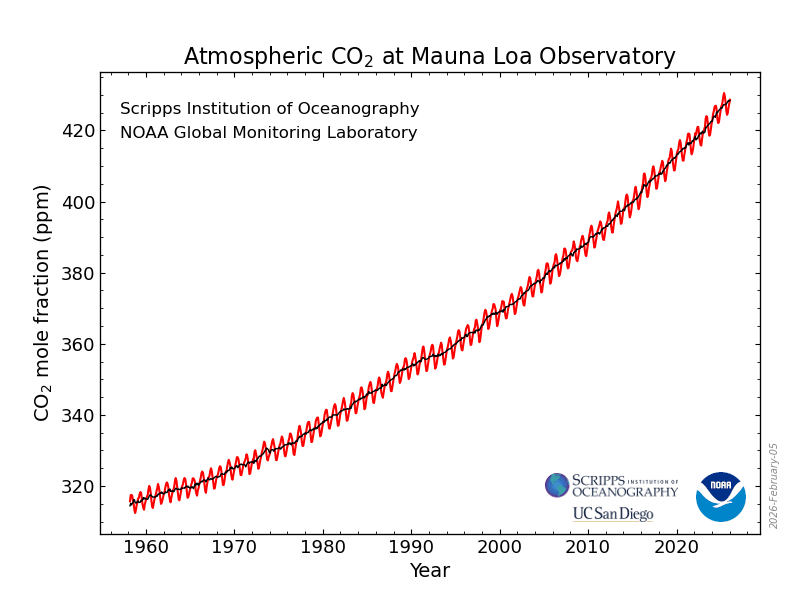
The main cause of climate change is the increase in carbon dioxide emissions – and it is an increase caused by human activities. The following chart shows the annual levels of CO2 emissions measured in parts per million. 350 ppm is the safe planetary boundary.  (1)

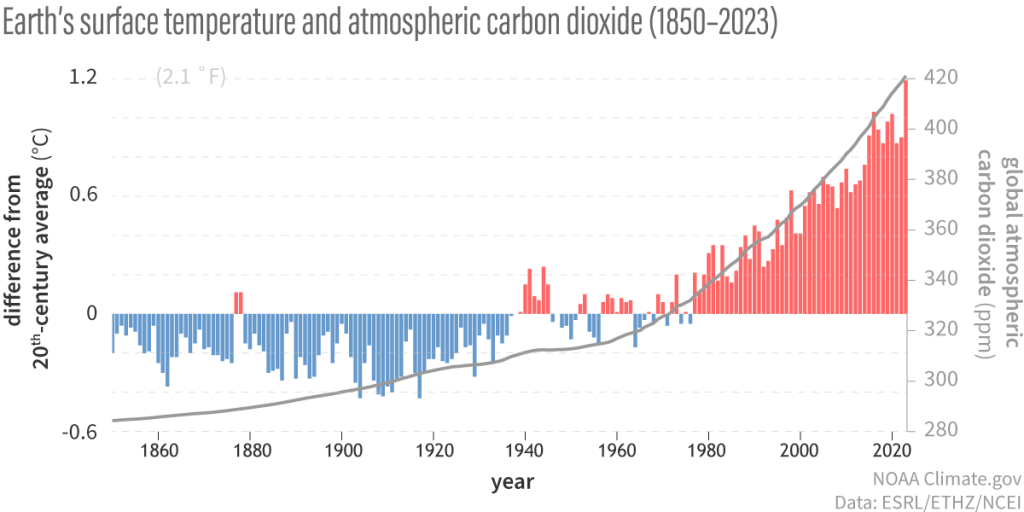
The second chart shows the correlation between rising levels of CO2 emissions and global temperatures. (2) 

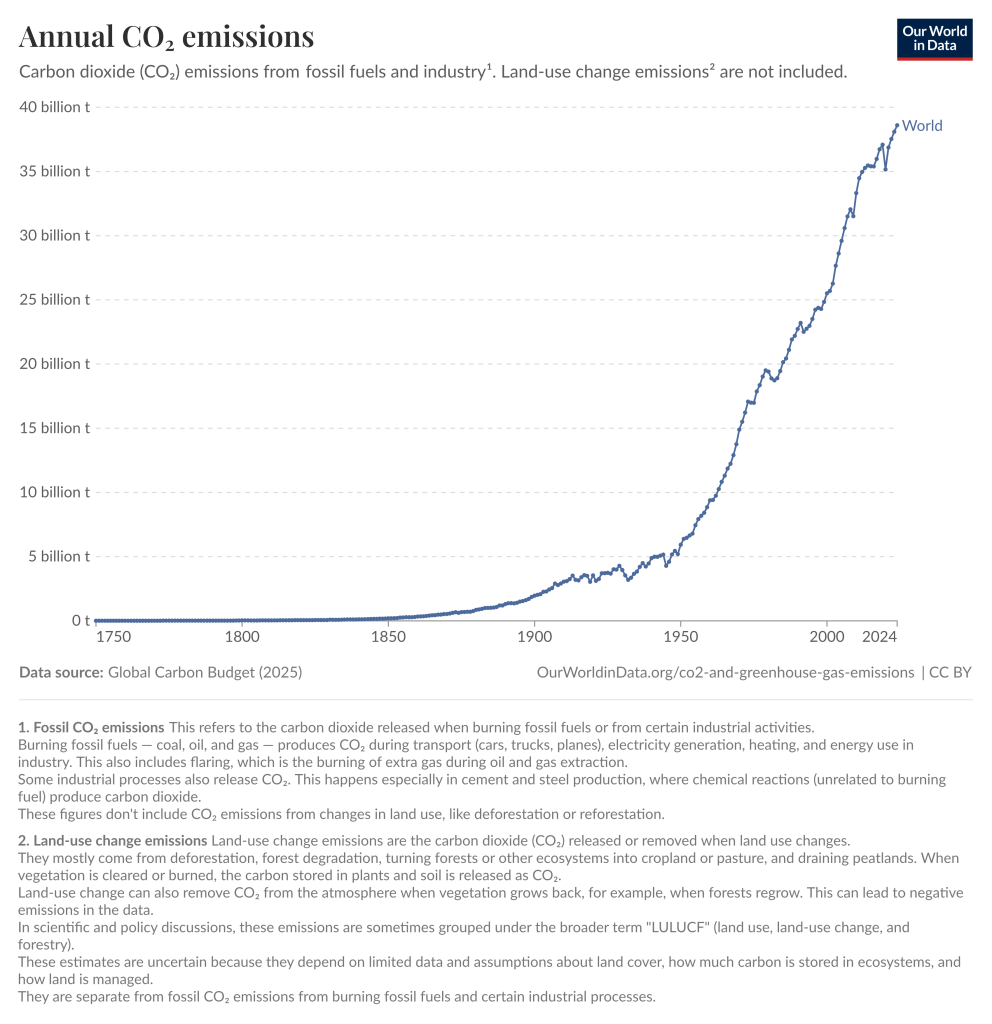
Once released into the atmosphere,  carbon dioxide remains there for centuries. So it is important to understand not just how much we emit each year, but also how much has already accumulated in the atmosphere and to which we are now adding. The chart below comes  from an article produced by Our 

World in Data. (3) 

Whilst climate deniers may point to periods on the past when temperatures in the UK during the past two thousand years have been higher than average, there has been no period during human history when global temperatures have risen to the levels now seen and nor when carbon emissions HVO been at current levels. We have very clearly passed the safe planetary boundary vis a vis carbon dioxide emissions.

  1. https://gml.noaa.gov/ccgg/trends/global.html
  2. https://www.climate.gov/media/13840
  3. https://ourworldindata.org/co2-emissions

Counting on 2026 …. Day 22

16th February 

Of the seven planetary boundaries where we have passed from the safe zone into the unsustainable zone, the last I am writing about is climate change which is subdivided into CO2 concentration and radioactive forcing.

Radioactive forcing is a scientific concept which measures the imbalance between incoming and outgoing energy in Earth’s climate system. When energy from the sun reaches Earth, some reflects back to space while some gets absorbed. The difference between these two creates what scientists call radiative forcing, expressed in watts per square meter (W m⁻²). (1)

Different gases and particles suspended in the atmosphere (aerosols) plus the reflective capacity of the land/ sea surface contribute to this. Of all the gases in the atmosphere carbon dioxide has the greatest impact – absorbing energy (heat) whilst of aerosols sulphur dioxide has the biggest impact reflecting  energy/ heat back out of the atmosphere. Thus the dirty smoke from coal power stations and from diesel shipping does in fact cool the planet, and as these sources of air pollution are reduced, there is an ironic increase in temperatures. Sulphur dioxide forms of smog which is harmful to health, often causing premature deaths (pictures of Delhi with obscured views of the city illustrate the density of these particles). (2)

“Scientists have proposed a PB for total anthropogenic radiative forcing at +1.0 W/m², relative to pre-industrial levels. This threshold is based on the climate system’s sensitivity to greenhouse gas forcing, observed responses of polar ice sheets to warming, and growing evidence of climate instability at forcing levels above +1.5 W/m². Exceeding this boundary increases the risk of irreversible climate impacts and long-term system feedback loops.” (3)

We exceeded this safe point in 1986.

  1.   https://climatechange.academy/introduction-to-climate-change/radiative-forcing-explained-climate-change/

(2) https://www.bbc.com/news/articles/ckg4d9kq2eno

(3) https://www.planetaryhealthcheck.org/boundary/climate-change/

The Joys and Sorrows of Civilisation 

14th February 2026

There shall come forth a shoot from the stump of Jesse, and a branch from his roots shall bear fruit. Isaiah 11:1

You Lord, are the source of all good things: 

We praise you.

You call us to tend and care for your creation: 

May we strive to do your will.

You have made us as brothers and sisters with all that lives: 

May we live together in peace.

A reading:  So Paul stood up and with a gesture began to speak: ‘You Israelites, and others who fear God, listen. The God of this people Israel chose our ancestors ….. he made David their king. In his testimony about him he said, “I have found David, son of Jesse, to be a man after my heart, who will carry out all my wishes.” Of this man’s posterity God has brought to Israel a Saviour, Jesus, as he promised. Acts 13: 16, 17a, 22b,23

Reflection 

Roots secure us to the past, ensure that we are part of the continuity of creation; shoots  and branches  take our lives forward into the as yet unformed future. Without the next generation there will be no ongoing continuity. The gospels of Luke and Matthew both locate Jesus within a human family tree;  the prologue of John’s gospel locates him as co existent with the beginning of all creation. Later in John’s  gospel, Jesus affirms his coexistence with the Father and the ongoing coexistence, through him, of all believers, all God’s children. 

For gifts of past generations:

We thank you God.

For the gift of fire for cooking and heating

For the gift of clean water and sewers:

We thank you God.

For the domestication of cattle and horses,

Cats and dogs, sheep and pigs, 

Hens and geese:

We thank you God.

For the gift of gardening and arable cultivation,

sowing and reaping, 

growing and harvesting:

We thank you God.

For the gift of healing and caring, 

of medicine and surgery

For the understanding of the intricacies of mind and body:

We thank you God.

For the gift of story telling and drama, 

of art and observation 

means of sharing grief and joy:

We thank you God.

For the gift of learning and research, 

of teaching and sharing:

We thank you God.

For the gift of exploration and endeavour, 

of travel and communication:

We thank you God.

For the gift of worship, 

of self realisation 

and of the knowledge of God:

We thank you God.

But what shall we pass on to generations to come?

Do we offer gifts or burdens?

Merciful God forgive and inspire us.

Clean air or choking smog?

Merciful God forgive and inspire us.

Living water or dying oceans?

Merciful God forgive and inspire us.

Renewables or fossil fuels?

Merciful God forgive and inspire us.

Biodiversity or widespread extinction?

 Merciful God forgive and inspire us.

Fertile soils or inhospitable dust?

Merciful God forgive and inspire us.

Balmy summers or wild fires?

Merciful God forgive and inspire us.

Snow capped mountains or drowned coastlines?

Merciful God forgive and inspire us.

Homes for all  or camps for migrants?

Merciful God forgive and inspire us.

May we be wise guardians of what we have received 

Skilful custodians of what we consume

Generous donors of what we hand on

That the future of creation will be bright and beautiful, 

fair and just.

Amen

Love overcomes hate

7th February 2026

Love never fails. 1 Corinthians 13:8

You Lord, are the source of all good things: 

We praise you.

You call us to tend and care for your creation: 

May we strive to do your will.

You have made us as brothers and sisters with all that lives: 

May we live together in peace.

A reading from Matthew 5:43-47 (The Message)

 “You’re familiar with the old written law, ‘Love your friend,’ and its unwritten companion, ‘Hate your enemy.’ I’m challenging that. I’m telling you to love your enemies. Let them bring out the best in you, not the worst. When someone gives you a hard time, respond with the supple moves of prayer, for then you are working out of your true selves, your God-created selves. This is what God does. He gives his best—the sun to warm and the rain to nourish—to everyone, regardless: the good and bad, the nice and nasty. If all you do is love the lovable, do you expect a bonus? Anybody can do that. If you simply say hello to those who greet you, do you expect a medal? Any run-of-the-mill sinner does that.

Response

Hate or love?

Hate smoulders and burns.

It reduces cheer to ash and clinker..

Love soothes the flaming rage,

And untangles twisted thoughts.

Hate rides roughshod over compassion.

It disregards the truth.

.

Love reads between the lines,

And hears the hidden words of hope..

Hate erects rigid boundaries.

It ring-fences every option.  

Love sees beyond the corner,

And stretches out new horizons.

Hate casts an evil guise over every action.

It masks every sign of joy.

Love lifts the veil, 

And finds the hidden virtue.

Hate feeds on anger. 

Its rapacious appetite knows no limit. 

Love expands with humility, 

And grows with easy care.

Hate is all consuming – 

Till nothing true remains.

Love is all consuming – 

Till only truth remains. 

Prayers

Holy God of love,

Heal the wounds where hate festers.

Renew our trust in one another.

Holy God of love,

Remove the log that blinds the eye. 

Restore our vision of the world aright.

Holy God of love,

Open the ears that are stopped.

Retune our understanding of forgiveness.

Holy God of love,

Cut through warfare and  vengeance –

In streets and cities in the UK.

In Palestine and Isreal.

In Iran.

In Yemen.

In North Sudan and the Sahel. 

In the Democratic Republic of Congo. 

In Ukraine and in Russia.

Cut through war and vengeance –

wherever it is found.

Replant the seeds of peace,

Water them with  love,  

with compassion, 

and feed them with vigorous determination. 

Amen 

The Lord’s Prayer

Counting on 2026 …. Day 21

6th February 

In response to the government’s national security report ‘Global biodiversity loss, ecosystem collapse and national security’ (1)  Sustain responded with its reading of the urgency of the situation, making the following recommendations:-

“The Government must now look to planning, nature recovery and food and farming policy to mutually support each other to deliver the wholescale changes in diets and food production that security experts recommend. Farming policy must prioritise global ecosystem recovery, and nature and climate policy include measures to grow more foods that boost our resilience and aren’t heavily reliant on imports. Immediate actions include:

  • Halting any further expansion of intensive livestock production
  • Investing in projects like Bridging the Gap, and schemes like Welsh Veg in Schools, to unlock profitable supply chains that increase the production and consumption of organic fruit, vegetables and legumes
  • A horticulture investment strategy that boosts commercial production of UK vegetables, beans, pulses, legumes and nuts, as well as increasing the UK market for these products 
  • Ending the exploitative practices of large agri-food corporations, and give farmers more power to set prices and market conditions
  • Funding farmer cooperatives, networks, and mentoring schemes to scale agroecological farming through knowledge sharing, pooling resources and building collective market power “ (2)

It is frustrating that there are so many clear solutions to the crisis we face, but so little willingness on the part of the Government to enact the policies and legislation that would enable these changes to be made – because market forces won’t do this alone and many people whether farmers, retailers or consumers are trapped by unrestrained market forces.  

  1. https://www.gov.uk/government/statistics/united-kingdom-food-security-report-2024/united-kingdom-food-security-report-2024-introduction

(2) https://www.sustainweb.org/news/jan26-national-security-risk-report/

Counting on 2026 …. Day 20

5th February 

Sustain’s report (released November 2025), Bridging the Gap: How to fix the food system for everyone, calls for the creation of “just, healthy and sustainable UK food system will require system-wide change alongside strong leadership. Farming of nutritious food with lower inputs, lower greenhouse gas emissions, which restore nature and support decent livelihoods for a diversity of growers must become the mainstream to build nutritional security and domestic resilience against global shocks. Our policy recommendations include ways to significantly increase domestic fruit and veg production in the UK7 and, with this, more jobs (up to 80 jobs per thousand tonnes produced), benefiting local communities.9

“Alongside this we need to double the consumption of fruit, veg and pulses to improve people’s health while securing a market for growers, supporting the transition to climate and nature friendly farming. For this triple bottom line to be possible, good food must be available and affordable in local retail settings and across our schools and hospitals, sourced through ethical, value-based supply chains that provide growers with better and more reliable incomes than what they currently experience via supermarket supply chains.11 

“If we are to produce food that is good for people and for the planet, and accessible to everyone regardless of their income, the Government must actively support climate and nature friendly horticulture and lead by example on how our food is bought and sold.” (1)

The report lists three clear policy recommendations:- 

1. Fix the supply – Boost British fruit, veg and pulse production

• Introduce cross-departmental horticulture strategies across the nations to support green growth and boost production and consumption of fruit, vegetables and pulses

* Support small-scale and organic farmers through grants, better land access, and training programmes

2. Fix the missing middle – Ensure fair prices and invest in infrastructure

•Invest in local food infrastructure like food hubs, processing and packing facilities (particularly for legumes), and distribution centres to help smaller local producers get produce to market.

•Strengthen supply chain fairness to enforce fair dealing across more of the supply chain.

3. Fix the access – Enable everyone to eat good food

• Use the state’s £5 billion of public food procurement from schools and hospitals to create stable markets for organic and locally produced produce. This will deliver on the Labour Government election manifesto commitment to ensure 50% of publicly procured food is local or to a higher environmental standard.

  • Run pilots and roll-out schemes to make healthy food more affordable for low-income households and reduce NHS spending, such as vouchers and ‘fruit and veg on prescription’. (1)

The report details 9 different pilot schemes that have been running for the last two years, and the results show clear win-win outcomes for health, climate and  environment, local economies, and food security.

Will the government take on these recommendations? Will they be supported by the farming industry, by retailers and by consumers? 

  1. https://www.sustainweb.org/assets/bridging-the-gap-how-to-fix-the-food-system-for-everyone-1764673053.pdf

Counting on 2026 … day 19

4th February 

To return to yesterday’s astounding statistic that the UK is just 62% self sufficient for all foods, and when looking at indigenous foods (ie those that can be grown in the UK) we are disappointingly only 75% self sufficient. And for fresh fruit we are about 15% self sufficient. 

It would seem that all too often imported fruit and vegetables are cheaper – perhaps coming from countries with lower wages or countries like Spain that use cheap seasonal labour from North Africa. (This is in itself a justice issue for these seasonal workers are often abused by their their employers – https://www.ethicalconsumer.org/ethicalcampaigns/agricultural-workers-rights-almeria). 

Do we need to encourage more horticulture in the UK and encourage consumers to buy UK produce? Maybe we need a “Buy British” advertising campaign as we did in the past with eggs.

Equally the government and local authorities could ensure that the Public Food Procurement sector does more to buy locally – encompassing buying British rather than imported produce, and buying from local (often small and medium sized) producers.

However this is not a simple straightforward problem to solve. If buying British means paying a higher price for fruit and vegetables, then the poorer sectors of our society need to receive a higher income – either through improved benefits and/ or improved pay. The proliferation of food banks already shows us that we are failing as a society – and therefore being failed by our government – to ensure everyone has enough money to eat well.

Wages also feed in as a cost factor for the producers of fruit and vegetables. Growing and harvesting is both labour intensive and seasonal. Increased wage costs (due to inflationary pressures and NI costs etc) are eating away at profit margins. This has also been compounded by Brexit which has reduced the supply of seasonal workers from Europe and sometimes crops have gone unharvested severely denting the viability of businesses. We need a better system of ensuring that everyone receives a fair wage as the bedrock of our economy.

The dominance of the supply chain by big supermarkets also needs to be reviewed. Supermarkets dominate the market giving them considerable leverage over prices paid to the producers. Whilst this does drive down costs on some items, it does so at the expense of the producers. A report from 2022 by the Sustainable Farming Campaign highlights the very small profit margin received by food producers as opposed to the profits made elsewhere in the supply chain: “For 1kg of apples purchased in a supermarket (about 6 apples), the apple grower has costs of 76p, yet receives in profit just 1% (3 pence) of a selling price of £2.20”. The same report observed that organic apples sold not by a supermarket but by a not-for profit hub, received : “1kg of organic apples purchased gives the organic apple grower three times -3% (10 pence) of the selling price of £4.00 with costs of 175p.” Ie a 0.06% profit margin as opposed to 0.04%. (1)

Another major costs for the producers of fruit and vegetables is energy. Rising energy prices have, for example, particularly affected crops grow under glass. In part this is because of the UK’s past heavy reliance on fossil fuels and the impact of the war in Ukraine. A concerted shift to renewable energy would bring down energy costs but in terms of a just transition, should grants be made available to enable fruit and vegetable growers to invest in solar panels? At the same time there needs to be urgent investment in the capacity of the grid.

Support  with investment in new technologies and infrastructure would also encourage an expansion of UK based production. Relatively speaking, horticulture doesn’t need lots of land vis a vis other crops or livestock,  but does need more infrastructure per hectare. 

Another factor to be considered in terms of promoting  UK grown fruit and vegetables is the growing insecurity of the supply of imported produce. Spain, Italy and North Africa from where much of our imported fruit and vegetables come, are countries that are increasingly the impacts of change – droughts  floods etc – and which have already resulted in reduced harvests. 

  1. https://www.sustainweb.org/news/nov22-unpicking-food-prices-new/

Background reading

 – https://researchbriefings.files.parliament.uk/documents/POST-PN-0707/POST-PN-0707.pdf

Counting on 2026 … day 18

3rd February 

The availability of food is highlighted as a major concern for the UK in the Government report,  Nature security assessment on global biodiversity loss, ecosystem collapse and national security. Food insecurity is seen as major national issue. 

The UK is just 62% self sufficient for all foods, and when looking at indigenous foods (ie those that can be grown in the UK) we are disappointingly only 75% self sufficient. In other words we are importing up to  25% of foods that could be grown here in the UK!

The Guardian recently produced an article about food security in Finland. (1) Despite a not very amenable climate with a short growing season, Finland is 80% self sufficient for food. Finland is by nature a country where a preparedness mindset is essential in the face of its climate, its geopolitical borders and its own geography.  

Finland’s National Emergency Supply Agency (Nesa) ensures that the nation will cope if things go wrong. They maintain a strategic store of grains – wheat, oats, barley and rye – which is rotated to ensure freshness. This reserve helped to reassure people when the war in Ukraine led to grain shortages. 

Farms form the backbone of their food system, and they have developed varieties of grain and other staples that are suitable for their short growing season. Alongside the farms, Finland ensures that their food supply chain is also resilient. Emergency fuel reserves are kept for both farm machinery and transport vehicles. 

Another key part of Finland’s resilience strategy is in ensuring preparedness at household level too. Finnish households are all encouraged to maintain a sufficient stock of food and other essentials to last 72 hours. 

(1) https://www.theguardian.com/commentisfree/2025/sep/16/finland-crisis-food-stockpiles-europe-supply-chains-fuel-reserves?CMP=Share_iOSApp_Other