Counting on … day 208

19th December 2025

What should we be doing? – 1

Reviewing and redesigning the way we use fresh water so as to conserve and protect this precious resource for the benefit of all.

“Human use of water, especially for agriculture, is [a] major driver of freshwater change. Irrigation alone accounts for about 70% of all freshwater withdrawals, and around 90% of the water that is consumed and not returned to the source. Large-scale river diversions, dams, and groundwater pumping have dramatically altered the flow and storage of blue water, lowering water levels in rivers, lakes, and aquifers and degrading aquatic habitats.” (1)

Where dams are placed and how the flow of water downstream is controlled is very important if fair access to water is to be ensured. One of the main factors causing Iran to be so short of water and why in parts of Tehran there is a real risk of taps literally running dry. Nations upstream of Iran have set up dams and extract so much water, that downstream rivers such as the Tigris have severely reduced flow. 

How water is used for agriculture also needs to be controlled and consideration given as to which crops are grown, and whether there are more water efficient plant varieties and methods of farming.

The Aral Sea has already been destroyed by agricultural water extraction (mainly for cotton which is a very thirsty crop – 15,000 tonnes of irrigation water per hectare) and now the Caspian Sea is similarly under threat. 

Consideration also needs to be given to the place of livestock farming. Globally 30–40% of fresh water is used to provide 16% of the food obtained as meat, eggs, and dairy products – the vast majority of this is water used in growing food crops for the animals.

All foods have a fresh water footprint. The size will vary with location. Strawberries grown for example in Spain will have a higher water footprint than those grown in the cooler climes of the UK. 70% of Spanish strawberries are grown in the Doñana region where the extraction of water is depleting the water in the region’s biodiverse wetlands.

Governments and farmers and scientists need to work together to ensure against the over-extraction of water. Different farming methods and different crops etc that use less water should be utilised.

As customers we too can contribute by shaping our diets around foods with lower water footprints. 

You can find more information online: eg-

Or look at the Planetary Health Diet. Its researchers estimate that following this optimised diet produces a lower water footprint of up to 30%.

(1) https://www.planetaryhealthcheck.org/boundary/freshwater-change/

Counting on … 196

1st December 2025

“Biogeochemical cycles are the pathways through which chemical elements move and are recycled through both the living and nonliving components of Earth’s systems. The term “biogeochemical” combines “bio” (living organisms), “geo” (Earth’s geological aspects like rocks, air, and water), and “chemical” (elements and compounds). These interconnected processes ensure the continuous availability of elements essential for sustaining life on our planet. Through these cycles, elements like carbon, nitrogen, and water are exchanged between the atmosphere, oceans, land, and all forms of life.” (1) 

Biogeochemical cycles include the water cycle (water from the oceans evaporates, is carried up into the atmosphere, moves with the wind, forms clouds and fall as rain creating rivers that flow back into the seas) , the carbon cycle (carbon dioxide from the atmosphere is absorbed by plants via photosynthesis, the plants are eaten by creatures building up their bodies; when either plants or creatures die, the carbon in their body is realised by the processes of decay and returns to the atmosphere); nitrogen cycles (relying on specialised plants such as peas and beans, as well as bacteria in the soil,, that can capture nitrogen from the atmosphere as well as in the case of bacteria and fungi, return nitrogen from decaying bodies back into the soil: nitrogen is important for promoting growth in plants) etc

These cycles are important for ensuring the health of all living things. If the cycles are disrupted it leads to environmental problems. So if humans use synthetic nitrogen and phosphorus fertilisers to boost plant growth, the runoff into the soil and water causes an imbalance in the local ecosystems. Too much of these chemicals  produces algal blooms that  damaging other life forms, rivers become dead and soils loose their fertility.

Widespread use of phosphorus and nitrogen based fertilisers to boost crop yields – including grass and  crops grown to feed livestock – has exceeded safe planetary boundaries severely  damaged clean water supplies, the health of our soils and biodiversity. Agricultural practices need to change! 

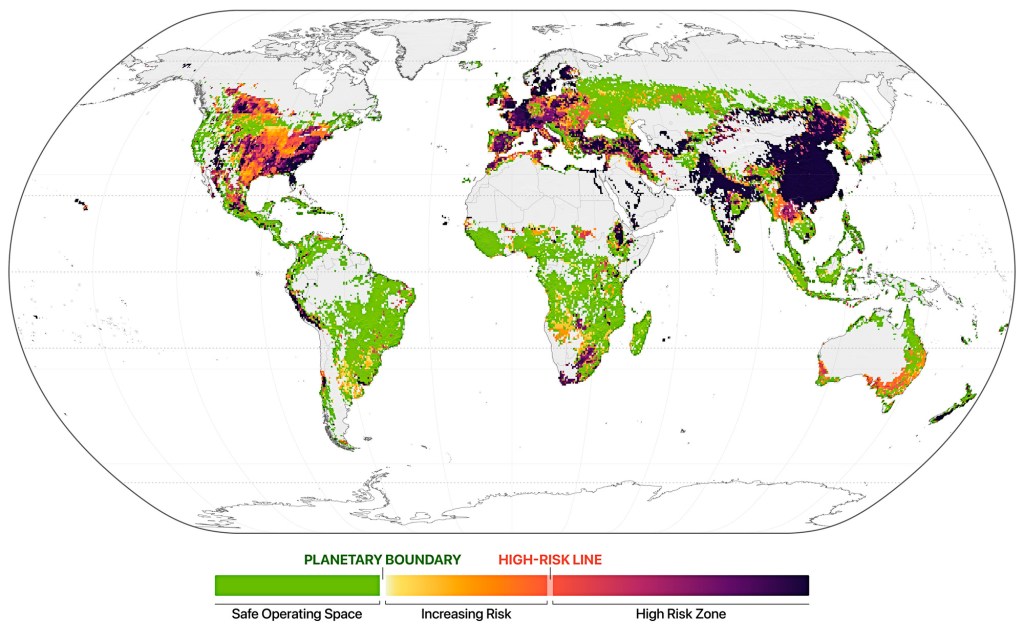
“Nitrogen use in agriculture has exceeded safe ecological limits in several regions of the world, particularly in parts of Asia and Europe, indicating significant environmental risks.

The regional boundary status is calculated based on agricultural nitrogen surplus in the year 2020 and estimates of regional surplus boundaries. Values range from within the Safe Operating Space (green; no exceedance of regional surplus boundaries) to the Zone of Increasing Risk (orange), and extend to the High-risk zone (red/purple). Based on data from model runs with IMAGE-GNM, using the methodology of Schulte-Uebbing et al. (2022).” (2)

  1. https://biologyinsights.com/what-are-biogeochemical-cycles-and-why-are-they-important/
  2. https://www.planetaryhealthcheck.org/boundary/modification-of-biogeochemical-flows/

Green Tau: issue 120

21st  November 2025

Why poor diets are a systems issue not just a food issue. 

Part 1

Recently The Eat-Lancet Commission updated its Planetary Health Diet. This is a scientifically developed diet that can be followed anywhere in the globe using local, traditional ingredients. As the name ambiguously suggests, it is a diet that both promotes our physical health and planetary health. It is a diet rich in plant based foods with small amounts of fish, meat and dairy items. 

The 2025  overview begins with the arresting sentence: “The food we eat is more than a personal choice.” Can what we choose to eat make that much of a difference to the lives of other people?

The report continues: “It is a public issue with global consequences. What we eat affects agricultural land use, greenhouse gas emissions, water availability and quality, labor systems, and public health. Today’s food systems are, in many ways, failing. Millions face hunger, while others suffer from completely preventable chronic diseases. Food production contributes to environmental degradation and deepens inequality, when it could be the primary source of environmental regeneration, and justice. The EAT-LancetCommission’s approach to food addresses these challenges by linking health, sustainability, and justice. It promotes a shift in both consumption and production patterns, making healthy and sustainable food more accessible and reducing pressure on planetary boundaries. Transforming food will require cooperation across sectors, cultures, and regions. But the science is clear: changing what we eat is essential to building a future in which both people and planet can thrive.” (1)

What we choose to eat can shape how much land has to be used to produce our food and if that is less than at present, then more land can be used to restore biodiversity and the natural resilience of the world’s ecosystems.

What we choose to eat can reduce greenhouse emissions and so contribute to ensure a more amenable (or perhaps just less disastrous) environment for everyone. 

What we choose to eat can reduce the amount of water needed for agriculture and so can make water available for more essential needs such as drinking and sanitation.

What we choose to eat can have an impact on the welfare given to livestock, the welfare given to the soil, the welfare given to agricultural workers and food producers. (For example a cheap cup of coffee may come at the expense of deforestation where the beans are grown, at the expense of an inadequate price paid to the person growing and processing the beans, at the expense of a poorly paid barista, and at the expense of society if the coffee chain doesn’t pay its taxes. (2))

So yes, the EAT-Lancet Commission is clear that diet is not just about the food we eat but also about the systems that being the food from the farm to the plate. And not only that, these systems also impact our health not just through the food produced but through the impact that food production has on our environment – and thus on our health – and that it has an impact on incomes earned by those in the food industry which again (as we will see in more detail below, impacts health. 

Part 2

In many way the Planetary Health Diet as a guide, is not hugely dissimilar from the UK government’s Eat Well diet guide (3) – although the later increases the proportions of plant based foods at the expense  of cereals/ starch and animal based foods. This Eat Well guide dates back to 2016 which itself  is not very dissimilar to the 2014 guide known as the Eat Well Plate.

The UK government produces a regular National Diet and Nutrition Survey. This  is “designed to assess the diet, nutrient intake and nutritional status of the general UK population … is used by UK governments to monitor progress towards achieving diet and nutrition objectives and to develop food and nutrition policies”.  (4) 

Has the Eat Well guide improved healthy eating in the UK? Sadly not. 

According to analysis of the data by Field Doctor, the most recent  survey shows :- 

  • only 17% of adults eat at least five portions of fruit and vegetable a day
  • We eat 100% more  sugar, and 25% more saturated fat than is recommended 
  • 96% of adults eat an insufficient amount of fibre 
  • 18% have sub optimal levels of vitamin D (5)

Whilst the Roadmap for Resilience: A UK Food Plan for 2050 (produced by The Agri-Food for Net Zero Network), notes that under 1% of people in the UK fully meet dietary guidelines  and comments: “Poor diets cost the UK dearly – through pressures on the NHS, lost productivity and poor quality of life. Shifting towards healthy diets is a win-win that cuts emissions, saves public money, and helps improve the quality of life and work for productivity.” (6)

And The Broken Plate Report 2025 (produced by the Food Foundation) highlighted the following findings from its research:-:

  • Over a third of supermarket promotions on food and nonalcoholic drinks are for unhealthy food. 
  • Over a third of food and soft drink advertising spend is on confectionery, snacks, deserts and soft drinks, compared to just 2% on fruit and veg. 
  • Three quarters of the baby and toddler snacks that have front-of-pack promotional claims contain high or medium levels of sugar.

And 

  • On average, healthier foods are more than twice as expensive per calorie as less healthy foods, with healthier food increasing in price at twice the rate in the past two years.
  • To afford the government-recommended diet, the most deprived fifth of the population would need to spend 45% of their disposable income on food, rising to 70% for those households with children. 

And

  • children in the most deprived fifth of the population are nearly twice as likely to be living with obesity as those in the least deprived fifth by their first year of school
  • Ditto twice as likely to have tooth decay in their permanent teeth. (7)

Clearly both poverty and the high cost of healthy foods,  plays a big part in the unhealthy diets of many people in the UK. Other factors are also relevant, some linked to poverty and inequality such as 

  • lack of access to cooking facilities (especially true of people living in hostels, bed and breakfast or other shared accommodation). Research carried out in 2020 revealed that 1.9 million people in the UK didn’t have a cooker and 900,000 didn’t have a fridge. (8) 
  • Lack of access to local shops selling fresh produce – so called food deserts – affecting 1.2 million people. (9) 
  • Lack of time to prepare and cook meals especially for households juggling multiple jobs and/or long hours (apparently this hasn’t been widely researched (10) but in one recent survey of 2000 adults, 21% sited lack of time as a reason for not eating healthily (11)).

And other factors that have an impact across the board

  • Power of advertising in promoting ready meals and ultra processed foods. This report from Obesity Action Scotland is very clear as to the advertising has on diets. (12) 
  • Lack of experience of cooking from scratch  – again this is area which has received little research so the conclusion is conjecture.

What I think these various surveys show is, that whilst lack of financial resources a major factor in poor diets, unjust social systems may be a more embracing reason. It is unjust social systems that means that households do not have adequate cooking facilities, do not have access to fresh food shops, so not receive adequate incomes and especially so for those households with children. At the same time big businesses have a disproportionate amount of power in influencing what is advertised and to whom, and in controlling (or at least influencing) where and how food is sold, and a major role in continuing to underpay their workforce.

Systems change is essential nationally and globally if we are to ensure everyone has a healthy diet (ideally the Planetary Health Diet) and a healthy environment in which to live.

Postscript

The Food Foundation produced a manifesto report to educate new MPs as to what changes were possible to improve healthy diets for all. https://foodfoundation.org.uk/sites/default/files/2023-09/Election%2024_Manifesto.pdf

  1. https://eatforum.org/eat-lancet/the-planetary-health-diet/
  2. https://www.ethicalconsumer.org/company-profile/starbucks-corporation

(3) https://assets.publishing.service.gov.uk/media/5bbb790de5274a22415d7fee/Eatwell_guide_colour_edition.pdf

(4) https://www.gov.uk/government/statistics/national-diet-and-nutrition-survey-2019-to-2023/national-diet-and-nutrition-survey-2019-to-2023-report

(5) https://www.fielddoctor.co.uk/health-hub/uk-eating-habits-2025

(6) Page 17 https://www.agrifood4netzero.net/wp-content/uploads/2025/10/AFN-ROADMAP-SUMMARY.pdf

(7) https://foodfoundation.org.uk/sites/default/files/2025-01/TFF_BP_At a Glance_FINAL.pdf

(8) https://www.turn2us.org.uk/about-us/news-and-media/media-centre/press-releases-and-comments/millions-across-the-uk-are-living-without-household-essentials

(9) https://sheffield.ac.uk/social-sciences/news/12-million-living-uk-food-deserts-studys-shows

(10) https://www.sciencedirect.com/science/article/abs/pii/S0195666306003813

(11) https://www.psychreg.org/busy-lifestyles-hinder-healthy-eating-many-britons/

(12) https://www.obesityactionscotland.org/media/as3leiwg/food-and-drink-advertising-briefing-2023.pdf

Counting on … day 83

12th June 2025

Diesel – or petroleum diesel – is made from fossil fuels.

Biodiesel is a similar product which is made from plant based oils, animal fats and recycled cooking grease. Once treated using a process of ‘transesterification’ it can be mixed with regular diesel for use in combustion engines – it is not sufficiently similar chemically for use a complete substitute for petroleum diesel. 

Renewable diesel or HVO (hydrotreated vegetable oil) is also made from plant and animals based fats, and waste oils using a process called ‘hydrotreating’. This diesel substitute closely mimics regular diesel and can be used as a direct replacement – ‘drop in’ – fuel for combustion engines.(1)

Again the issue that makes the sustainability of renewable diesel questionable is the available supply of plant and animals based fats and waste oil needed in its production. There is a risk that virgin forests in South America and Asia may be cleared to make way for soy and palm oil cultivation – as fuel crops – exacerbating the imbalance of CO2 emissions (virgin forests are net absorbers of carbon dioxide). Equally relying animal based fats (also known as tallow) that come from beef farming adds to the growing trend in deforestation to make way for grass and fodder crops. And, ironically for a product sold as sustainable, when demand for waste oil exceeds supply, the shortfall is made up by substituting virgin plant oil. (2) 

Replacing fossil fuel diesel with plant based diesel does not provide a sustainable low carbon solution. Plants and animals are best farmed to provide food and not as a fuel source for energy. 

  1. https://hartfueling.com/the-difference-between-renewable-diesel-biodiesel-regular-diesel/
  2. https://news.mongabay.com/2025/05/as-renewable-diesel-surges-sustainability-claims-are-deeply-questioned/

Counting on … Lent 20

1st April 2025  

You visit the earth and water it, you greatly enrich it; the river of God is full of water; you provide the people with grain, for so you have prepared it. You water its furrows abundantly, settling its ridges,

softening it with showers, and blessing its growth. Psalm 65:9-10

The Earth has sufficient water to maintain both the natural environment and agriculture provided water is suitably garnered – eg as here, with furrows that collect the rain allowing it to gently soak into the soil. Good agricultural practices are key but equally non agricultural land use must also respond appropriately in its relationship with water. For example covering land with hard surfaces such as paving, concrete or tarmac, prevents rain water from soaking into the ground. Instead it rushes off and gathers in great volumes that can overwhelm drainage systems, and cause flooding and damage to land down stream.  Equally extracting water from lakes and rivers to supply water intensive enterprises such as growing cotton or bottling water, should be limited so as not to diminish these sources of water.

Looking after creation with empathy, paying attention to God’s wisdom, is vital for the wellbeing of the Earth.

“Nearly every water-related intervention involves some kind of cooperation. Growing crops require shared irrigation systems among farmers. Providing safe and affordable water to cities and rural areas is only possible through a communal management of water-supply and sanitation systems. And cooperation between these urban and rural communities is essential to maintaining both food security and uphold farmer incomes.”

Green Tau: issue 100

14th December 2024

How we can make a just transition? Agriculture and land use

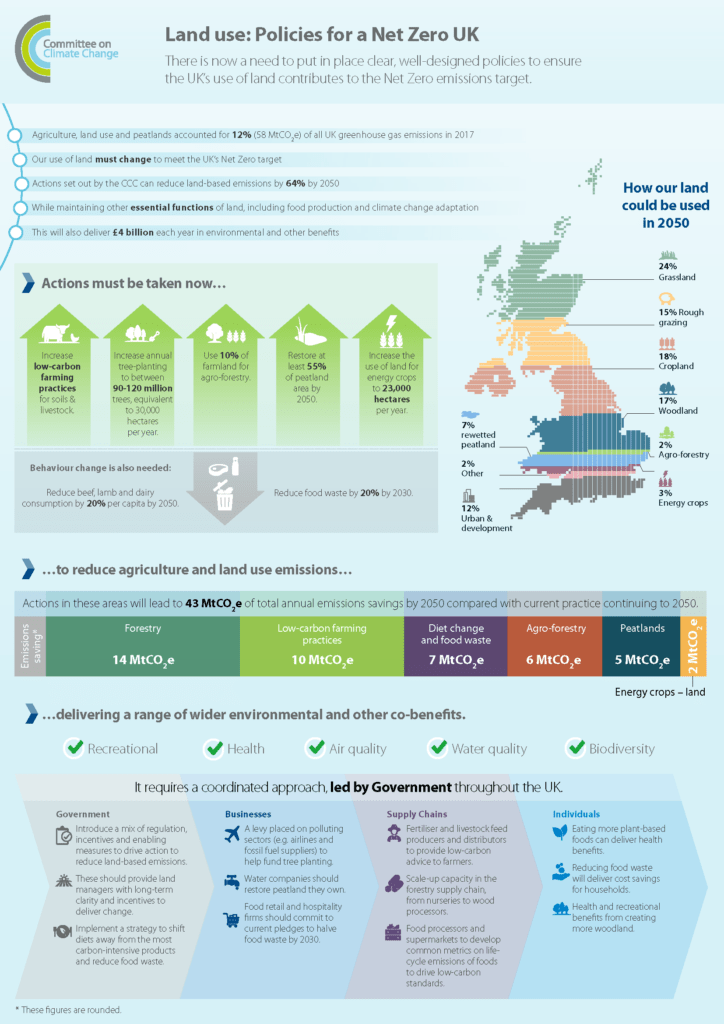
Approximately 12% (58MtCO2 as of 2020) of the UK’s greenhouse gas emissions come from farming but of that 10% more than half is methane from livestock and a further 30% is nitrous oxides from fertilisers (1). As the UK moves to a net zero economy, it is obvious that emissions from agriculture need to be reduced – the Climate Change Committee’s target is 21 MtCO2 by 2050. (Agriculture – including deliberate none cultivation of the land – offers opportunities to increase natural carbon absorption which should more than offset this remaining 21Mt of CO2).

The Climate Change Committee which draws up carbon budgets and roadmaps to advise the Government as to the means by which net zero targets can be achieved, recommended in its 2020 report Land use: Policies for a Net Zero UK, the following policy proposals:

  • Increase tree planting – increasing UK forestry cover from 13% to at least 17% by 2050 by planting around 30,000 hectares (90 – 120 million trees) of broadleaf and conifer woodland each year.
  • Encourage low-carbon farming practices – such as ‘controlled-release’ fertilisers, improving livestock health and slurry acidification.
  • Restore peatlands – restoring at least 50% of upland peat and 25% of lowland peat.
  • Encourage bioenergy crops – expanding UK energy crops to around 23,000 hectares each year.
  • Reduce food waste and consumption of the most carbon-intensive foods – reduce the 13.6 million tonnes of food waste produced annually by 20% and the consumption of beef, lamb and dairy by at least 20% per person, well within current healthy eating guidelines. (2)

In the summer of this year, 2024, the Climate Change Committee’s report on progress found that reducing emissions from agriculture and land use had slowed and that ‘total emissions from agriculture have not significantly decreased since 2008’! (3) Commenting on the Report, ADAS  notes “A key CCC recommendation is that  tree planting and peatland restoration must be accelerated. Under the CCC pathways to net zero, tree planting must be scaled up in the 2020s in order for abatement (carbon sequestration and storage) to be sufficient to meet later carbon budgets and reach net zero by 2050. This will require a doubling of current rates to get as close as possible to the targets of 30,000ha of new woodland creation per year by 2025 and 32,000ha of peatland restoration a year by 2026.” (4) As regards reducing livestock levels, whilst figures previously showed a decline, this seems to have plateaued, suggesting further focus here is needed. 

Whether through converting more arable or grass lands to woodland, restoring peatlands or by reducing livestock numbers, the farming world is going to have to face ongoing change. 

The demands of climate change, go beyond just reducing carbon emissions, and include further action in protecting land, properties and lifestyles from the impacts of increasingly adverse weather conditions and rising sea levels. Again referencing the latest CCC report ADAS notes “This latest CCC report comes after the wettest 18 months on record in England. Farmers and land managers have been among the most affected with thousands of acres of farmland flooded, crop yields down and harvesting delayed, as well as knock-on impacts into this season and likely longer-term.

“The impacts of this record rainfall highlight the urgent need to adapt to the physical risks of climate change, to avoid more costly and less effective adaptations further down the line. The CCC reports that currently the UK’s Third National Adaption programme (NAP3) lacks the ambition and pace to address the scale of climate risks we are already experiencing in the UK”. (6)

Under the terms of the Climate Change Act 2008 the UK is required to produce ‘national adaptation plans’ setting out how the government will protect the country from the impacts of climate change by   constructing flood defences, developing green spaces, cultivating drought-resistant crops, and building resilient infrastructure etc. NAP3 covers the period 2023 to 2028. To date most commentators note that the provisions made by NAP3 are inadequate, but clearly they will impact on the farming world whether through more farmland suffering the adverse consequences of droughts and floods, or through changing agricultural practices and changes to land use – eg restoring water meadows, planting more woodland and re-setting peatlands.

At the same time as the need to address climate change by transitioning to net zero, the UK also needs to address biodiversity loss which is another issue linked with the need for change in agricultural practices. As regards England (other parts of the UK have their own policies) the Parliament has noted that “the Environment Act 2021 … set legally binding biodiversity targets ….:

  • to reduce the risk of species going extinct in 2042, compared with 2022
  • to create or restore 500,000 hectares of wildlife-rich habitats by 2042
  • to ensure overall species abundance is increasing rather than decreasing by 2030, and increases by 10% by 2042, compared with 2030”(5)

These are in addition to the UK’s commitment to meet the international Convention on Biological Diversity’s ‘30 by 30 target’ – vis achieving effective conservation and management of at least 30% of land and sea by 2030.

Again these are targets which are going to impact the farming world, through adopting less intensive farming techniques, and through the restoration – and expansion of – hedgerows, ponds, woods, peatlands and meadows etc. 

Not all these changes are going to be self financing. It is possible that less intensive farming by reducing the amount – and therefore cost –  of inputs such as fertilisers, may be cost neutral, but in most cases less intensive farming will only be financially viable if the end product can be sold to,the customer at an enhanced price.  But weather restoring a pond in a field or rewetting peatland will be self financing is perhaps more doubtful. On the other hand the benefit to us as a whole will be significant – so may be we need to work out how we put a value on that benefit and how we work out who pays and how. 

It seems to me that we need a conversation that allows farmers and consumers to explore what the options are and how the transition to  climate and biodiversity friendly farming can be achieved. If farms are going to have less livestock, are we consumers going to eat less meat? If crops are grown less intensively, are we consumers willing to pay more? And is the government going to ensure that wages and benefits increase commensurately? If farmers are to convert grazing land to woodlands, are we as tax payers, willing to pay for loss of income? Might we instead see the cost as the cost of protecting our homes from flooding? Might those with the resources (financial and volunteering capacity) be willing to purchase farmland with the aim of rewilding it? Will the government provide funds to encourage new rural industries that would provide employment and maintain or reinvigorate rural communities? 

We certainly need to have these conversations urgently to ensure both a just transition and to protect our climate and environment for the wellbeing of current and future generations to come. The next five years look as if they are increasingly going to be when decisive action (not just plans) happens.

  1. https://ahdb.org.uk/knowledge-library/carbon-footprints-food-and-farming
  2. https://www.theccc.org.uk/2020/01/23/major-shift-in-uk-land-use-needed-to-deliver-net-zero-emissions/

(3) https://www.theccc.org.uk/publication/progress-in-reducing-emissions-2024-report-to-parliament/

(4)  https://adas.co.uk/news/credible-plans-and-actions-urgently-needed-to-decarbonise-uk-agriculture-sector/

(5) https://commonslibrary.parliament.uk/biodiversity-loss-uk-international-obligations/

(6) https://adas.co.uk/news/credible-plans-and-actions-urgently-needed-to-decarbonise-uk-agriculture-sector/

Counting on … day 202

29th October 2024

About 34% of all our greenhouse gas emissions are food related so looking at what we eat and making changes can be – cumulatively – a very effective way of addressing the climate crisis.(1)

80% of agricultural land is used for feeding and grazing livestock, yet produces only 17% of global calories.(2) Reducing the meat and dairy products we eat, not only reduces the emissions linked directly to the livestock, but also frees up land that could be used to grow plant based foods for humans, and frees up land that could be rewilded to boost both biodiversity and natural carbon capture. 

The Ethical Consumer’s report ‘Closing the Gap 2024’ records that this change in diet in the UK has already started, so let’s carry on and boost this trend even more!

Tips for swopping to a plant based diet – https://greentau.org/2021/10/12/eco-tips-11/

  1. https://www.nature.com/articles/s43016-021-00225-9
  2. https://ourworldindata.org/global-land-for-agriculture

Further reading https://www.unep.org/news-and-stories/story/how-tweaking-your-diet-can-help-save-planet

Green Tau: issue 96

13th October 2024

The biodiversity crisis and the Church

Globally we have been loosing vast amounts of the rich biodiversity which God gave us – both with the extinction of individual species and with the loss of numbers within species. The Natural History Museum has produced the Biodiversity Intactness Index (BII) which “measures biodiversity change using abundance data on plants, fungi and animals worldwide. The Index shows how local terrestrial biodiversity responds to human pressures such as land use change and intensification.” A BII of less than 90% is considered to be detrimental to planetary wellbeing. Sadly large amounts of the globe, including Europe, fall below this level. (1) For the UK the BIK is 53%.

The UK’s State of Nature Report 2023 noted that species studied had declined on average by 19% since 1970; that 16% of species were threatened with extinction – including 43% of birds, 31% of amphibians and reptiles, and 28% of fungi and lichen – and that 151 of the 10,008 species assessed had already become extinct since 1500.(2)

This year’s Big Butterfly Count Big Butterfly Count revealed the lowest numbers on record. (3)

Biodiversity loss in the UK – as well as globally – is real and alarming. 

Why is the of concern? 

Agricultural production is dependent on healthy soils but this relies on a multitude of organisms that live in the soil. If these become depleted in both number and diversity, the health of the soil suffers – and this is not something that can be repaired by the addition of artificial fertilisers.

Many crops are dependent on pollinators, typically insects. If these decline in number and diversity, yields decline. 

Agricultural yields can be adversely affected by flooding. Declining areas of wetlands, of peat moors, of woodlands, and of natural river courses and floodplains, increased the risk and extent of flooding.

Food security is also threatened if we become reliant on only a few commercial species. A virus or a change in climate can wipe out crops. Future losses can be avoided if scientists can access wild plants that have more resilient characteristics. But what if those wild alternatives are no longer there? 

Air quality too is affected by the decline in biodiversity. Trees in particular, but other plants too, are important natural absorbers of pollutants both in the air and in the water. 

The lack of anyone species can cause a cascading affect where other dependent species also decline. Declining numbers of insects lead to declining numbers of species of birds and bats. Biodiversity decline can accelerate at speed.

Biodiversity loss affects us as spiritual beings. Our lives are diminished as biodiversity is diminished. I have never heard a nightingale sing – that is a loss. I am lucky that as a child I did hear cuckoos, and even now as an adult, I do hear sky larks because they are still resident in Richmond Park. If I did not have green spaces to walk in, my mental health would suffer. 

God too suffers from the loss of biodiversity. By their very nature, the flora and fauna of this world praises God in an endless wordless song. As they decline, so does this profound worship. 

The nations of the world have been rightly concerned at the rapid loss of biodiversity globally and the impact that was – and increasingly would have – on human life and wellbeing. In 2022 the United Nations Biodiversity Conference (COP15) agreed the Kunming-Montreal Global Biodiversity Framework (GBF). This set out to halt and reverse nature loss, including putting 30 per cent of the planet and 30 per cent of degraded ecosystems under protection by 2030. This is often summarised as the 30:30 target.  (4) 

The UK government was party to this UN Conference and undertook the commitment to achieving this 30:30 target. However it is a tough target and progress to date has been slow and patchy. 

Earlier this year  Restore Nature Now organised a march in London in which between 60,000 and 100,000 people took part, representing  a wide range for groups including the RSPB, the National Trust, the Wildlife Trusts, the Climate Coalition, WWF-UK, the WWT, the Woodland Trust, the Wildlife and Countryside Link, Rewilding Britain, Extinction Rebellion and Christian Climate Action. 

Their demand was for more and greater action by the government. (5)

Last weekend another march took place organised by the group, Wild Card. A scroll was unrolled before the vast edifice of St Paul’s Cathedral, revealing 95 theses as to why as Christians and therefore as a Church, we should care about biodiversity and the well-being of the natural world. Just as Martin Luther’s 95 theses were put forward to stimulate theological debate, so too are these theses. (6) 

Hymns were sung and speeches given, highlighting the plight of biodiversity and calling on the Church to show leadership in addressing the crisis. In particular the call was made that the Church Commissioners, as stewards of extensive land holdings (105,000 hectares) , should undertake to rewild 30% by 2030. (7)

Wild Card defines rewilding thus: “To rewild the land and water is to allow untamed life to return to ecosystems and landscapes, such that they are once again sustained by the natural processes that created them in the first place. In restoring these processes, humans are often intimately involved. Be it from rewetting bogs to reintroducing missing species, humans are very much invited to the rewilding party.” (8) Rewilding goes beyond goes simply protecting the biodiversity we still have and seeks to restore the biodiversity of our environment back towards 90% BII needed for a sustainable future. 

Of course rewilding church land will have a profound effect on what we harvest – less meat and milk, more diverse horticultural and sylvocultural products; less cereal crops for animal feed, more meadows, fenlands and heaths; less livestock, more wild birds and animals; less mono-species plantations, more mixed broadleaf woodlands; less factory farming, more blue and green spaces for spiritual and mental re-creation, and more green jobs. There will be tough decisions to make and we all need to be part of the discussion: what changes in the lifestyles we live are we prepared to make. As Christians we are called throughout our life time to repent and believe, we are called embrace ‘metanoia’ – to see things differently, to change direction, to transform our relationships.

(1) https://www.nhm.ac.uk/our-science/services/data/biodiversity-intactness-index.html

(2) https://stateofnature.org.uk/

(3) https://butterfly-conservation.org/news-and-blog/uk-butterfly-emergency-declared

(4) https://www.cbd.int/gbf

(5) https://www.restorenaturenow.com/aims

(6) https://wildcard.land/campaigns/rewild-the-church/95-wild-theses

(7) https://wildcard.land/campaigns/rewild-the-church

(8) https://wildcard.land/about/about-wildcard

Counting on…. Day 1.157

23rd August 2023

If we need to slow down agricultural expansion, do we know what caused its expansion?  There is I’m sure no one answer but a multiplicity of interconnecting reasons. 

  • Population growth. Globally we now need to feed over 8 billion people, up from 6 billion in 1999, and 3 billion in 1960. Yet researchers tell us that we could feed 10 billion people without exceeding the planet’s environmental boundaries  (https://www.nature.com/articles/s41893-019-0465-1)
  • Income growth – as people become richer they choose to eat more expensive foods which are often  more resource expensive too – eg imported tropical fruits, sugar based foods, and especially meat
  • Developments in agriculture that allow more intensive production such as pig breeds that can reach a slaughter weight in 4 months; high protein feed made from soy beans that rapidly fatten chickens; high yielding grains that combine with fertilisers and pesticides to increase harvests. 
  • Financial rewards that encourage rain forests to be cleared to make way for sugar plantations, soy crops and cattle ranching. 
  • Irrigation and airfreight that allow crops such as asparagus, avocados and blueberries to be grown in the southern hemisphere and imported as out of season alternatives for the northern hemisphere. 
  • Social changes that have made chicken a staple rather than a special treat, that have reduced the popularity of foods – in the UK – such as cabbage and runner beans, replacing them with courgettes and peppers. 
  • Social changes that mean less food is home produced, that less food is preserved at home (eg jam/ chutney/ sauerkraut),  that less food is home grown.
  • Increasing quantities of food going to waste – caused by social changes and increasingly long supply chains.

Counting on …. Day 1.152

18th August 2023

In the high alpine meadows of Switzerland there is a rich biodiversity of flowering plants and insects (various bees, flies, grasshoppers, ants) spiders, butterflies and moths – far more than I have seen in the UK. Is this richness a result of the alpine dairy farming? Quite probably so. Without the cows, the vegetation is tends to shrub and forest, which though totally natural is less biodiverse rich. Away from the steep slope, dairy farming is more intense and doesn’t support the same richness of plant and insect life. Even on the alpine slopes, repeated cutting of grass for silage reduces the biodiversity.  

Our human presence can have a positive effect on the natural environment.