Counting on … 183

10th November 2025

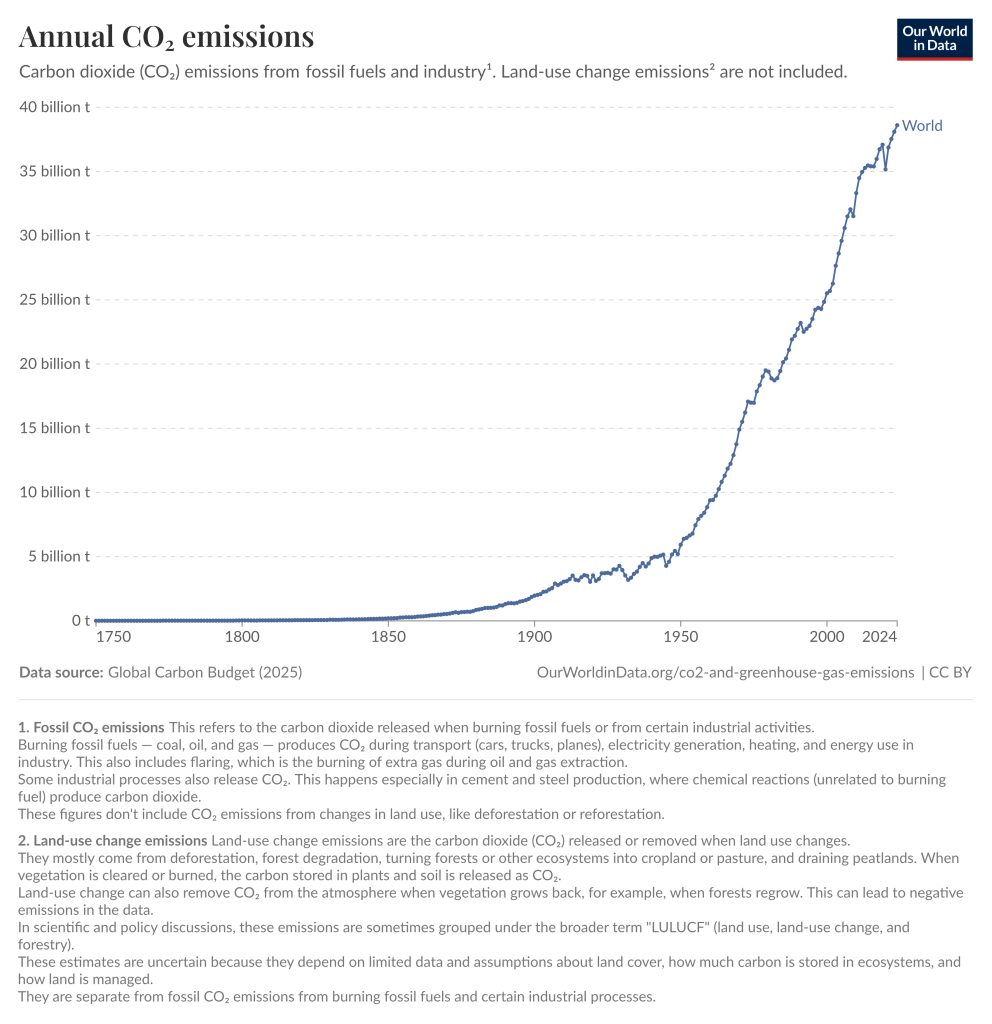
COP30 starts this week in Belém, Brazil. Global greenhouse gas emissions are continuing to rise as are global temperatures. The real hope is the all the parties will agree to transition rapidly away from fossil fuels – fossil fuels are the single biggest cause of greenhouse gas emissions. Unless they are eliminated, there is no way we can curb, let alone rein in, rising global temperatures and all that that will do to destroy the ecosystems in which we rely.

The main greenhouse gas, and one most easily measured, is carbon dioxide. Carbon dioxide in the atmosphere keeps in heat. Without some CO2 in the atmosphere our planet would be very cold. 

CO2 levels in the atmosphere (measured in parts per million) have varied throughout geological time. This graph (1)  shows atmospheric carbon dioxide concentrations in the atmosphere over the last 800,000 years (red line). CO2 levels were lower during the ice ages, and higher during the warmer interglacial periods. During this entire era, CI2 levels never exceeded 300 PPM until the modern era. The graphic also shows the differences  global temperatures above and below the mean – the temperature anomaly.

There is a clear correlation between CO2 levels and temperature fluctuations. But more significantly the graph shows how rapidly both CO2 levels and temperatures are rising. It is a rate of change that is not due to natural deviations but to the impact of human activity. 

 (1) – https://theconversation.com/the-three-minute-story-of-800-000-years-of-climate-change-with-a-sting-in-the-tail-73368

Counting on day 211

11th November 2024

Over the next two weeks we hope that we can count on the world leaders agree and enact radical policies that will curb the inexorable rise of the climate crisis. At last year’s COP28 they agreed to transition away from fossil fuels in what was a very woolly agreement. This year, with conviction, they need to agree to not just phase out but end our use of fossil fuels. 

Fossil fuels are the biggest source of CO2 emissions which drive climate change. Currently carbon dioxide levels in the  atmosphere are at 423.58 ppm (parts per million) – and rising. This is way above the safe level of 350ppm which was passed in 1990. 

See also for more stats – https://www.theguardian.com/environment/2024/oct/28/planet-heating-pollutants-in-atmosphere-hit-record-levels-in-2023?CMP=Share_iOSApp_Other

Counting on … day 122

10th July 2024

In less than a month the world’s population will have used up a year’s worth of renewable resources. Earth Overshoot Day – this year 1st August – is the day when our consumption of resources exceeds the rate at which the earth can regenerate those resources for future consumption.  

Natural resources regenerate over time. For example annual plants such as wheat, poppies, beans lettuces produce seeds each year which can sprout and produce a fresh crop. Some do this on an annual cycle, whilst others, such as rice, may reproduce several crops per year – depending on climatic conditions. Other plants have a much longer regenerative time frame. An oak for example may take 150 years to be of an age to produce acorns. 

The same is true for fauna. Some species such as fruit flies  will produce the next generation within a matter of days, where as for an elephant, the time scale is closer to twenty years.

Other regenerative resources include water, nitrogen and carbon. The life cycle of these varies according to climatic, topographical, and other factors. In tropical rain forests water can go through a daily cycle of rainfall, evaporation, condensation and once again, rainfall. In the artic regions rainfall is usually infrequent with much of the water then being locked away as ice sheets and glaciers. 

Air, soil and water have regenerative features in terms of absorbing and ‘cleaning’ pollutants. One of the major causes of the current climate breakdown is our human action in pumping more carbon dioxide into the atmosphere than can safely be absorbed. The safe level of carbon dioxide in the atmosphere is around 280 part per million. In March 2024 CO2 levels were at 425 ppm and still rising.

Counting on … day 87

16th April 2024

Green cement – part 2

As part of the need to reduce all greenhouse gas emissions to address the climate crisis, reducing emissions from cement production is essential. 

50% of the emissions come from the release of carbon dioxide as a byproduct during the clinker making process. One solution is carbon capture- capturing the CO2 before it escapes into the atmosphere, pressurising it to a liquid which is injected into rock strata deep underground.  This technology has yet to be developed for use at an industrial scale. 

Another solution is to replace the limestone with an alternative that produces less CO2 – such as magnesium oxide mixed with magnesium chloride solution. However such alternative cements may not have all the attributes of cement when in use – different construction methods may be needed.

40% of the emissions are attributable to the energy needed to heat the clinker kilns. Switching to renewable energy to replace coal is one solution but requires considerable investment in green electricity production and distribution. 

Using materials other than limestone – such as volcanic rock – that can produce clinker at lower temperatures is another possible solution. Another alternative is to replace a proportion of the cement with an alternative binder such as ground granulated blast furnace slag or pulverised fly ash. Again this may alter the properties of the cement and require different construction methods.

10% of the emissions comes from energy used in mining and transporting the raw materials. Energy efficiency and the use of renewable energy will be a way forward.

Further reading –https://theconversation.com/green-cement-a-step-closer-to-being-a-game-changer-for-construction-emissions-126033

(https://theconstructor.org/concrete/green-cement-types-applications/5568/

Counting on … day 86

15th April 2024

Green cement? Part 1

Cement is made by heating limestone and clay together at very high temperatures. The clay and limestone is converted to a dried out material called clinker, whilst at the same time releasing large amounts of carbon dioxide. The clinker when ground to a powder is what we know as cement. 

The production of cement has a very high carbon footprint arising from a) the energy needed to roast the clay and limestone which invariably comes from fossil fuels, and b) the carbon dioxide released during manufacture. Each tonne of cement produces up to 622kg carbon dioxide. 

Cement is widely used in large quantities across the globe in the construction of buildings, roads, drains and various other types of infrastructure. CO2 emissions from cement account for 7% of all global emissions – 1605 tonnes per year. Here in the UK cement produces about 4b tonnes CO2.

https://www.bbc.co.uk/news/science-environment-46455844

Counting on … day 71

21st March 2024

The carbon cycle 

The earth’s systems have various ways of absorbing and using carbon dioxide in such a way as to enable life to flourish. Plants absorb carbon dioxide as part of the process of photosynthesis storing the carbon as cellular material  in their leaves, branches etc. Plants release carbon dioxide back into the atmosphere as they respire – breathe. A living growing plant absorbs more carbon dioxide than it releases. When the plant dies, the carbon that has been stored as leaves and branches etc slowly decays – breaks down – and the carbon returns to the atmosphere as carbon dioxide. This is as true of water and marine plants as it is true of land plants. 

 (For a short video describing how trees absorb and use  carbon – https://www.woodlandtrust.org.uk/climate-change/carbon-trees/)

Soil in part is made up of dead plant and animal material which decays slowly overtime. Soil is therefore a storer of carbon.

The seas and oceans also contain carbon dioxide that is dissolved in the water. This carbon dioxide cycles through the water as marine plants take in, store and release the carbon as they grow. Marine waters  and the layers of sediment at the bottom of the seas and oceans store carbon in the same way as does soil. 

This brings us back to an earlier post about how much carbon dioxide there is in the atmosphere (measured in part per million) and the rate at which that concentration is increasing due to human activities – https://greentau.org/2024/02/19/counting-on-day/

Counting on … day 52

23rd February 2024

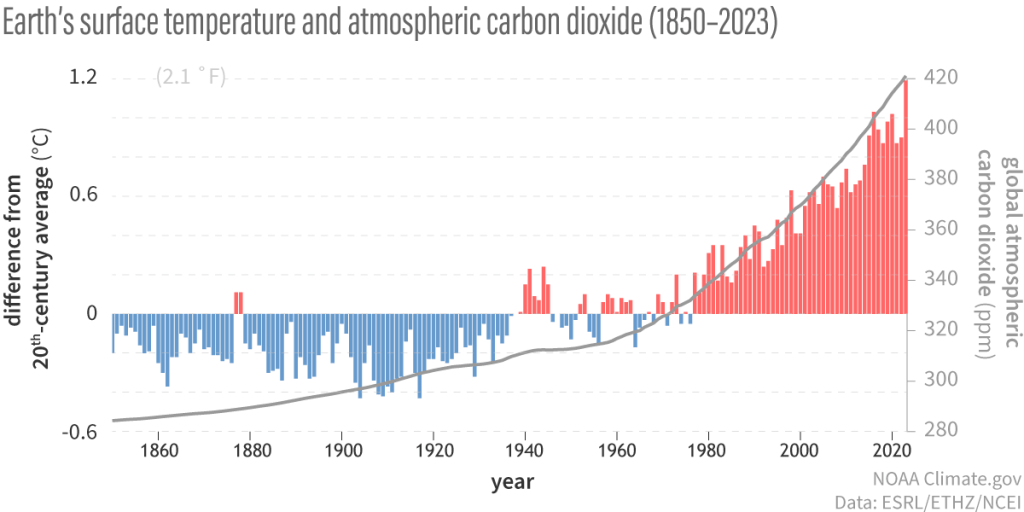
Keeping the temperature rise – global warming – within 1.5C necessitates constraining the carbon dioxide (and other greenhouse gas) emissions we release into the atmosphere. The diagram below shows the correlation between global temperatures and carbon dioxide concentrations in the atmosphere. 

Keeping global warming within this window involves both reducing the amount of greenhouse gases we emit and enhancing processes that absorb such gas emissions. An example of the first would be reducing – or even cutting out entirely – the burning of fossil fuels; an example of the second would be reinstating woodlands and wetlands. 

Counting on … day 

19th February 2024

Carbon dioxide – parts per million

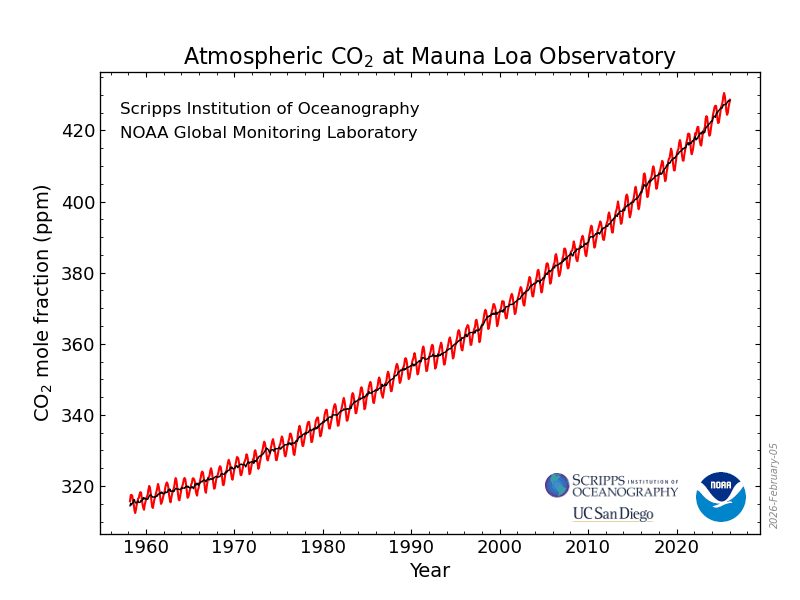
The concentration of carbon dioxide is measured as so many ‘parts per million’. Measurements of carbon dioxide are made at the Mauna Loa Observatory, Hawaii (NOAA). Recordings there first began in 1958. 

Pre industrial levels of CO2 were fairly constant (for at least 6000 years) at around 240ppm. However since the Industrial Revolution this has been rising. Between 1750 and 1800 the average CO2 levels was 278ppm and it is from this baseline that the IPCC has been measuring increases. It has been suggested that between 280 and 350ppm represents a safe level. However we have past 350ppm in 1987. In 2018 scientific models suggested carbon dioxide levels of 425-785 ppm would lead to 1.5 °C temperature rise, and and 489-1106 ppm for 2 °C.

As of January 2024 the level of carbon dioxide had risen to 423ppm. In 2023 global temperatures were 1.5 °C higher than the pre-industrial average – but this in part was due to the El Niño effect, so in terms of human-made heating, the rise for 2023 is calculated at 1.3°C of warming. 

The red lines and symbols represent the monthly mean values, centered on the middle of each month. The black lines and symbols represent the same, after correction for the average seasonal cycle. The latter is determined as a moving average of SEVEN adjacent seasonal cycles centered on the month to be corrected, except for the first and last THREE and one-half years of the record, where the seasonal cycle has been averaged over the first and last SEVEN years, respectively.