Laudate Si: discussion notes 2

Chapter 3 of Laudate Si is titled “The Human Roots of the Ecological Crisis”. If we focus initially on the climate crisis, this is being caused by an ongoing increase in the amount of carbon dioxide in the atmosphere. 

1. Looking at the diagram below, what do you think has been and/or is the cause of this rise on CO2? 

Prior to the industrial revolution, the energy to power machinery or equipment came from wind or water, human or animal power – oxen pulled ploughs and carts; wind or water ground flour and other such necessities; horses or ‘shanks’s pony’ moved people and messages; pedal power worked lathes and spindles; hand power cut timber, wove cloth or created portraits. Wood provided fuel for heat and cooking. When wood is burnt, it releases carbon dioxide in proportion to the amount of carbon that has been formed in the tree as it grew. Over a relatively short time scale the absorption of carbon dioxide by the tree and its release through burning, are evened out. This is not the case with the burning of fossil fuels.

Coal, oil  and gas are all forms of carbon that were living on earth millions of years ago as plants and animals. When they died and decayed the carbon content of those living beings was compressed in layers below the surface of the soil or the surface of the oceans. There it became deposits of coal, oil and gas: concentrations of carbon locked away. When these fossil fuels are burnt, the carbon dioxide absorbed into the earth over thousands of years, is realised rapidly within a whole different time frame.

2. The Industrial Revolution began with the use of coal to create steam to power machines in factories, in mines and on railway tracks. Continuing improvement and refinement gave rise to a proliferation of products that could be consumed, of labour-saving devises, of large scale farming, improvements in health, faster and cheaper communications …

As well as creating all this, did the industrial Revolution also create new markets? Did the industrialists need to stimulate demand for the products that they could manufacture with increasing speed and in increasing quantity? Who knew that they needed fish knives until they were marketed to the up and coming middle classes?

Can we say with any certainty that the Industrial Revolution was either good or bad? Might we vary our judgement if we were to consider who has benefited and who has lost out?

3. Over time, steam engines became more efficient and were the in their time replaced by petrol and Diesel engines, and electric motors. Continuing improvement in both purpose and efficiency are still ongoing. Telephones that replaced the telegraph, have now been replaced by the mobile phone – initially the size of a large brick, they now slip into a back pocket and yet have the capacity to make and show films, to interrogate the internet, send messages, programme home heating programmes, monitor hearts rates and so on. 

Why might it be that despite all these improvements in design and efficiency, our demand for energy is still increasing? And that despite the increase in nuclear and renewable energy, our use of fossil fuels and the consequent production of polluting CO2 does not seem to abate?

5. What causing us to consume more and more? Because it is more efficient, is it better? Because it advances technology, is it better?  Because it makes a bigger profit, is it better? Who actually gains?

Have we become trapped in a viscous circle?

Pope Francis begins by quoting from Benedict XVI “… we have “a sort of ‘super-development’ of a wasteful and consumerist kind which forms an unacceptable  contrast with the ongoing situations of dehumanising deprivation” and goes in to write “ while we are all too slow in developing We fail to see the deepest roots of our present failures, which have to do with direction, goals, meaning and social implications of technological and economic growth.” (Laudate Si section 119) He then goes on to write (section 111) “Ecological culture cannot be reduced to a series of urgent and partial response to the immediate problems of pollution, environmental decay and the depletion of natural resources. There needs to be a distinctive way of looking at things, a way of thinking, policies, an educational programme, a lifestyle and a spirituality which together generate resistance to the assault of the technocrat paradigm. Otherwise, even the best ecological initiatives can find themselves caught up in the same globalised logic. To seek only a technical remedy to each environmental problem which comes up is to separate what in reality is interconnected and to mask the true and deepest problems of the global system.”

What might this ‘distinctive way’ look like? Here are some suggestions picked out from sections 112 – 122.

i. Be non consumerist, cooperative 

ii. Enable people to live with more dignity and less suffering

iii. Recover a sense of meaning and depth to life, encouraging wonder about the purpose and meaning of life

iv. Offer the possibility of a happy future

v. Be a cultural revolution 

vi. Recognise the intrinsic dignity and beauty of the world 

vii. Understand humanity’s true in the world and have a humble awareness of our limits, 

viii. Acknowledge the worth of our fellow humans and not to take advantage of them

ix. Accept our responsibility to care for  creation  – our particular gifts give us an equally particular responsibility

x. Acknowledge the connection between our relationship with God and our relationship with nature

6. How might these suggestions change the way we look at the world. How might they change the way we do things?

7.  Can the Christian faith offer this “distinctive way”?

Who could propose and promote it? And how? 

8. Who would listen? Would it ‘reach the ears’ of governments, businesses (their board and shareholders), banks and investors, social commentators? And if not, why not?

Below is a sustainability diagram which may be of interest.

A prayer for our earth

All powerful God,

you are present in the universe

and in the smallest of your creatures.

You embrace with your tenderness all that exists. Pour out upon us the power of your love,

that we may protect life and beauty.

Fill us with your peace, that we may live

as brothers and sisters, harming no one.

O God of the poor,

help us to rescue the abandoned

and forgotten of this earth,

so precious in your eyes.

Bring healing to our lives,

that we may protect the world and not prey on it, that we may sow beauty,

not pollution and destruction.

Touch the hearts

of those who look only for gain

at the expense of the poor and the earth.

Teach us to discover the worth of each thing,

to be filled with awe and contemplation,

to recognise that we are profoundly united

with every creature

as we journey towards your infinite light.

We thank you for being with us each day. Encourage us, we pray, in our struggle,

for justice, love and peace.

Amen.

‘A prayer for our earth’ was published in Pope Francis’ encyclical, Laudato Si’. It is for all who believe in God who is the all-powerful Creator.

Proper 16

21st August 2022

(The readings follow on after the reflection)

Reflection 

Both the psalm and the passage from Jeremiah concur: God is our creator, the source of being and of our ongoing existence from the beginning. Throughout life God is present and is our sustainer, our rock and stronghold, our hope – and the one who calls us to act. The writer of Hebrews describes the otherness of God – but this is not an otherness that is fearsome and terrifying. Rather it is an otherness reflected in joyful festivities and community and new beginnings and the saving grace of Jesus. Ours is a God who offers hope and salvation!

The passage from Hebrews presents us with a God who can and will transform the world. And in the gospel, we see Jesus doing just that. He transform the life of the woman with a deformed back (and presumably changes too the life of her family) and he transforms the local people’s understanding of God’s law, showing them a different way of interpreting the law and understanding the nature of the world God has in mind.

From our first reading comes the word of the Lord saying “ pluck up and to pull down, destroy and  overthrow, build and plant”. And that is what Jesus does in the gospel reading. He ‘plucks up and pulls down’ the traditional understanding of the law and ‘builds and plants’ something new and life enhancing in its place. Jeremiah, to whom the Lord had been speaking, was given the  hard task of taking that message to the people of Judah. Jeremiah knew that the people had strayed away from correctly understanding and living according to God’s word. He knew that if they continued this way of living that they would be overrun by one of the competing superpowers that then ruled the world. Jeremiah was nevertheless convinced that whatever evil befell God’s people, there would be a time of renewal and restoration – of ‘building and planting’ according to God’s will. 

Sadly Jeremiah did not see this renewal in his own life time,  but he believed that it would happen. Later in the book, it tells how Jeremiah bought some land in Jerusalem – even though the city was about to be overrun by the invading force of the Assyrian army – to show his confidence that there would be a future for God’s people in that city. Jeremiah showed the kind of faith we heard of a few weeks ago in the Letter to the Hebrews – ‘faith [that] is the assurance of things hoped for, the conviction of things not seen’.

 Our hope is that the world will withstand the worst ravages of the climate crisis, and be restored –  be re-built and planted – as intended by God. To demonstrate our faith in this is to actively live as if that future were happening now. We are called to,show how the world could, and can, be transformed. The way we live should be an example of sustainable living. The way we live should demonstrate care for creation, care for wildlife and live stock (including the welfare of donkeys and oxen), and care for our fellow humans especially those whose lives are stunted by the complaints – the ills – of our current age. Those affected by drought and wildfires, by floods and the denuding of the soil. Those affected by disease and war. Those affected by poverty and discrimination. Those affected by rising sea levels and receding rivers.

That is what groups such as Christian Climate Action and Christian Aid are campaigning for. It is what groups like Toilet Twinning and Practical Action are working for on the ground. It is what A Rocha does in enabling Christians to be environmentally aware.
This is what we as Christian communities – churches – can be embracing and supporting. We need to show the confidence that Jesus showed in healing the woman – doing what is right, regardless of what others may be saying, regardless of convention says, because doing what is right is what God wants. We need to show confidence in demonstrating how the world God gave us can be healed.

Jeremiah 1:4-10

The word of the Lord came to me saying,

“Before I formed you in the womb I knew you,
and before you were born I consecrated you;
I appointed you a prophet to the nations.”

Then I said, “Ah, Lord God! Truly I do not know how to speak, for I am only a boy.” But the Lord said to me,

“Do not say, ‘I am only a boy’;
for you shall go to all to whom I send you,
and you shall speak whatever I command you,
Do not be afraid of them,
for I am with you to deliver you,

says the Lord.”

Then the Lord put out his hand and touched my mouth; and the Lord said to me,

“Now I have put my words in your mouth.
See, today I appoint you over nations and over kingdoms,
to pluck up and to pull down,
to destroy and to overthrow,
to build and to plant.”

Psalm 71:1-6

1 In you, O Lord, have I taken refuge; *
let me never be ashamed.

2 In your righteousness, deliver me and set me free; *
incline your ear to me and save me.

3 Be my strong rock, a castle to keep me safe; *
you are my crag and my stronghold.

4 Deliver me, my God, from the hand of the wicked, *
from the clutches of the evildoer and the oppressor.

5 For you are my hope, O Lord God, *
my confidence since I was young.

6 I have been sustained by you ever since I was born;
from my mother’s womb you have been my strength; *
my praise shall be always of you.

Hebrews 12:18-29

You have not come to something that can be touched, a blazing fire, and darkness, and gloom, and a tempest, and the sound of a trumpet, and a voice whose words made the hearers beg that not another word be spoken to them. (For they could not endure the order that was given, “If even an animal touches the mountain, it shall be stoned to death.” Indeed, so terrifying was the sight that Moses said, “I tremble with fear.”) But you have come to Mount Zion and to the city of the living God, the heavenly Jerusalem, and to innumerable angels in festal gathering, and to the assembly of the firstborn who are enrolled in heaven, and to God the judge of all, and to the spirits of the righteous made perfect, and to Jesus, the mediator of a new covenant, and to the sprinkled blood that speaks a better word than the blood of Abel.

See that you do not refuse the one who is speaking; for if they did not escape when they refused the one who warned them on earth, how much less will we escape if we reject the one who warns from heaven! At that time his voice shook the earth; but now he has promised, “Yet once more I will shake not only the earth but also the heaven.” This phrase, “Yet once more,” indicates the removal of what is shaken– that is, created things– so that what cannot be shaken may remain. Therefore, since we are receiving a kingdom that cannot be shaken, let us give thanks, by which we offer to God an acceptable worship with reverence and awe; for indeed our God is a consuming fire.

Luke 13:10-17

Now Jesus was teaching in one of the synagogues on the sabbath. And just then there appeared a woman with a spirit that had crippled her for eighteen years. She was bent over and was quite unable to stand up straight. When Jesus saw her, he called her over and said, “Woman, you are set free from your ailment.” When he laid his hands on her, immediately she stood up straight and began praising God. But the leader of the synagogue, indignant because Jesus had cured on the sabbath, kept saying to the crowd, “There are six days on which work ought to be done; come on those days and be cured, and not on the sabbath day.” But the Lord answered him and said, “You hypocrites! Does not each of you on the sabbath untie his ox or his donkey from the manger, and lead it away to give it water? And ought not this woman, a daughter of Abraham whom Satan bound for eighteen long years, be set free from this bondage on the sabbath day?” When he said this, all his opponents were put to shame; and the entire crowd was rejoicing at all the wonderful things that he was doing.

 Counting on …day280

17th August 2022

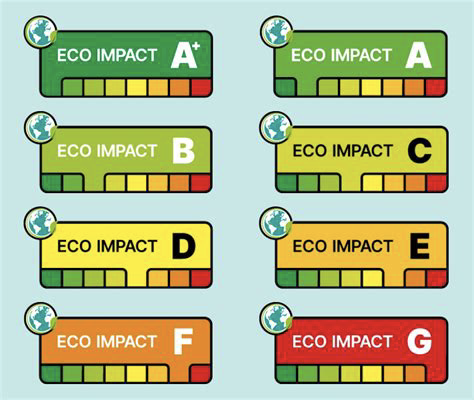
Some food items – such as sandwiches in cafés or packets of lentils in supermarkets – are now carrying a label indicating their sustainability. The labelling system reflects the product’s carbon footprint, water usage, water pollution and impact on biodiversity. 

One by Foundation Earth ( https://www.foundation-earth.org/ ) scores products between A (most sustainable) coloured green and G (worst) coloured orange. Another is organised by Oxford University – https://www.theguardian.com/environment/2021/sep/22/green-food-eco-labels-study-environmental-cost-consumers?CMP=Share_iOSApp_Other

The aim is to enable customers to make more informed choices.

Counting on …. day 279

16th August 2022

In response to COP26 the five leading supermarkets – Tesco, Sainsbury’s, Waitrose, Co-op and M&S – said they would reduce carbon emissions, deforestation and the food waste and packaging they produce.The chief executives of the supermarkets, which together serve more than half of UK food shoppers, said in a joint statement: “We recognise that a future without nature is a future without food. By 2030 we need to halt the loss of nature.” Before the end of next year(2022), they also promised to set science-based targets for how they would help to limit global warming to 1.5C above pre-industrial temperatures. https://www.bbc.co.uk/news/uk-59184278

Write to your local supermarket and ask if they are in track to meet climate change prevention targets.

Proper 15

14th August 2022 (the readings follow after the reflection)

Reflection

This passage from Isaiah reminds us that parables are not just to be found in the New Testament. The image of Israel as a vine planted and tended by God appears in both the passage from Isaiah and in the Psalm. Both passages tell very much the same story. Despite the thorough and expert ministrations of God, the vine fails to deliver its goods and is therefore allowed to fall prey to those destructive forces that seem ever present. Its protective surrounds are dismantled, its territory invaded. The vine is consumed and trampled upon. The psalm talks of wild boar being the protagonists; Isaiah is less specific but wild beasts come to mind and later in the same chapter the alien forces invading Israel are likened to roaring lions. The cost of not responding positively to God’s loving care and attention is extreme. 

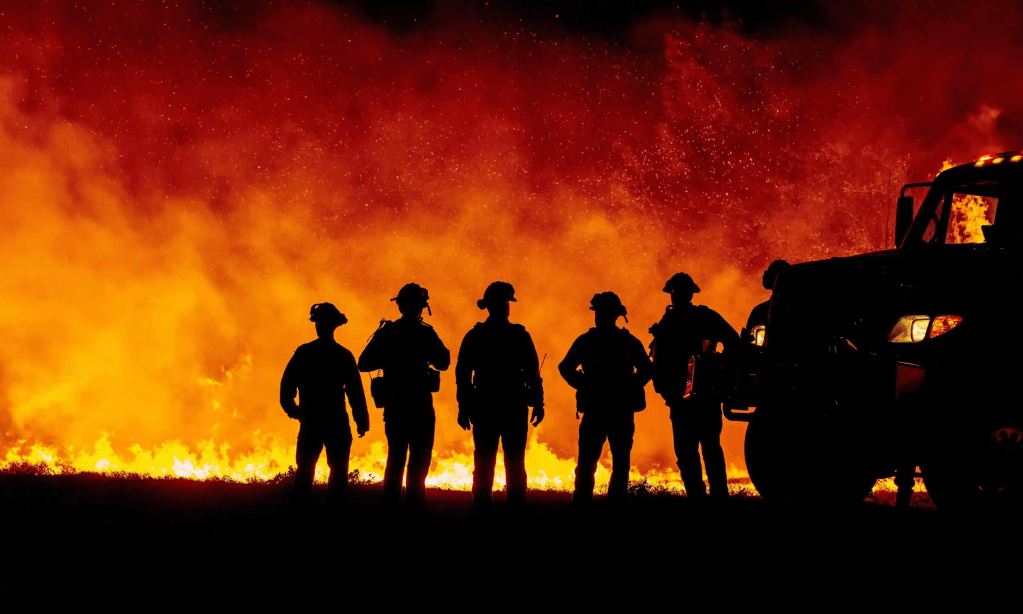
Do we sense that that is our predicament when we look at the disasters that surround us? Heatwaves, droughts and wild fires; floods and storms; rapidly diminishing biodiversity; poverty and starvation; war and conflicts and threats of  war? 

In his opening speech at the Lambeth Conference, Justin Welby spoke of the ‘roaring lions’ that best our world. The reference comes from the Letter of Peter which warns its readers to be aware of the devil that prowls around like a roaring lion. One of the loudest of the roaring lions is, says Welby, climate change – the climate crisis that is causing such devastation and anguish world wide – and closely followed by the lion of inequality. We might echo the Psalmist in saying ‘Restore us, O Lord God of hosts; show the light of your countenance, and we shall be saved.’

The writer of Hebrews reminds us of the importance of faith. Faith that can close the mouths of lions. Faith that can with stand mockery and torture, persecution and destitution, imprisonment and death. The writer ends with the stark reminder that faith doesn’t mean that in this life everything will turn out rosey. Often faith is tested to the hilt because it persists even when there is no hope of salvation any time soon.  Our only hope is faith in Jesus Christ. 

The words of Jesus from today’s gospel are equally blunt. Jesus has not come to white wash over the cracks in society, to call lions cats, or in anyway downplay the evil which we have created. Rather Jesus has come to transform the world. He has, to use Welby’s words, come to kill the roaring lions. To remove the causes of conflict and suffering.

It is not, I believe, that Jesus wills division and conflict, but rather that He knows the state of the world, the prejudices and proclivities of those of us how should know better and of those who have been trapped in a system that gives them very little choice. What I think does anger Jesus is that we can see the signs of impending disaster and suffering all around us and yet do nothing. We ignore the signs that tell us that we cannot keep on drilling for oil and burning it. That we cannot keep on taking from the soil and do nothing to restore its fertility. That we cannot stand back as all around  plants and animals, birds and insects decline in numbers to the point of extinction. That we cannot allow a few to take and take building up wealth and riches, whilst the many struggle to feed themselves. That we cannot allow businesses to invest in products that destroy our environment rather than in those that would enhance life for all. That we cannot stand back whilst big pharmaceutical companies profit from selling vaccines to the rich whilst the poor go away empty handed. That we cannot stand back whilst media moguls control what we hear whilst burying the truth.

Welby began his address by saying that he hoped everyone would leave the Conference with their  “heart full of desire for friendship with Jesus Christ. For to desire Jesus is to desire God. To desire Jesus is to desire to be filled with love for God and, by God, love for His people and love for His word.”

Time and again, this is where we must return: to the overwhelming love that God has for us and the power that love has to change the world.

Isaiah 5:1-7

Let me sing for my beloved
my love-song concerning his vineyard:

My beloved had a vineyard
on a very fertile hill.

He dug it and cleared it of stones,
and planted it with choice vines;

he built a watchtower in the midst of it,
and hewed out a wine vat in it;

he expected it to yield grapes,
but it yielded wild grapes.

And now, inhabitants of Jerusalem
and people of Judah,

judge between me
and my vineyard.

What more was there to do for my vineyard
that I have not done in it?

When I expected it to yield grapes,
why did it yield wild grapes?

And now I will tell you
what I will do to my vineyard.

I will remove its hedge,
and it shall be devoured;

I will break down its wall,
and it shall be trampled down.

I will make it a waste;
it shall not be pruned or hoed,
and it shall be overgrown with briers and thorns;

I will also command the clouds
that they rain no rain upon it.

For the vineyard of the Lord of hosts
is the house of Israel,

and the people of Judah
are his pleasant planting;

he expected justice,
but saw bloodshed;

righteousness,
but heard a cry!

Psalm 80:1-2, 8-18

1 Hear, O Shepherd of Israel, leading Joseph like a flock; *
shine forth, you that are enthroned upon the cherubim.

2 In the presence of Ephraim, Benjamin, and Manasseh, *
stir up your strength and come to help us.

8 You have brought a vine out of Egypt; *
you cast out the nations and planted it.

9 You prepared the ground for it; *
it took root and filled the land.

10 The mountains were covered by its shadow *
and the towering cedar trees by its boughs.

11 You stretched out its tendrils to the Sea *
and its branches to the River.

12 Why have you broken down its wall, *
so that all who pass by pluck off its grapes?

13 The wild boar of the forest has ravaged it, *
and the beasts of the field have grazed upon it.

14 Turn now, O God of hosts, look down from heaven;
behold and tend this vine; *
preserve what your right hand has planted.

15 They burn it with fire like rubbish; *
at the rebuke of your countenance let them perish.

16 Let your hand be upon the man of your right hand, *
the son of man you have made so strong for yourself.

17 And so will we never turn away from you; *
give us life, that we may call upon your Name.

18 Restore us, O Lord God of hosts; *
show the light of your countenance, and we shall be saved.

Hebrews 11:29-12:2

By faith the people passed through the Red Sea as if it were dry land, but when the Egyptians attempted to do so they were drowned. By faith the walls of Jericho fell after they had been encircled for seven days. By faith Rahab the prostitute did not perish with those who were disobedient, because she had received the spies in peace.

And what more should I say? For time would fail me to tell of Gideon, Barak, Samson, Jephthah, of David and Samuel and the prophets– who through faith conquered kingdoms, administered justice, obtained promises, shut the mouths of lions, quenched raging fire, escaped the edge of the sword, won strength out of weakness, became mighty in war, put foreign armies to flight. Women received their dead by resurrection. Others were tortured, refusing to accept release, in order to obtain a better resurrection. Others suffered mocking and flogging, and even chains and imprisonment. They were stoned to death, they were sawn in two, they were killed by the sword; they went about in skins of sheep and goats, destitute, persecuted, tormented– of whom the world was not worthy. They wandered in deserts and mountains, and in caves and holes in the ground.

Yet all these, though they were commended for their faith, did not receive what was promised, since God had provided something better so that they would not, apart from us, be made perfect.

Therefore, since we are surrounded by so great a cloud of witnesses, let us also lay aside every weight and the sin that clings so closely, and let us run with perseverance the race that is set before us, looking to Jesus the pioneer and perfecter of our faith, who for the sake of the joy that was set before him endured the cross, disregarding its shame, and has taken his seat at the right hand of the throne of God.

Luke 12:49-56

Jesus said, “I came to bring fire to the earth, and how I wish it were already kindled! I have a baptism with which to be baptised, and what stress I am under until it is completed! Do you think that I have come to bring peace to the earth? No, I tell you, but rather division! From now on five in one household will be divided, three against two and two against three; they will be divided:

father against son
and son against father,

mother against daughter
and daughter against mother,

mother-in-law against her daughter-in-law
and daughter-in-law against mother-in-law.”

He also said to the crowds, “When you see a cloud rising in the west, you immediately say, `It is going to rain’; and so it happens. And when you see the south wind blowing, you say, `There will be scorching heat’; and it happens. You hypocrites! You know how to interpret the appearance of earth and sky, but why do you not know how to interpret the present time?”

Counting on …day 276

14th August 2022

Last year I suggested “Take a photo of the youngest person in your family. How old will that person be in 2030? By then we hope the world will have reduced our greenhouse gas emissions by at least 55% below 1990. This should keep the rise in global temperatures to 1.5C. Try and imagine what their world then will be like? Will summers be even hotter and even wetter than now? Will there be more and stronger storms and floods? Will houses be better insulated? Will they have been adapted to cope with heat waves? Will transport system be all electric? Will they have been adapted to cope with floods and landslides? Will there still be the same diversity of wild plants and animals that we see now or will some have been pushed out of their niche in the  ecosystem by climate change? Will schools be solar powered? Will school leavers be finding jobs in a burgeoning green sector?” 

Since then we have failed globally and are, according to the IPCC, on pathway to global warming of more than double the 1.5C target. If we are to keep temperatures rises to 1.5C we must ensure that emissions peak by 2025 at the latest. Hopefully our lived experiences of global warming this summer will motivate us to take all necessary actions. 

Green Tau: Lambeth Conference: Environment and Sustainable Development 

12th August 2022

Every ten years (or thereabouts) all the bishops of the Anglican Communion meet together as the Lambeth Conference at the invitation of the Archbishop of Canterbury. Their meeting this year was the 15th such gathering with over six hundred bishops – and spouses – convening from all parts of the globe: Alaska, Australia, Brazil, South Sudan, the Philippines, Scotland, India and the Solomon Islands, and more. (Sadly the bishops of Nigeria, Rwanda Uganda declined to attend).   

The theme of the conference has been ‘God’s Church for God’s World – walking, listening and witnessing together.’  In fact the conference begins before the bishops arrive with the preparation of a document called ‘Lambeth Calls’. On each issue to be discussed at the conference a  paper – or “call” – is drafted by a group made up of bishops, clergy and laity from around the communion led by a Primate or senior bishop. Each Call includes:

  • A declaration, summarising what the Christian Church has always taught about these matters.
  • An affirmation, summarising what the bishops want to say on these matters in the present time.
  • Specific requests (The Calls) to future witness, sharing actions or challenges that the bishops want to give to each other, to fellow Christians and to the world.

Within each ‘Call’ there are be matters to discuss and decisions to be made. It may be that not all bishops will want to add their voices to every element of every call. As has always been the case at every Lambeth Conference bishops will confer together but they will not necessarily agree on everything. And the work of the conference continues after each participant has returned home as matters are taken forwards. https://www.lambethconference.org/programme/lambeth-calls/

The conference itself takes place in Canterbury but midway everyone travels to London for a day at Lambeth Palace. The focus for this day was the Environment and Sustainable Development. You can read the material prepared for this day here, pages 19 to 21 –  https://www.lambethconference.org/wp-content/uploads/2022/07/Lambeth-Calls-July-2022.pdf The Call clearly states the biblical imperative that humans should care for all creation, as well as being honest about the crisis we now face – 

“the triple environmental crisis of climate change, biodiversity loss and pollution is an existential threat to millions of people and species of plants and animals across the globe. The Intergovernmental Panel on Climate Change (IPCC) has warned that it is “code red for humanity”; “It’s now or never, if we want to limit global warming to 1.5°C”. Drastic action is needed in the next three years to bring down greenhouse gas emissions.” 

The Call also addresses the need to take action – “With crisis comes opportunity: for the Church to listen to God’s voice, to imagine how the world could be different, and to help build towards God’s Kingdom” – and is realistic about the lack of time available. “By the next Lambeth Conference, increasing areas of the Communion will be uninhabitable, because of drought, rising sea levels and other impacts as we reach tipping points in climate change. Meanwhile despite these terrible realities, carbon emissions continue to rise and there are over 50,000 new fossil fuel developments in the pipeline. Our oceans and rivers are clogged with plastic and people are choking and dying from polluted air. The web of life is becoming so damaged by the loss of biodiversity that the integrity of creation is under threat.” 

The Call then moves on to action that needs to be taken:-

“We call on world leaders to:

1. Enact bold and urgent policy changes, including:

• achieving net-zero carbon emissions as soon as possible to limit the global average temperature rise to 1.5 degrees above pre-industrial levels.

• fulfilling and substantially increasing their commitments to climate finance, including for loss and damage due to climate change.

• halting new gas and oil exploration.

• protecting and restoring biodiversity and tackling pollution.

2. Challenge wealthier nations and those with greatest responsibility for climate change to take the lead on climate action and just financing for other countries to reduce emissions.”

Those assembled to hear, think and talk about these pressing issues included those from communities already suffering the dire consequences of the climate crisis, those from communities who have historically been most responsible for the causes, those who have most to offer by means of practical and financial help, and those least able. As such the Anglican Communion can, together, speak from a basis of lived experience. This does not make the dilemmas any less tractable. Certainly some of the bishops spoke from experience when they highlighted the dangers of speaking out against the views of both governments and big business. For some communities the idea of living within reliance on fossil fuels seems a near impossible ask. 

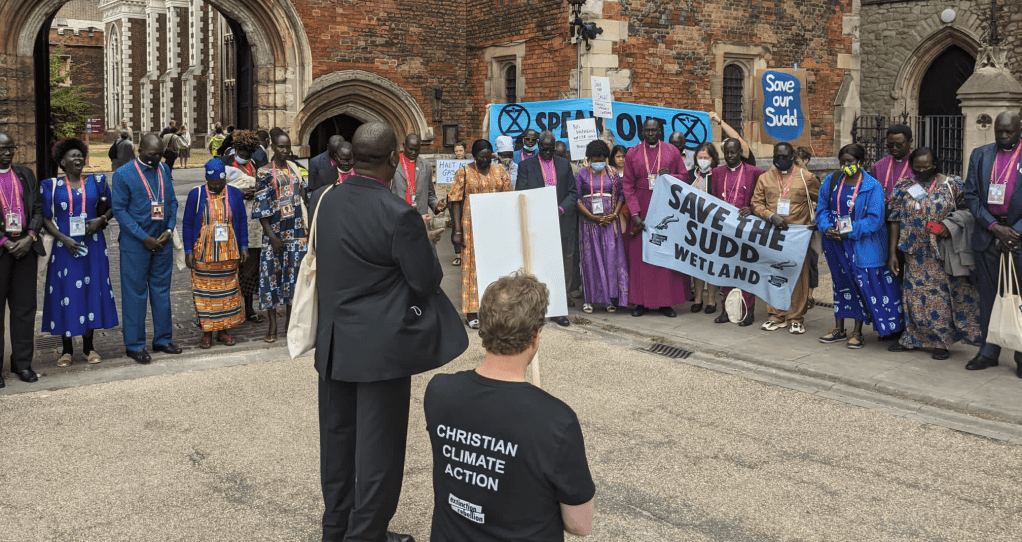
I spent the day outside the Palace with Christian Climate Action actively praying that the outcome of the day would be that bishops would have a clear understanding of the need to end reliance on fossil fuels and to address the global injustices of climate change. In advance of the day, CCA had contacted all the bishops, highlighting these concerns and inviting them to share in a prayerful response. 

One of the bishops from South Sudan in turn asked for support for his campaign to protect Africa’s largest wetland, The Sudd. Fed by the White Nile this area floods each year providing a wetland habitat for a diversity of wildlife as well as provide irrigation and subsequent rainfall for the grasslands surrounding the wetland that supports pastoral farming. The future of this wetland is threatened by a project to build a 300km  canal that bypasses the Sudd, transferring the flood waters to the northerly reaches of the Nile. 

It was encouraging when some of the bishops as they passed on their way into  – and at the end of the day, out off – the Palace diverted to talk with us or wave a hand to show their support. Some revelled in having their photos taken with the CCA banners as a back drop! From those who talked and prayed with us we learnt more of the issues that they face. In seeing such numbers of people – many dressed in brilliant colours reflecting their national identity – we were made aware of the scope and scale of this global crisis.

And the outcome of the day? Bishops spoke of heating at first hand from their colleagues about the effects of the climate. Hopefully it was a means to greater understanding and empathy, and a spur to more incisive action. At a corporate level, the day saw the launch of The Communion Forest – “a global initiative comprising local activities of forest protection, tree growing and eco-system restoration undertaken by provinces, dioceses and individual churches across the Anglican Communion to safeguard creation.”

In the run up to the Lambeth Conference, the Vatican signed up to the call for a Fossil Fuel Non Proliferation treaty  – https://fossilfueltreaty.org/vatican There was perhaps a hope that the Anglican Communion might have taken the opportunity of echoing this. At their conference earlier this year, the call for this treaty was endorsed by various faith groups including the Methodist Church of Great Britain. Other signatories include Green Christian UK, Anglican Church of Southern Africa Environment Network, Interfaith Scotland, North Carolina Council of Churches,  Operation Noah, Quaker Earthcare Witness. 

In his final key note speech Justin Welby said of the Lambeth Calls, “They are not an end in themselves. They are an appeal to each  Church and Province, and  Bishop and Diocese, to every Anglican, to be more visibly the people of God…” This then is where we can take action.As individuals we can sign this call for a Fossil Fuel Non Proliferation treaty; we can ask our churches to sign; we can ask our diocese to sign – and do so with reference to the Lambeth Call for the Environment and Sustainable Development. Step by step, piece by piece we can work together for the care of creation. 

Later in the same speech he said, “The Church, salt and light, courageous in prophetic utterance, gracious yet clear, is not another NGO: it is God’s chosen means of shining light in the darkness…This is not the church getting involved in politics. It’s the church getting involved in God. “

See also https://christianclimateaction.org/2022/08/04/bishops-at-lambeth-conference-join-protestors-calling-for-climate-action-from-the-anglican-church/

 Counting on …day 273

11th August 2022

The effects of the climate crisis could be as dire as that of nuclear war which has prompted various parliamentarians, cities, faith groups, academics, scientists, charities and NGOs to call for a Fossil Fuel Non-Proliferation Treaty:- 

Prevent the proliferation of coal, oil and gas by ending all new exploration and production; 

Phase-out existing production of fossil fuels in line with the 1.5C global climate goal; and 

Fast-track real solutions and a just transition for every worker, community and country.

You can endorse this as an individual or as a group, church,  company or business – https://fossilfueltreaty.org/#endorse

Counting on …day 272

10th August 2022

Last week I began to collect newspaper items about the climate crisis just as I had a year ago. Within a day I had as many as I had collected in week. The climate crisis is certainly a hot topic in the Guardian, and I hope in other news outlets too. This should make it easier to talk about with friends,  neighbours, businesses, MPs and councillors. 


“Climate endgame: risk of human extinction ‘dangerously underexplored’
Scientists say there are ample reasons to suspect global heating could lead to catastrophe”

The Guardian 1-8-2022

Counting on … day 271

9th August 2022

I don’t generally watch much television but have just watched the BBC’s series Big Oil v the world. I  had not realised how little I knew about the power of big oil companies to influence the world’s future. When we talk about about the capacity of humanity to cause climate change, we are shocked and  stunned. It seems we should be doubly shocked at our human capacity to create a deadly future for ourselves.

It is worth watching so as to be more fully informed and hopefully, be more committed to take preventative and mitigating action. If we can count on humans to cause this crisis, we must have the belief that humans have the capacity to reverse it. 

https://www.bbc.co.uk/iplayer/episode/p0cgqlv1/big-oil-v-the-world-series-1-1-denial