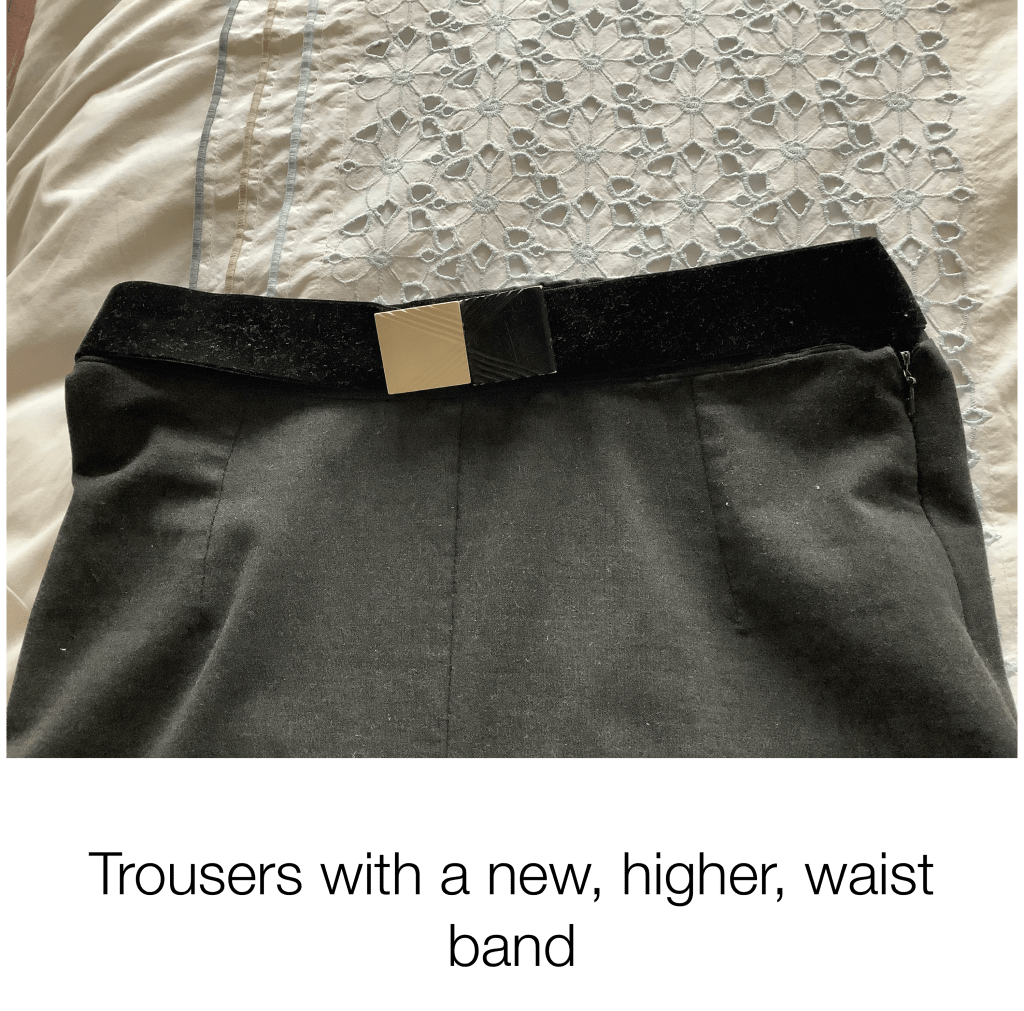
Counting on … day 105

9th July 2025

Mend, darn and repair clothes. Ideally clothes and household fabrics will give us years of use and pleasure. And even as they wear out, they can still be of use.

Initially we can avoid waste by looking after our clothes and household fabrics will – ‘a stitch in time saves nine’ is a reminder that the sooner  we restitch a broken hem or seem, or mind a tear, or darn a hole, the smaller will be the necessary repair. It can be tempting not to repair an item if it’s replacement is cheap – eg holes in socks, but we should consider not just the cost of replacement but the cost of discarding the sock. On that basis darning a hole makes even more sense. (1)

We have moved from a society that would turn collars and replace cuffs rather than buy a new shirt (2), or that would cut old sheets in half and resew, sides to the middle, to get maximum use from the sheet (3)

You can also patch clothes, sheets and even towels  (4) but eventually you may get to the stage where the item is no longer useable in its present form. Then rather than being throw away waste, maybe the item can be repurposed. An old sheets and even might be transformed into a pillow slip or a  pile of handkerchiefs. A towel might become a set of flannels or cleaning clothes. Old socks make good dusters or shoe polishing cloths. A t-shirt might become a duster or a pair of pants. (5)

(1) https://www.woolovers.com/page/how-to-darn-a-sock

(2) https://mathomhouse.typepad.com/bluestocking/2016/11/turning-shirt-collars.html

(3) https://forum.lettucecraft.com/t/turning-a-sheet-sides-to-middle-saving-the-planet-one-mend-at-a-time/22619

(4) https://designmom.com/living-well-4-secrets-to-patching-clothes/

(5) https://www.redhandledscissors.com/2010/06/17/t-shirt-to-underpants-upcycling/

Counting on …. Day 17

17th January 2024

Mending – darning, patching, replacing buttons and zips etc – helps clothes remain wearable longer. Repairs can be done  – almost invisibly- or they can be made decorative and obvious. 

Sewing skills improve with practice so you might want to begin with replacing a button or sewing up a hem, before trying your hand at replacing a zip or turning a  shirt collar (taking off a worn collar, flipping it over and sewing it back, so that the worn side is now inside the fold). 

Here are some previous posts – https://greentau.org/tag/darning/

https://greentau.org/tag/repairs/

And try this for decorative mending – https://blog.seasaltcornwall.com/decorative-darning/

https://www.marthastewart.com/1535789/sashiko-japanese-art-mending-fabric-visible-stitches

And this too may be of  – https://www.theguardian.com/commentisfree/2024/jan/16/what-have-i-gained-by-learning-to-sew-great-clothes-and-a-clear-conscience?CMP=Share_iOSApp_Other

Counting on … day 16

16th January 2024

Reusing rather than replacing can also apply to clothes. Some of our favourite pieces of clothing are often items we have had for many years. I have jumpers that go back 40 years and a kilt that is even older (I had it second hand as a child).

Reusing can also including passing on clothes such as from older to younger children, or between generations. I have several items originally worn by my mother. My husband has items that belonged to his father whilst some of his father’s clothes have already  been appropriated by our youngest son who loves the 1930s style. 

An alternative way of reusing clothes is to repurpose or reshape them. A pair of trousers that becomes ragged at the knees can be repaired or it can be repurposed as a pair of shorts – potentially leaving you some extra material from the bottoms that can be used to patch something else or to make a small bag. A skirt, dress or trousers etc that are too large can be reshaped to fit a smaller figure. Flaired trouser legs can be narrowed. If you don’t have these skills yourself, you might find someone else who has via a repair cafe or a tailor. 

 Another way of reusing clothes is to buy second hand ones from a vintage of charity shop – and to likewise pass on items you no longer wear. 

Greenpeace reports “Partly because of all this plastic use, and the energy needed to process it, the fashion industry produces 8-10% of global CO2 emissions (4-5 billion tonnes annually).”

Further reading – https://www.greenpeace.org.uk/news/fast-fashion-climate-change-pollution-violence/

https://www.bbc.co.uk/news/science-environment-60382624

Counting on … day 1.225

28th November 2023

Last week in response to the news that Lidl was renting out Christmas jumpers,  the Guardian noted that “The environmental charity Hubbub reported in 2019 that 12m jumpers were forecast to be bought that year, despite 65m already languishing in UK wardrobes. The novelty jumpers are, the charity said, one of the worst examples of fast fashion, now recognised as hugely damaging to the environment.” (1)

Hubbub’s website lists various ways of avoiding this waste – https://hubbub.org.uk/cheap-sustainable-christmas-jumper-ideas

  1. https://www.theguardian.com/lifeandstyle/2023/nov/23/lidl-christmas-jumper-loan-scheme-nspcc?CMP=Share_iOSApp_Other

Counting on … day 1.143

18th June 2023

We can sometimes underestimate the cumulative effect of small steps. The Earth Overshoot Day website notes that If we move the date 6 days each year, humanity can be out of overshoot before 2050. 

‘Halving our Ecological Footprint of clothing would move the date of Earth Overshoot Day 5 days …If we can double the lifetime use of our clothes, we can reduce the resource demand by half. Maintaining our existing wardrobe by buying pre-owned, repairing, and upcycling increases the lifespan of clothing.’ https://www.overshootday.org/portfolio/giving-clothing-a-longer-life/

Counting on ….day 1:017

17th January 2023

Clothes and the fashion industry contributes about 10% of all global carbon emissions. These stem from the production of synthetic materials as well as the large footprint of growing cotton; shipping and manufacturing; and the trend towards fast fashion. People buy more clothes than ever but wear them less often. Barely worn clothes plus a large number of unworn clothes (those that have overnight become unfashionable) end up in landfill. With cheaply made clothes, replacement is cheaper than repair. As clothes are often made from a mixture of different material types, recycling is not straightforward and can be expensive. 

But change can and is happening. Buying clothes that are made to last, maintaining and repairing clothes, rewearing or swopping clothes, buying from vintage and second hand sources, altering and adapting clothes to new circumstance, all helps to reduce the carbon  – and environmental- footprint of what we wear. 

I still wear a skirt that was my mother’s, a kilt which was second hand when I had it as a child, and my wedding dress (for dances not weddings!)

For more information –

 https://www.bbc.com/future/article/20211105-how-carbon-might-go-out-of-fashion https://www.weforum.org/agenda/2020/01/fashion-industry-carbon-unsustainable-environment-pollution/

 Counting on …day 79

 29th January 2022

We can improve the sustainability of the clothes we wear by considering on how and when we wash them. Washing clothes uses significant amounts of water and energy. Often we throw clothes in the washing basket without considering whether they actually need washing. (There are some things like pants and socks that we might want to wash daily, but they are the exception).  After one of two wears a shirt or jumper may not be dirty!  Wooden jumpers do better if they are aired rather than repeatedly washed. If we only wash items when they are dirty , we will run the washing less often saving water and energy.  We will save even more energy if it means using a tumble dryer less. If you can, air drying whether inside or outside, is preferable to using a tumble dryer.

 Counting on …day 80 

30th January 2022

Upcycling is a popular way of extending the life of the clothes we wear. Trousers worn at the knees can become a pair of shorts. Flared trousers can be tapered, or straight trousers can acquire a flair. A plain T shirt can be embroidered with a pattern or a message. Skirts can be shortened – or lengthened  if you add new material below the hem line. Dresses or trousers  can become skirts. Sometimes it may involve downgrading – the pair of jeans that has patches on the knees and patches on the buttock area is likely to become useful gardening gear!