Counting on … day 69

19th March 2024

The Carboniferous era began around 359 million years ago and lasted some 60 million years. It was an era in which life, land and marine, was well established – verdant swamps and forests. Raised oxygen levels in the atmosphere encouraged the evolutionary expansion of land and marine fauna. It is also known as the Age of the Amphibians as these dominated the  environment – later eras saw the evolutionary journey onto mammals. This abundance of plant and animal life as they decayed became coal beds, often forming in shallow seas and swampy areas of the landscape. It was also a time of increased tectonic movement as land masses moved and mountains were formed. Towards the end of the era, increased  glacial activity and climate change brought about the collapse of the Carboniferous rain forests. 

The name Carboniferous comes from the Latin ‘carbo’ for coal and ‘fera’ for carrying or bearing. Ie it was the coal bearing era. An era 60 million years in the making, locking away tonnes of carbon dioxide as coal, it is mind blowing to think that at current consumption levels – 7.25 billion tonnes a year – we have just 133 years of coal left. (https://www.worldometers.info/coal/).

Counting on … day 1.214

13th November 2023

Earlier this month I wrote about plans for switching from coal fired to electric fired furnaces for producing steel. It is an essential move in terms of reducing green house gas emissions, but it comes with complications – the electric furnaces need a smaller workforce so new jobs needed in other parts of the economy; the electric furnaces use recycled metal rather than raw ore which is a good thing in terms of reducing unsustainable consumption of raw materials but does need us now to have better systems for collecting and recycling unwanted metal; and a reduction in demand for coal:

“Electric arc furnaces require only 9kg of coking coal a tonne of steel against 780kg for a tonne of blast furnace steel, according to the lobby group UK Steel. British blast furnaces produced 4.8m tonnes of steel in 2022, suggesting they may have used 3.7m tonnes of coking coal. Based on UK Steel’s figures, producing the same amount of steel in electric arc furnaces would require only 43,000 tonnes of coal, or about 1.7% of the Cumbrian mine’s output.” (1)

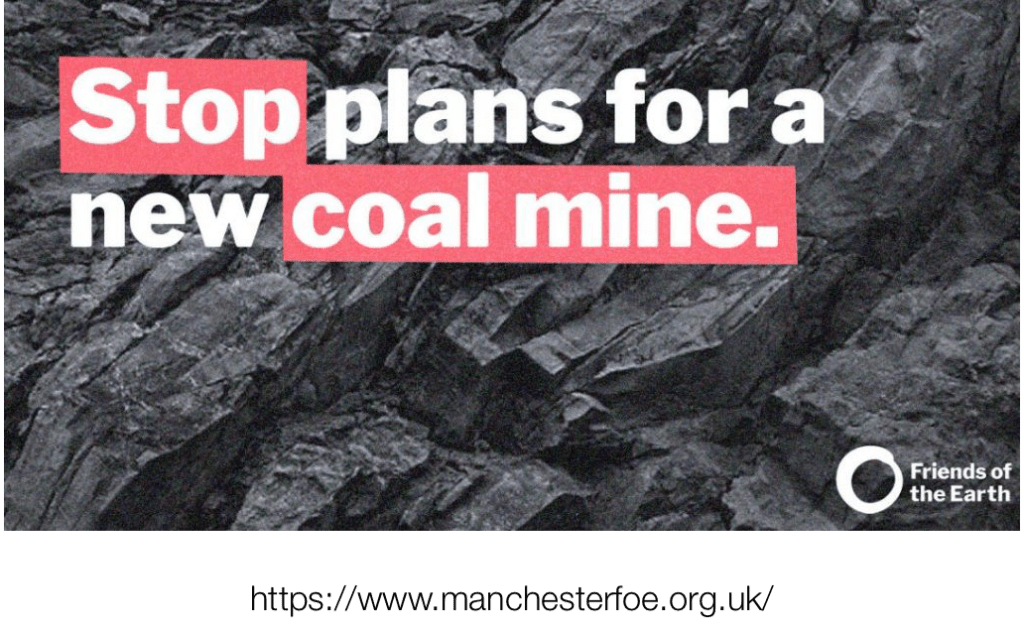
This must call into question whether there is any sense of continuing with the creation of the West Cumbrian coal mine. But equally it points to the need to develop other parts of our economy to create employment and to use the skills that people have.

 (1) https://www.theguardian.com/business/2023/nov/07/fresh-calls-to-scrap-cumbrian-coalmine-amid-steel-industrys-green-push

Counting on day … 1.054

23rd February 2023

Yesterday I joined a poignant observance of Ash Wednesday with others from Christian Climate Action. We held a service of ashing in Parliament Square, using coal dust as we confessed our – and those of society – in allowing our flagrant use of fossil fuels that has and is still causing so much damage to the world we live in – and its future. We called on the government to take action and in particular to overturn its approval for the new Cumbrian Coal Mine. Carrying coal, and to a slow drum beat, we took our lament and our prayers to the Home Office which had granted the Mine permission in December of last year, 

Finally we processed to the office of Javelin Global Commodities where we symbolically laid down the coal we had been carrying in our hands. We renewed our resolve to seek a different, better future.

Javelin is a significant partner of West Cumbria Mining, being  34 percent owned by U.S. coal miner Murray Energy, 28 percent owned by German utility E.ON and 38 percent owned by its principal traders, some of whom were previously at Goldman Sachs.Javelin is undertaking to purchase all of WCM’s production output and to sell the coal to steelmaking customers in the UK and Europe, as it “aims to ramp up its coal trading”

Counting on … day 403

10th December 2022

On Thursday the Government gave approval for the opening of a new coal mine in Cumbria despite the averse affect that its carbon emissions will have on the environment. Would this result have been different if Nature had a voice in Parliament? 

In the meantime if you wish to voice your opposition to this new coal mine Greenpeace a petition in place. https://action.greenpeace.org.uk/no-new-coal?source=UN&subsource=ECENCLPEUN03DJ&utm_source=Native&utm_medium=Thank+You+Page+Mobile+Share&utm_campaign=Pardot+Coal+Petition+-+Feb+22+%5BBW%5D++PE