Proper 16, 12th Sunday after Trinity

23rd August 2026

Reflection with readings below

“What is the foundation of our faith, what underpins it, from what substrate does it grow, what is its backstory?” Such questions would seem to be what Isaiah is both asking and answering. What emerges is overwhelmingly positive. 

God’s meta narrative (ie overarching story) is of restoration and redemption. What has become barren and desert-like will become as flourishing garden. The descendants of Abraham will receive instruction and justice, such that whatever the fragility of life, there will always be redemption and salvation. This is a story whose truth goes back to the beginning of time and continues to the end of time.

Our response, as the Psalmist reminds us, is to offer God due worship, sacrifice and praise. Whilst Paul’s words remind us that the sacrifice that God desires is to shape our lives, not according to the ways of the world – ways for example that are selfish, greedy and callous – but according to the ways – the wisdom – of God. ie. a mindset of which Jesus is the perfect exemplar. 

We are then offered two different, or maybe overlapping, views of how the church might be shaped. Matthew’s Gospel, tells us that Jesus appoints Peter as the rock – the bedrock perhaps – on which the church will be founded. Peter is designated, or maybe ordained, to shape and lead the assembly of people that will become the Church. He will have the power to determine what will and what will not be lawful. 

Paul on the other hand, has a vision of the church as being a collective that exists within the being – or presence – of Jesus, a collective in which each person has a role or a gift to contribute such that no one is less important nor more important than anyone else. 

Of the two, I think the latter is both more demanding of each individual – and more rewarding. It is, perhaps, quite easy to understand and value our own skills, to see how important it is that we achieve our full potential –  and receive our just praise and reward. It is less easy to understand and value the skills of a community that works together harmoniously. It is less easy to appreciate and accommodate in our lives, the skills and gifts that others have. 

It would seem easier to have an understanding of ‘my personal vocation’, my personal role in following Jesus, in which my success will be doing what is right and my failure will be when others thwarted me. It is harder I think to have an understanding of the ‘community’s vocation’, of its role in following Jesus. For in that scenario I have to know my neighbours, I have to know and value their gifts. I have to work in harmony with them, ensuring that the joint efforts of our gifts is what flourishes. I have to accept what others have to give me, and be willing to share what I have with them. This is a community where teamwork is key, where trust and honesty are essential, where communication – both in hearing and in articulating – has to be clear, where the common good not personal gain is the objective. This is a community where forbearance and leadership must work together.

It is a community with a way of life that will be counter-cultural until such time as everyone embraces the reign of God. It is therefore a community that will have to think carefully as it seeks to find ways of living alongside – but not conforming to – the ways of the ‘world’.  Holding onto the promise, the vision, of God’s meta narrative will be important. 

We will, for example, need to be a community that welcomes the stranger, the alien, the outsider – doing so because that is part of God’s story even when the ‘world’ stigmatises such people. 

We will, for example, need to be a community that respects and cares for the natural world because doing so is part of God’s story even when the ‘world’ sees nature as either a nice to have extra or as a mere resource to be exploited to maximise profits.

We will, for example, need to be a community that shares its resources so that there is neither rich nor poor, because doing so is part of God’s story even when the ‘world’ says we must hang onto our wealth to ensure that nobody else gets the better of us.

Paul does not ignore the role of leadership. Leadership is one of the gifts that is a constituent part of the church body – but it is a gift that is exercised in partnership with all the other gifts that make up the living body of the church – the living body of Jesus Christ. Such leadership is equally to be recognisable because it is counter cultural, because it is not conformed to the ‘world’s’ way of doing things but is shaped by the wisdom of God.

Isaiah 51:1-6

Listen to me, you that pursue righteousness,
you that seek the Lord.

Look to the rock from which you were hewn,
and to the quarry from which you were dug.

Look to Abraham your father
and to Sarah who bore you;

for he was but one when I called him,
but I blessed him and made him many.

For the Lord will comfort Zion;
he will comfort all her waste places,

and will make her wilderness like Eden,
her desert like the garden of the Lord;

joy and gladness will be found in her,
thanksgiving and the voice of song.

Listen to me, my people,
and give heed to me, my nation;

for a teaching will go out from me,
and my justice for a light to the peoples.

I will bring near my deliverance swiftly,
my salvation has gone out
and my arms will rule the peoples;

the coastlands wait for me,
and for my arm they hope.

Lift up your eyes to the heavens,
and look at the earth beneath;

for the heavens will vanish like smoke,
the earth will wear out like a garment,
and those who live on it will die like gnats;

but my salvation will be for ever,
and my deliverance will never be ended. 

Psalm 138

1 I will give thanks to you, O Lord, with my whole heart; *
before the gods I will sing your praise.

2 I will bow down toward your holy temple
and praise your Name, *
because of your love and faithfulness;

3 For you have glorified your Name *
and your word above all things.

4 When I called, you answered me; *
you increased my strength within me.

5 All the kings of the earth will praise you, O Lord, *
when they have heard the words of your mouth.

6 They will sing of the ways of the Lord, *
that great is the glory of the Lord.

7 Though the Lord be high, he cares for the lowly; *
he perceives the haughty from afar.

8 Though I walk in the midst of trouble, you keep me safe; *
you stretch forth your hand against the fury of my enemies;
your right hand shall save me.

9 The Lord will make good his purpose for me; *
O Lord, your love endures for ever;
do not abandon the works of your hands.

Romans 12:1-8

I appeal to you therefore, brothers and sisters, by the mercies of God, to present your bodies as a living sacrifice, holy and acceptable to God, which is your spiritual worship. Do not be conformed to this world, but be transformed by the renewing of your minds, so that you may discern what is the will of God– what is good and acceptable and perfect.

For by the grace given to me I say to everyone among you not to think of yourself more highly than you ought to think, but to think with sober judgment, each according to the measure of faith that God has assigned. For as in one body we have many members, and not all the members have the same function, so we, who are many, are one body in Christ, and individually we are members one of another. We have gifts that differ according to the grace given to us: prophecy, in proportion to faith; ministry, in ministering; the teacher, in teaching; the exhorter, in exhortation; the giver, in generosity; the leader, in diligence; the compassionate, in cheerfulness.

Matthew 16:13-20

When Jesus came into the district of Caesarea Philippi, he asked his disciples, “Who do people say that the Son of Man is?” And they said, “Some say John the Baptist, but others Elijah, and still others Jeremiah or one of the prophets.” He said to them, “But who do you say that I am?” Simon Peter answered, “You are the Messiah, the Son of the living God.” And Jesus answered him, “Blessed are you, Simon son of Jonah! For flesh and blood has not revealed this to you, but my Father in heaven. And I tell you, you are Peter, and on this rock I will build my church, and the gates of Hades will not prevail against it. I will give you the keys of the kingdom of heaven, and whatever you bind on earth will be bound in heaven, and whatever you loose on earth will be loosed in heaven.” Then he sternly ordered the disciples not to tell anyone that he was the Messiah. 

Counting on 2026 …. Day 40

11th May

‘Simplifying life is not a one-time decision, but an ongoing practice. It requires discernment, honesty and, often, a willingness to live differently from the dominant patterns around us. It also requires community. These shifts are difficult to sustain alone.’ (1) 

Living any counterculture lifestyle can, by definition, be lonely. If only living simply were not counter cultural but the norm! This is where finding your community – Green Christian/ Christian Climate Action/ Hazelnut Community etc – helps

(1) https://hazelnutcommunity.substack.com/p/the-life-we-miss-while-wanting-more?r=1r0y9l

6th Sunday in Lent, Palm Sunday

13th April 2025

Reflection with readings for the liturgy of the palms below

The collect for today tell us that for love of us, God sent Jesus into our world to give us a lived example of how we as human should inhabit the world.

In today’s first gospel reading, the parable Jesus has just told is that of the money (talents misdirects us into thinking of gifts or aptitudes not metal coinage) where the one who buries the money he has been given, is punished for not earning his master a rich profit. It is not a straight forward parable. Does the rich merchant present God who has given us gifts of varying value, or does the rich merchant represent the ungodly ‘world’ in which inequality is rife? Is it a parable that calls on us to make a profit for God, or one that invites us to challenge the concept of unearned profits? 

This is how the parable begins: A  nobleman went to a distant country to get royal power for himself and then return. But the citizens of his country hated him and sent a delegation after him, saying, “We do not want this man to rule over us”. Not an image that reflects our idea of God. And ends “But as for these enemies of mine who did not want me to be king over them—bring them here and slaughter them in my presence.” Again not an image that suggests a forgiving, loving God.

Is it maybe a parable about power and kingship? In the wilderness Satan has already offered Jesus the power and wealth of all the kingdoms of the world. Jesus refused that offer then; is he also challenging what is meant by power and kingship as he prepares to enter Jerusalem? The image of power and kingship represented by Caesar, or by Herod, or by the chief priest?

Just as Jesus’s parable about financial investments is not easy to understand, I’m not sure that the instructions Jesus gave to his disciples about securing a donkey were easy. Following his instructions required a lot of faith and a lot of humility: trusting that doing what Jesus asks will not result in ridicule and that even if it does, would you will still complete the commission or look sheepish and sidle away?.

But once they have secured the donkey – once they have taken that risk and stepped outside conventional, ‘worldly’ behaviour – it is easier to enter into the spirit of the occasion. Quickly they deck the donkey with robes, and lay a red carpet of palms and yet more robes. Now they feel part of something that is both radical and special. Stepping of the pavement into the road at the start of a march can be nerve wracking – we have been brought up to walk only on the pavements – but once everyone is marching along the road, chanting and waving banners, it all becomes so much easier, so much fun: “Here we are! We’re the change that is already happening!”

The disciples are beginning to see Jesus’s plan. He is going to enter Jerusalem on his own terms. And yes it will be a triumphal eye-catching entry – no sneaking in undercover. But equally it is going to challenge the status quo. Yes Jesus is a king but not like any king that the authorities might imagine. This is a king who will humbly ride in on a donkey. He is not going to laud his authority overs. His route into the city is not going to be created by armed troops, nor is he going to be accompanied by an armed body guard that would ensure an appropriate degree of distance between king and people. This king is going to be surrounded by the ordinary people – the people of the street and the land – by people who willing choose him as their king. Jesus is not going to become king through force of power. His entry will be surrounded by genuine shouts of joy, by a widespread celebration that here at last is someone who knows their needs and will satisfy them. This is the king chosen and endowed by God as their messiah. 

The example Jesus gives us is, in terms of worldly convention, not straight forward. Rather Jesus is challenging us to rethink whether we should be aligning ourselves with worldly conventions and practices. As followers of Jesus we should be thinking outside that box; we should be challenging the world’s assumptions. Power that is controlled by a small and rich elite is not how things should be in God’s kingdom. Support should not be gained through the exploitation of fear and/or greed. Kingship – authority – should be about humility and should reflect the voices of the many. Kingship/ authority should be about joy and celebration, about meeting people’s needs, restoring hope and ultimately renewing our relationship with God.

As followers of Jesus we need to find ways of supporting the incoming reign of God’s kingdom and of countering the corrupting, destructive power of the current ‘worldly’ order that we see flaunted by so many world leaders. 

Luke 19:28-40

After telling a parable to the crowd at Jericho, Jesus went on ahead, going up to Jerusalem. When he had come near Bethphage and Bethany, at the place called the Mount of Olives, he sent two of the disciples, saying, “Go into the village ahead of you, and as you enter it you will find tied there a colt that has never been ridden. Untie it and bring it here. If anyone asks you, ‘Why are you untying it?’ just say this, ‘The Lord needs it.'” So those who were sent departed and found it as he had told them. As they were untying the colt, its owners asked them, “Why are you untying the colt?” They said, “The Lord needs it.” Then they brought it to Jesus; and after throwing their cloaks on the colt, they set Jesus on it. As he rode along, people kept spreading their cloaks on the road. As he was now approaching the path down from the Mount of Olives, the whole multitude of the disciples began to praise God joyfully with a loud voice for all the deeds of power that they had seen, saying,

“Blessed is the king
who comes in the name of the Lord! 

Peace in heaven,
and glory in the highest heaven!” 

Some of the Pharisees in the crowd said to him, “Teacher, order your disciples to stop.” He answered, “I tell you, if these were silent, the stones would shout out.”

Psalm 118:1-2, 19-29

1 Give thanks to the Lord, for he is good; *
his mercy endures for ever.

2 Let Israel now proclaim, *
“His mercy endures for ever.” 

19 Open for me the gates of righteousness; *
I will enter them;
I will offer thanks to the Lord.

20 “This is the gate of the Lord; *
he who is righteous may enter.”

21 I will give thanks to you, for you answered me *
and have become my salvation.

22 The same stone which the builders rejected *
has become the chief cornerstone.

23 This is the Lord’s doing, *
and it is marvellous in our eyes.

24 On this day the Lord has acted; *
we will rejoice and be glad in it.

25 Hosannah, Lord, hosannah! *
Lord, send us now success.

26 Blessed is he who comes in the name of the Lord; *
we bless you from the house of the Lord.

27 God is the Lord; he has shined upon us; *
form a procession with branches up to the horns of the altar.

28 “You are my God, and I will thank you; *
you are my God, and I will exalt you.”

29 Give thanks to the Lord, for he is good; *
his mercy endures for ever.

Advent 22: unofficial signs

Not all street signs are official  – in the sense of being installed by the local or highway authority. Often  these unofficial signs advertised local events. Sometimes they concern lost cats and dogs, or keys that have been found (and not usually the other way round). This one here is providing a counter message to the prevailing media message that the ULEZ expansion was an intolerable  inconvenience for the average motorist. Instead this sign is celebrating the positive, life enhancing benefits of the traffic scheme. 

Prophets often have to shout out about the benefits of God’s ways to counter the ‘me, me, me’ message of society. That too must be our calling.

Wail, you who live in the market district; all your merchants will be wiped out, all who trade with silver will be destroyed. 
Zephaniah 1:11

If you oppress poor people, you insult the God who made them; but kindness shown to the poor is an act of worship. 
Proverbs 14:31

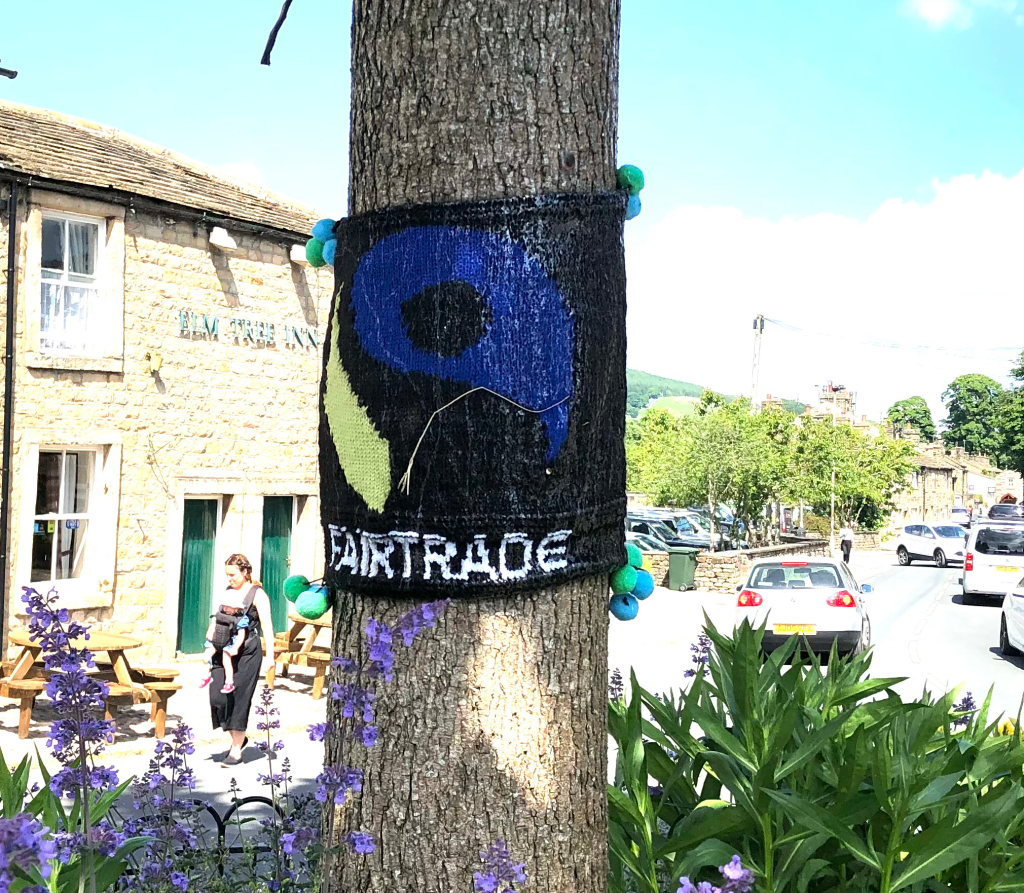
Advent 19: mixed media

Some messages are more noticeable when displayed using unusual mediums. This one is knitted!

The prophets of the Old Testament used this technique of unusual media to convey God’s messages. Jeremiah bought a brand new  loincloth which he deliberately buried so that it was irreparably ruined: a sign of what would happen to the people if they refused to listen to God. Hosea married a prostitute as a sign that even if God’s people followed other gods, God would still love them and forgive them. 

Then the LORD said to me, “Go show love to your wife again, though she is loved by another and is an adulteress. Love her as the LORD loves the Israelites, though they turn to other gods and offer raisin cakes to idols.” Hosea 3:1