The economic systems that predominate globally with their focus on growth (of GDP) and determined by the pursuit of profit (for the share holders) is a cause of growing inequality and with that (as outlined over the last few weeks) come problems such as climate change, biodiversity loss, social injustice etc.
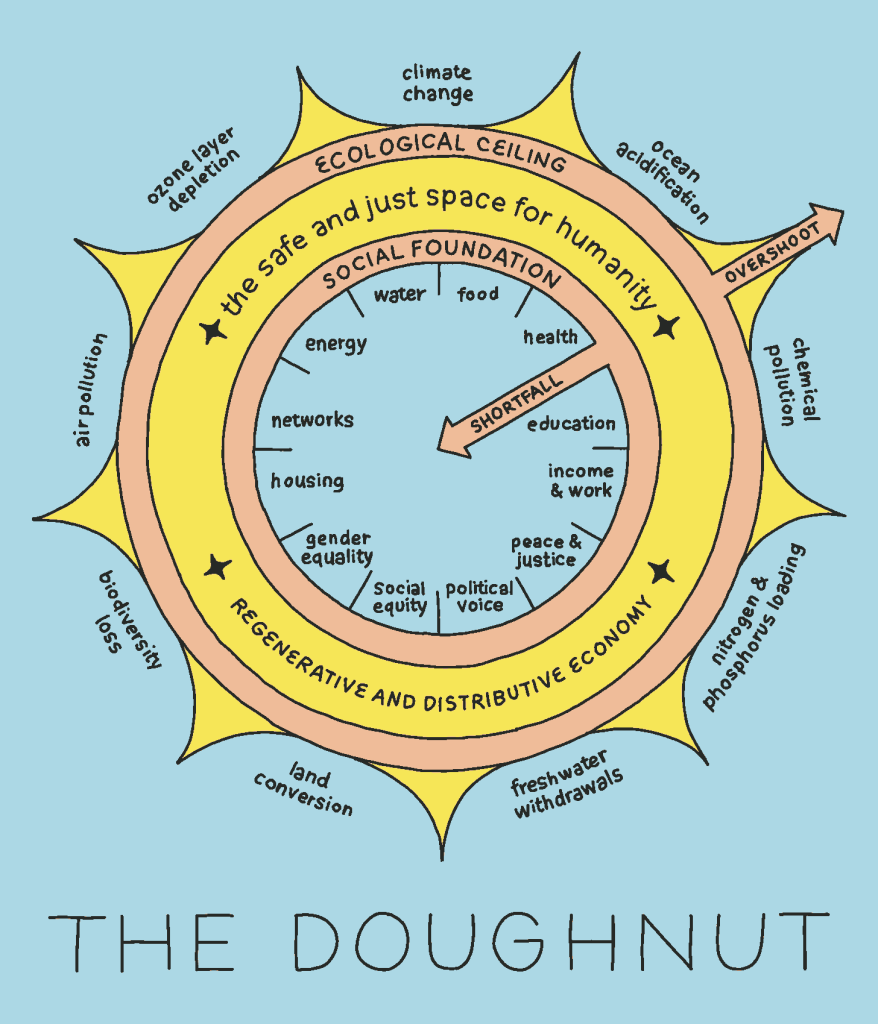
The economic theory that underpins this is flawed. There is no trickle down effect by which one can justify growing wealth for the already wealthy. The economist Kate Raworth has proposed an alternative model known as Doughnut Economics. Its basic premise is that there is on the one hand an outer limit to our economic activity which is determined by the limitedness of the Earth’s resources – planetary boundaries. And on the other hand a lower limit determined by what is needed to ensure the needs of each individual – food, water, housing, healthcare, education, mental well being. These inner and outer boundaries thus encasing the doughnut of economic activity.
In other words we would ensure consumption levels stayed within the boundary of what the Earth can provide – and than would include not putting more waste/ pollutants, including carbon dioxide , into the Earth’s systems than can be absorbed. It would mean reining in total consumption to that which one planet can sustain – ie bringing back Earth overshoot day back to 31st December.
And it would mean ensuring a fair and equitable distribution of resources so that everyone has enough – reining in the excessive levels of income and wealth currently accruing to a minority – and by so doing this will enable everyone contribute from the their full potential rather than being constrained by the limits of poverty, ill health etc.
Intergenerational justice asks us to embrace “the interconnectedness of all things, the recognition of the inherent value of nature and its interdependence with the human world.” (1) Such insights are not new – in 1624 Donne wrote ‘no man is an island’ and in1224 St Francis wrote about all creation as being our brothers and sisters. Rather is seems as if it is our industrial world, our market economy, that has separated our activities into discrete silos. Traditionally economic theory only considered demand and supply of a product and not its impact on society (for good or ill) nor any damage it may cause in terms of pollution or diminishing future supplies. Indeed as regards the latter, a diminishing supply can in fact boost profits for the supplier!
The free market economic model does not protect future generations – it is not even capable of caring for present generations. We need alternative approaches to manage our economies – such as Kate Raworth’s Doughnut Economics (2) (More on this next week).
To transition is to move from one state to another from way of doing things to another. It can involve change that is not much more than a minor adjustment or it can involve change that is a complete turnabout. Swopping from incandescent to LED lightbulbs might be an example of the former. Swopping from air travel to flight free journeys, from meat-based to plant based diets, from drilling for oil to the building wind farms, more an example of the latter. Most recently we have seen in the introduction of the expansion of ULEZ, a scheme that whilst fair and just for most people (providing clean air for pedestrian, cyclists and car drivers) is unjust for a small number of people who are dependent on their – non compliant – vehicles but have insufficient funds to buy an alternative and in adequate public transport to remove the initial need for a car.
The transition maybe even more deep rooted. We may need to transition from our market economies where profit and monopoly power determines what is produced and who consumes it, to an economy based on the the common good, on the least polluting, on satisfying need rather than greed. For a just transition we might see the introduction of a universal basic income, free health and social care at the point of need, an inter grated public transport system in place of private cars, the elevation of food sovereignty over futures markets, the adoption of doughnut economics.
You might also read this Time article about Amsterdam’s decision to pursue doughnut economics – but be aware, the webpage is full of adverts encouraging your to buy more and thus contribute to the GDP model of economics! https://time.com/5930093/amsterdam-doughnut-economics/
It seems to me that food production in the UK is caught between two objectives: that food should be produced as cheaply as possible, and that profits for the shareholders should be maximised. Producing food as cheaply as possible has been seen as a way of ensuring everyone can afford to eat. However producing food cheaply doesn’t necessarily make it affordable.
Reducing the cost of food can be achieved in various way:-
Industrialising processes whether that is the Chorleywood method of making bread or factory farming livestock
Large scale monoculture farming where land is cleared to grow single crops on a large scale – including the clearing of rain forests.
Intensified farming where animals are kept in barns and fed high protein diets rather than having a free range lifestyle, foraging and grazing as they go – low intensive free range animal foraging requires a much greater area of land. On the other hand, eg high protein diets fed to indoor animals has to be grown somewhere.
Intensive use of pesticides, herbicides and fertilisers to maintain high crop yields. This can become an expensive option when the cost of these inputs rise.
Keeping costs down by paying low wages and/ or by employing people on a seasonal or zero hours basis only. This applies throughout the food industry from the farmhand to the supermarket check out.
Automation of processes whether that is robots picking crops or automated diary parlours miking cows.
Importing food from countries where labour costs are even lower. is of course a flaw here.
Many of these cost saving practices involve reducing wages and/ jobs. As wages and jobs fall so the need for even cheaper food rises. There seems to be a flaw in the system!. Recently Ranjit Singh Boparan, the UK’s biggest poultry supplier of chicken, queried how it was that his industry could producing chickens that sold for less that a pint of beer – and whether such low prices could be maintained. In part he was questioning whether there were any ways in which costs can be cuts. Yet even at £2.66 (Tesco’s) for a chicken, chicken is still of the menu for a lot of people.
People who have to resort to food banks to eat, are not just people who are unemployed. They are also those who, because of disabilities and illness, receive disability benefits, those who are elderly and living on state pensions, those who are employed on zero hours contracts, and even those who are in full employment. The current minimum wage is £8.91 per hour for those over the age of 21. The Job Seekers Allowance is £77 a week for those 25 and over – depending on circumstances, this may be supplemented by Universal Credit. The full basic State Pension is £141.85 per week. All of these are less than the minimum wage recommended by Living Wage Foundation – £9.90 (£11.05 in London). Whether even this figure will be sufficient at a time of sharply rising fuel costs (and the knock on effect that will have an all products) is yet to be seen.
We have created an economy that does not provide the poorest with the necessary financial resources to enable them to buy the daily food they need – let alone enough to pay for heating, period products, housing, travel etc. Why is this so? Because the economic model we use says that profits must take priority. If costs rise such that they risk profits, then costs must be reduced – even if that means reducing wages and employment opportunities. As a fig leaf, a vague promise is proffered that, by maintaining profits and ensuring that the economy continues to grows, the trickle down effect will – ultimately – increase the wealth of even the poorest in society. No where does our economic system suggest that goods should be priced at a level that allows the workforce to be paid a genuinely fair wage – a wage such that they could afford the essentials of life including chicken and a pint of beer.
If everyone was paid at levels of pay (including benefits and pensions) that allowed them to eat properly, heat their homes, pay for their accommodation etc, then yes prices of some goods (such as chicken) would go up. And of course that proposed ‘fair’ level of pay would have to be sufficient for the recipients to pay those higher food (and other) prices. There would be a knock on for those already on higher incomes in that their day to day living costs too would go up – but usually the higher our income the smaller the proportion we spend on essentials such as food so the impact would be smaller the higher one’s income. Would we not all feel more comfortable as a society knowing that everyone was being properly fed and that no one was benefiting because someone else was being underpaid?
This reinvisiging of the economy is not a pipe dream but is to be found in the shape of Doughnut Economics. In her book, Doughnut Economics: Seven Ways to Think Like a 21st-Century Economist, Oxford University’s Kate Raworth argues for a radical overhaul of our traditional economic models: “Humanity’s 21st century challenge is to meet the needs of all within the means of the planet,” she says. “In other words, to ensure that no one falls short on life’s essentials … while ensuring that collectively we do not overshoot our pressure on Earth’s life-supporting systems, on which we fundamentally depend.”
Doughnut Economics challenges our existing profit orientated economics that sees economic growth as the only way forwards. Doughnut Economics argues that we can have a more caring and more sophisticated economic model which has two key objectives. First that everyone should have a comfortable standard of living – one that meets all seven priorities of the UN Sustainable Development Goals. Second that all economic activity should be sustainable and not cause irreparable damage to life on earth – ensuring a stable climate, fertile soils, healthy oceans, a protective ozone layer, ample freshwater and abundant biodiversity. https://doughnuteconomics.org/about-doughnut-economics
This economic model would not only prioritise the needs of the 2 million in the UK who cannot afford to eat on a daily basis; it would also prioritise the needs of the 3 billion globally who are malnourished. And it would prioritise the well-being of chickens that are reared for less than the cost of a latte!


 The Green Tau