
Prayers for the ecosystems of South America 

7th March 2026

The desert and the parched land will be glad; the wilderness will rejoice and blossom like the crocus Isaiah 35:1

You Lord, are the source of all good things: 

We praise you.

You call us to cherish and protect your creation: 

May we strive to do your will.

You have made us as brothers and sisters with all that lives: 

May we live together in peace.

A Reading: Daniel 4: 10-12

Upon my bed this is what I saw; there was a tree at the centre of the earth, and its height was great. The tree grew great and strong, its top reached to heaven, and it was visible to the ends of the whole earth. Its foliage was beautiful, its fruit abundant, and it provided food for all. The animals of the field found shade under it, the birds of the air nested in its branches, and from it all living beings were fed.

During Lent these prayers  focus on a different continent; this week South America. 

South America, the fourth-largest continent, extends from the Gulf of Darién in the northwest to the archipelago of Tierra del Fuego in the south. South America can be divided into three physical regions: mountains and highlands, river basins, and coastal plains. Mountains and coastal plains generally run in a north-south direction, while highlands and river basins generally run in an east-west direction.
South America’s extreme geographic variation contributes to the continent’s large number of biomes. A biome is a community of animals and plants that spreads over an area with a relatively uniform climate.  Within a few hundred kilometres, South America’s coastal plains’ dry desert biome rises to the rugged alpine biome of the Andes mountains. One of the continent’s river basins (the Amazon) is defined by dense, tropical rain forest, while the other (Paraná) is made up of vast grasslands.
The diversity of animal life in the Amazon rain forest is unsurpassed in the rest of the world. There can be as many as 100 different tree species on a single acre. The rain forest is perfectly suited for arboreal, or tree-living, animals. More than 2 million species of insects are native to the region, including hundreds of spiders and butterflies. Primates are abundant—howler monkeys, spider monkeys, and capuchin monkeys—along with sloths, snakes, and iguanas. Thousands of native birds include brightly coloured macaws, parrots, toucans, and parakeets. https://www.nationalgeographic.org/encyclopedia/south-america-physical-geography/

Glory to God 

Creator of rivers and oceans:

We praise you for the Amazon, 1725 miles long!

Glory to God, 

Creator of mountains and valleys:

We praise you for the Amazon Basin, all 2.7 million squares miles.

Glory to God, 

 Creator of trees and plants:

We praise you for the 40,000 plants species of the Amazon.

We praise you for biome that supports 350 millions tonnes of life per square kilometre.

Glory to God, 

Creator of all that crawls and swims and flies.

We praise you for wildlife of the Amazon – 

2 million species of insect, 2000 birds and mammals, 800 amphibians and reptiles.

Merciful God,

Creator of human kind, 

Forgive us for the destruction of the Amazonian rainforest,  18% lost and counting.

Forgive our greed that replaces trees with cattle ranches and fields of soy for their fodder.

Forgive our greed that replaces trees with sugar cane, for sweetmeats and bio fuel.

Merciful God,

Creator of air and space, 

Forgive our foolishness in destroying the source of 20% of the world’s oxygen.

Forgive our greed that gobbles up the living space of others, endangering  the survival of jaguars and blue macaws, poison dart frogs and river dolphins.

Merciful God

Creator of climates and seasons,

Forgive our foolishness that creates droughts and heat waves.

Forgive our greed that fills the air with carbon dioxide and destroys carbon sinks.

Guiding God,

Source  of all wisdom, 

Transform our hearts and minds, turn the direction of our hands and feet 

so that with alacrity and commitment we may reform our lives 

and live only in harmony with your creation. 

Amen.

The Grace
Prayers for the ecology of Australasia 

28th February 2026

The desert and the parched land will be glad; the wilderness will rejoice and blossom like the crocus Isaiah 35:1

You Lord, are the source of all good things: 

We praise you.

You call us to tend and care for your creation: 

May we strive to do your will.

You have made us as brothers and sisters with all that lives: 

May we live together in peace.

A Reading: Isaiah 42: 5, 10-12 

Sing to the Lord a new song,
    his praise from the end of the earth!
Let the sea roar and all that fills it,
    the coastlands and their inhabitants.

Let the desert and its towns lift up their voice,
    the villages that Kedar inhabits;
let the inhabitants of Sela sing for joy,
    let them shout from the tops of the mountains.

Let them give glory to the Lord,
    and declare his praise in the coastlands.

These prayers during Lent focus each week on a different continent; this week Australasia. 

The Australasia realm is dominated by the Australian continent and 2 additional subrealms — New Zealand and  the Australasian Islands: Papua, Sulawesi, and other Indonesian islands east of the Makassar Strait and south of the Java Sea, as well as the Solomon Islands, Vanuatu, and New Caledonia. Australasia encompassed a diversity of environments from the vast interior deserts of Australia, dry and wet tropical savannahs and rainforests, Mediterranean woodlands, temperate grasslands and  alpine uplands. With its seven seas and immense coral reefs, Australasia is one of the most important realms for ocean biodiversity. The Great Barrier Reef, considered one of the Seven Natural Wonders, is the world’s largest coral reef system. https://www.oneearth.org/realms/australasia/

Australasia is already greatly affected by the ongoing climate crisis, with rising land temperatures and an increasing frequency of heat waves and bush fires; rising sea levels and an increasing frequency of heavy rain causing flooding, interspersed with increasing periods of drought. Rising sea levels disproportionately affect small islands nations. Rising temperatures in the oceans are destroying  coral reefs. 

An extract from ‘Kangaroo’ by D H Lawrence

Delicate mother Kangaroo 

Sitting up there rabbit-wise, but huge, plump-weighted, 

And lifting her beautiful slender face, oh! so much more 

gently and finely lined than a rabbit’s, or than a hare’s, 

Lifting her face to nibble at a round white peppermint drop 

which she loves, sensitive mother Kangaroo. 

Her sensitive, long, pure-bred face. 

Her full antipodal eyes, so dark, 

So big and quiet and remote, having watched so many 

empty dawns in silent Australia. 

Her little loose hands, and drooping Victorian shoulders. 

And then her great weight below the waist, her vast pale belly, 

With a thin young yellow little paw hanging out, and 

straggle of a long thin ear, like ribbon, 

Like a funny trimming to the middle of her belly, thin 

little dangle of an immature paw, and one thin ear. 

Her belly, her big haunches 

And, in addition, the great muscular python-stretch of her tail. 

There, she shan’t have any more peppermint drops. 

So she wistfully, sensitively sniffs the air, and then turns, 

goes off in slow sad leaps 

On the long flat skis of her legs, 

Steered and propelled by that steel-strong snake of a tail. 

Intercessions 

We give thanks for the beauty and diversity of the world you have given us, 

for its colour and abundance, its richness and vitality.  

Generous God, hear our prayer.

With sorry we acknowledge our part in damaging what you have created. 

We acknowledge that our lifestyles have been selfish and careless.  

We acknowledge that we could and can do more 

to tend this earth and care for its inhabitants. 

Merciful God, hear our prayer.

We pray for these who conserve plant and animal wildlife, birds and insects. 

We pray for the work of agriculturalist and scientists 

developing better, kinder ways of living on this earth. 

We pray for the resilience of indigenous communities 

that strive to live in harmony with their environment. 

Gracious God, hear our prayer. 

We pray for government leaders and advisers, 

farmers and business leaders, 

that they will hold dear the needs of the environment 

and strive to avert the risks of the ecological crisis. 

Enabling God, hear our prayer.

The Grace 

Counting on …. Day 1.149

15th August 2023

The relationship between urban and rural areas and the protection and enhancement of green landscapes and biodiversity is two way in both directions. Yes those in urban areas need to address their lifestyle and ecological impact to protect both urban and rural environments, but those in rural areas also need to be able to do the same. Yet living ecologically in rural areas can be harder than in urban areas. 

In London, people have access to what is – generally – a good public transport network. This is not a given in rural areas – and not even in some urban areas outside London. 

In London, people have access to milk deliveries, refill stores, markets, charity/ second hand shops – all without the need to drive a car. Indeed in many parts of London people do live within 15 minutes of their local shops, medical centre, post office, schools, cinema, gym, green space, railway station etc.

If we want everyone to be able to live ecologically, protecting and enhancing the environment, then it is important that everyone has access to the necessary services and infrastructure to do so whether they live in rural or urban areas.

 Counting on …day 364

30th October 2022 

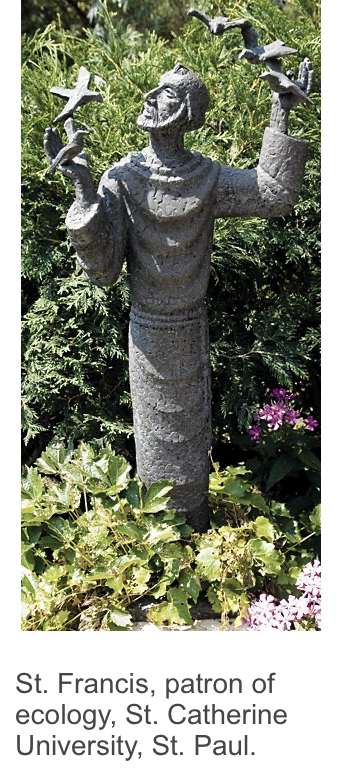
In 1979 St Francis was declared the patron saint of ecology reflecting his deep sense of the connectedness of all aspects of creation and in which all creation lives to praise God. Francis undertook very radical changes in his lifestyle in order that he could be true to his understanding of God, and yet – or because of this – he was also full of joy. 

Counting on …day 328 

4th October 2022

Today is the feast of St Francis, patron saint of ecology. Like the writers of the Old Testament and Jesus, Francis understood the innate connectedness that humanity shares with the rest of creation. It is a connectedness created by God. When we live in harmony we worship God; when we live in disharmony we grieve God. 

Laudate Si: discussion notes 1

These notes were first produced in the autumn of 2021 for our ecumenical house group. They are based around the encyclical letter written by Pope Francis. You don’t have to have read the encyclical to use the discussion notes but I would recommend it as worth reading. The encyclical is available to read on line – https://www.vatican.va/content/francesco/en/encyclicals/documents/papa-francesco_20150524_enciclica-laudato-si.html

Introduction.

“Laudate Si – care of our common home” is an encyclical written by Pope Francis in 2015 in response to the various environmental crises facing the world. This was the same year that produced the Paris Agreement on Climate Change and the UN’s Sustainable Development Goals. The former set goals to keep the rise in global temperature (compared with pre industrial levels) to within at least 2C  and ideally less than 1.5C, as being the only way to substantially reduce the effects of climate change. This reduction was to be achieved by cutting green house gas emissions with a target of net zero emissions by 2050. (The Agreement included 5 yearly interim targets for the period to 2030). The latter SDGs set 17 interlinked goals which are intended to produce a good and sustainable future for everyone. With a target date of 2030, these goals include an end to poverty, an end to hunger, gender equality, quality education for all, peace and justice and the institutions to maintain them etc. 

Into this focus on reducing the impact of climate change and of creating a sustainable way of living that would benefit the whole world, Pope Francis’s encyclical brings a welcome theological dimension for protecting the earth and its human society.  It also brings in the equally theological understanding that humans have a responsibility to act to ensure these changes happen.

Five plus years later, that need for action is still there. This autumn the COP26 climate conference – the successor to the conference  that produced the 2015 Paris Agreement – will be taking place in Glasgow. It will need to lay out clear targets and specific plans for their implementation, to ensure the whole world does indeed become net zero carbon by 2050 and that global temperature increases are kept within the 1.5C safety range. Can we once again take the message from Laudate Si and use it to bring about the changes needed? 

In 2020 Cafod launched its Reclaim our Common Home campaigns (https://cafod.org.uk/Campaign/Reclaim-our-common-home) which draws heavily on the themes covered by Laudate Si. The campaign calls on individuals, organisations and government to take action to:-

  • RECLAIM nature so that everyone can breathe clean air and be protected from the threat of climate disasters.
  • RECLAIM the world’s land and resources so they are more fairly distributed and all our brothers and sisters around the world can live in dignity.
  • RECLAIM power so that everyone can be involved in decision making and have control over their own lives.

 What’s in a name? 

Laudate Si, meaning praise be, is the repeated refrain from the Canticle of the Creatures written by St Francis circa 1225 (see page 5 for a copy). Its verses call on the listener (and the cantor) to praise creation, identifying each part of creation as one of humanity’s many siblings, from Bother Sun and Sister Moon to Sister Death. This valuing of creation as co-equals with humanity is picked up repeatedly in St Francis’s approach to life. It is told of in the stories of Francis preaching to the birds and acting as an arbitrator between a man-eating wolf and the villagers of Gubio. It is an interconnectedness that is now recognised by both scientists and environmentalists – and one hopes by economists.

The second part of the encyclical’s title talks of ‘our common home’. The earth, this world in which we live, is our home, but not just our home but that of all manner and number of other living beings, plant and animal. Just as we are all brothers and sisters, so we are all part of one household. Study of our common home gives us the word ecology – the Greek oikos  means house or habitation/ habitat and  logia means study.

  1. Praise Be! Let all creation praise God in its differing ways and let humanity – both in words and art forms – praise God by praising every part of creation! The psalms include many lines praising God, praises that come from humans as well as praises that come from creation itself – psalm 19 is a good example. In what ways do you most naturally or readily praise God through praising creation?
  1. Do we devote enough time and energy to  celebrating the wonder and beauty of creation? Do we share this joy often enough with other people? (This is one way in which we can share the good news). Would a more widespread enjoyment and admiration of the beauty of creation, induce a more widespread and concerted concern for the well being of our environment? Is this one reason why writings such as Laudate Si are so important?
  1. As well as psalms of praise, there are psalms of lament – psalms that cry out to God with words of suffering, pain, anguish and despair (for example psalm 31:9-13). Usually we read such psalms as being the lament of a human being, but should we be ready to hear them also as a lament of an animal or bird, a river or even a landscape? How might that change the focus or feel of our private or corporate worship?
  1. Given that we are brethren or siblings together, living in a common home, why is it that we as humans have a) managed to so disrupt or distort the ecosystem such that life as we know it is threaten, and b) feel that we have a responsibility to God to do all we can to correct these things? 
  1. The psalms of lament invariably lead to cries of repentance, of contrition, of seeking God’s mercy and of turning one’s life around. How often do we take time to examine our lives from an ecological viewpoint? How often do we reflect on the degree of suffering our lives may be causing our creaturely brothers and sisters? Might contrition prompt us to both make a fresh start and to make good the damage we have caused? 
  1. The creation story in Genesis chapters 2 and 3, describes how the harmonious relationships between humans and God, and between humans and other living beings became broken. St Francis’s experience and practice of being at one with all living things has been seen as a way of  caring for, and increasing awareness of, our mutual relationships with nature. Can this practice also improve our relationship with God?
  1. What does it mean to share a common home? I am sure at some point you have had experience of having to share your home with someone else. Maybe a new sibling or your own new born child, maybe a returning adult child or an elderly parent, maybe a cat or dog, maybe a lodger or a carer. Current and incoming inhabitants have to make adjustments, there will be times when either party must bear or forebear, sometimes additional leeway is called for whilst at others a reassessment of house rules may be needed. At the end of the day an accommodation has to be found that is acceptable to all parties. How good are we at sharing our global home, our national home, our local  ‘home’ with others? Is it our inability to share that causes most grief?
  1. The covid pandemic has shown us how interconnected our world is, whether through the transfer of viruses  between species or the transfer of mutations between countries. It has changed our view of what is important about where and how we live. Has it also shifted our understanding of the role leaders and governments play? Has it challenged our reliance on them? Has it instead increased our reliance on God and neighbour?

Prayer

Loving God, 

Open our minds and touch our hearts

so that we may attend to your gift of creation … 

Now more than ever may we feel 

that we are all connected and interdependent; 

enable us to listen and respond 

to the cry of the Earth and the cry of the poor. 

May the present sufferings be the birth pangs 

of a more familial and sustainable world. 

We make this prayer through Christ our Lord.

Amen. 

Prayer for the Sixth Anniversary of Laudato Si’:  Columban Missionaries (Britain)

Active Response 

In Laudate Si, Pope Francis says that our friendship with God is often linked to particular places which take on a intensely personal meaning. This might include mountains or vistas, places where we played as children, churches,  sea coasts. Revisiting them may enable us to recover something of our true selves (Laudate Si section 84). Later Pope Francis commends paying close attention to the natural world – it being a continuing revelation of the divine – so that we might more clearly see ourselves as part of the sacredness of the living whole (Laudate Si section 85).

Between now and our next meeting, practice with praising creation, with exploring places of personal significance and/ or with contemplating the natural world, and note how it affects your relationship with God and with your creaturely siblings.

This poster is the work of  Elizabeth Perry/CCOW (Christian Concern for One World)