
Proper 20, 16th Sunday after Trinity 

20th September 2026

Reflection with readings below

God is a God of mercy, of forgiveness, of second chances.

Likewise we are called to be as generous and as forgiving. But to forgive, is not to condone or encourage the continuance of words and actions that are contri to God’s wisdom. Rather than condoning shortcomings – whether in ourselves or others – we are called to encourage and put into practice lifestyles that pursue God’s wisdom. And as the letter to the Philippians reminds us, our Christian calling will include sacrifice – will include putting the needs of others before our own.

We all have a duty to look at our own actions, to see what is contri to God’s wisdom, and to repent and reform our lives. We also have a duty to speak out when we see wrong happening in the lives of others, when we see wrong being condoned, and when we see systemic wrong.

In examining ourselves and the world around us we are not to judge according to our own desires and bias, but according to God’s wisdom – and we may be surprised, even discomforted, when this seems to favour others rather than ourselves; when this seems to involve us in making sacrifices, putting the needs of others before ourselves – or what can be even harder –  putting the needs of others before our own families and communities. Here we might empathise with Jonah’s grievance that God, having judged the wicked behaviour of the Ninevites, is so quick to shower them with benefits when they repent, whilst Jonah goes unrewarded. 

We might equally empathise with the all-day workers in the vineyard whose long and gruelling working receives no greater reward than the light-weight input of the latecomers. I think we might equally find it hard to persuade the all-day workers that they were not being penalised, to explain that in reality the whole community benefits when all are provided for equally. This understanding is countercultural to many norms of the present day. Indeed the political and economic systems of our world reinforce the idea – and practice – of rewarding those who are already advantaged, and disadvantaging those who are already struggling. 

This week three such instances come to mind. The Guardian has been highlighting the newly published Register of British Slave Traders that reveals the widespread extent to which British individuals and organisations promoted and benefitted from the transatlantic slave trade. Profits accruing from the economic advantage of cheap labour plus the profits accruing from commandeering the natural resources of other countries through colonialism, boosted the British economy ensuring that we are today one of the richest nations in the world. Many will argue that as much as we abhor slavery, the era of the transatlantic slave trade is in the past and no one from the current generation can in any way be responsible for what happened then. Nevertheless the economic well being we enjoy is rooted in those profits. Should we not then be pursuing restorative justice? 

Next week at the UN conference in New York, members will be considering the creation of an International Panel on Inequality- similar to the International Panel on Climate Change – to find a way of reversing the acceleration distribution of wealth across the globe. Between 2000 and 2024, the richest 1 % of the global population has captured 41 % of all new wealth, while the bottom 50 % saw their wealth increase by just 1 %. And 83% of countries, representing about 90 % of the world’s population, have highly unequal societies. Further data suggests that accumulated and inherited wealth — with an estimated $70 trillion expected to be passed on over the next decade — as a key driver entrenching inequality and undermining social mobility, fairness, and opportunity for lower-income populations. Inequality invariably leads to democratic decline, political instability and the potential for conflict. Would we be willing to see a global redistribution of wealth and resources as well as a redistribution of wealth within our own society? Should we be willing to see our personal wealth taxed? 

Nepal is seeking a payout from the Climate loss and damage fund to enable them to rebuild lives and infrastructure destroyed by the glacial tsunami. This fund was established in 2022 to pay for loss and damage that results from climate change events, with the intention that the  developed nations would each make appropriate financial contributions. Those nations who had contributed most to the climate crisis through – and benefited most from –  decades of coal, oil and gas fuelled industrialisation, would contribute most to the fund. However many nations, including the UK, reneged on the scale of their promises, and the fund is already struggling to pay out on the 100 plus prior claims already in the queue ahead of Nepal. Again the question has to be are we willing to forego some of our wealth and income to aid those most impacted by the consequences of our actions?

In each example I would argue that God’s justice demands a self sacrificing generosity. Equally I would suggest that to do so will not only benefit the recipients, but ourselves too. For it is the whole community benefits when all are provided for equally. Like the all-day workers in the vineyard we may initially resent what is being asked of us, but when we step back and see the benefits of the in-coming of God’s kingdom here on earth, we will share in the rejoicing.

How do we achieve this in practice I’m not sure. It could be by giving sacrificial to appropriate charities. It could be by campaigning alongside groups such as Christian Aid, Oxfam and Global Justice. It could be by campaigning directly to change government policy. It could be by encouraging and supporting the reparative justice objectives of the Church of England’s Spire Project. It could be by talking with our family, with our friends, normalising the concept, rooting it as a key part of our Christian discipleship.

What is important is that is those with the most wealth and income who contribute, not those with the least. And that it is those with least who then benefit. 

Jonah 3:10-4:11

When God saw what the people of Nineveh did, how they turned from their evil ways, God changed his mind about the calamity that he had said he would bring upon them; and he did not do it.

But this was very displeasing to Jonah, and he became angry. He prayed to the Lord and said, “O Lord! Is not this what I said while I was still in my own country? That is why I fled to Tarshish at the beginning; for I knew that you are a gracious God and merciful, slow to anger, and abounding in steadfast love, and ready to relent from punishing. And now, O Lord, please take my life from me, for it is better for me to die than to live.” And the Lord said, “Is it right for you to be angry?” Then Jonah went out of the city and sat down east of the city, and made a booth for himself there. He sat under it in the shade, waiting to see what would become of the city.

The Lord God appointed a bush, and made it come up over Jonah, to give shade over his head, to save him from his discomfort; so Jonah was very happy about the bush. But when dawn came up the next day, God appointed a worm that attacked the bush, so that it withered. When the sun rose, God prepared a sultry east wind, and the sun beat down on the head of Jonah so that he was faint and asked that he might die. He said, “It is better for me to die than to live.”

But God said to Jonah, “Is it right for you to be angry about the bush?” And he said, “Yes, angry enough to die.” Then the Lord said, “You are concerned about the bush, for which you did not labour and which you did not grow; it came into being in a night and perished in a night. And should I not be concerned about Nineveh, that great city, in which there are more than a hundred and twenty thousand persons who do not know their right hand from their left, and also many animals?”

Psalm 145:1-8 

1 I will exalt you, O God my King, *
and bless your Name for ever and ever.

2 Every day will I bless you *
and praise your Name for ever and ever.

3 Great is the Lord and greatly to be praised; *
there is no end to his greatness.

4 One generation shall praise your works to another *
and shall declare your power.

5 I will ponder the glorious splendour of your majesty *
and all your marvellous works.

6 They shall speak of the might of your wondrous acts, *
and I will tell of your greatness.

7 They shall publish the remembrance of your great goodness; *
they shall sing of your righteous deeds.

8 The Lord is gracious and full of compassion, *
slow to anger and of great kindness.

Philippians 1:21-30

To me, living is Christ and dying is gain. If I am to live in the flesh, that means fruitful labour for me; and I do not know which I prefer. I am hard pressed between the two: my desire is to depart and be with Christ, for that is far better; but to remain in the flesh is more necessary for you. Since I am convinced of this, I know that I will remain and continue with all of you for your progress and joy in faith, so that I may share abundantly in your boasting in Christ Jesus when I come to you again.

Only, live your life in a manner worthy of the gospel of Christ, so that, whether I come and see you or am absent and hear about you, I will know that you are standing firm in one spirit, striving side by side with one mind for the faith of the gospel, and are in no way intimidated by your opponents. For them this is evidence of their destruction, but of your salvation. And this is God’s doing. For he has graciously granted you the privilege not only of believing in Christ, but of suffering for him as well– since you are having the same struggle that you saw I had and now hear that I still have.

Matthew 20:1-16

Jesus said, “The kingdom of heaven is like a landowner who went out early in the morning to hire labourers for his vineyard. After agreeing with the labourers for the usual daily wage, he sent them into his vineyard. When he went out about nine o’clock, he saw others standing idle in the marketplace; and he said to them, ‘You also go into the vineyard, and I will pay you whatever is right.’ So they went. When he went out again about noon and about three o’clock, he did the same. And about five o’clock he went out and found others standing around; and he said to them, ‘Why are you standing here idle all day?’ They said to him, ‘Because no one has hired us.’ He said to them, ‘You also go into the vineyard.’ When evening came, the owner of the vineyard said to his manager, ‘Call the labourers and give them their pay, beginning with the last and then going to the first.’ When those hired about five o’clock came, each of them received the usual daily wage. Now when the first came, they thought they would receive more; but each of them also received the usual daily wage. And when they received it, they grumbled against the landowner, saying, ‘These last worked only one hour, and you have made them equal to us who have borne the burden of the day and the scorching heat.’ But he replied to one of them, ‘Friend, I am doing you no wrong; did you not agree with me for the usual daily wage? Take what belongs to you and go; I choose to give to this last the same as I give to you. Am I not allowed to do what I choose with what belongs to me? Or are you envious because I am generous?’ So the last will be first, and the first will be last.” 
Proper 19, 15th Sunday after Trinity 

13th September 2026

Reflection with readings below

The reading from Genesis talks of the gift of forgiveness – its ability to dispel fear and restore relationships – and the importance and freedom of not holding a grudge. Today’s psalm expands on this by declaring how it is that God bestows benefits on us: forgiving our sins, healing our infirmities (our shortcomings), redeems and gives value to our lives, satisfies our needs, and executes righteousness and judgement for us all. All this is encapsulated in the phrase ‘compassion and mercy’. 

God’s character is to show compassion and mercy to all creation. Our calling is to imitate God, or calling on the language of Genesis 1, we who are made in the image of God, are to ‘image’ in our behaviour the behaviour of God. We are to show compassion and mercy to all creation. We are to forgive sins – and not hold grudges. This may mean letting go of privileges or rights or possessions or land, that we previously valued more than our love for our neighbour.  We are to heal broken relationships and mend what we have damaged. This includes making peace with those we deem our enemies but also establishing right relationships with those we have abused. 

Some of these are inter human relationships such as our failure to ensure our young people have access to loving families, to accessible education, to green spaces, secure homes and safe streets. Or our failure to provide loving homes and attentive care for our elderly citizens. Or our failure to take any responsibility for those in other lands affected by colonial oppression, climate change etc.

Some of these are relationships with wildlife, and here we have clearly failed when we see and measure the extent to which populations have declined and species have become extinct. Only this week did I read that one in in nine migratory birds are threatened with extinction and 45% of migratory species such as cuckoos, turtle doves and Arctic terns are in decline, which are overwhelmingly caused by humans and include the intensification of farming, unsustainable hunting, pollution, invasive species and global heating. (1) 

Some of these are relationships with domesticated creatures, hens forced to live severely curtailed lives (often not more than 6 weeks for a bird that could live as many years) in cramped lives devoid of access to the natural world; cows that must give birth annually only to have their baby removed within hours, and who may have their own lives prematurely curtailed after 3 or 4 years. 

Some of those are relationships with ecosystems such as soils which we pollute with herbicides and pesticides, and rivers that we pollute with a similar cocktail of chemicals to which we add sewage and industrial waste. Or with ancient woodlands and tropical forest which we have cleared to replace them with monocultures of Sitka fir, palm oil and soya beans for yet more cattle fodder.

We are to redeem life which must include restoring lives that we have damaged – lives not just of people but of plants and animals, of river systems and marine environments, of the air we breath and the water we drink.

We are to satisfy the needs of all our neighbours – ensuring food and homes, and environments within which to thrive. Ensuring provision for health, for education, and opportunities for fulfilling work. Ensuring a fair sharing of wealth and resources.

We are to act righteously and ensure justice for all. And it’s not that we don’t know what is needed!! And it’s not that we can’t do this!! We have the wealth and the resources globally to ensure everyone can live sustainably. We have the knowledge and the skills to effect this. We have enough visionaries and prophets to be able to visualise this as a reality. What we seem to lack is the will! We are so reluctant to share our wealth, to change our lifestyles, to adapt our diets, to forgive and make peace, to pursue justice and ensure restoration.

Here we need to turn again to our faith, to studying and drawing strength from scripture, from the prayer and practice that draws us closer to Jesus, following more closely his way, for studying the book of nature and realising and imbuing the love of our creator. We must let this power is into action – for action is needed! 

Action cannot be a nice extra. Actions cannot be what someone else does. Action cannot wait until everyone steps forwards. !

We must make the changes in our own lives, to speak out where  God’s will is ignored, where error and damage persist, to help others and to receive their love and help in return –  do it now, for that is to act in the image of God.

  1. https://www.theguardian.com/environment/2026/sep/11/migratory-birds-species-threatened-extinction-decline-global-report?CMP=Share_iOSApp_Other

Genesis 50:15-21

Realising that their father was dead, Joseph’s brothers said, “What if Joseph still bears a grudge against us and pays us back in full for all the wrong that we did to him?” So they approached Joseph, saying, “Your father gave this instruction before he died, ‘Say to Joseph: I beg you, forgive the crime of your brothers and the wrong they did in harming you.’ Now therefore please forgive the crime of the servants of the God of your father.” Joseph wept when they spoke to him. Then his brothers also wept, fell down before him, and said, “We are here as your slaves.” But Joseph said to them, “Do not be afraid! Am I in the place of God? Even though you intended to do harm to me, God intended it for good, in order to preserve a numerous people, as he is doing today. So have no fear; I myself will provide for you and your little ones.” In this way he reassured them, speaking kindly to them. 

Psalm 103: 1-13

1 Bless the Lord, O my soul, *
and all that is within me, bless his holy Name.

2 Bless the Lord, O my soul, *
and forget not all his benefits.

3 He forgives all your sins *
and heals all your infirmities;

4 He redeems your life from the grave *
and crowns you with mercy and loving-kindness;

5 He satisfies you with good things, *
and your youth is renewed like an eagle’s.

6 The Lord executes righteousness *
and judgment for all who are oppressed.

7 He made his ways known to Moses *
and his works to the children of Israel.

8 The Lord is full of compassion and mercy, *
slow to anger and of great kindness.

9 He will not always accuse us, *
nor will he keep his anger for ever.

10 He has not dealt with us according to our sins, *
nor rewarded us according to our wickedness.

11 For as the heavens are high above the earth, *
so is his mercy great upon those who fear him.

12 As far as the east is from the west, *
so far has he removed our sins from us.

13 As a father cares for his children, *
so does the Lord care for those who fear him.

Romans 14:1-12

Welcome those who are weak in faith, but not for the purpose of quarrelling over opinions. Some believe in eating anything, while the weak eat only vegetables. Those who eat must not despise those who abstain, and those who abstain must not pass judgment on those who eat; for God has welcomed them. Who are you to pass judgment on servants of another? It is before their own lord that they stand or fall. And they will be upheld, for the Lord is able to make them stand.

Some judge one day to be better than another, while others judge all days to be alike. Let all be fully convinced in their own minds. Those who observe the day, observe it in honour of the Lord. Also those who eat, eat in honour of the Lord, since they give thanks to God; while those who abstain, abstain in honour of the Lord and give thanks to God.

We do not live to ourselves, and we do not die to ourselves. If we live, we live to the Lord, and if we die, we die to the Lord; so then, whether we live or whether we die, we are the Lord’s. For to this end Christ died and lived again, so that he might be Lord of both the dead and the living.

Why do you pass judgment on your brother or sister? Or you, why do you despise your brother or sister? For we will all stand before the judgment seat of God. For it is written,

“As I live, says the Lord, every knee shall bow to me,
and every tongue shall give praise to God.” 

So then, each of us will be accountable to God.

Matthew 18:21-35

Peter came and said to Jesus, “Lord, if another member of the church sins against me, how often should I forgive? As many as seven times?” Jesus said to him, “Not seven times, but, I tell you, seventy-seven times. 

“For this reason the kingdom of heaven may be compared to a king who wished to settle accounts with his slaves. When he began the reckoning, one who owed him ten thousand talents was brought to him; and, as he could not pay, his lord ordered him to be sold, together with his wife and children and all his possessions, and payment to be made. So the slave fell on his knees before him, saying, ‘Have patience with me, and I will pay you everything.’ And out of pity for him, the lord of that slave released him and forgave him the debt. But that same slave, as he went out, came upon one of his fellow slaves who owed him a hundred denarii; and seizing him by the throat, he said, ‘Pay what you owe.’ Then his fellow slave fell down and pleaded with him, ‘Have patience with me, and I will pay you.’ But he refused; then he went and threw him into prison until he would pay the debt. When his fellow slaves saw what had happened, they were greatly distressed, and they went and reported to their lord all that had taken place. Then his lord summoned him and said to him, ‘You wicked slave! I forgave you all that debt because you pleaded with me. Should you not have had mercy on your fellow slave, as I had mercy on you?’ And in anger his lord handed him over to be tortured until he would pay his entire debt. So my heavenly Father will also do to every one of you, if you do not forgive your brother or sister from your heart.”

The Glory of Creation and our Failings

24th January 2026

The earth is the LORD’s and the fullness thereof, the world and those who dwell therein. Psalm 24:1

You Lord, are the source of all good things: 

We praise you.

You call us to tend and care for your creation: 

May we strive to do your will.

You have made us as brothers and sisters with all that lives: 

May we live together in peace.

A Reading Ephesians 2:8-10 (The Living Bible)

Because of God’s  kindness, you have been saved through trusting Christ. And even trusting is not of yourselves; it too is a gift from God. Salvation is not a reward for the good we have done, so none of us can take any credit for it. It is God himself who has made us what we are and given us new lives from Christ Jesus; and long ages ago God prepared that we should spend these lives in helping others.

Glory to God,

Creator of rivers and streams, lakes and mountains. 

We praise you for the majesty of the Alps, their glittering snowy peaks 

and the frozen waters stored in their glaciers. 

Glory to God, 

Creator of forests and plains:

We thank you for the vast lands where we can grow crops, for hillsides where we grow vines, and for meadows where sheep and cattle may graze.

Glory to God

Creator of rocks and minerals:

We thank you for the wealth of raw materials with which we can make so much; 

we thank you for fast flowing waters that provide us with energy.

Glory to God, 

Creator of  curiosity and ingenuity:

We thank you for the wisdom we have learnt from the study of your world; 

thank you for the skills we have learnt in harnessing the resources you have given us.

Forgive us when we have misused that wisdom; 

forgive us when we have used those skills for ill. 

Merciful God,

Creator of human kind, 

Forgive our greed that has mined land and sea for fossil fuels, jeopardising our future.

Forgive our greed that industrialises farming, destroying soils and draining lakes. 

Forgive our greed that turns animals into commodities and disregards their sentient nature. 

Forgive our greed for consumer goods that strips the earth’s reserves.

Merciful God,

Creator of our brothers and sisters:

Forgive the casualness with which we let the rich grow richer 

and the poor poorer.

Forgive the casualness with which we let the rich break the laws 

and yet still penalise the poor.

Forgive the carelessness with which we discard what we buy 

ignoring the meagre pay of those who labour. 

Guiding God,

Source  of all wisdom, 

Transform our hearts and minds, turn the direction of our hands and feet 

so that with alacrity and commitment we will reform our lives 

and live only in harmony with your creation. 

Amen.

The Grace

Proper 25

26th October 2025

Reflection with readings below

The first  part of the Book of Joel (which we don’t hear today’s reading) tells of repeated plagues of locust that have destroyed the people’s crops. And of an invasion by foreign forces that has devastated the land, uprooting trees and vines so that there has been nothing to harvest. And of a drought that has caused trees and crops to shrivel and the field to lie in ruin. A severe drought  such that the rivers have dried up and wildfires have burnt the grass leaving the animals to waste away. Even the heavens have been troubled with solar and lunar eclipses darkening the sky. And so the priests and ministers of God had called for the people to look hard at themselves and their conduct, to acknowledge where they had done wrong – where they had gone against God – and to repent and seek God’s mercy.

But where all was destruction and anguish, today’s reading is full of encouragement and optimism. Joel speaks of a time to come when again there will be fruitfulness and flourishing, a time of plenty and of contentment. Joel knows how much the people are loved by God. He knows that God will not abandon the people but will show them mercy – a word that can be understood as loving kindness. And more specifically Joel tells the people that God will pour out God’s own spirit on them – they will be blessed!

The Psalmist writes with the same confidence, assuring God’s people that God does forgive our sins, that God does heal and restore us when we have made mistakes, that God does intend for us to live lives of peace and plenty, and that God does envisage a world where all of creation lives together in harmony and joyfulness.

And who wouldn’t want to live in such a world? 

Why then do we humans continue to the things that are wrong, that are destructive, that are unjust? Why do we pollute the atmosphere with excessive amounts of carbon dioxide? Why do we plunder the land destroying forests and draining the soil of its nutrients? Why do we let a select few enjoy excessive riches whilst standing by as the poorest and most vulnerable of our kin suffer hunger and illness and oppression?

Is it that we do not see ourselves as those who pollute and plunder and oppress? Do we look in the mirror and instead see ourselves as successful, as those able to look after our own families, as those who have been provident in ensuring a comfortable life for ourselves, as those who, being self sufficient, deservedly have access to quality health care and education, fresh food and overseas holidays? Do we see ourselves as those who have worked hard and wisely and have received no less than we deserve? Of course we give to charity. Of course we pay our taxes. Of course we go to church. We’re not heartless. Yes we do know that there are others less fortunate but they probably didn’t work hard enough. They sadly don’t live in a safe country – but that’s not our fault. Maybe they don’t live in a wealthy country – but again that’s not our fault. Maybe they didn’t benefit from a good education or health care system – but that’s probably because their government is corrupt. Maybe it’s because they live in countries where storms and floods are common place, where heat waves and droughts have become more extreme.

Surely none of this can be our fault? 

Well maybe yes; maybe in part. For even if it is not our personal fault, it is likely the fault of the systems within which we live – and from which we have benefited. Like the people Joel was addressing, we need to look at ourselves, our behaviour and the way our economies and society work, to acknowledge where they have gone wrong – where they had gone against God’s will – and to repent and seek God’s mercy. For if we find better ways of living, fairer systems of sharing and consuming resources, more equitable ways of meeting everyone’s needs, then as Joel envisaged, we can all live lives of fruitfulness and flourishing, of plenty and of contentment.

When we hear today”s parable we know that Jesus is calling us not to be like the self-satisfied, self-justifying figure. Rather Jesus wants us to seeking the satisfaction of all, and to be reliant on God’s loving kindness and wisdom. As Jesus’s followers we are called to this task of seeking out God’s will – finding the better ways of living together. We are called to call out injustice and to seek restitution for those affected. We are called to speak truth to those in power and challenge those who manipulate the truth. We are called to set an example by living lives that are not motivated by greed but by the desire to live lives that are fair and sustainable. 

We are Jesus’s agents for change. 

Joel 2:23-32

O children of Zion, be glad
and rejoice in the Lord your God; 

for he has given the early rain for your vindication,
he has poured down for you abundant rain,
the early and the later rain, as before. 

The threshing floors shall be full of grain,
the vats shall overflow with wine and oil. 

I will repay you for the years
that the swarming locust has eaten,

the hopper, the destroyer, and the cutter,
my great army, which I sent against you. 

You shall eat in plenty and be satisfied,
and praise the name of the Lord your God,
who has dealt wondrously with you. 

And my people shall never again be put to shame.

You shall know that I am in the midst of Israel,
and that I, the Lord, am your God and there is no other. 

And my people shall never again
be put to shame.

Then afterward
I will pour out my spirit on all flesh; 

your sons and your daughters shall prophesy,
your old men shall dream dreams,
and your young men shall see visions.

Even on the male and female slaves,
in those days, I will pour out my spirit.

I will show portents in the heavens and on the earth, blood and fire and columns of smoke. The sun shall be turned to darkness, and the moon to blood, before the great and terrible day of the Lord comes. Then everyone who calls on the name of the Lord shall be saved; for in Mount Zion and in Jerusalem there shall be those who escape, as the Lord has said, and among the survivors shall be those whom the Lord calls. 

Psalm 65

1 You are to be praised, O God, in Zion; *
to you shall vows be performed in Jerusalem.

2 To you that hear prayer shall all flesh come, *
because of their transgressions.

3 Our sins are stronger than we are, *
but you will blot them out.

4 Happy are they whom you choose
and draw to your courts to dwell there! *
they will be satisfied by the beauty of your house,
by the holiness of your temple.

5 Awesome things will you show us in your righteousness,
O God of our salvation, *
O Hope of all the ends of the earth
and of the seas that are far away.

6 You make fast the mountains by your power; *
they are girded about with might.

7 You still the roaring of the seas, *
the roaring of their waves,
and the clamour of the peoples.

8 Those who dwell at the ends of the earth will tremble at your marvellous signs; *
you make the dawn and the dusk to sing for joy.

9 You visit the earth and water it abundantly;
you make it very plenteous; *
the river of God is full of water.

10 You prepare the grain, *
for so you provide for the earth.

11 You drench the furrows and smooth out the ridges; *
with heavy rain you soften the ground and bless its increase.

12 You crown the year with your goodness, *
and your paths overflow with plenty.

13 May the fields of the wilderness be rich for grazing, *
and the hills be clothed with joy.

14 May the meadows cover themselves with flocks,
and the valleys cloak themselves with grain; *
let them shout for joy and sing.

2 Timothy 4:6-8,16-18

I am already being poured out as a libation, and the time of my departure has come. I have fought the good fight, I have finished the race, I have kept the faith. From now on there is reserved for me the crown of righteousness, which the Lord, the righteous judge, will give me on that day, and not only to me but also to all who have longed for his appearing.

At my first defence no one came to my support, but all deserted me. May it not be counted against them! But the Lord stood by me and gave me strength, so that through me the message might be fully proclaimed and all the Gentiles might hear it. So I was rescued from the lion’s mouth. The Lord will rescue me from every evil attack and save me for his heavenly kingdom. To him be the glory forever and ever. Amen.

Luke 18:9-14

Jesus told this parable to some who trusted in themselves that they were righteous and regarded others with contempt: “Two men went up to the temple to pray, one a Pharisee and the other a tax collector. The Pharisee, standing by himself, was praying thus, `God, I thank you that I am not like other people: thieves, rogues, adulterers, or even like this tax collector. I fast twice a week; I give a tenth of all my income.’ But the tax collector, standing far off, would not even look up to heaven, but was beating his breast and saying, `God, be merciful to me, a sinner!’ I tell you, this man went down to his home justified rather than the other; for all who exalt themselves will be humbled, but all who humble themselves will be exalted.”

Prayers with Psalm 104

15th April 2025

The Lord God took and placed the human in the garden of Eden to till it and keep it. And the Lord God commanded Adam, ‘You may freely eat of every tree of the garden;  but of the tree of the knowledge of good and evil you shall not eat, for in the day that you eat of it you shall die.’ Genesis 2: 15-17

A reading: Psalm 104:1-24 from The Message 
O my soul, bless God!

God, my God, how great you are!

beautifully, gloriously robed,

Dressed up in sunshine,

and all heaven stretched out for your tent.

You built your palace on the ocean deeps,

made a chariot out of clouds and took off on wind-wings.

You commandeered winds as messengers,

appointed fire and flame as ambassadors.

You set earth on a firm foundation

so that nothing can shake it, ever.

You blanketed earth with ocean,

covered the mountains with deep waters;

Then you roared and the water ran away—

your thunder crash put it to flight.

Mountains pushed up, valleys spread out

in the places you assigned them.

You set boundaries between earth and sea;

never again will earth be flooded.

You started the springs and rivers,

sent them flowing among the hills.

All the wild animals now drink their fill,

wild donkeys quench their thirst.

Along the riverbanks the birds build nests,

ravens make their voices heard.

You water the mountains from your heavenly cisterns;

earth is supplied with plenty of water.

You make grass grow for the livestock,

hay for the animals that plow the ground.

Oh yes, God brings grain from the land,

wine to make people happy,

Their faces glowing with health,

a people well-fed and hearty.

God’s trees are well-watered—

the Lebanon cedars he planted.

Birds build their nests in those trees;

look—the stork at home in the treetop.

Mountain goats climb about the cliffs;

badgers burrow among the rocks.

The moon keeps track of the seasons,

the sun is in charge of each day.

When it’s dark and night takes over,

all the forest creatures come out.

The young lions roar for their prey,

clamouring to God for their supper.

When the sun comes up, they vanish,

lazily stretched out in their dens.

Meanwhile, men and women go out to work,

busy at their jobs until evening.

What a wildly wonderful world, God!

You made it all, with Wisdom at your side,

made earth overflow with your wonderful creations.

Response:
Lord God, where did we go astray?

How have we managed to destroy so many habitats, 

kill off so many species, 

poison the air we breathe and the waters we drink?

How is it that we even endanger the lives of our fellow human beings?

Why have we ignored the warning signs that our greed was costing the earth?


Lord God, have mercy on us.

Grant us time to repent and repair.

Open our eyes and ears to receive your wisdom.

Speed our hearts and minds to do your will, 

to restore justice and harmony.

Empower our hands and feet to revitalise our care for the earth.

Renew our commitment to care for all you give us.

Amen. 

Lamenting our shortcomings

26th October 2024

The LORD is a shelter for the oppressed, a refuge in times of trouble. Psalm 9:9

You Lord, are the source of all good things: 

We praise you.

You call us to tend and care for your creation: 

May we strive to do your will.

You have made us as brothers and sisters with all that lives: 

May we live together in peace.

A reading: Psalm 10:1-6, 12

Why, O Lord, do you stand far off?
   Why do you hide yourself in times of trouble?
In arrogance the wicked persecute the poor—
   let them be caught in the schemes they have devised. 

For the wicked boast of the desires of their heart,
   those greedy for gain curse and renounce the Lord.
In the pride of their countenance the wicked say, ‘God will not seek it out’;
   all their thoughts are, ‘There is no God.’ 

Their ways prosper at all times;
   your judgements are on high, out of their sight;
   as for their foes, they scoff at them.
They think in their heart, ‘We shall not be moved;
   throughout all generations we shall not meet adversity.’ 

Rise up, O Lord; O God, lift up your hand;
   do not forget the oppressed. 

Response based on Daniel 9:4-10

Great and awesome God, 

keeper of promises

and steadfast in love, 

we have sinned and done wrong: 

our greed has made paupers of those we should love, 

our desire for more has taken away even the little they had, 

we have despised and oppressed our brothers and sisters.

Great and awesome God, 

keeper of promises

and steadfast in love,

we have acted wickedly and rebelled: 

we have carved out our paths 

and ignore the ways of your creation 

leaving behind us a trail of devastation.

Great and awesome God, 

keeper of promises

and steadfast in love,

we have turned aside from your commandments:  

we over-grazed the land, over fished the seas, 

we have decimated the forests and polluted the waterways, 

we have taken more than we can restore.

Great and awesome God, 

keeper of promises

and steadfast in love,

we have not listened to your prophets, who speak in your name: 

we have ignored the wail of the sea birds, 

the gasps of the rhino

and the disappearing drone of the insects. 

Great and awesome God, 

keeper of promises

and steadfast in love,

shame falls on us:

we let islands drown and ice sheets melt, 

we let the tundra burn and rivers dry up,

we let cities flood and fields whither.

Lord our God, 

to you belong mercy and forgiveness,

reform and redeem us, 

renew a right spirit within us, 

that all your creation may be treated 

with love and care.

Amen.    

The Grace.

Lent Reflection

14th April 2022

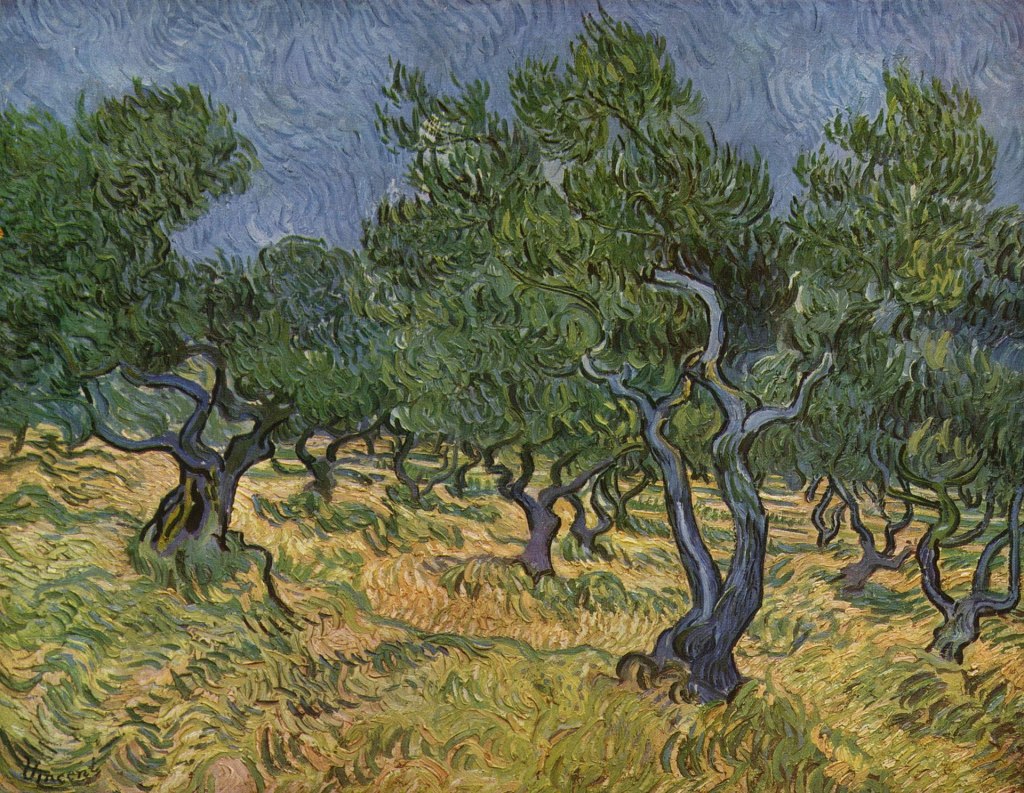
Olive Orchard mid-June 1889 Kröller-Müller Museum, Otterlo, Netherlands

The olive tree – olea europaea – is an evergreen tree growing to a height of 15m, and a life span of 1000 or even 2000 years! It is a native of the Mediterranean and surrounding areas and has been cultivated here since ancient times. It is grown for its fruit and for the oil that produces; the word oil itself derives from its name – oleum in Latin and elaia in Greek. Olive oil has many uses, for cooking, lighting, cleansing and medicinal purposes, for massage and for coating the bodies of athletes in Ancient Greece. It has long been used too for sacred purposes to annoying holy people and holy places. It symbolises abundance, prosperity and peace. Olive branches were given as tokens of benediction and victory, and wreathes of olives leaves crowned the victors. Olive oil is still used for anointing baptism candidates, priests and monarchs.

On the night he was betrayed, Jesus went out to the garden of Gethsemane in the Mount of Olives to pray. Then Jesus said, ‘Father, forgive them, for they know not what they are doing.’ Luke 23:34a

The three most powerful resources you have available to you: love, prayer and forgiveness. 

H Jackson Brown Jr

Lent Reflection

13th April 2022

https://en.wikipedia.org/wiki/Cercis_siliquastrum#/media/File:PikiWiki_Israel_3421_Geography_of_Israel.jpg

The Judas tree – cercis siliquastrum – is a small tree, growing up to 12m whose ranges extends from Southern Europe to Western Asia. It was common in Israel, and its French name ‘arbre de Judée‘,  may give rise to its English name. Other suggestions are that it is so named because Judas hung himself on  this tree. It bears bright pink blossoms in spring which appear before its leaves, which are heart shaped. In the autumn it produces flat seed pods – the seeds themselves are poisonous. The pods are said to resemble a weaver’s shuttle, which in Greek is ‘kerkis’ which gives rise to its botanical name.

Forgive our sins, as we forgive those who sin again us. And do not let us yield to temptation. 

Luke 11.4

For there to be betrayal, there would have to have been first trust. Suzanne Collins, Hunger Games