Counting on … day 114

22nd July 2025

During a vigil holding up the plight of the Palestinian people in the absence of any concern during the debates at this month’s Church of England synod, someone spoke of ‘wasting love’. This I take to mean being so generous with love that it is poured out liberally, abundantly, with careless abandon, with no regard as to whether it is either earned by the recipient or likely to repaid. In other words to be as generous as God who daily wastes love on us.

In the parable of the sower and the seed, the behaviour of the sower might be seen as wasteful but maybe it is actually generous, casting the seed everywhere because the sower doesn’t prejudge where it will take root. 

Third Sunday of Lent

23rd March 2023

Reflection with readings below

God does see the suffering that happens in the world and desires that it should not be so, that it should not continue. In the reading from Exodus, Moses is open to a relationship with God and understands God’s desire that the Israelites be brought out of the place where they are suffering and be released from the oppressive power of the Pharaoh. And Moses agrees to do what is necessary to effect this. 

God’s saving work did not stop with the rescue of the Israelites from Egypt, nor was Moses the last person willing to undertake  effect God’s will. Ensuring salvation is an ongoing task as in each generation we humans still fail to truly love one another; we still fail to share the Earth’s riches equitably; we still allow hate and envy and greed to distort relationships; we still fail to be open and receptive to the presence and wisdom of God. 

Last year I was invited to share in a Passover meal. The words we used came from The Legacies of Resistance: an Anti-Zionist Haggadah for a Liberation Seder, which refreshes the traditional words and thinking to reflect new theological understandings. When speaking of Egypt it used the Hebrew word ‘Mitzyrayim’ which translates literally as “a narrow place”. This is seen as “a metaphor for all

which is in opposition to life, justice, connection and sustainability.” Just as the  Passover celebrates how the people of God left Egypt – left the narrow place which confined and imprisoned them – so the Passover celebrates how we all, whether as individuals or as communities, can escape from those narrow places that confine and imprison us. 

Moses was open and receptive to seeking God, and willing to enter into a relationship with God. The psalmist too extols the virtues of seeking a close relationship with God. That is what we need to cultivate – indeed that is the enduring message that runs through the scriptures – if we are to escape the ‘narrow places’.

Today’s Gospel reading has an important message that our politicians should embrace! People who succumb to tragedy, whose lives involve suffering, are not more sinful and no less deserving of loving kindness – which is mercy – than anyone else. Rather says Jesus, those who are suffering, those whose lives do not seem to be flourishing, are all the more deserving of loving care so that they can live fruitful lives. People who are struggling because of disabilities, people who are struggling because of a lack of opportunities, people who are struggling because of because they are victims of an intolerant system, people who are struggling because they lack the physical necessities for daily life – they need to be given care and opportunities and the necessary wherewithal so that they can thrive as children of God. And those who have in abundance should be willing to give to those who do not – whether through self motivated generosity or through a just taxation system. 

We should not be creating systems that constrict and trap people in ‘narrow places’ whether that is in within social and economic systems of the UK or globally.  We need both in just and effective systems that provide aid and development for those who are in need. We need just and effective systems that enable trade and finance to flourish for the equal benefit of all we need just and effective systems that establish and enforce international agreements, ending war and conflict. We also need a culture in which we all act out of generosity, with love and empathy and compassion.  

We must, to quote Micah, “act justly and to love mercy and to walk humbly with God.”

Exodus 3:1-15

Moses was keeping the flock of his father-in-law Jethro, the priest of Midian; he led his flock beyond the wilderness, and came to Horeb, the mountain of God. There the angel of the Lord appeared to him in a flame of fire out of a bush; he looked, and the bush was blazing, yet it was not consumed. Then Moses said, “I must turn aside and look at this great sight, and see why the bush is not burned up.” When the Lord saw that he had turned aside to see, God called to him out of the bush, “Moses, Moses!” And he said, “Here I am.” Then he said, “Come no closer! Remove the sandals from your feet, for the place on which you are standing is holy ground.” He said further, “I am the God of your father, the God of Abraham, the God of Isaac, and the God of Jacob.” And Moses hid his face, for he was afraid to look at God.

Then the Lord said, “I have observed the misery of my people who are in Egypt; I have heard their cry on account of their taskmasters. Indeed, I know their sufferings, and I have come down to deliver them from the Egyptians, and to bring them up out of that land to a good and broad land, a land flowing with milk and honey, to the country of the Canaanites, the Hittites, the Amorites, the Perizzites, the Hivites, and the Jebusites. The cry of the Israelites has now come to me; I have also seen how the Egyptians oppress them. So come, I will send you to Pharaoh to bring my people, the Israelites, out of Egypt.” But Moses said to God, “Who am I that I should go to Pharaoh, and bring the Israelites out of Egypt?” He said, “I will be with you; and this shall be the sign for you that it is I who sent you: when you have brought the people out of Egypt, you shall worship God on this mountain.”

But Moses said to God, “If I come to the Israelites and say to them, ‘The God of your ancestors has sent me to you,’ and they ask me, ‘What is his name?’ what shall I say to them?” God said to Moses, “I am who I am.” He said further, “Thus you shall say to the Israelites, ‘I am has sent me to you.’” God also said to Moses, “Thus you shall say to the Israelites, ‘The Lord, the God of your ancestors, the God of Abraham, the God of Isaac, and the God of Jacob, has sent me to you’:

This is my name forever, and this my title for all generations.”

Psalm 63:1-8

1 O God, you are my God; eagerly I seek you; *
my soul thirsts for you, my flesh faints for you,
as in a barren and dry land where there is no water.

2 Therefore I have gazed upon you in your holy place, *
that I might behold your power and your glory.

3 For your loving-kindness is better than life itself; *
my lips shall give you praise.

4 So will I bless you as long as I live *
and lift up my hands in your Name.

5 My soul is content, as with marrow and fatness, *
and my mouth praises you with joyful lips,

6 When I remember you upon my bed, *
and meditate on you in the night watches.

7 For you have been my helper, *
and under the shadow of your wings I will rejoice.

8 My soul clings to you; *
your right hand holds me fast.

1 Corinthians 10:1-13

I do not want you to be unaware, brothers and sisters, that our ancestors were all under the cloud, and all passed through the sea, and all were baptised into Moses in the cloud and in the sea, and all ate the same spiritual food, and all drank the same spiritual drink. For they drank from the spiritual rock that followed them, and the rock was Christ. Nevertheless, God was not pleased with most of them, and they were struck down in the wilderness.

Now these things occurred as examples for us, so that we might not desire evil as they did. Do not become idolaters as some of them did; as it is written, “The people sat down to eat and drink, and they rose up to play.” We must not indulge in sexual immorality as some of them did, and twenty-three thousand fell in a single day. We must not put Christ to the test, as some of them did, and were destroyed by serpents. And do not complain as some of them did, and were destroyed by the destroyer. These things happened to them to serve as an example, and they were written down to instruct us, on whom the ends of the ages have come. So if you think you are standing, watch out that you do not fall. No testing has overtaken you that is not common to everyone. God is faithful, and he will not let you be tested beyond your strength, but with the testing he will also provide the way out so that you may be able to endure it.

Luke 13:1-9

At that very time there were some present who told Jesus about the Galileans whose blood Pilate had mingled with their sacrifices. He asked them, “Do you think that because these Galileans suffered in this way they were worse sinners than all other Galileans? No, I tell you; but unless you repent, you will all perish as they did. Or those eighteen who were killed when the tower of Siloam fell on them–do you think that they were worse offenders than all the others living in Jerusalem? No, I tell you; but unless you repent, you will all perish just as they did.”

Then he told this parable: “A man had a fig tree planted in his vineyard; and he came looking for fruit on it and found none. So he said to the gardener, ‘See here! For three years I have come looking for fruit on this fig tree, and still I find none. Cut it down! Why should it be wasting the soil?’ He replied, ‘Sir, let it alone for one more year, until I dig around it and put manure on it. If it bears fruit next year, well and good; but if not, you can cut it down.'”

2nd Sunday before Lent

Could we withstand seven years with no harvests? 

The UK imports 60% of its food – and amazingly if viewed by sector we import 45% of our vegetables and 83% of our fruit! As many of the countries from whom we import fruit and vegetables are prone to the adverse effects of climate change, food security for us as a nation is a concern. And for us as part of a global population, the adverse impacts of climate change of food security for many vulnerable communities should be an even greater concern.

What about our food security as individual households? Unlike in the past, many of us do not bottle, dry or otherwise preserve food to see us through the rest of the year. Nor do we tend to stock large quantities of staples such as flour, oats and rice.  If they were a snow storm or flood such that the shops were closed for even a week, would we have enough food in our homes? 

God has created a world which is constantly producing edible plants, fruits and seeds which serve to feed all manner of fauna including humans. Our love for God should be expressed in the grateful caring and sharing of this harvest – and that surely includes safeguarding the soil and the climate upon which the plants depend, and ensuring that throughout the seasons and during times of sufficiency and insufficiency, that food is fairly shared.

Jesus is quite clear in his teachings that love is not something that we reserve just for ourselves and our nearest and dearest. Echoing the challenge of last Sunday’s readings about the blessings of feeding the hungry rather than the woes of stashing away private wealth, today’s gospel tells us to love our enemies. To do good to those who hate and abuse us. To give without expecting anything in return – and in fact to give in an outrageously extravagant manner, giving more than is asked. 

This may seem counter-intuitive to those of us who brought up to look after ourselves, to be self-sufficient, to safely garner wealth so that we won’t be needy. It is hard to give generously if we feel we can not trust that our own future needs will be met – and for me the fear is that even if I am generous, the financial institutions are not and will persist with their greater power to hoard more and more of the world’s wealth. But is that a self fulfilling approach that does not allow us to try the alternative of being truly generous now so that everyone can have enough – the poor as well as the rich, the bad as well as the good? 

Each time we say the Lord’s Prayer we say ‘Your kingdom come, your will be done.’ God’s kingdom is surely the one where everyone shares generously what they have been given, so that all may have enough regardless of their merits? How do we get to that situation? 

What will change global systems so that those with power and wealth can’t get and take more and more?

What will change global systems so that the needs of the poor and vulnerable are met? So that everyone can get enough food, live in a safe comfortable home, have access to education, employment and health care, have quality leisure time with access to green spaces and community events?

What will change global systems so that all nations and communities are treated with respect?

What will change global systems so that justice and peace prevail, so that we all cooperate for the common good?

Can we as Christians, who know we are weak and compromised, act upon Jesus’s instruction and be overwhelmingly generous with what we have to share? Can we respond to the words of the prayer he taught us and work to change systems – at what ever level: family/local/ community/ national – to enable God’s kingdom, God’s reign to prevail?

Genesis 45:3-11, 15

Joseph said to his brothers, “I am Joseph. Is my father still alive?” But his brothers could not answer him, so dismayed were they at his presence.

Then Joseph said to his brothers, “Come closer to me.” And they came closer. He said, “I am your brother, Joseph, whom you sold into Egypt. And now do not be distressed, or angry with yourselves, because you sold me here; for God sent me before you to preserve life. For the famine has been in the land these two years; and there are five more years in which there will be neither plowing nor harvest. God sent me before you to preserve for you a remnant on earth, and to keep alive for you many survivors. So it was not you who sent me here, but God; he has made me a father to Pharaoh, and lord of all his house and ruler over all the land of Egypt. Hurry and go up to my father and say to him, ‘Thus says your son Joseph, God has made me lord of all Egypt; come down to me, do not delay. You shall settle in the land of Goshen, and you shall be near me, you and your children and your children’s children, as well as your flocks, your herds, and all that you have. I will provide for you there–since there are five more years of famine to come–so that you and your household, and all that you have, will not come to poverty.'”

And he kissed all his brothers and wept upon them; and after that his brothers talked with him. 

Psalm 37:1-12, 41-42

1 Do not fret yourself because of evildoers; *
do not be jealous of those who do wrong.

2 For they shall soon wither like the grass, *
and like the green grass fade away.

3 Put your trust in the Lord and do good; *
dwell in the land and feed on its riches.

4 Take delight in the Lord, *
and he shall give you your heart’s desire.

5 Commit your way to the Lord and put your trust in him, *
and he will bring it to pass.

6 He will make your righteousness as clear as the light *
and your just dealing as the noonday.

7 Be still before the Lord *
and wait patiently for him.

8 Do not fret yourself over the one who prospers, *
the one who succeeds in evil schemes.

9 Refrain from anger, leave rage alone; *
do not fret yourself; it leads only to evil.

10 For evildoers shall be cut off, *
but those who wait upon the Lord shall possess the land.

11 In a little while the wicked shall be no more; *
you shall search out their place, but they will not be there.

12 But the lowly shall possess the land; *
they will delight in abundance of peace.

41 But the deliverance of the righteous comes from the Lord; *
he is their stronghold in time of trouble.

42 The Lord will help them and rescue them; *
he will rescue them from the wicked and deliver them,
because they seek refuge in him. 

1 Corinthians 15:35-38,42-50

Someone will ask, “How are the dead raised? With what kind of body do they come?” Fool! What you sow does not come to life unless it dies. And as for what you sow, you do not sow the body that is to be, but a bare seed, perhaps of wheat or of some other grain. But God gives it a body as he has chosen, and to each kind of seed its own body.

So it is with the resurrection of the dead. What is sown is perishable, what is raised is imperishable. It is sown in dishonour, it is raised in glory. It is sown in weakness, it is raised in power. It is sown a physical body, it is raised a spiritual body. If there is a physical body, there is also a spiritual body. Thus it is written, “The first man, Adam, became a living being”; the last Adam became a life-giving spirit. But it is not the spiritual that is first, but the physical, and then the spiritual. The first man was from the earth, a man of dust; the second man is from heaven. As was the man of dust, so are those who are of the dust; and as is the man of heaven, so are those who are of heaven. Just as we have borne the image of the man of dust, we will also bear the image of the man of heaven.

What I am saying, brothers and sisters, is this: flesh and blood cannot inherit the kingdom of God, nor does the perishable inherit the imperishable.

Luke 6:27-38

Jesus said, “I say to you that listen, Love your enemies, do good to those who hate you, bless those who curse you, pray for those who abuse you. If anyone strikes you on the cheek, offer the other also; and from anyone who takes away your coat do not withhold even your shirt. Give to everyone who begs from you; and if anyone takes away your goods, do not ask for them again. Do to others as you would have them do to you.

“If you love those who love you, what credit is that to you? For even sinners love those who love them. If you do good to those who do good to you, what credit is that to you? For even sinners do the same. If you lend to those from whom you hope to receive, what credit is that to you? Even sinners lend to sinners, to receive as much again. But love your enemies, do good, and lend, expecting nothing in return. Your reward will be great, and you will be children of the Most High; for he is kind to the ungrateful and the wicked. Be merciful, just as your Father is merciful.

“Do not judge, and you will not be judged; do not condemn, and you will not be condemned. Forgive, and you will be forgiven; give, and it will be given to you. A good measure, pressed down, shaken together, running over, will be put into your lap; for the measure you give will be the measure you get back.”

Advent 21

December 2022

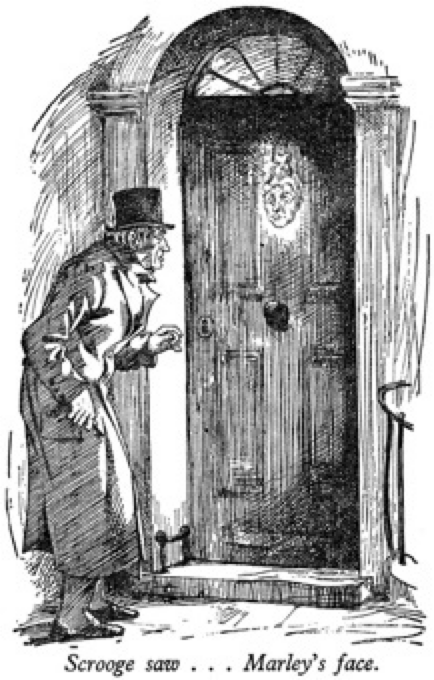
An illustration from A Christmas Carol. Scrooge, about to unlock his front door, is confronted with the image of his deceased partner. This visionary experience continues during the night when he is visited by the spirits of Christmas past, present and yet-to-come, that challenge Scrooge to reconsider how he will celebrate Christmas and how he will relate to his fellow neighbours. Think back over your past celebrations of Christmas. Are there things that stand out is being particularly enjoyable, things that made Christmas special for you or for someone else, things that reflected the love and generosity of God? Are there things you could replicate so that your Christmas celebration reflects that love and generosity of God?

But the father said to his slaves, ‘Quickly bring out the best robe and put it on him, and put a ring on his hand and sandals on his feet; and bring the fattened calf, kill it, and let us eat and celebrate; for this son of mine was dead and has come to life again; he was lost and has been found.’ And they began to celebrate. Luke 15:22-24

Do not be conformed to this world, but be transformed by the renewing of your minds, so that you may discern what is the will of God—what is good and acceptable and perfect. Romans 12:2