Stuff and sustainability

What does sustainability look like in daily life? I thought I would share my experiences.

Previous pages have looked at the use of heating and energy, food and travel for which it is generally easier to calculate one’s carbon footprint and assess the sustainability of alternative choices. Today I am going to reflect on the none food things I buy such as books, clothes, things for the house and garden. These all have a carbon footprint and have more or less sustainable credentials. Here are some of the ways I try to ensure that I use stuff sustainably.

*Not acquiring things that I don’t actually need. It is surprising how often we are tempted  – or encouraged by advertising – to buy things we don’t need. Do I really need it? Do I need to buy it now or could I wait and see if I still need it at a later date? Have I got something similar that will fulfil the same purpose?

* Research – find out what choices are available: which product is most sustainably, how long it will last and, if electrical, its energy efficiency. The internet is useful, as is Ethical Consumer which has both a web site and a magazine. When we needed a new printer, we bought a more expensive Epson model that instead of using disposable cartridges (which hardly last any time at all) has an economical  refill system  – and 8 months later we have yet to need to refill these. 

  • Buying second hand – or more endearingly, preloved – items allows existing resources to be reused  rather than consuming even more fresh resources. I buy clothes and books from charity shops with the plus of funding a worthwhile cause. Sometimes I can also find household items here too – such as a saucepan or a pestle and mortar – but then I do have to be patient as what a charity shop stocks is not predictable! I bought my mobile phone and iPad from Music Magpie – an online second hand site.  When I need a particular book I try web sites such as World of Books and Oxfam – I avoid Abe Books and The Book Depositary being subsidiaries of Amazon. If I buy new books, I use our local independent book shop. 

* Repairing rather than replacing. When something breaks, see if it can be repaired – either at home or via a specialist. Years ago, I bought a Globe Trotter suitcase because of their reputation for quality. When the handle broke, I was able to take it back and have a new one fitted. I frequently darn socks and T shirts, patch up tears, glue broken items in the kitchen, mend punctured tyres, takes shoes to the cobbler,  and buy spare parts from the manufacturer.

  • Up cycling – sometimes rather than buying, I can make what I need from something I already have. Eg pillow cases from worn sheets, plant pots from have cartons, a seed sprouted from a jam jar and a piece of muslin. Old inner tubes become garden ties, and shoe laces are reused as string. Old trousers become shorts, and trouser legs bags for root vegetables.
  • Making do with – enjoying! – what I have: I could buy a food processor but instead I use the knife and the ballon whisk I already have. We have an old kettle whose automatic switch no longer works but since the rest functions, we continue to use it. 

* Lending and borrowing: do I need to buy something if I am only  go to use it occasionally? As well as libraries for books and videos, there are libraries for things. I prefer to rent skis  knowing that they are going to be well used, as opposed to buying skis that would become obsolescent before they wore out.

* If I can, I look for options that will make a positive contribution to someone else: eg choosing a fair trade or organic option, supporting a local producer, buying from a B corp.

  • Packaging – I often make choices dependant on packaging, choosing not to buy something because it comes wrapt in plastic. For example buying a pencil I might choice the pencils sold loose over those pre-packed in plastic.
  • I prefer to spend money on doing rather than having: going to a cafe for a coffee and a cake rather than buying a magazine, going to the theatre rather than buying clothes, buying membership for a nature reserve (eg The Wetlands Centre) rather than cosmetics.

 Counting on ….day 234

5th July 2022

Having to think before we discard or throw something away is a good thing. Maybe what we are discarding could be repaired, or reused or at the very least be recycled. Maybe it was surplus to needs and now we know not to get it future. Maybe it is the packaging that is superfluous and next time we can find a different supply that comes with zero waste.

 Counting on …day 190

22nd May 2022

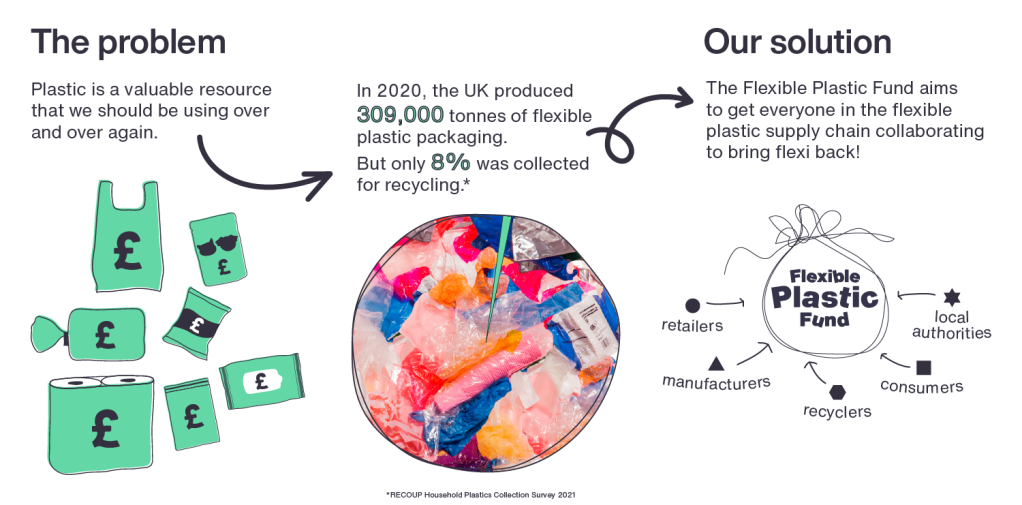
This month saw the launch of FlexCollect, a 3 year trial project in which  flexible – soft/ scrunchable – plastic will be part of the kerbside recycling collection  made by local authorities. The first council taking part will be Cheltenham Borough Council.

https://flexibleplasticfund.org.uk/

For more articles about recycling  see https://greentau.org/tag/recycling/

Counting on …day 189 

21st May 2022

HDPE and LDPE are widely used for packaging – plastic bags and wrappers, margarine cartons and milk containers  – and both can be recycled. As with PET bottles closed loop recycling is possible but more often these plastics are recycled into none food items such as pipes, plastic ‘wood’ for outdoor furniture,  recycling bins and rubbish bags. Clearly it would be better for the environment if all recycling were closed loop recycling as this is the best way of eliminating the use of oil to make virgin plastic. 

Again ask companies whether they use recycled plastics and of not, what not. 

NB the recycling of plastics is made much easier of the plastic is washed/ cleaned before it is put in the  recycling bin. Dirty plastic can contaminate a whole batch sent for recycling .

Counting on …day 187

19th May 2022

If only 44% of plastic packaging waste is recycled, what happens to the other 56%? 

Some will litter the streets and pavements, before being blown into hedgerows and trees, into waterways and out to sea. There it will break down into smaller and smaller bits until it is small enough to count as micro plastic (less than 5mm in length). Micro plastics have been found in the ice at both north and south Poles. They have infiltrated the food chain. They have even crossed the placenta from the mother to the foetus. 

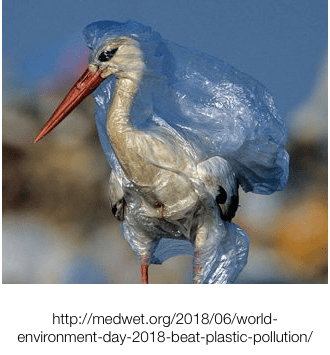
Some of this litter will be eaten by animals and birds almost certainly causing premature death. Some will go via domestic dustbins,  public waste bins and commercial waste bins, into either landfill where again it will break down over time into micro plastic particles, or it will be burnt in an incinerator further adding to air pollution. 

Want to recycle ‘hard to recycle’ plastics? Here is a partial solution – https://greentau.org/2022/04/13/counting-on-day-150/

 Counting on …day 184

16th May 2022

Most plastics can now be recycled especially as much plastic packaging is what is known as ‘soft plastic’. Soft plastics can be recycled at various supermarkets including the Coop and Amazon Fresh. To check what counts as soft plastic, the Coop has a good listing- https://www.coop.co.uk/environment/soft-plastics/packaging-list

Want to know what happens to the plastic that goes into the recycling bin? https://greentau.org/2022/02/10/green-tau-issue-33/

Counting on …day 183 

15th May 2022

An update from DEFRA reported that only 44% of the 2.5m tonnes of plastic packaging waste produced in 2021 was recovered for recycling. This compares with 73.6% for glass. (https://www.gov.uk/government/statistics/uk-waste-data/uk-statistics-on-waste )Plastic can seem harder to recycle because it comes in so many different categories each with its own recycling protocol. Greenpeace’s plastic survey – The Big Plastic Count – which starts tomorrow will collect data that can be used to ease/ resolve this problem. https://thebigplasticcount.com/

 Counting on …day 150

13th April 2022

We have just invested in a Rework recycling box for all our otherwise un-recyclable plastic. We will continue to use our kerb side recycling bin for plastic pots and bottles, the soft plastic recycling facility at the Coop, toothpaste tubes at Boots, but this box will be for all the other plastics we cannot otherwise recycle. We can even use it for lateral flow test kits. It should reduce our landfill to nil. 

 Counting on ….day 124

16th March 2022

Recently I have inquired of a number of producers whether their plastic packaging uses recycled plastic. The response has been mixed, but two commented that part of the issue was a lack of recycled plastic. According to Recycling Today  ‘The collection rate for plastics packaging recycled from April 2019 to March 2020 is 59 percent for bottles; 33 percent for pots, tubs and trays, 7 percent for film and 39 percent for all household plastic packaging’. https://www.recyclingtoday.com/article/recoup-plastic-recycling-rate-april-2019-march-2020/

This highlights the importance of ensuring waste materials are recycled and not jettisoned to land fill/ incineration. It also highlights the importance of cutting back on the amount of plastic we use. 

Counting on …day 106 

26th February 2022

Slowly we are seeing more products being made of recycled materials. Brabantia is one such producer. Their StepUp Pedal Bins are made from 91% recycled plastic consumer waste from Dutch households. The bins are also 99% recyclable. The Cradle-to-Cradle Products Innovation Institute assesses products on material quality, material reuse, the use of renewable energy and CO2 management, water management and fairness, and has awarded these bins a silver accreditation. 

They are on sale in our local hardware shop – however only buy one if you need it. It is more ecological to stick with the bin you have.