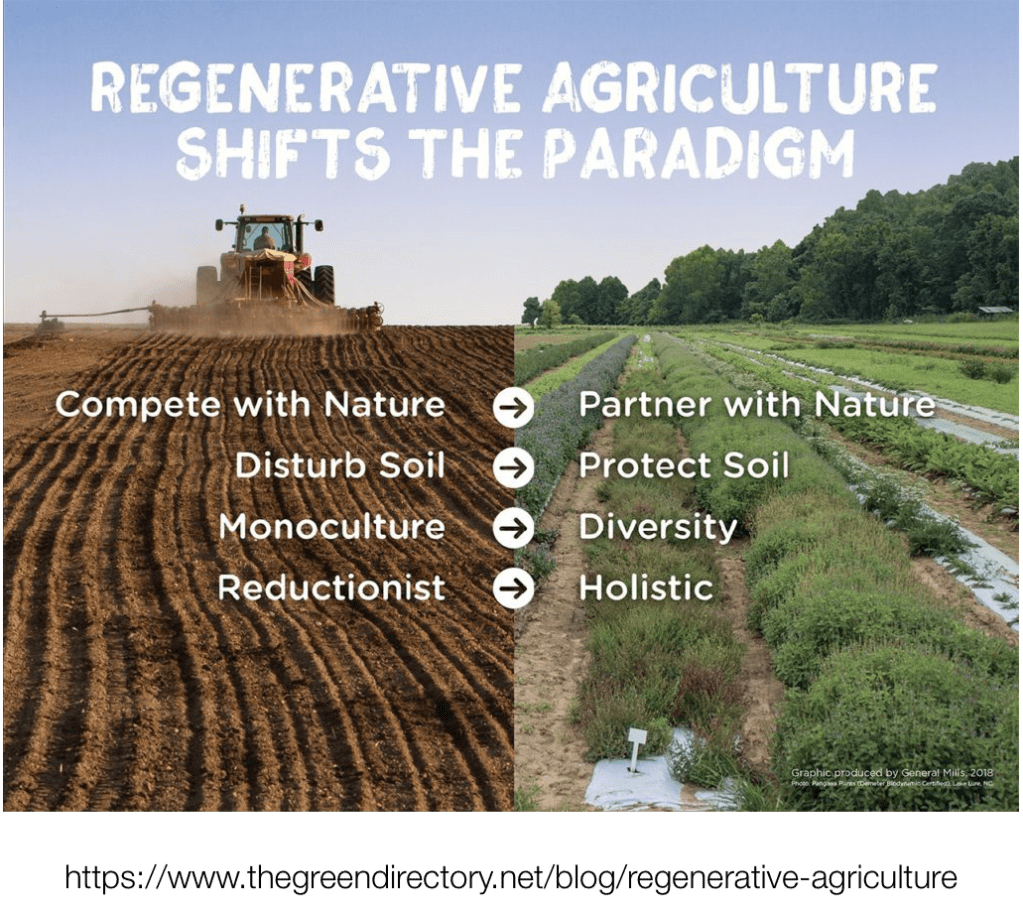
Regenerative farming is one way in which carbon dioxide levels can be reduced. Regenerative farming aims both to increase the amount of carbon stored in the soil and the plants it sustains, and by lowering livestock numbers, reducing emissions. Livestock account for about 14% of greenhouse gas emissions.
The World Economic Forum advocates for regenerative farming as “an agricultural technique that essentially focuses on the health of the soil more than other types of agriculture tend to do. Obviously, soil is effectively the base of any farm, and surprisingly, it can sequester quite a bit of our planet’s CO2. Therefore, treating it organically, with natural products and less human disturbance, is key.” (1)
Scottish based Farming For a Better Climate describes regenerative farming as “an approach centred around improving and revitalising soil health. The group are focusing their work around the following principles:
Minimise soil disturbance – help support a healthy soil food web.
Maximise crop diversity – different crops bring different rooting depths and attributes,
supporting a range of biodiversity both above and below ground.
Provide constant soil cover – protect soils from wind and water erosion; reduces water loss.
Keep a living root in the system – root exudates benefit microbial populations, supporting soil health.
Integration of livestock – promoting species diversity from microbes to mammals and putting dung back into the system.” (2)
A report produced by the World Economic Forum in 2022 found “that if just an additional 20% of farmers adopted climate-smart , by 2030, the EU could reduce its annual agricultural GHG emissions by 6% and improve soil health over an area equivalent to 14% of EU’s agricultural land while improving livelihoods by between €1.9 €9.£ billion annually.” (3)
And not just in Europe.
“By 2040, through just a 50% adoption of regenerative agriculture across Africa, farmers could see:
30% reduction in soil erosion
Up to a 60% increase in water infiltration rates
24% increase in nitrogen content
20% increase in carbon content, or higher depending on the intervention – and not just topsoil (this is huge as soil is the second biggest storehouse of carbon, after oceans). The benefits are even greater when shrubs and grasses are promoted through agroforestry.”
The annual State of Nature report was issued 27th September, revealing that 1 in 6 species in the UK is threatened with extinction. On average the abundance of land and freshwater species in England has declined by 32% since 1970.
The National Biodiversity network noted: “The State of Nature report also found that out of the assessed habitats which are important for wildlife, only one in seven (14%) were found to be in a good condition and only one in fourteen (7%) woodlands and a quarter (25%) of peatlands were assessed to be in a good ecological state. Due to habitat damage from fishing gear, none of the seafloor around the UK was found in good condition…Despite recent moves towards more nature-friendly land and sea use, as yet only a fifth of farmland is now in agri-environment schemes with only some of that helping nature, just 44% of woodland is certified as sustainably managed and only half of fish stocks are sustainably harvested. While all three measures have improved markedly over the past 20 years, there is still a very long way to go.” (1)
Beccy Speight, the RSPB’s chief executive, said: “The UK’s wildlife is better studied than in any other country in the world and what the data tells us should make us sit up and listen. What is clear is that progress to protect our species and habitats has not been sufficient and yet we know we urgently need to restore nature to tackle the climate crisis and build resilience.
“We know that conservation works and how to restore ecosystems and save species. We need to move far faster as a society towards nature-friendly land and sea use, otherwise the UK’s nature and wider environment will continue to decline and degrade, with huge implications for our own way of life. It’s only through working together that we can help nature recover.” (2)
The Soil Association’s head of Farming Policy Gareth Morgan yesterday said: “It is deeply concerning to see this detailed report on the state of nature in the UK but sadly it does not come as a huge shock. Farmland makes up 70% of Britain and we can’t fix the decline in nature without a transformation in food and farming. Many farmers are working with nature and many more are keen to do so. But we remain too dependent on over-intensive, chemical-reliant methods such as industrial livestock systems fed on imported soy. The evidence shows some success for recovery in small protected areas but we cannot ignore what happens in the rest of our countryside where we need a renewed focus on producing good food in harmony with nature.” (3)
Just as switching from fossil fuels to renewable energy sources will be key to achieving net zero for carbon emissions, so it would seem that switching from what might be termed industrial farming to regenerative farming will be key to achieving the restoration of nature.
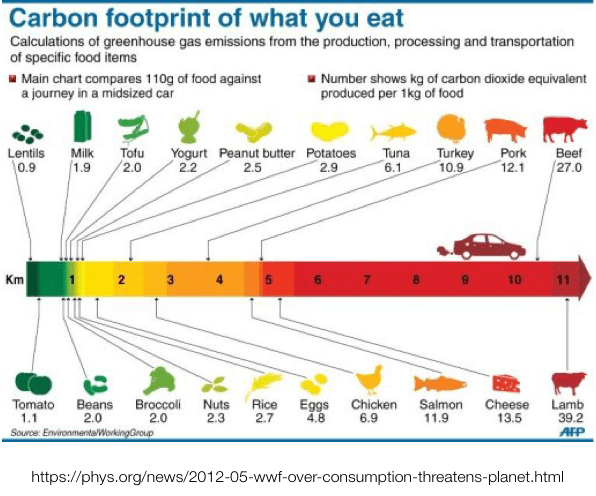
Particularly relating to food, you might choose to reduce – or cut out completely – animal products from your diet. You might choose to only what is in season to avoid importing food over long distances. https://greentau.org/2021/08/14/green-tau-issue-12/
You might support charities such as Practical Action that help poorer farmers change their practices to adapt to the new and more extreme climates – https://practicalaction.org/
3. Paying a fair price for the food we eat. You might buy direct from a farm or a group of farms, or via a local vegetable box scheme. You might support a local farmers’ market. You might buy from a local independent green grocer. Similarly you might buy milk etc from a milk round where the price reflects the cost to the farmer. For cheeses, look to buy from small scale producers via a local cheese shop. And again buying fair trade options for imported foods can help ensure a fair price for the producer. Alternatively look out for products – coffee beans and chocolate in particularly – that have been sourced directly from the grower. These are often available through local independent shops and cafés.
Another option would be to subscribe to the OddBox fruit and veg scheme which buys food stuffs that would otherwise go to waste because they are misshapen, because the supermarket doesn’t want the crop, or because the crop has been too large or too small for the supermarket buyer – https://www.oddbox.co.uk/
4. Buying from local producers and local retailers helps to improve local supply chains.
5. Again the best approach to improving global food security and ensuring there is enough food for everyone is to reduce – or cut out completely – animal products.

 The Green Tau