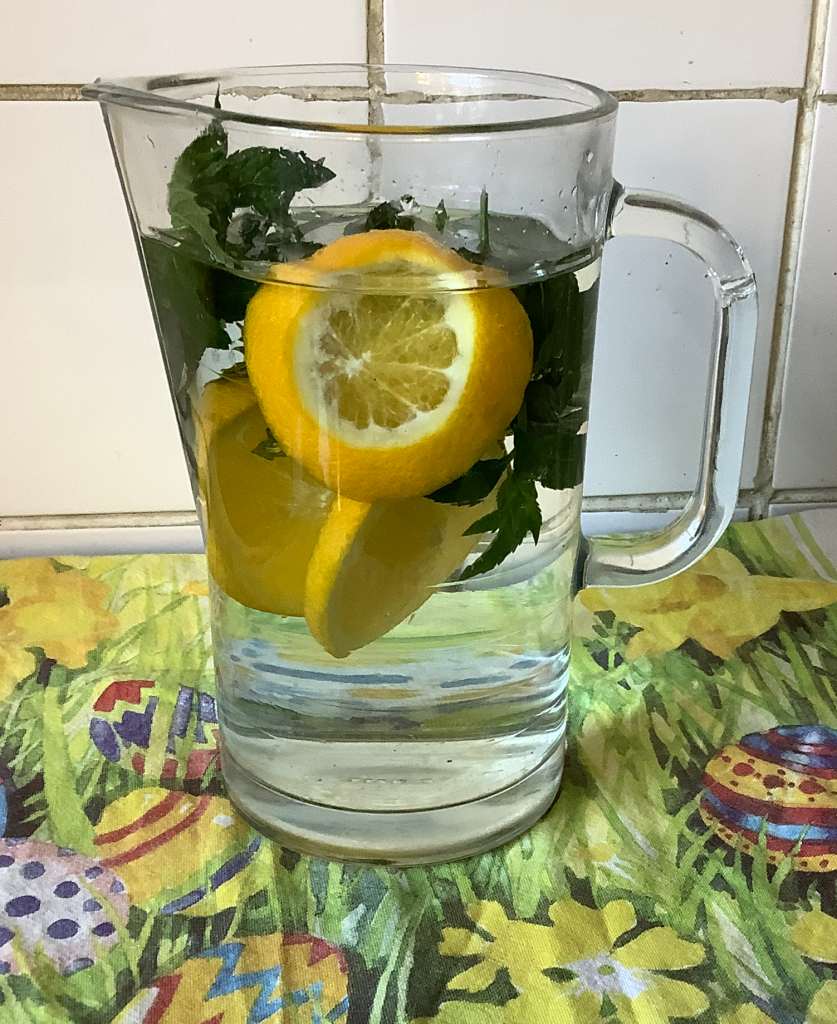
You see it in some cafés – for a cool drink, fill a jug with water and add strips of cucumber/ slices of lemon or orange/ sprigs of mint/ slices of root ginger/ even melon rinds. Keep the jug in the fridge – it will stand a few refills before the additions loose their flavour. (No sugar, and no bottles to recycle).
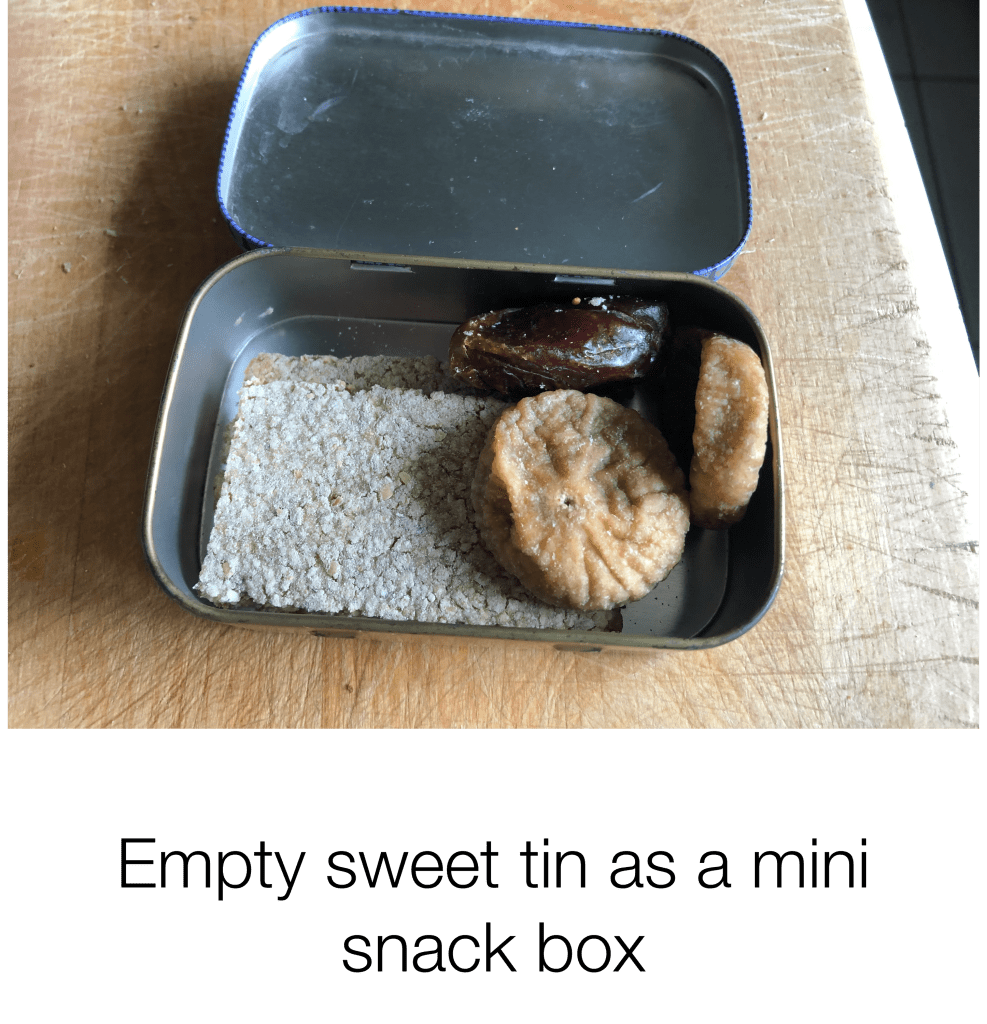
Small plastic packets for crisps and individually wrapped biscuits, sweets and ice creams and many other snacks proliferate and can often be seen as wind blown litter. Why not use the impetus of Plastic Free July to make a break and stop buying these products. Look for chocolate bars wrapped in paper and freshly served ice creams in cones. Prepare snacks in advance putting dried fruits and biscuits into reusable containers. Take a banana – they come with inbuilt packaging!
What does sustainability look like in daily life? I thought I would share our (that’s me and my husband) experiences. What we cook and eat and where we shop, has been shaped by three principles.
L is for local: locally produced food, which can include things grown or produced in one’s immediate locality and things where local can mean the UK rather than abroad. For example in East Sheen we can buy honey that comes from Richmond Park. We can buy coffee beans roasted across the river in Chiswick. We can have breakfast in Putney enjoying porridge or eggs Benedict made on the premises. We can choose to buy strawberries from Kent as opposed to imported from Spain. Equally we can eat strawberries grown in our back garden. We buy beans and pulses, seeds and grains such as quinoa, from Hodmedod whose produce is all UK grown.
O is for organic: organic food has a less damaging impact on the planet than non organic food. Indeed it’s effect can be positive, with soils improved with vegetable matter rather than being stripped of its micro-organisms by fertilisers, with pollinators encouraged rather than being killed by pesticides, with livestock well cared for rather than being routinely treated with antibiotic prophylactics. We buy organically grown oats, and flour that comes from farms in Cambridgeshire and which is milled in a windmill!
A is for animal friendly: animals that live as near a natural life as possible (often organically raised). If we buy eggs for my husband we opt for free range, organic ones (although at the moment no eggs are free range owing to restrictions around bird flu). At Christmas the festive bird for my husband is a cockerel that has enjoyed a whole year of life unlike most of chicken meat which comes from birds that live may be 6 – 8 weeks (up to 12 for organically raised birds).
F is for fairly traded: the Fair Trade mark is well known as measure where production has guaranteed a price above the market minimum, where the work force receive fair wages and where provision is made for services such as schooling and health care. We buy fair trade bananas, chocolate and tea which are now widely available. We buy coffee beans that have been ethically sourced from small scale producers who grow top quality beans, appreciating that the higher cost reflects their value.
2. Secondly we avoid excess and plastic packaging, a habit we learnt through a zero waste experiment. We buy dried fruit and nuts, and dry goods such as rice, baking powder and bicarbonate of soda, spices, sugar, cocoa, millet and polenta from local refill stores where goods are dispensed into paper bags – often ones we have brought to reuse. We also buy refills of olive oil, soy sauce, maple syrup, tahini and peanut butter, taking our own jars and bottles to refill. Milk – both oat and dairy – comes in reused glass bottles on the milk round. Since we cook meals from scratch we avoid lots of single use plastic boxes. Likewise making our own cakes and biscuits reduces the amount of waste we generate. Jam jars are reused when we make jam, marmalade and chutneys and when we bottle summer fruits. Deliveries from Hodmedod come in paper or compostable bags, flour and oats come in bulk in paper sacks.
3. Thirdly we seek to reduce the carbon footprint of what we eat. Most meals are vegan – Paul enjoys cheese in his sandwiches and dairy milk on his cereal. A vegan diet can save in the region 400 and 900 kgCO2 a year. Even with a vegan diet there are ways of being more or less carbon efficient. By choosing locally produced food, food that is in season and cutting back on food waste (other vegetable leaves, tea bags and coffee grounds all go into the compost bin whilst apple cores go to make cider vinegar) we aim to minimise our carbon footprint. We have a weekly fruit and vegetable delivery from OddBox which collects fruit and vegetables from farmers and suppliers that would otherwise go to waste – because supermarket demand has dropped, crops have been larger (or sometimes smaller) than expected), crops have ripened too quickly/ slowly, or items are too small/ big/ misshapen for general sale. OddBox by preventing food from going to waste, saves some 11,000 tonnes of CO2 a year.
Zero Waste is the idea that nothing should end up as land fill, in an incinerator or being washed out to sea/ caught in a tree/ blown onto a mountain top as rubbish. Whatever is left after we have consumed something should be recyclable so that nothing is wasted. Zero waste means not buying/ consuming more than you need. Zero waste means cradle-to-cradle or closed loop design of all we consume.
Why is waste an issue?
Waste that we throw away has to be disposed of. Historically waste was buried in midden heaps or burnt on the household fire or thrown onto the street or into a nearby river. The amount of waste was generally small enough that this was not impractical. As towns grew and as the amount of things people could acquire and casually discard grew, so waste became a problem. As long as amongst the waste there were things that could be recycled for financial gain, there were people who would take on the waste problem. In the 18th century urban areas had business known as ‘dust yards’ where rubbish was collected and sorted to,extract what could be resold – bones for knife handles and glue, coal ash for bricks etc. When waste became a potential health hazard, the authorities intervened. In 1846 the Nuisance Removal and Disease Prevention Act set up the first regulatory waste management system operate by municipal boards. The Public Health Act of 1875 required all householders to put their rubbish in bins for weekly collection.
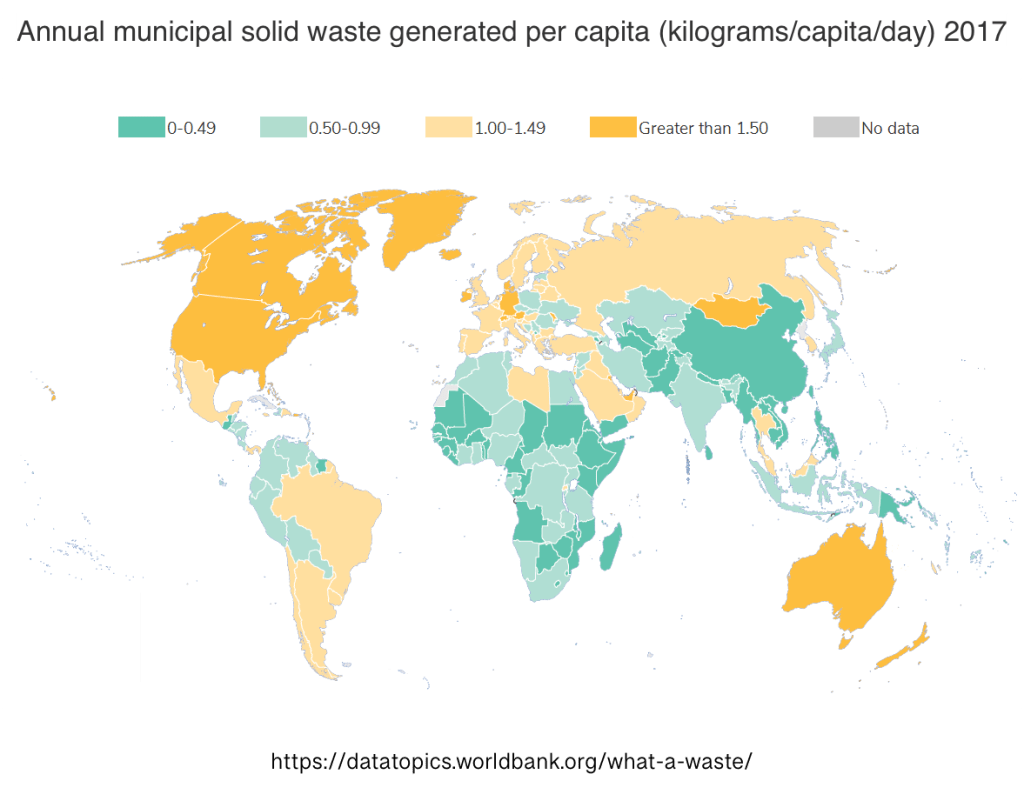
Having a system for taking waste away doesn’t reduce the amount of waste produced. The amount of waste we produced has grown exponentially. Globally (circa2016) we produce 2.01 billion tonnes of municipal waste a year (ie waste from households, shops and small businesses collected by local authorities – as opposed to waste generated on an industrial scale such as in mining, farming , manufacturing). The average of 0.74 kg per per person per day masks a range from 0.11kg to 4.55kg. Typically it is the less developed countries that generate least waste whilst it is nations such as Denmark, the USA, New Zealand, the most. Here in the UK we averaged 392kg (2017) down from 425kg in 2010. As more countries become increasingly developed/ westernised, the World Bank estimates that average per capita waste will increase to 3.4kg per day by 2050 – a projected annual total of 3.4 billion tonnes.
Waste and its disposal can cause various pollution and health concerns. Uncollected waste can be a source of infection. It can attract vermin and scavengers that may further transmit infections. It can block drains and water ways causing flooding. It can produce chemicals that pollute water supplies. It can create unpleasant odours as well dangerous gases that irritate and damage lungs or that can enter the blood steam and cause further forms of ill health. It can be blown across land, lodging in trees and branches where it may injure wildlife as well domesticated animals (n Richmond Park deer die each year from eating rubbish). It can end up in the middle of oceans or on remote mountain tops. It may end up as waste polluting the seas – this is especially true of discarded marine nets.
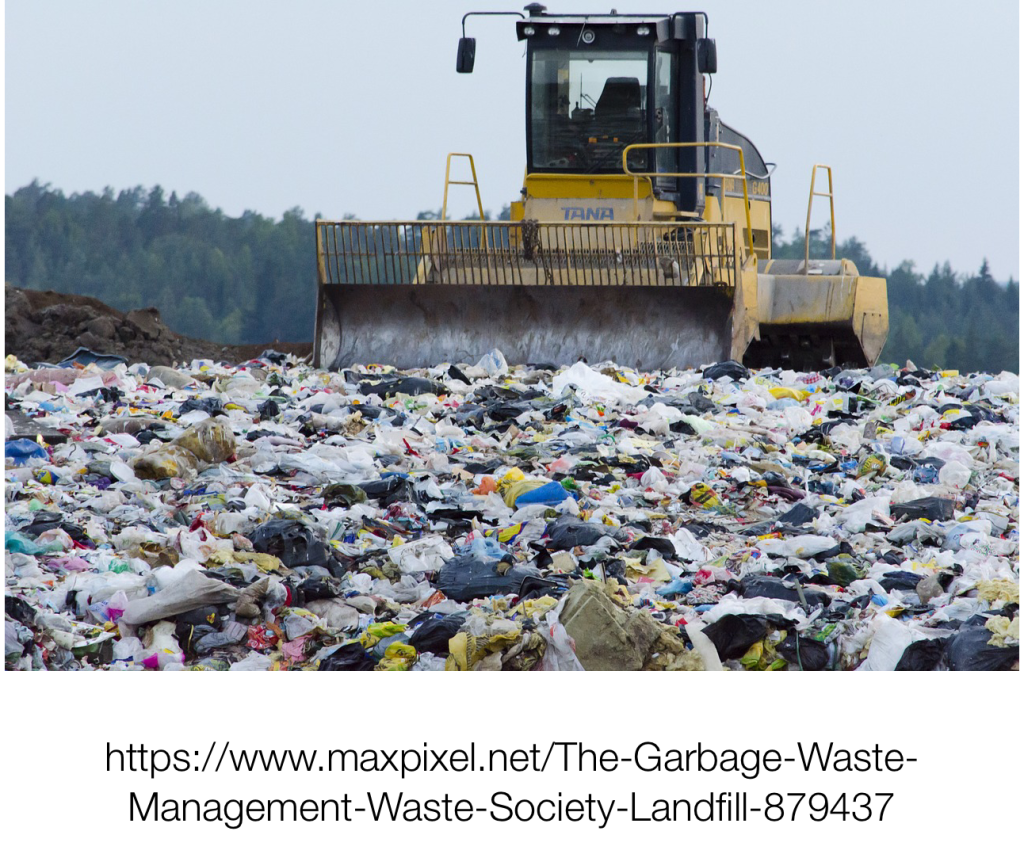
Most waste is collected but that doesn’t eradicate the health and pollution risks. Most will either be incinerated producing noxious fumes and health debilitating small particulates as well as CO2, or goes into some form of landfill which depending upon the level of safeguards in place, will still be a cause of much pollution. Buried waste in landfill also produces methane. Globally only 13.5% of municipal waste is recycled (https://datatopics.worldbank.org/what-a-waste/trends_in_solid_waste_management.html).
The world’s stock of resources – in particular raw materials such as minerals, but also things such as water, timber, peat, helium gas – is finite. We cannot carry on manufacturing and consuming at current levels. In 2021 Earth Overshoot Day – the day when we have consumed as many resources as the world can annually regenerate – fell on 29th July (https://www.overshootday.org/). On the one hand we need to find ways of consuming less, and in the other – or at the same time – we need to ensure we extract and recycle as much as we can from what we throw away. This imperative to use less and recycle more applies as much to industry as it does to individual consumers. And much of the burden must lie within the industries, for it is here that designs can be adapted so as a) to use less resources and b) to ensure ease of recycling when the product reaches its end of life.
What is needed is cradle-to-cradle or closed-loop design, production and recycling. Whilst the onus for this lies with the industries, consumers do have a role to play. We can do our research and only buy, where possible, items that come from closed-loop system. This could be milk in glass bottles that are collected and reused by the milk company. It could be clothes that the maker takes back when they expire and use to create new clothes. It could be paper or cardboard that are collected and processed into new paper and cardboard. We can be conscientious about collecting, sorting and recycling everything we use. And on the way, we can extend the life of the things we use by reusing and repairing them. We can aim for a 100% zero waste lifestyle.