Weekly Green Tau

Prayers for the ecosystems of Africa

14th March 2025

Happy are those  who do not follow the advice of the wicked… They are like trees planted by streams of water, which yield their fruit in its season,  their leaves do not wither. In all that they do, they prosper. Psalm 1:1a,3

You Lord, are the source of all good things: 

We praise you.

You call us to tend and care for your creation: 

May we strive to do your will.

You have made us as brothers and sisters with all that lives: 

May we live together in peace.

A Reading: Isaiah 35:1-7 

The desert and the parched land will be glad; the wilderness will rejoice and blossom.
Like the crocus, it will burst into bloom; it will rejoice greatly and shout for joy.
The glory of Lebanon will be given to it, the splendour of Carmel and Sharon;
they will see the glory of the Lord, the splendour of our God. Strengthen the feeble hands,
steady the knees that give way; say to those with fearful hearts, “Be strong, do not fear;
your God will come, will come with vengeance; with divine retribution he will come to save you.”

Then will the eyes of the blind be opened and the ears of the deaf unstopped. Then will the lame leap like a deer, and the mute tongue shout for joy. Water will gush forth in the wilderness and streams in the desert. The burning sand will become a pool, the thirsty ground bubbling springs.
In the haunts where jackals once lay, grass and reeds and papyrus will grow.

Each week during Lent I am focusing on a different continent; this week Africa. 

Africa is sometimes nicknamed the “Mother Continent” due to its being the oldest inhabited continent on Earth. Humans and human ancestors have lived in Africa for more than 5 million years. Africa has eight major physical regions: the Sahara, the Sahel, the Ethiopian Highlands, the savanna, the Swahili Coast, the rain forest, the African Great Lakes, and Southern Africa. Some of these regions cover large bands of the continent, such as the Sahara and Sahel, while others are isolated areas, such as the Ethiopian Highlands and the Great Lakes. Each of these regions has unique animal and plant communities. Equally diverse are the many ethnic groups and tribes – running into thousands – that each have their own culture, language, religion and heritage.

Glory to God 

Creator of rivers and deserts:

We praise you for the Nile, and the fertility it brings,

We praise you for the Sahara and the ingenuity of plants and animals 

that bring their own richness of life. 

Glory to God, 

Creator of mountains and valleys:

We praise you for the Ethiopian Highlands and the depths of the Rift Valley, 

for the snowy peak of Kilimanjaro and for the grandeur of the Victoria Falls – Mosi-oa-Tunya “ The Smoke That Thunders”

Glory to God

Creator of grasslands and savannahs:

We praise you for the animals of the plains 

– antelope and elephant, wildebeest and lion;

We praise you for the baobab tree, the acacia and the humble thorn tree.

Glory to God, 

Creator of flora and fauna:

We praise you for the 20,000 plants species of the Southern Cape; 

We praise you for the diversity of  Africa’s wildlife 

and marvel at the tenacity of the 150 species of migrating  birds.

Merciful God,

Creator of human kind, 

Forgive us for the destruction of Africa’s rainforest,  4% lost annually. 

Forgive our greed that destroys its rich diversity in favour of logging and mining, 

and monoculture farming in the pursuit of cut-price coffee and cocoa.

Merciful God,

Creator of our brothers and sisters:

Forgive the casualness with which we ignore their plight when faced with war and conflict, 

their poverty  when corporate greed takes away their livelihoods 

and their hunger when climate change decimates their crops.

Merciful God, 

Creator of climates and seasons,

Forgive our foolishness that creates both drought and flood.

Forgive our greed that pumps out evermore carbon dioxide 

and continues to destroy our carbon sinks.

Guiding God,

Source  of all wisdom, 

Transform our hearts and minds, turn the direction of our hands and feet 

so that with alacrity and commitment we will reform our lives 

and live only in harmony with your creation. 

Amen.

The Grace

Fourth Sunday of Lent

15th March 2026

Reflection with readings below

The gospel of John is full of signs. They are signs that invite to see beyond what has just happened.  Jesus wants us to see the signs as a stepping stone to understanding something fundamental about the kingdom  of God. At Cana we are invited not just to see that water has been turned into wine, but that generosity and transformation are key characteristics of God’s kingdom. In today’s story we are invited not just to marvel at the healing of a blind man, but to question our own ability to see. Our ability to see determines our ability to engage with the ways of the kingdom of God. 

It seems to us curious that anyone would think that blindness would be a result of sin – particular the sin of a parent – where is the justice in that? But what do we mean by sin? 

A starting point might be to understand sin as that which separates us from God or which separates us from our fellow brothers and sisters (and the two are interlinked. To love God is to love our brothers and sisters; to love our brothers and sisters is to love God). Nothing separates Jesus from God, and nothing separates him from his love for this fellow human. In that love, God’s glory is to be revealed.

The man does as Jesus directs and as he washes at the Pool of Siloam, finds that he has been healed. However it is a change of circumstances in which others do not seem able to rejoice. They don’t seem to feel that he is deserving of healing, and keep questioning him – and then question the validity of his healing: maybe he wasn’t really blind in the first place! Not surprisingly the man born blind is getting somewhat annoyed. He has been healed, he is grateful to Jesus for what he has done. He understands Jesus to be a prophet who has through the power of God healed him. He senses that Jesus is closer to God than the Pharisees. 

When Jesus seeks him out, his faith in Jesus as the promised messiah is completed.

Jesus declares his mission –  that he has come “that those who do not see may see, and those who do see may become blind.” It seems clear that the Pharisees whilst their eyes see – indeed pry – they are the ones who are blind: blind to God’s presence and purpose. The response of those Pharisees who hear Jesus, is ambiguous but maybe some who were unable to see the truth now come to understand their blindness and repent accordingly.

In response to the line in Amazing Grace, “Once I was blind but now I see”, Nadia Bolz-Weber said, “Once I was blind blind, now I see badly!” I think in her answer there is a lot of honesty. We are not good at seeing clearly. We are often struggle to see what it is that is obstructing our vision.

When I buy a coffee, am I blind to the low pay received by the barista? Am I blind to the poor price paid to the coffee grower? Am I blind to the vulnerability of coffee growing areas to the impact of climate change?

It is easy to be blinded by a prevailing expectation that a cup of coffee should be cheap; the belief that free markets always ensure fair prices; the common understanding that climate change is a future – not a present – worry. We only see badly. Like the Pharisees, we don’t look beyond the norms we have grown up with, to see what God might really be wanting.

And it is not just in buying cups of coffee, but in so many other parts of our lives that we are – perhaps unwittingly – going along blind and indifferent to the plight of our brother and sisters and so failing at the same time to love God.

The Pharisees are surprised when Jesus suggests they cannot see: they are surely inherently good people, following the laws of God. And I am sure each in their own way did love their chosen neighbour and did in their own way love God. Yet they are blind to so much. The culture and system in which they live perpetuates this blindness, this inability to see what is separating them from all their neighbours, from the expansive eternal nature of God.

This can be true for us. Our blindness to the suffering of neighbours – both human and creaturely – happens because we are trapped in a culture and system that is inherently unjust and unsustainable. Simply paying for a more expensive, fair trade, coffee or recycling all our plastic, will not at scale restore justice or ensure sustainability. We need system change – salvation – so that we can live in harmony together with all our brothers and sisters, in harmony with God. 

This radical transformation – this healing of our blindness to the – is what Jesus declares and offers to us. How will our lives be if we accept his healing? 

1 Samuel 16:1-13

The Lord said to Samuel, “How long will you grieve over Saul? I have rejected him from being king over Israel. Fill your horn with oil and set out; I will send you to Jesse the Bethlehemite, for I have provided for myself a king among his sons.” Samuel said, “How can I go? If Saul hears of it, he will kill me.” And the Lord said, “Take a heifer with you, and say, ‘I have come to sacrifice to the Lord.’ Invite Jesse to the sacrifice, and I will show you what you shall do; and you shall anoint for me the one whom I name to you.” Samuel did what the Lord commanded, and came to Bethlehem. The elders of the city came to meet him trembling, and said, “Do you come peaceably?” He said, “Peaceably; I have come to sacrifice to the Lord; sanctify yourselves and come with me to the sacrifice.” And he sanctified Jesse and his sons and invited them to the sacrifice.

When they came, he looked on Eliab and thought, “Surely the Lord’s anointed is now before the Lord.” But the Lord said to Samuel, “Do not look on his appearance or on the height of his stature, because I have rejected him; for the Lord does not see as mortals see; they look on the outward appearance, but the Lord looks on the heart.” Then Jesse called Abinadab, and made him pass before Samuel. He said, “Neither has the Lord chosen this one.” Then Jesse made Shammah pass by. And he said, “Neither has the Lord chosen this one.” Jesse made seven of his sons pass before Samuel, and Samuel said to Jesse, “The Lord has not chosen any of these.” Samuel said to Jesse, “Are all your sons here?” And he said, “There remains yet the youngest, but he is keeping the sheep.” And Samuel said to Jesse, “Send and bring him; for we will not sit down until he comes here.” He sent and brought him in. Now he was ruddy, and had beautiful eyes, and was handsome. The Lord said, “Rise and anoint him; for this is the one.” Then Samuel took the horn of oil, and anointed him in the presence of his brothers; and the spirit of the Lord came mightily upon David from that day forward. Samuel then set out and went to Ramah. 

Psalm 23

1 The Lord is my shepherd; *
I shall not be in want.

2 He makes me lie down in green pastures *
and leads me beside still waters.

3 He revives my soul *
and guides me along right pathways for his Name’s sake.

4 Though I walk through the valley of the shadow of death,
I shall fear no evil; *
for you are with me;
your rod and your staff, they comfort me.

5 You spread a table before me in the presence of those who trouble me; *
you have anointed my head with oil,
and my cup is running over.

6 Surely your goodness and mercy shall follow me all the days of my life, *
and I will dwell in the house of the Lord for ever.

Ephesians 5:8-14

Once you were darkness, but now in the Lord you are light. Live as children of light— for the fruit of the light is found in all that is good and right and true. Try to find out what is pleasing to the Lord. Take no part in the unfruitful works of darkness, but instead expose them. For it is shameful even to mention what such people do secretly; but everything exposed by the light becomes visible, for everything that becomes visible is light. Therefore it says, 

“Sleeper, awake!  Rise from the dead, and Christ will shine on you.” 

John 9:1-41

As Jesus walked along, he saw a man blind from birth. His disciples asked him, “Rabbi, who sinned, this man or his parents, that he was born blind?” Jesus answered, “Neither this man nor his parents sinned; he was born blind so that God’s works might be revealed in him. We must work the works of him who sent me while it is day; night is coming when no one can work. As long as I am in the world, I am the light of the world.” When he had said this, he spat on the ground and made mud with the saliva and spread the mud on the man’s eyes, saying to him, “Go, wash in the pool of Siloam” (which means Sent). Then he went and washed and came back able to see. The neighbours and those who had seen him before as a beggar began to ask, “Is this not the man who used to sit and beg?” Some were saying, “It is he.” Others were saying, “No, but it is someone like him.” He kept saying, “I am the man.” But they kept asking him, “Then how were your eyes opened?” He answered, “The man called Jesus made mud, spread it on my eyes, and said to me, ‘Go to Siloam and wash.’ Then I went and washed and received my sight.” They said to him, “Where is he?” He said, “I do not know.”

They brought to the Pharisees the man who had formerly been blind. Now it was a sabbath day when Jesus made the mud and opened his eyes. Then the Pharisees also began to ask him how he had received his sight. He said to them, “He put mud on my eyes. Then I washed, and now I see.” Some of the Pharisees said, “This man is not from God, for he does not observe the sabbath.” But others said, “How can a man who is a sinner perform such signs?” And they were divided. So they said again to the blind man, “What do you say about him? It was your eyes he opened.” He said, “He is a prophet.” 

The Jews did not believe that he had been blind and had received his sight until they called the parents of the man who had received his sight and asked them, “Is this your son, who you say was born blind? How then does he now see?” His parents answered, “We know that this is our son, and that he was born blind; but we do not know how it is that now he sees, nor do we know who opened his eyes. Ask him; he is of age. He will speak for himself.” His parents said this because they were afraid of the Jews; for the Jews had already agreed that anyone who confessed Jesus to be the Messiah would be put out of the synagogue. Therefore his parents said, “He is of age; ask him.” 

So for the second time they called the man who had been blind, and they said to him, “Give glory to God! We know that this man is a sinner.” He answered, “I do not know whether he is a sinner. One thing I do know, that though I was blind, now I see.” They said to him, “What did he do to you? How did he open your eyes?” He answered them, “I have told you already, and you would not listen. Why do you want to hear it again? Do you also want to become his disciples?” Then they reviled him, saying, “You are his disciple, but we are disciples of Moses. We know that God has spoken to Moses, but as for this man, we do not know where he comes from.” The man answered, “Here is an astonishing thing! You do not know where he comes from, and yet he opened my eyes. We know that God does not listen to sinners, but he does listen to one who worships him and obeys his will. Never since the world began has it been heard that anyone opened the eyes of a person born blind. If this man were not from God, he could do nothing.” They answered him, “You were born entirely in sins, and are you trying to teach us?” And they drove him out.

Jesus heard that they had driven him out, and when he found him, he said, “Do you believe in the Son of Man?” He answered, “And who is he, sir? Tell me, so that I may believe in him.” Jesus said to him, “You have seen him, and the one speaking with you is he.” He said, “Lord, I believe.” And he worshiped him. Jesus said, “I came into this world for judgment so that those who do not see may see, and those who do see may become blind.” Some of the Pharisees near him heard this and said to him, “Surely we are not blind, are we?” Jesus said to them, “If you were blind, you would not have sin. But now that you say, ‘We see,’ your sin remains.”

Third Sunday of Lent

8th March 2026

Reflection with readings below 

In the reading from Exodus, the people are up  in arms that they don’t have enough fresh water to drink. Quite rightly so. They know how important water is. Without water they will not survive.   

Do we know what is important for life – or do we get distracted by populist issues such as wifi speed, foreign travel, journey times between London and Manchester, how many asylum seekers are occupying cheap hotel rooms, or the availability of strawberries in January? 

Equally do we get up in arms about what is truly important? Are we more concerned about the love-lives of pop stars or the fate of prisoners? The domestic arrangements of the royal family or the plight of steel workers in Wales?  The most recent diatribe from Nigel Farage or waiting times in our local A and E?

Returning to the necessity of water, how many of us are aware that Tehran is about to run out of drinking water? How many of us are concerned about the amount of water needed to cool AI data centres here in the UK?  

The UK already faces a projected daily water deficit of nearly 5 billion litres by 2050 –  which doesn’t include what might be needed by as yet to be built data centres. Might we expect agriculture to take precedence over data processing? 

Water shortages re not just a UK issue, but a global issue. Across the world we are collectively consuming fresh water faster than supplies can be replenished! How many of us are outraged at the amount of water needed to make a cheap t shirt  – worn today and thrown away tomorrow? Or how many of us are outraged that so much water is used to grow crops for cattle to eat so that ever greater quantities of meat can be consumed? 

If nothing else, maybe their time in the wilderness taught the Hebrews that they couldn’t just expect water to be readily available at the drop of a hat – or a stick! More precisely they would have learnt that their access to water was dependent on their understanding their relationship with God. They should expect to go through life – or through the wilderness – without engaging in a real and trusting relationship with God.

God, as creator, is the source of the wisdom we need to live sustainably, securely, happily within the limits of creation. We are not gods.  We cannot make creation conform to our demands. We have to live within the limitations of the created world. We cannot consume more water than the world can supply. We cannot discharge more pollution than the environment can absorb. We cannot take more resources from the earth than the earth can sustain.  

Where are our contemporary prophets, who, like Moses, will challenge us to think rationally, who will challenge us to understand our dependency on God? Where are the preachers, the thinkers and writers,  who will help us understand how  God wishes to  – and indeed does – relate with us, and the rest of creation? Are we ready to ‘kneel before the Lord our maker and listen to his voice’?

We can, nevertheless, draw consolation from the fact that God does not require us to be sinless for God to love us. What ever the state of our stupidity, our greed, our misplaced self-assurance, God is always willing to pay heed to our concerns, to afford us her wisdom, to show us a way forward. But we do have to want to engage with God – and that surely is what we mean by faith: the desire to be guided by God, to be in a relationship with God, to trust that God does indeed have answers to our problems. That is faith. 

The Samaritan woman had the means of taking water out of the well. She could do this day in, day out – for as long as there was water in the well.  What she hadn’t understood was that water like everything else was a gift that God had given her so that she might understand the universal nature of God, so that she might replicate God’s actions by sharing what was freely given so that all might benefit, that this water might enable eternal life not just for her and her tribe, but for everyone.

Like the Samaritan woman, we, even now in the 21st century, have a lot to learn about the life giving properties of water, and most particularly that those properties depend upon water being properly cherished and shared – to understand that all water is holy.

Exodus 17:1-7

From the wilderness of Sin the whole congregation of the Israelites journeyed by stages, as the Lord commanded. They camped at Rephidim, but there was no water for the people to drink. The people quarrelled with Moses, and said, “Give us water to drink.” Moses said to them, “Why do you quarrel with me? Why do you test the Lord?” But the people thirsted there for water; and the people complained against Moses and said, “Why did you bring us out of Egypt, to kill us and our children and livestock with thirst?” So Moses cried out to the Lord, “What shall I do with this people? They are almost ready to stone me.” The Lord said to Moses, “Go on ahead of the people, and take some of the elders of Israel with you; take in your hand the staff with which you struck the Nile, and go. I will be standing there in front of you on the rock at Horeb. Strike the rock, and water will come out of it, so that the people may drink.” Moses did so, in the sight of the elders of Israel. He called the place Massah and Meribah, because the Israelites quarrelled and tested the Lord, saying, “Is the Lord among us or not?” 

Psalm 95

1 Come, let us sing to the Lord; *
let us shout for joy to the Rock of our salvation.

2 Let us come before his presence with thanksgiving *
and raise a loud shout to him with psalms.

3 For the Lord is a great God, *
and a great King above all gods.

4 In his hand are the caverns of the earth, *
and the heights of the hills are his also.

5 The sea is his, for he made it, *
and his hands have moulded the dry land.

6 Come, let us bow down, and bend the knee, *
and kneel before the Lord our Maker.

7 For he is our God,
and we are the people of his pasture and the sheep of his hand. *
Oh, that today you would hearken to his voice!

8 Harden not your hearts,
as your forebears did in the wilderness, *
at Meribah, and on that day at Massah,
when they tempted me.

9 They put me to the test, *
though they had seen my works.

10 Forty years long I detested that generation and said, *
“This people are wayward in their hearts;
they do not know my ways.”

11 So I swore in my wrath, *
“They shall not enter into my rest.”

Romans 5:1-11

Since we are justified by faith, we have peace with God through our Lord Jesus Christ, through whom we have obtained access to this grace in which we stand; and we boast in our hope of sharing the glory of God. And not only that, but we also boast in our sufferings, knowing that suffering produces endurance, and endurance produces character, and character produces hope, and hope does not disappoint us, because God’s love has been poured into our hearts through the Holy Spirit that has been given to us.

For while we were still weak, at the right time Christ died for the ungodly. Indeed, rarely will anyone die for a righteous person– though perhaps for a good person someone might actually dare to die. But God proves his love for us in that while we still were sinners Christ died for us. Much more surely then, now that we have been justified by his blood, will we be saved through him from the wrath of God. For if while we were enemies, we were reconciled to God through the death of his Son, much more surely, having been reconciled, will we be saved by his life. But more than that, we even boast in God through our Lord Jesus Christ, through whom we have now received reconciliation.

John 4:5-42

Jesus came to a Samaritan city called Sychar, near the plot of ground that Jacob had given to his son Joseph. Jacob’s well was there, and Jesus, tired out by his journey, was sitting by the well. It was about noon. 

A Samaritan woman came to draw water, and Jesus said to her, “Give me a drink.” (His disciples had gone to the city to buy food.) The Samaritan woman said to him, “How is it that you, a Jew, ask a drink of me, a woman of Samaria?” (Jews do not share things in common with Samaritans.) Jesus answered her, “If you knew the gift of God, and who it is that is saying to you, ‘Give me a drink,’ you would have asked him, and he would have given you living water.” The woman said to him, “Sir, you have no bucket, and the well is deep. Where do you get that living water? Are you greater than our ancestor Jacob, who gave us the well, and with his sons and his flocks drank from it?” Jesus said to her, “Everyone who drinks of this water will be thirsty again, but those who drink of the water that I will give them will never be thirsty. The water that I will give will become in them a spring of water gushing up to eternal life.” The woman said to him, “Sir, give me this water, so that I may never be thirsty or have to keep coming here to draw water.” 

Jesus said to her, “Go, call your husband, and come back.” The woman answered him, “I have no husband.” Jesus said to her, “You are right in saying, ‘I have no husband’; for you have had five husbands, and the one you have now is not your husband. What you have said is true!” The woman said to him, “Sir, I see that you are a prophet. Our ancestors worshiped on this mountain, but you say that the place where people must worship is in Jerusalem.” Jesus said to her, “Woman, believe me, the hour is coming when you will worship the Father neither on this mountain nor in Jerusalem. You worship what you do not know; we worship what we know, for salvation is from the Jews. But the hour is coming, and is now here, when the true worshipers will worship the Father in spirit and truth, for the Father seeks such as these to worship him. God is spirit, and those who worship him must worship in spirit and truth.” The woman said to him, “I know that Messiah is coming” (who is called Christ). “When he comes, he will proclaim all things to us.” Jesus said to her, “I am he, the one who is speaking to you.”

Just then his disciples came. They were astonished that he was speaking with a woman, but no one said, “What do you want?” or, “Why are you speaking with her?” Then the woman left her water jar and went back to the city. She said to the people, “Come and see a man who told me everything I have ever done! He cannot be the Messiah, can he?” They left the city and were on their way to him. 

Meanwhile the disciples were urging him, “Rabbi, eat something.” But he said to them, “I have food to eat that you do not know about.” So the disciples said to one another, “Surely no one has brought him something to eat?” Jesus said to them, “My food is to do the will of him who sent me and to complete his work. Do you not say, ‘Four months more, then comes the harvest’? But I tell you, look around you, and see how the fields are ripe for harvesting. The reaper is already receiving wages and is gathering fruit for eternal life, so that sower and reaper may rejoice together. For here the saying holds true, ‘One sows and another reaps.’ I sent you to reap that for which you did not labor. Others have laboured, and you have entered into their labour.”

Many Samaritans from that city believed in him because of the woman’s testimony, “He told me everything I have ever done.” So when the Samaritans came to him, they asked him to stay with them; and he stayed there two days. And many more believed because of his word. They said to the woman, “It is no longer because of what you said that we believe, for we have heard for ourselves, and we know that this is truly the Saviour of the world.”

Prayers for the ecosystems of South America 

7th March 2026

The desert and the parched land will be glad; the wilderness will rejoice and blossom like the crocus Isaiah 35:1

You Lord, are the source of all good things: 

We praise you.

You call us to cherish and protect your creation: 

May we strive to do your will.

You have made us as brothers and sisters with all that lives: 

May we live together in peace.

A Reading: Daniel 4: 10-12

Upon my bed this is what I saw; there was a tree at the centre of the earth, and its height was great. The tree grew great and strong, its top reached to heaven, and it was visible to the ends of the whole earth. Its foliage was beautiful, its fruit abundant, and it provided food for all. The animals of the field found shade under it, the birds of the air nested in its branches, and from it all living beings were fed.

During Lent these prayers  focus on a different continent; this week South America. 

South America, the fourth-largest continent, extends from the Gulf of Darién in the northwest to the archipelago of Tierra del Fuego in the south. South America can be divided into three physical regions: mountains and highlands, river basins, and coastal plains. Mountains and coastal plains generally run in a north-south direction, while highlands and river basins generally run in an east-west direction.
South America’s extreme geographic variation contributes to the continent’s large number of biomes. A biome is a community of animals and plants that spreads over an area with a relatively uniform climate.  Within a few hundred kilometres, South America’s coastal plains’ dry desert biome rises to the rugged alpine biome of the Andes mountains. One of the continent’s river basins (the Amazon) is defined by dense, tropical rain forest, while the other (Paraná) is made up of vast grasslands.
The diversity of animal life in the Amazon rain forest is unsurpassed in the rest of the world. There can be as many as 100 different tree species on a single acre. The rain forest is perfectly suited for arboreal, or tree-living, animals. More than 2 million species of insects are native to the region, including hundreds of spiders and butterflies. Primates are abundant—howler monkeys, spider monkeys, and capuchin monkeys—along with sloths, snakes, and iguanas. Thousands of native birds include brightly coloured macaws, parrots, toucans, and parakeets. https://www.nationalgeographic.org/encyclopedia/south-america-physical-geography/

Glory to God 

Creator of rivers and oceans:

We praise you for the Amazon, 1725 miles long!

Glory to God, 

Creator of mountains and valleys:

We praise you for the Amazon Basin, all 2.7 million squares miles.

Glory to God, 

 Creator of trees and plants:

We praise you for the 40,000 plants species of the Amazon.

We praise you for biome that supports 350 millions tonnes of life per square kilometre.

Glory to God, 

Creator of all that crawls and swims and flies.

We praise you for wildlife of the Amazon – 

2 million species of insect, 2000 birds and mammals, 800 amphibians and reptiles.

Merciful God,

Creator of human kind, 

Forgive us for the destruction of the Amazonian rainforest,  18% lost and counting.

Forgive our greed that replaces trees with cattle ranches and fields of soy for their fodder.

Forgive our greed that replaces trees with sugar cane, for sweetmeats and bio fuel.

Merciful God,

Creator of air and space, 

Forgive our foolishness in destroying the source of 20% of the world’s oxygen.

Forgive our greed that gobbles up the living space of others, endangering  the survival of jaguars and blue macaws, poison dart frogs and river dolphins.

Merciful God

Creator of climates and seasons,

Forgive our foolishness that creates droughts and heat waves.

Forgive our greed that fills the air with carbon dioxide and destroys carbon sinks.

Guiding God,

Source  of all wisdom, 

Transform our hearts and minds, turn the direction of our hands and feet 

so that with alacrity and commitment we may reform our lives 

and live only in harmony with your creation. 

Amen.

The Grace

 Thank you for inviting me here today to explore with you today’s Bible readings and to relate them to the mission of Christian Climate Action.

Psalm 121 asks where does our help comes from? Not from hills say the Psalmist.  Those are the high places where the Cananite gods and goddesses were worshipped. No our help comes from God!

In his letter to the Romans St Paul is writing to a Christian community that is a mix of those who have come to believe in Jesus as the fulfilment and expansion of the very Jewish faith that they have grown up with. Others will be those who have grown up within the culture of worshipping the gods and goddesses of the Greek and Roman tradition, and who have now adopted a completely different faith – that of following Jesus.

But what underpins their faith? From what Paul is writing, it seems as if some want to read the scriptures as telling them that strict adherence to the old laws is essential, and that this is the only know that they are righteous. And it may have been just a much the non-Jewish believers who wanted the certainty that a rigid set of rules would give. No more thinking: just follow the rules: job done. 

Paul however takes the story of Abraham to help them their understand the scriptures from a new – Christian – perspective . Look, says Paul, Abraham’s relationship with God wasn’t established or maintained through him doing X number of good works or performing particular rituals – and it certainly wasn’t about following the law because Abraham predates that. No Abraham’s relationship with God was established through faith, through his implicit trust in God.  

Paul is saying to the Christians in Rome that they must read the Jewish scriptures – remember at this stage the Gospels had yet to be written – through a new lens which is Jesus Christ. And whether they have been brought up as Jews or as followers of Greek and Roman gods, it is not following the law that will grow their relationship with God, but faith. This is a radical but inescapable truth that Paul is urging them to understand. 

So we come to today’s Gospel reading. What is going on here? It sounds as if Jesus is answering a different set of questions to the ones that Nicodemus is asking! Or is it that Jesus is answering the questions that Nicodemus ought to have asked?

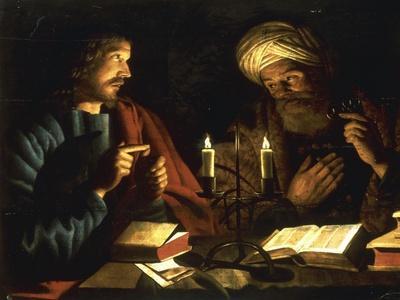
This sense of the two protagonists debating together is captured in a picture by the 17th century artist, Crijn Henricksz Volmarijn. Here by the aid of candlelight Jesus and Nicodemus sit together with  several books on the table in front of them. Jesus is using his fingers to enumerate the points he is making. 

The open books in front of Nicodemus are the Jewish scriptures which he had grown up with. The painter shows him with a pair of spectacles which he is holding in his hand. These glasses are  the painter’s way of telling us that Nicodemus has always read the scriptures through the lens of his pharisaical learning. But as he is listening to Jesus, he has taken the glasses off because Jesus is giving him a different way of understanding the scriptures. Now at last Nicodemus is beginning to grasp what Jesus is saying. 

The book in front of Jesus is only partly open. It represents the Gospel – the new scripture – that has yet to be written but which Jesus – who is the Word – is proclaiming through what he says and does.  Jesus is inviting Nicodemus to read the scriptures differently, to see the world around him in a different light, and therefore to start living differently, to begin life anew! “You must be born again, you must be born from above.”

And isn’t that what Jesus also asks of us? 

Especially during Lent when we are invited to hear and read the scriptures anew, alert to how Jesus wants us to hear his word, ready to step away from where we were going wrong, and to begin afresh following the new ways of the radical Jesus.

I’m both part of Green Christian and of Christian Climate Action, and it is through prayer, the study of scripture and theological reflection that we are constantly trying to focus on where Jesus is leading us and what he is asking us to do.

Recently we have had some conversations about the two creation stories in Genesis, and how are the Hebrew word translated as dominion might be understood. In the past the story has been read as sanctioning human rule over and exploitation of all natural resources, plants and creatures. A more contemporary understanding would be that humanity is tasked with relating to natural resources, plants and creatures in the same way that God himself exercises dominion over all creation. This developing theology is one that embraces that of St Francis of Assisi who held that all creatures, all parts of the natural world from sun to rain, from moon to fire, should be treated as brother and sister, to the more recent thinking of Pope Francis who called this earth our common home. From this viewpoint humanity is seen as an integral and interdependent part of creation  – and not as a separate and superior species.

We can see afresh that our human self assurance and greed have led us to exploit fossil fuels such that their carbon emissions dioxide have increased to such an extent that the earth’s climates has been irreversibly changed (at least for the next millennia). Human activities are now causing overheating, extreme weather conditions, floods and wild fires, and are harming – and killing – our fellow brothers and sisters, human and creaturely. 

As followers of Jesus, we are called to love all our neighbours.  And so Christian Climate Action has been calling on the Government not to licence the development of the Rosebank oil field in the North Sea. 

We have been calling on oil companies such as Equinor and Shell to transition into renewable energy companies.

We have been calling on banks such as Barclays, to stop funding new oil and gas projects.

We have successfully campaigned in calling upon the Church of England’s dioceses and their National Investment Bodies (NIBs) to divest from fossil fuels.

We have successfully campaigned in calling upon organisations such as Oxfam and Christian Aid to switch away from banking with Barclays. And we continue to campaign calling on other institutions such as our dioceses and the National Trust, to likewise shift to ethical banks.

We take to heart the command in Genesis 2 to cherish and protect the earth. Across the world, biodiversity – natural wildlife in all its richness and beauty – is rapidly diminishing, pushed out of existence by human urbanisation, industrialised farming, and the impacts of climate change. An international consensus has led to the development of the Kunming-Montreal Biodiversity Framework. 

This framework sets out how we can reverse the rapid loss of biodiversity across the world and protect the natural ecosystems  – clean air, fresh water, fertile soils, a sufficient number and variety of pollinators etc – on which life depends. Each participating nation, including the UK, has committed  to restore and protected for nature 30% of their land and seas by 2030. 

This clearly is in line with God’s words of instruction in Genesis.

In response to this Christian Climate Action is in dialogue with the Church Commissioners over the scope they have to restore for nature up to 30% of the land that they control. 

In light of the increasing ecological crisis that the earth faces, Christian Climate Action has produced a vision document entitled ‘Stop Crucifying Creation.’ The  document was drawn together after much prayer and reflection, as we looked again at what God is calling us to do in the face of the damage we humans are causing. 

It is a call to  the Church to discover afresh its roots – that lively and compelling faith demonstrated by the early churches that St Paul wrote to.

It is a call to the Church to embrace anew the courage it has shown at other critical points in history, and to reclaim its prophetic role in speaking truth to power – whether that is calling on oil companies to cease burning the planet, or calling on water companies to stop polluting the rivers, or calling on the Government to take urgent action in addressing the climate and nature crisis, or calling on world leaders to seek peace and dialogue rather than  a knee jerk reaction towards aggression and conflict. 

Truly we are being called to see the world and the scriptures anew, to be as ones born again as we follow in the steps of the radical Jesus, loving whole heartedly our neighbours whoever and wherever they are.

Amen.

Psalm 121

Levavi oculos

1 I lift up my eyes to the hills; *
from where is my help to come?

2 My help comes from the Lord, *
the maker of heaven and earth.

3 He will not let your foot be moved *
and he who watches over you will not fall asleep.

4 Behold, he who keeps watch over Israel *
shall neither slumber nor sleep;

5 The Lord himself watches over you; *
the Lord is your shade at your right hand,

6 So that the sun shall not strike you by day, *
nor the moon by night.

7 The Lord shall preserve you from all evil; *
it is he who shall keep you safe.

8 The Lord shall watch over your going out and your coming in, *
from this time forth for evermore.

The Epistle

Romans 4:1-5, 13-17

What then are we to say was gained by Abraham, our ancestor according to the flesh? For if Abraham was justified by works, he has something to boast about, but not before God. For what does the scripture say? “Abraham believed God, and it was reckoned to him as righteousness.” Now to one who works, wages are not reckoned as a gift but as something due. But to one who without works trusts him who justifies the ungodly, such faith is reckoned as righteousness. 

For the promise that he would inherit the world did not come to Abraham or to his descendants through the law but through the righteousness of faith. If it is the adherents of the law who are to be the heirs, faith is null and the promise is void. For the law brings wrath; but where there is no law, neither is there violation. 

For this reason it depends on faith, in order that the promise may rest on grace and be guaranteed to all his descendants, not only to the adherents of the law but also to those who share the faith of Abraham (for he is the father of all of us, as it is written, “I have made you the father of many nations”) —in the presence of the God in whom he believed, who gives life to the dead and calls into existence the things that do not exist. 

The Gospel

John 3:1-17

There was a Pharisee named Nicodemus, a leader of the Jews. He came to Jesus by night and said to him, “Rabbi, we know that you are a teacher who has come from God; for no one can do these signs that you do apart from the presence of God.” Jesus answered him, “Very truly, I tell you, no one can see the kingdom of God without being born from above.” Nicodemus said to him, “How can anyone be born after having grown old? Can one enter a second time into the mother’s womb and be born?” Jesus answered, “Very truly, I tell you, no one can enter the kingdom of God without being born of water and Spirit. What is born of the flesh is flesh, and what is born of the Spirit is spirit. Do not be astonished that I said to you, ‘You must be born from above.’ The wind blows where it chooses, and you hear the sound of it, but you do not know where it comes from or where it goes. So it is with everyone who is born of the Spirit.” Nicodemus said to him, “How can these things be?” Jesus answered him, “Are you a teacher of Israel, and yet you do not understand these things? 

“Very truly, I tell you, we speak of what we know and testify to what we have seen; yet you do not receive our testimony. If I have told you about earthly things and you do not believe, how can you believe if I tell you about heavenly things? No one has ascended into heaven except the one who descended from heaven, the Son of Man. And just as Moses lifted up the serpent in the wilderness, so must the Son of Man be lifted up, that whoever believes in him may have eternal life. 

“For God so loved the world that he gave his only Son, so that everyone who believes in him may not perish but may have eternal life. 

“Indeed, God did not send the Son into the world to condemn the world, but in order that the world might be saved through him.”

Prayers for the ecology of Australasia 

28th February 2026

The desert and the parched land will be glad; the wilderness will rejoice and blossom like the crocus Isaiah 35:1

You Lord, are the source of all good things: 

We praise you.

You call us to tend and care for your creation: 

May we strive to do your will.

You have made us as brothers and sisters with all that lives: 

May we live together in peace.

A Reading: Isaiah 42: 5, 10-12 

Sing to the Lord a new song,
    his praise from the end of the earth!
Let the sea roar and all that fills it,
    the coastlands and their inhabitants.

Let the desert and its towns lift up their voice,
    the villages that Kedar inhabits;
let the inhabitants of Sela sing for joy,
    let them shout from the tops of the mountains.

Let them give glory to the Lord,
    and declare his praise in the coastlands.

These prayers during Lent focus each week on a different continent; this week Australasia. 

The Australasia realm is dominated by the Australian continent and 2 additional subrealms — New Zealand and  the Australasian Islands: Papua, Sulawesi, and other Indonesian islands east of the Makassar Strait and south of the Java Sea, as well as the Solomon Islands, Vanuatu, and New Caledonia. Australasia encompassed a diversity of environments from the vast interior deserts of Australia, dry and wet tropical savannahs and rainforests, Mediterranean woodlands, temperate grasslands and  alpine uplands. With its seven seas and immense coral reefs, Australasia is one of the most important realms for ocean biodiversity. The Great Barrier Reef, considered one of the Seven Natural Wonders, is the world’s largest coral reef system. https://www.oneearth.org/realms/australasia/

Australasia is already greatly affected by the ongoing climate crisis, with rising land temperatures and an increasing frequency of heat waves and bush fires; rising sea levels and an increasing frequency of heavy rain causing flooding, interspersed with increasing periods of drought. Rising sea levels disproportionately affect small islands nations. Rising temperatures in the oceans are destroying  coral reefs. 

An extract from ‘Kangaroo’ by D H Lawrence

Delicate mother Kangaroo 

Sitting up there rabbit-wise, but huge, plump-weighted, 

And lifting her beautiful slender face, oh! so much more 

gently and finely lined than a rabbit’s, or than a hare’s, 

Lifting her face to nibble at a round white peppermint drop 

which she loves, sensitive mother Kangaroo. 

Her sensitive, long, pure-bred face. 

Her full antipodal eyes, so dark, 

So big and quiet and remote, having watched so many 

empty dawns in silent Australia. 

Her little loose hands, and drooping Victorian shoulders. 

And then her great weight below the waist, her vast pale belly, 

With a thin young yellow little paw hanging out, and 

straggle of a long thin ear, like ribbon, 

Like a funny trimming to the middle of her belly, thin 

little dangle of an immature paw, and one thin ear. 

Her belly, her big haunches 

And, in addition, the great muscular python-stretch of her tail. 

There, she shan’t have any more peppermint drops. 

So she wistfully, sensitively sniffs the air, and then turns, 

goes off in slow sad leaps 

On the long flat skis of her legs, 

Steered and propelled by that steel-strong snake of a tail. 

Intercessions 

We give thanks for the beauty and diversity of the world you have given us, 

for its colour and abundance, its richness and vitality.  

Generous God, hear our prayer.

With sorry we acknowledge our part in damaging what you have created. 

We acknowledge that our lifestyles have been selfish and careless.  

We acknowledge that we could and can do more 

to tend this earth and care for its inhabitants. 

Merciful God, hear our prayer.

We pray for these who conserve plant and animal wildlife, birds and insects. 

We pray for the work of agriculturalist and scientists 

developing better, kinder ways of living on this earth. 

We pray for the resilience of indigenous communities 

that strive to live in harmony with their environment. 

Gracious God, hear our prayer. 

We pray for government leaders and advisers, 

farmers and business leaders, 

that they will hold dear the needs of the environment 

and strive to avert the risks of the ecological crisis. 

Enabling God, hear our prayer.

The Grace 

First Sunday of Lent

22nd February 2026

Reflection with readings below 

Life is full of choices: whether to get up or lie in a bit longer; what to have for breakfast; which coffee to have – the skinny decaf latte or the oat flat white; whether to be vegan or vegetarian; to drive or take the bus; which bank to bank with. Most choices are innocuous and inconsequential. But it is surprising how even when the choice is between a safe bet and a dead cert risk, we can still make the wrong choice. That certainly was the case in the story of Adam and Eve. They had all the food they needed but they chose to eat the one fruit destined to kill them!

Yes they were tempted. The snake fed them a slippery line one that as not quite truthless but definitely flawed. Perhaps that snake was a budding marketing executive or maybe a spin doctor.

Would we have been so gullible? So foolish?

Yet for 30 plus years we have know that putting excessive amounts of carbon dioxide into the atmosphere causes global warming – causing extreme weather conditions, rising sea levels, loss of biodiversity etc  – and yet we have carried on not just putting CO2 into the atmosphere, but increasing the amount we put in! 

Have we been duped? Yes. Big businesses – the fossil fuel industry, the meat industry, the plastics industry, the tech industry etc – have all been encouraging us to buy, buy and buy. They have argued against restraint. They have green washed the truth. They have fought and bought themselves the freedoms that they want.

Have we been trapped? Yes. Big business has created a vast network of systems that overshadows the freedom of the individual. We are dependent on transport networks to provide roads and trains. We are dependent on electricity grids and energy companies to heat our homes and power our computers. We are dependent on software updates and mobile signals. We are dependent on supermarkets and their supply chains for our weekly shopping. We’re dependent on investment funds to build homes and schools, hospitals and prisons. And we’re dependent on governments to create workable rules that will constrain the worst of the risks.

The writers of the scriptures knew the compromised state of the world – hence this story today of Adam and Eve. They also knew that the world wasn’t in the state desired by God – both creation stories present a picture goodness and harmony of God’s original making. Yet God doesn’t abandon or give up the world. If we read on we hear that God speaks with Adam and Eve, draws out from them sufficient wisdom that they see their error and can accept forgiveness. God re-equips them to live in the world as it now was. Once more humanity is willing to work with God (and almost as a footnote we hear that God replaces their scanty leaf attire with something more robust).

Jesus too experiences the temptation of being human.  He is tempted to do things the human way that ignores God and relies on hearsay and half truths. But Jesus stay true to the word and the wisdom of God. And Jesus – both there in the wilderness – and back on the roads and in the towns, challenges the systems that distort God’s word, that disregard God’s wisdom. Systems that fail. Systems that fail the vulnerable, that do not help the weakest, that do not protect the environment, that do not result in love for our neighbour.

What makes temptation tricky is that it can seem so plausible. That as systems become more complex it is harder to see the truth, to understand where the good lies, to find the path that helps our neighbour. 

Last week, starting on Ash Wednesday, Christian Climate Action held a 24 hour vigil outside St Paul’s cathedral, calling on the Church as an institution to speak out prophetically against the suffering of the world, against injustice, and against our tacit crucifying of creation. As each hour past, we prayed for different areas of the world, which within just the first six weeks of 2026, had suffered from the impacts of the climate crisis. Places as far afield as Patagonia and Albania, as Morocco and the UK.

It was a cold, tiring 24 hours, and at times wet! Yet we maintained our quiet presence and continued to pray.  But no one, no one from the cathedral, from the institutional church that is seen as a leader of faith in this country, came out to pray with us or even talk with us. Who is going to challenge the systems that distort truth, that aggravate the climate crisis, that persist in rewarding the rich and penalising the poor? The temptation perhaps is to do nothing!

Genesis 2:15-17; 3:1-7

The Lord God took the man and put him in the garden of Eden to till it and keep it. And the Lord God commanded the man, “You may freely eat of every tree of the garden; but of the tree of the knowledge of good and evil you shall not eat, for in the day that you eat of it you shall die.”

Now the serpent was more crafty than any other wild animal that the Lord God had made. He said to the woman, “Did God say, ‘You shall not eat from any tree in the garden’?” The woman said to the serpent, “We may eat of the fruit of the trees in the garden; but God said, ‘You shall not eat of the fruit of the tree that is in the middle of the garden, nor shall you touch it, or you shall die.’“ But the serpent said to the woman, “You will not die; for God knows that when you eat of it your eyes will be opened, and you will be like God, knowing good and evil.” So when the woman saw that the tree was good for food, and that it was a delight to the eyes, and that the tree was to be desired to make one wise, she took of its fruit and ate; and she also gave some to her husband, who was with her, and he ate. Then the eyes of both were opened, and they knew that they were naked; and they sewed fig leaves together and made loincloths for themselves.

Psalm 32 

1 Happy are they whose transgressions are forgiven, *
and whose sin is put away!

2 Happy are they to whom the Lord imputes no guilt, *
and in whose spirit there is no guile!

3 While I held my tongue, my bones withered away, *
because of my groaning all day long.

4 For your hand was heavy upon me day and night; *
my moisture was dried up as in the heat of summer.

5 Then I acknowledged my sin to you, *
and did not conceal my guilt.

6 I said, “I will confess my transgressions to the Lord.” *
Then you forgave me the guilt of my sin.

7 Therefore all the faithful will make their prayers to you in time of trouble; *
when the great waters overflow, they shall not reach them.

8 You are my hiding-place;
you preserve me from trouble; *
you surround me with shouts of deliverance.

9 “I will instruct you and teach you in the way that you should go; *
I will guide you with my eye.

10 Do not be like horse or mule, which have no understanding; *
who must be fitted with bit and bridle,
or else they will not stay near you.”

11 Great are the tribulations of the wicked; *
but mercy embraces those who trust in the Lord.

12 Be glad, you righteous, and rejoice in the Lord; *
shout for joy, all who are true of heart.

Romans 5:12-19

As sin came into the world through one man, and death came through sin, and so death spread to all because all have sinned– sin was indeed in the world before the law, but sin is not reckoned when there is no law. Yet death exercised dominion from Adam to Moses, even over those whose sins were not like the transgression of Adam, who is a type of the one who was to come.

But the free gift is not like the trespass. For if the many died through the one man’s trespass, much more surely have the grace of God and the free gift in the grace of the one man, Jesus Christ, abounded for the many. And the free gift is not like the effect of the one man’s sin. For the judgment following one trespass brought condemnation, but the free gift following many trespasses brings justification. If, because of the one man’s trespass, death exercised dominion through that one, much more surely will those who receive the abundance of grace and the free gift of righteousness exercise dominion in life through the one man, Jesus Christ.

Therefore just as one man’s trespass led to condemnation for all, so one man’s act of righteousness leads to justification and life for all. For just as by the one man’s disobedience the many were made sinners, so by the one man’s obedience the many will be made righteous.

Matthew 4:1-11

Jesus was led up by the Spirit into the wilderness to be tempted by the devil. He fasted forty days and forty nights, and afterwards he was famished. The tempter came and said to him, “If you are the Son of God, command these stones to become loaves of bread.” But he answered, “It is written, 

‘One does not live by bread alone,
but by every word that comes from the mouth of God.’” 

Then the devil took him to the holy city and placed him on the pinnacle of the temple, saying to him, “If you are the Son of God, throw yourself down; for it is written, 

‘He will command his angels concerning you,’
and ‘On their hands they will bear you up, 

so that you will not dash your foot against a stone.’” 

Jesus said to him, “Again it is written, ‘Do not put the Lord your God to the test.’” 

Again, the devil took him to a very high mountain and showed him all the kingdoms of the world and their splendour; and he said to him, “All these I will give you, if you will fall down and worship me.” Jesus said to him, “Away with you, Satan! for it is written, 

‘Worship the Lord your God,
and serve only him.’” 

Then the devil left him, and suddenly angels came and waited on him. 

Prayers for the ecosystems of the Antarctic

21st February 2026

The desert and the parched land will be glad; the wilderness will rejoice and blossom like the crocus Isaiah 35:1

You Lord, are the source of all good things:

We praise you.

You call us to tend and care for your creation:

May we strive to do your will.

You have made us as brothers and sisters with all that lives: 

May we live together in peace.


A Reading: Job 38:4-7,18

‘Where were you when I laid the foundation of the earth?
   Tell me, if you have understanding.
Who determined its measurements—surely you know!
   Or who stretched the line upon it?
On what were its bases sunk,
   or who laid its cornerstone
when the morning stars sang together
   and all the heavenly beings shouted for joy? 

Have you comprehended the expanse of the earth?
   Declare, if you know all this.

During Lent I shall be focusing on the different continent; this week Antarctica.

Antarctica is the fifth-largest continent in terms of total area. There are no countries in Antarctica, although seven nations claim different parts of it: New Zealand, Australia, France, Norway, the United Kingdom, Chile, and Argentina. The Antarctic also includes island territories of  South Orkney Islands, South Shetland Islands, South Georgia, the South Sandwich Islands, Peter I Island and Bouvet Island, Heard and McDonald islands, Scott Island and the Balleny Islands.
The Antarctic Ice Sheet dominates the region. It is the largest single piece of ice on Earth. This ice sheet even extends beyond the continent when snow and ice are at their most extreme.
Antarctica has a number of mountain summits, including the Transantarctic Mountains, which divide the continent into eastern and western regions. A few of these summits reach altitudes of more than 4,500m. The elevation of the Antarctic Ice Sheet itself is about 2,000m and reaches 4,000m above sea level near the centre of the continent. 

The Antarctic region has an important role in global climate processes. It is an integral part of the Earth’s heat balance. The heat balance, also called the energy balance, is the relationship between the amount of solar heat absorbed by Earth’s atmosphere and the amount of heat reflected back into space. 

Lichens, mosses, and terrestrial algae are among the few species of vegetation that grow in Antarctica. The interior has little if any vegetation. The ocean, however, teems with fish and other marine life – among the most diverse on the planet. Upwelling allows phytoplankton and algae to flourish. Thousands of species, such as krill, feed on the plankton. Fish and a large variety of marine mammals thrive in the cold Antarctic waters – especially blue, fin, humpback, right, minke, sei, and sperm whales. One of the apex predators in Antarctica is the leopard seal. The most familiar animal of Antarctica is probably the penguin. They have adapted to the cold, coastal waters. Their wings serve as flippers as they “fly” through the water in search of prey such as squid and fish. Their feathers retain a layer of air, helping them keep warm in the freezing water. https://www.nationalgeographic.org/encyclopedia/antarctica/

Global warming is raising temperatures and melting ice sheets. This has wide ranging impacts from rising sea levels, the disruption of ocean currents, the disruption of weather systems, the displacement of those living beings that only thrive in the particular Antarctic conditions and the consequential knock-on effect on other interdependent species. 


Seeking first your kingdom & righteousness may all things needful be added to us.


We pray for the wellbeing of the Antarctic, the protection of its climate and preservation of its ice cap. Inspire and encourage us, as citizens and consumers, governments and leaders to truly address the means by which we can radically reduce greenhouse gas emissions.


You open your hand
and satisfy the desires of every living thing.
We recognise ourselves in the fractured and frail failures of the stories of God’s people. and we pause to reorient ourselves towards love of God and neighbour.


Love is patient; love is kind; love is not envious or boastful or arrogant or rude.
Our love has been as the morning mist, as the dew that goes early away.
God be gracious;
Lord, have mercy
Love does not insist on its own way; it is not irritable or resentful; Love does not rejoice in wrongdoing, but rejoices in the truth
Our love has been as the morning mist, as the dew that goes early away.
God be gracious;
Lord, have mercy
Love bears all things, believes all things, hopes all things, endures all things.
Our love has been as the morning mist, as the dew that goes early away.
God be gracious;
Lord, have mercy.
O Soul be joyful; our merciful God stretches out a loving hand to you.
                 (1 Cor 13:4-7; Hosea 13:3)  https://ourcommonprayer.org/2017/07/22/lent/

The Grace 

Counting on 2026 …. Day 24

18th February 

Yesterday was Shrove Tuesday when in the past people confessed their sins and were shriven so that they could start Lent free of the burden of guilt. 

If in observing Lent, we are following the example of Jesus who prepared for his mission in sharing the gospel by spending 40 days of prayer and fasting in the wilderness, what can the next 7 weeks offer us?

In the wilderness Jesus was totally reliant for his survival on what God could give him and what the wilderness – ie nature – could give him. Through this experience he would have been very close relationship with both God and nature. So is that, I wonder, what we should be aiming for during Lent? A chance to deepen our understanding of, relationship with and reliance on, God and nature?

Green Tau Shrove Tuesday Reflection

17th February 2026

Today is Shrove Tuesday. Shrive comes from the Old English to write, and thence to assign or prescribe, and from that to confess. Today would be a good day to list all the things that we feel are out of kilter in our lives and in the lives of our society, with perhaps a particular focus on those relating to our care of creation. 

In the 15th century (and earlier) Shrovetide wasn’t just a Tuesday but was the three days before Ash Wednesday. Three days, including a Sunday, would have given more opportunity for people to formally confess their sins and receive their penance – what they must do to atone for the sins they have committed. 

Once shriven – absolved from sin – the penitent was ready to embark on the forty days of Lent: forty days of fasting and observing the penance they had been given. 

Fasting is holding back for pleasures and often includes food. Not ‘not eating’ but not eating certain foods, typically meat and dairy products. In many countries the days preceding Ash Wednesday are called Carnival. The name comes from the Medieval Latin ‘carnelevamen’ meaning to put away, to not eat, meat. Not wanting perhaps to waste food, or perhaps to enjoy one last pleasure before the fast began, the days before Lent have becomes days for feasting and merriment. Hence Carnival and shrove Tuesday pancakes! For those of us who are carnivores or vegetarians, giving up meat and dairy products for forty days could be a challenge. In the 15th century it may have been less so – Lent coincided with the lean time of the year when winter supplies had largely been eaten and spring foods had yet to appear. Fasting from meat and dairy products may have been a necessity rather than a choice.  But now, as more people swop to plant based diets, the restrictions of Lent can seem less daunting. There is a growing range of plant based foods, recipes, cuisines etc that makes not eating meat no penance. 

What then is the purpose of fasting? Fasting can be a way of cultivating self discipline. It can be a way of focusing our awareness on the needs of others: some people opt to limit their food intake to the limited amount that many brothers and sisters ensure as a necessity. Some opt to eat only locally grown produce, such as the Fife diet, as a way of rooting their awareness of local food production. Some might concentrate on foods that adhere to Green Christian’s LOAF principles – local, organic, animal friendly and fairly traded.

Such fasting for Lent shows us how penance can be constructive. It helps us both to address the harm we have caused and to learn new habits to stop us from committing the same sins again. Fasting and penance need not apply just to food. Some people practice a carbon fast, cutting back on activities or use of equipment that has a high carbon footprint. Some might opt out fast from consumerism, and cut back on new purchases, cut out of retail therapy etc. some might fast from work – some of us put work and achievement as a priority in our lives and may wish to spend more time with friends, with family, with nature, with God. 

In some cultures past and present, those who were penitent wished to make a clear statement of their decision – their need – to repent and would put on clothing made for sacking, would cut their hair, or go barefoot. Such action strengthened their resolve and was a witness to others for the need for repentance.

If we want to take Lent seriously as a time for re orientating ourselves towards the resurrection and life lived in Christ, then observing Shrove Tuesday as a time to confess our sins and to accepting a penance that will be make good at least some of the harm our sins, is a good starting point. However you may find yourself in a minority with most people deferring such reflection and preparation till Ash Wednesday. Even in the church, Shrovetide has been replaced by ‘pancake day’ and become a day in which to eat pancakes in all shapes and sizes and adorned with all manner of flavourings from the sweet sour lemon and sugar, to the meaty ones of bacon and maple syrup. 

Ash Wednesday is the modern Shrovetide. 

NB this is based on earlier articles I wrote in 2022 and 2023