
What is earth?
Earth is the name we give both to the planet on which we live and to the topmost surface of the planet. As the latter, it is also known as soil, dirt, dust and ground.
Earth as soil is a mix of minerals and organic matter, containing air, water and micro-organisms. The mineral component comes principally from eroded rocks. The organic matter from decaying flora and fauna. Water and air come from the atmosphere that surrounds the planet. Earth really is made from the earth! Earth as soil filters and recycles waste products. The earth is a key vehicle for the nitrogen cycle, the carbon cycle and the water cycle. The earth provides nutrients and water for plants as well as providing structural support. The earth is home to millions of micro-organisms that facilitate the processes by which plants grow and decay. One teaspoon can contain as many as 1 billion bacteria.

These micro-organisms are the means by which chemicals are processed and moved from plant to soil and soil to plant. The health and fertility of the earth is measured by the abundance of these micro populations.
Below is a photo of a magnified view of some earth.

- How amazing is earth? Why do we sometimes give it the derogatory name of dirt?
- Does this more scientific understanding of earth change you understanding of the story in Genesis of the creation of Adam and Eve?
- Does it suggest a stronger connection between humans and the earth? When God calls on Adam to till and care for the earth, is Adam simply being asked to cultivate the soil or to safeguard all of humanity?
https://www.tate.org.uk/art/artworks/newman-adam-t01091
https://www.tate.org.uk/art/artworks/newman-eve-t03081 - Do you like this pair of paintings depicting Adam and Eve? (Click on links above) What might the artist been telling us about these two figures? The Hebrew from which Adam’s name is derived has a meaning of red, blood as well as earth. That for Eve’s name has a meaning of breath and life, as well as symbiosis. ‘Adam named his wife Eve because she was the mother of all living.’ (Genesis 3:20)
- Adam and Eve were in a sense routed in the earth. As tillers of the soil, they continued to live in a close relationship with the earth. It is often observed that some older cultures still maintain a close affinity with the earth around them and an awareness that they are sustained by that earth. Do you feel that you are rooted in the earth? In your life have or are, there any local traditions, celebrations or observances that link human life and earth? Are we more cut off from the earth by modern shopping, farming and/ or housing arrangements?
- The following painting is by Katherine Marshall Nakamarra. Do you like it? How does it make you feel? Does it tell you a story?
“Katherine Marshall Nakamarra paints the ceremonial sites and stories that she has inherited through her mother, the famous artist Walangkura Napanangka. They represent a women’s ceremonial site on her own country near Kintore. The colours that she uses are very much the colours of the earth, ranging through reds, oranges, tans and browns. She represents the rocky country where this ceremonial site is located. The area is surrounded by hills. She marks out the ceremonial sites as concentric circles. This is a landscape painting utilising elements of the Western Desert symbolism and using what we would associate as the very earth colours of this open sandy and rocky country.” https://japingkaaboriginalart.com/articles/aboriginal-desert-landscape-colour-palettes/

7. Adam and Eve are followed by Cain and Abel. When Cain, the one who tills the soil, kills Abel it is the ground that channels Abel’s plight: ‘And the Lord said, ‘What have you done? Listen; your brother’s blood is crying out to me from the ground! And now you are cursed from the ground’ (Genesis 4: 10, 11a). Do you think the earth still pleads the cause of the victims of human sinfulness?
8. Read the following poem by John Heath Stubbs:-
Golgotha
In the middle of the world, in the centre
Of the polluted heart of man, a midden;
A stake stemmed in the rubbish.
From lipless jaws, Adam’s skull
Gasped up through the garbage:
“I lie in the discarded dross of history,
Ground down again to the red dust,
The obliterated image. Create me.”
From lips cracked with thirst, the voice
That sounded once over the billows of chaos
When the royal banners advanced,
replied through the smother of dark:
“All is accomplished, all is made new, and look –
All things, once more, are good.”
Then, with a loud cry, exhaled His spirit.
Many Mediaeval pictures of the crucifixion show a skull lying in the ground beneath the cross, partly to reflect Golgotha’s name as meaning the place of the skull, as well as reflecting a tradition it was also the burial place of Adam. Is this a poem about death or resurrection, or indeed both?
In what ways might we think of earth as a vehicle for resurrection?
9. Read this next poem by Malcolm Guite
Good Ground
I love your simple story of the sower,
With all its close attention to the soil,
Its movement from the knowledge to the knower,
Its take on the tenacity of toil.
I feel the fall of seed a sower scatters,
So equally available to all,
Your story takes me straight to all that matters,
Yet understands the reasons why I fall.
Oh deepen me where I am thin and shallow,
Uproot in me the thistle and the thorn,
Keep far from me that swiftly snatching shadow,
That seizes on your seed to mock and scorn.
O break me open, Jesus, set me free,
Then find and keep your own good ground in me.
What does this poem tell us about earth as a medium for growth? And who is it who tills or gardens our ‘ground’?
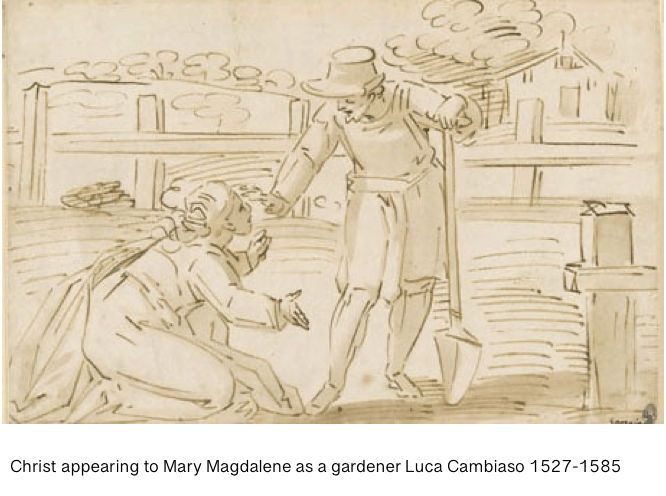
10. In John’s Gospel Mary Magdalene mistakes Jesus for a gardener, and the place where Jesus has been buried is presented as a garden. Does this resurrection story return us to Adam and Eve in the Garden of Eden?
Holy God,
Ground of our being,
You have moulded and shaped us from the earth,
and have planted us in the garden of your creation.
Feed us and prune us that we may fulfil your will
to green this earth-bound world.
Amen.
Part 2: Fire
What Is Fire Made Of?
According to Anne Marie Helmenstine it is “A flame is a mixture of its fuel, light, and the solids and gases that both form the fire and are produced by it. Incomplete combustion produces soot, which is mainly carbon… Fire is the result of a chemical reaction called combustion. At a certain point in the combustion reaction, called the ignition point, flames are produced. Ordinarily, flames consist primarily of carbon dioxide, water vapour, oxygen, and nitrogen… However, incomplete combustion yields a host of other possibilities. Soot is a primary component of incomplete combustion. Soot mainly contains carbon, but various organic molecules may occur… A candle flame consists of vaporised water, carbon dioxide, water, nitrogen, oxygen, soot hot enough that it is incandescent, and light/heat from the chemical reaction.” https://www.thoughtco.com/what-is-fire-made-of-607313
We might think of fire as having three properties: heat, light, and transformation.

- Do you like this picture? How does it make you feel? If you had been around, would you have one of the onlookers?
- Volcanic activity creates mountains and rift valleys; it produces igneous and metamorphic rocks. The latter are existing rocks, that are transformed into new hard, more dense rocks – shale becomes slate, granite becomes gneiss, limestone becomes marble. Volcanic activity leads to the formation of mineral deposits such as gold silver, lead, copper, and zinc and the creation of gem stones. Volcanoes are also by their nature destructive. How do we reconcile or understand the dual creative and destructive powers of volcanic activity with the belief in a loving God? Does it help to think of volcanic activity as transformative?
- How do you feel about this image (please use this link –https://en.wikipedia.org/wiki/Coalbrookdale_by_Night#/media/File:Philipp_Jakob_Loutherbourg_d._J._002.jpg) compared with the previous painting? Does the fact that this is an industrial scene, a man-made fire, make a difference? Do we see our human use of fire as creative in the same way we know God to be creative?
- Smelting is both destructive and constructive – removing impurities and creating new bonds between molecules to create a new material. As with volcanic activity we can describe the process as transformative. Does this alter our reading of passages such as this one from Ezekiel?
- Do you like this poem? Are there any words or phrases that stand out? In what ways is the poem describing the process of formation and how might this reflect on our own formation as individuals/ Christians?
- The eruption of Mount Vesuvius conjured up a sense of awe – or maybe fear – and wonder, as does the burning bush in this passage from Exodus. Is there something about fire that creates this feeling? Does fire express something of the untouchableness of God?
- What other examples of biblical stories about fire can you recall? (Eg The pillar of fire that leads the Israelites through the wilderness; God descending on Mount Sinai as fire; Elijah’s encounter with fire on the mountain; tongues of flame that appeared on the heads of the disciples on the day of Pentecost etc) What further attributes of God might fire reflect?
- How does this poem make you feel? Are there any words or phrases that stand out? What might Elizabeth Browning be saying about the relationship between God and the world around us? Why might it be that only some ‘see’?
- What can you see in this picture? https://huariqueje.tumblr.com/post/111116245661/candlelight-johannes-rosierse-dutch-painter
What is the girl doing? Is she a scholar, or a poet, or might she be writing a love letter? Is the candle just a source of light or might it also be a source of inspiration? Would a light bulb have the same power/ symbolism?
- Candles are often used in churches – why do you think this is? What is it that candles can represent? How might they aid worship? Maybe these words from the Psalms are relevant: Your word is a lamp for my feet, a light on my path. (Psalm 119:105) The LORD is my light and my salvation— whom shall I fear? The LORD is the stronghold of my life— of whom shall I be afraid? (Psalm 27:1)
- Holman Hunt made three copies of this painting; this is the first which is in Keble College. https://en.wikipedia.org/wiki/The_Light_of_the_World_(painting)#/media/File:Hunt-light-of-the-world.jpeg
There are two sources of light: one from the lantern symbolises the light of conscience, whilst that around Christ’s head is the light of salvation. Do you like the picture? How does it make you feel?
- Do you warm to this poem? How might this companionable description of fire describe – or not – our relationship with God?
From the hymn by Graham Kendrick
Lord, the light of Your love is shining
In the midst of the darkness, shining
Jesus, light of the world, shine upon us
Set us free by the truth You now bring us
Shine on me, shine on me
[Chorus]
Shine, Jesus, shine, fill this land with the Father’s glory
Blaze, Spirit, blaze, set our hearts on fire
Flow, river, flow, flood the nations with grace and mercy
Send forth Your word, Lord, and let there be light
Part 3: Water
Water – H2O – covers (currently) 71% of the earth’s surface. As we noted previously, the pressure of the earth’s atmosphere keeps it in its liquid state allowing it to form rivers, lakes and oceans. Having said that, it is also one of the few substances that under normal conditions can exist as liquid, gas and solid. It is a solvent of most other substances making it a key part of living organisms – humans comprise 57-60% water – conveying essentials such as oxygen, vitamins and minerals, sugars et around the body. It is known as the ‘solvent of life’. When living things are deprived of water they will die. The oceans were the first place where life evolved – indeed when life first evolved there was no dry land, only water.
In the beginning when God began to create the heavens and the earth, the earth was a formless void and darkness covered the face of the deep, while the Spirit of God hovered over the face of the waters. … And God said, ‘Let the waters under the sky be gathered together into one place, and let the dry land appear.’ And it was so. God called the dry land Earth, and the waters that were gathered together. he called Seas. And God saw that it was good. Genesis 1:1-2, 9-10
Now no shrub had yet appeared on the earth and no plant had yet sprung up, for the Lord God had not sent rain on the earth and there was no one to work the ground, but streams came up from the earth and watered the whole surface of the ground. ..The Lord God made all kinds of trees grow out of the ground—trees that were pleasing to the eye and good for food. Genesis 2:5-6, 9a
Yonder is the sea, great and wide, creeping things innumerable are there, living things both small and great. There go the ships, and Leviathan that you formed to sport in it. Psalm 104:25-26
- How well does the Bible capture the wonder of water as a creative medium? What images or experiences for you, characterises water as something creative?
By the first day of the first month of Noah’s six hundred and first year, the water had dried up from the earth. Noah then removed the covering from the ark and saw that the surface of the ground was dry. …Then God said to Noah and to his sons with him: “I now establish my covenant with you and with your descendants after you and with every living creature that was with you—the birds, the livestock and all the wild animals, all those that came out of the ark with you—every living creature on earth. I establish my covenant with you: Never again will all life be destroyed by the waters of a flood; never again will there be a flood to destroy the earth.” And God said, “This is the sign of the covenant I am making between me and you and every living creature with you, a covenant for all generations to come: I have set my rainbow in the clouds, and it will be the sign of the covenant between me and the earth.” Genesis 8:13, 9:9-13
2. In the story of Noah, is water a creative or a destructive force?
Could one view this story as a re-creation story?
3. Do you like this painting? How does it make you feel? What does it say to you about the power or the forcefulness of water?

4. (I don’t know the name of the artist of this second painting). How does this one make you feel? What does it convey about the baptism of Jesus? Do you like it?

In those days Jesus came from Nazareth of Galilee and was baptised by John in the Jordan. And just as he was coming up out of the water, he saw the heavens torn apart and the Spirit descending like a dove on him. And a voice came from heaven, ‘You are my Son, the Beloved; with you I am well pleased.’ Mark 1:9-11
5. The Gospel of Mark doesn’t contain a birth narrative so this brief passage is our first encounter with Jesus. In what ways might this be understood as a ‘birth’ narrative?
6. The following prayer comes from the Anglican baptism service and is said over the water in the font.
We thank you, almighty God, for the gift of water
to sustain, refresh and cleanse all life.
Over water the Holy Spirit moved in the beginning of creation.
Through water you led the children of Israel
from slavery in Egypt to freedom in the Promised Land.
In water your Son Jesus received the baptism of John
and was anointed by the Holy Spirit as the Messiah, the Christ,
to lead us from the death of sin to newness of life.
We thank you, Father, for the water of baptism.
In it we are buried with Christ in his death.
By it we share in his resurrection.
Through it we are reborn by the Holy Spirit.
Therefore, in joyful obedience to your Son,
we baptise into his fellowship those who come to him in faith.
Now sanctify this water that, by the power of your Holy Spirit,
they may be cleansed from sin and born again.
Renewed in your image, may they walk by the light of faith
and continue for ever in the risen life of Jesus Christ our Lord;
to whom with you and the Holy Spirit
be all honour and glory, now and for ever. Amen.
Are there phrases here that particularly catch your attention? How many different roles are given to water in this prayer and what are they?
7. The following poem, Baptism, is by Malcolm Guite.
Baptism
Love’s hidden thread has drawn us to the font,
A wide womb floating on the breath of God,
Feathered with seraph wings, lit with the swift
Lightning of praise, with thunder over-spread,
And under-girded with an unheard song,
Calling through water, fire, darkness, pain,
Calling us to the life for which we long,
Yearning to bring us to our birth again.
Again the breath of God is on the waters
In whose reflecting face our candles shine,
Again he draws from death the sons and daughters
For whom he bid the elements combine.
As living stones around a font today,
Rejoice with those who roll the stone away.
Do you like the poem? Are there any phrases that particularly catch your attention?
In what ways does it reflect the previous prayer, and in what ways does it add to the ideas contained in the prayer?
Reading this poem, how does it make you feel about baptism? Does it make you feel that you would like to renew your baptism promises, to renew your connection with your baptism? (The renewal of baptism vows often forms part of the Easter Day liturgy).
8. In the gospel of John, Jesus encounters a Samaritan woman with whom he has the following conversation.
Jesus said to her, ‘Everyone who drinks of this water will be thirsty again, but those who drink of the water that I will give them will never be thirsty. The water that I will give will become in them a spring of water gushing up to eternal life.’ John 4:13-14
What is the water Jesus is offering? Is it the water of baptism? Or is it a metaphor for the new – eternal – life that is our heritage as those who are born again/ born from above?
Does the use of water suggest that there is something universal about the offer or availability of eternal life?
9. Do you like this painting? If you lived in an ice and/or snow bound landscape, how do you think these first signs of spring would make you feel?

Might the freshly running water suggest freedom and newness of life? Perhaps after a period of dormancy?
10. The prophet Ezekiel is shown a vision by an angel of the restored temple in Jerusalem.
Then he brought me back to the entrance of the temple; there, water was flowing from below the threshold of the temple towards the east (for the temple faced east); and the water was flowing down from below the south end of the threshold of the temple, south of the altar. ….Then he led me back along the bank of the river. As I came back, I saw on the bank of the river a great many trees on one side and on the other. He said to me, ‘This water flows towards the eastern region and goes down into the Arabah; and when it enters the sea, the sea of stagnant waters, the water will become fresh. Wherever the river goes, every living creature that swarms will live, and there will be very many fish, once these waters reach there. It will become fresh; and everything will live where the river goes. … On the banks, on both sides of the river, there will grow all kinds of trees for food. Their leaves will not wither nor their fruit fail, but they will bear fresh fruit every month, because the water for them flows from the sanctuary. Their fruit will be for food, and their leaves for healing.’
This passage echoes Genesis 2 where water springs up from within the garden of Eden and then flows, in four branches, to water the whole earth. It also echoes the passage in the Book of Revelation where a river flows out from the throne of God through the streets of the new Jerusalem and along whose banks are trees whose leaves are for the healing of the nations.
Should all our churches have a fountain or stream of water to remind us of God’s enduring gift of life?

SALISBURY CATHEDRAL FONT
Water is the predominant feature of this work, its surface reflecting and extending the surrounding architecture, while four smooth filaments of water pass through spouts at each of the four corners of a bronze vessel and disappear through a bronze grating set into the floor. See video footage here. The base is clad in Purbeck stone. Here two contrasting aspects of water are woven seamlessly together: stillness expressed in the reflecting surface, and the flow and movement though the spouts expressing its essential life giving properties.
The shape was developed from a square footprint. A cruciform shape is created by scooping out radiused sections of the four sides. This immediately accentuates the directional flow of water, channelling it towards the corners which at the same time provide obvious and natural positioning within the embrace of the bronze vessel for priest and candidate for baptism.
The font was consecrated by the Archbishop of Canterbury on 28th September 2008. Until recently, Salisbury Cathedral had no permanently installed font. The move to procure a permanent font for Salisbury was initiated by the then Canon Treasurer June Osborne, who has gone on to become Dean of Salisbury.
During this decade, I installed a series of my own works at the North Porch Crossing which was the chosen location for the font. For the first one in 2001, I made a trapezoidal tray echoed the shape of St Osmond’s tomb. This was a temporary installation, primarily aimed towards demonstrating the immense potential of reflection of the surrounding architecture in still water within the Cathedral.
In the subsequent years, versions of my Brimming Bowl series were installed over the Easter periods, when they became temporary fonts for baptisms. These installations were all aimed towards finding a solution that would be acceptable to all parties involved including the congregation. Not only was I to produce a working font, but also to do something that would become a major attraction to the 90% of visitors entering the Cathedral who are not there to worship, but simply as visitors. A design was finally approved in 2007. https://www.williampye.com/works/salisbury-cathedral-font
Prayer
“With joy you will draw water
from the wells of salvation.
And you will say on that day:
Give thanks to the Lord,
call on his name;
make known his deeds among the nations;
proclaim that his name is exalted.”*
Lord Jesus may the fountain of living water
ever be renewed in our hearts.
Amen.
- Isaiah 12: 3-4
Part 4: Air
Air is a colourless, odourless mixture of gases comprising (typically) 78% nitrogen, 21% oxygen, 1% argon, 0.04% carbon dioxide, small amounts of other gases and a varying amount of water vapour – on average about 1% at sea level. Air forms layers around the surface of the earth known as the earth’s atmosphere. With increasing distance from the earth so the concentration of the gases in the atmosphere decreases. This wrap-around atmosphere protects life on earth in several ways:
- It creates sufficient pressure to ensure water remains as a liquid on the earth’s surface.
- It absorbs ultraviolet solar radiation.
- It retains heat (the greenhouse effect) that warms the earth’s surface
- and reduces the extremes of temperature between night and day.
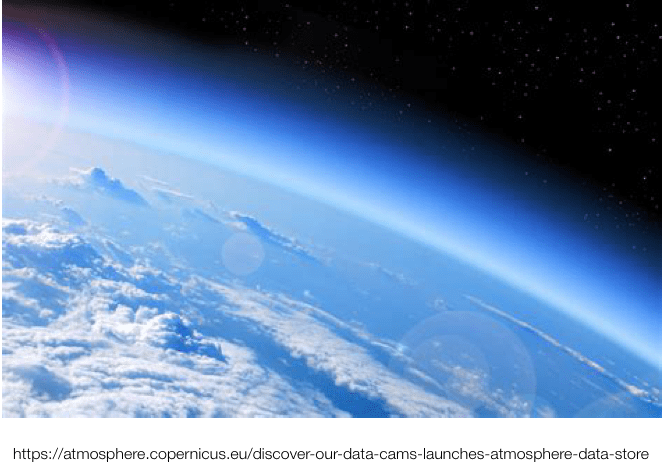
- How might this idea of a wrap-around atmosphere that protects the earth provide us with an image of God?
Air is essential for life. When we breath in the air fills our lungs and there the oxygen in the air is transferred into the cells of our body keeping them and thus our whole body functioning. This is true for all birds and animals. If we stop breathing, we die. In Genesis 2:7 God breathes life into Adam, and in Job 33:4, Job says “The Spirit of God has made me, and the breath of the Almighty gives me life.”
2. How does it make you feel to consider that the breath in you comes from God? How often do we think of the air as a gift from God?
Breath by Luci Shaw
When, in the cavern darkness, Jesus
opened his small, bleating mouth (even before
his eyes widened to the supple world his
lungs had sighed into being), did he intuit
how hungrily the lungs gasp? Did he begin, then,
to love the way air sighs as it brushes in and out
through the portals of tissue to sustain
the tiny heart’s iambic beating? And how,
fuelled by air, the dazzling blood tramps
the crossroads of the brain like donkey tracks,
corpuscles skittering to the earlobes and toenails?
Bottle of the breath of God, speaking in stories,
shouting across wild, obedient water, his voice
was stoppered only by inquisition, unfaith
and anguish. Did he know that he would,
in the end, leak all his blood, heave a final
groan and throw his breath,
oxygen for the world, back to its Source
before the next dark cave?
3. Do you like this poem? Do any words or phrases stand out?
What does it tell us about Jesus as human and Jesus as God?
4. John’s Gospel recounts how Jesus breathed on his disciples saying, “Receive the Holy Spirit.” (John 20:22) Do you think this deliberately mirrors the verse from Genesis 2? Is creation an on-going process of salvation?
Air that moves is wind. Winds occur due to differences in temperature across the earth. Warm air rises and as it does reduces the pressure of the air on the earth’s surface. Elsewhere cooling air will sink, increasing air pressure. Areas of low pressure will pull in more air, whilst in areas of high pressure air will be pushed out. This creates wind. Areas of very low pressure creates extreme winds such as typhoons and hurricanes.
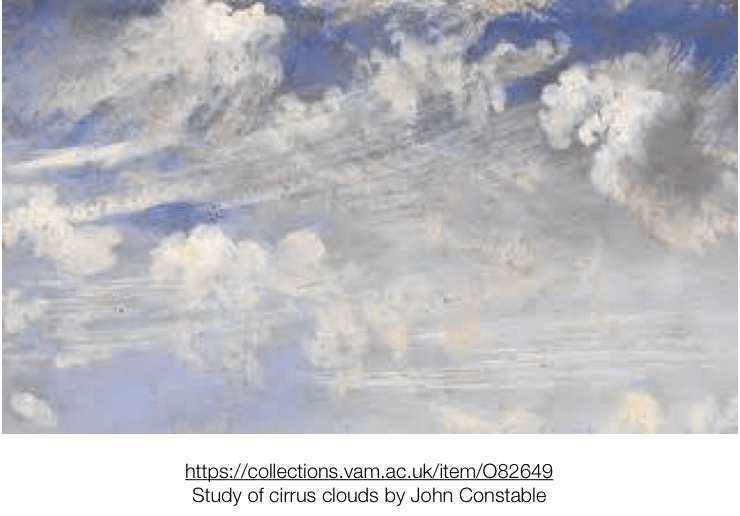

5.. Do you like either or both of these paintings? How do they each convey the presence of the wind? Are the colours they use important?
6. Winds enable us to feel the air. Have you memorable experiences of feeling the wind that you would like to share?
Is our experience of the wind different depending on the time of year – summer or autumn? Or place – urban street or beach?
Can wind change our mood?
7. Interestingly the Greek word used – pneuma – means both breath and spirit and wind. And Hebrew has a similarly multi-talented word – ruach – which again has the meaning of breath and sprit and wind.
How might it change our expectation of God’s presence in our lives, if we were to think of the Spirit within us as a storm or whirlwind? The writer of Genesis taps into this when he describes the presence of God hovering over the void of creation. And Jesus uses the same ambiguity when, in John’s gospel, he talks with Nicodemus.
Can you think of other examples in the Bible where the wind is used to indicate the presence of God?
“Pentecost Villanellette” by Mark Debolt
Not as a dove the Holy Spirit came
to the disciples gathered in a room,
but as a violent wind and tongues of flame.
A cyclone roared the ineffable name
as fire on each blushing brow did bloom.
Not as a dove the Holy Spirit came
to give sight to the blind and heal the lame
and raise the dead and dispel error’s gloom,
but as a violent wind and tongues of flame.
The Breath of God is anything but tame.
Who dally with it dally with their doom.
Not as a dove the Holy Spirit came,
but as a violent wind and tongues of flame.
(villanelle – a pastoral or lyrical poem of nineteen lines, with only two rhymes throughout, and some lines repeated.)
8. Do you like this poem? Are there particular words or phrases that stand out? Do you think that writer feels we have overly ‘tamed’ the Holy Spirit with our use of language?
Why is the sky blue? Light that from the sun is a spectrum of colours – as in a rainbow. The different colours have different waves lengths with blue and violet having the shortest. When the sun light reaches the earth’s atmosphere it is scattered or deflected by tiny gas molecules in the air – mostly nitrogen and oxygen. The shorter wave length colours are scattered most and so our eyes (which are also blue sensitive) see the sky as blue. At dawn and dusk the sun light we see has come through a greater depth of the atmosphere and then we see more of the longer wave length colours such as red and yellow.
The reds and yellows of sun sets and sun rises are intensified when the air is full of other particles such as are released by smoke and ash. Following the eruption of the Tambora Volcano eruption in 1815, there were several years when sunsets were particularly vivid and these intense colours were picked upon and recreated by J M W Turner.
9. Do you warm to this picture? How does it make you feel?
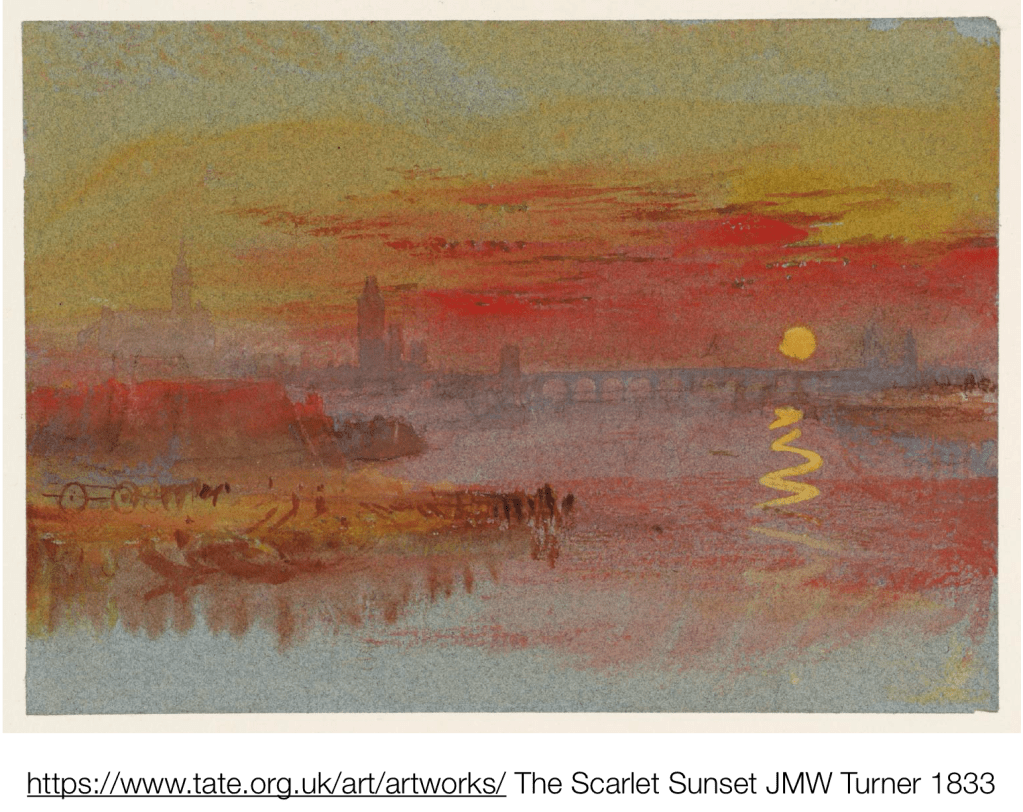
Are you surprised that the colour of the sky can be affected by a volcano eruption on the other side of the world? (Tambora is in Indonesia.)
This photo was taken in New York at midday in 2020 and shows the effect of smoke from the wild fires in California that were polluting the air.
According to the WHO, ‘Household combustion devices, motor vehicles, industrial facilities and forest fires are common sources of air pollution… [with] almost all of the global population (99%) breathe air that exceeds WHO guideline limits … Air quality is closely linked to the earth’s climate and ecosystems globally. Many of the drivers of air pollution (i.e. combustion of fossil fuels) are also sources of greenhouse gas emissions.’
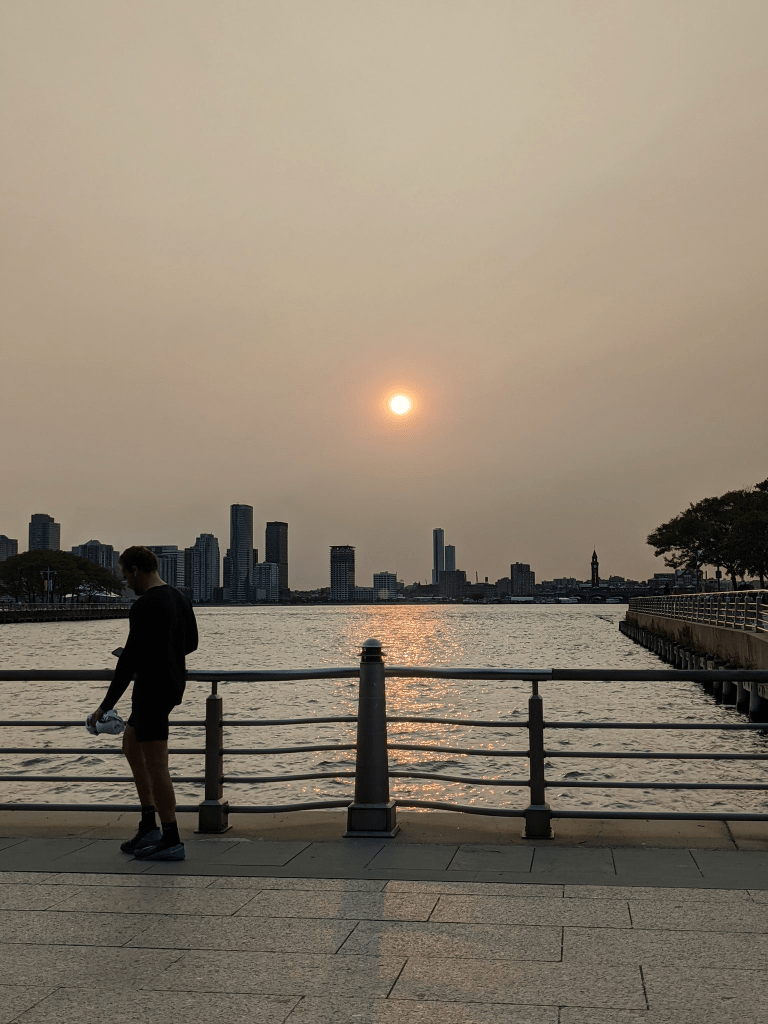
‘I brought you into a plentiful land to eat its fruits and its good things. But when you entered you polluted the earth, and made my heritage an abomination.’ Jeremiah 2:7
10. If we think of air or breath being God’s gift of life to us, how do we feel about air pollution that results from our current human lifestyle?
Do we need an annual day when we corporately repent of our sins against creation?
Prayer
All-powerful God, you are present in the whole universe and in the smallest of your creatures.
You embrace with your tenderness all that exists.
Pour out upon us the power of your love,
that we may protect life and beauty.
Fill us with peace, that we may live
as brothers and sisters, harming no one.
O God of the poor,
help us to rescue the abandoned and forgotten of this earth, so precious in your eyes.
Bring healing to our lives,
that we may protect the world and not prey on it,
that we may sow beauty, not pollution and destruction. Touch the hearts
of those who look only for gain
at the expense of the poor and the earth.
Teach us to discover the worth of each thing,
to be filled with awe and contemplation,
to recognise that we are profoundly united
with every creature
as we journey towards your infinite light.
We thank you for being with us each day.
Encourage us, we pray, in our struggle
for justice, love and peace.
Amen.
From Pope Francis’ Laudato Si
https://time.com/3925814/pope-francis-climate-change-encyclical-prayers


#/media/File:Hunt-light-of-the-world.jpeg)
Wow Judith. Such a lot here. Did you curate it yourself? I want to find a way I can use this. So much to engage with. Brilliant.
Sent from my iPhone
LikeLike