
27th January
“Biosphere Integrity refers to the capacity of ecosystems across the planet to support life and maintain the overall health and stability of the Earth system. This depends on the health, diversity, and interactions of the organisms that make up these ecosystems.” (1)
This is a safety boundary that we – because of human activity – have passed. We are living in the danger zone that means crises are inevitable. We experience this through rapidly declining numbers of pollinators (essential for growing crops); increasing soil infertility; declining ability of the environment to absorb carbon dioxide; declining ability of ecosystems to absorb rain so limiting flooding; loss of species removing opportunities to benefit from them for food, medicines, building materials etc; increasing loss of green and blue spaces that maintain our physical and mental wellbeing.
Human activities that are causing the loss of biodiversity integrity include:-
- Deforestation
- Changing land uses including the expansion of urban structures
- Increased intensification of agricultural
- Expansion of agricultural land use
- Industrialised fishing
- Expansion of mining activities including deep sea mining
- Expansion of industrial processes increasing pollution
- Expansion of activities producing greenhouse gases – eg use of fossil fuels and livestock farming
- Increased production of novel entities and the spread of invasive, non-indigenous species
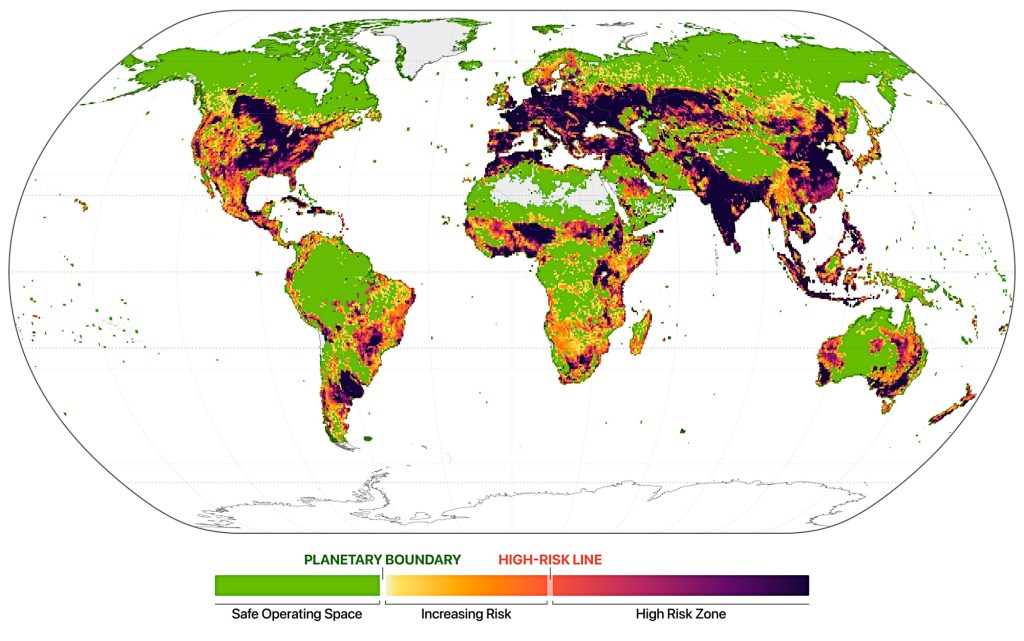
Global risk map of the Change in Biosphere Integrity, based on the functional integrity (HANPP) control variable. Transgression is based on the HANPP control variable. All values shown on the map refer to the year 2010. Based on data from Kastner et al. 2022.
Most boundary transgressions occur in large, continuous regions with high land-use intensity. In contrast, areas in regions without transgressions, such as the Amazon, the Congo Basin, and boreal forests, are primarily natural or semi-natural.

 The Green Tau