
6th Sunday of Easter

14th May 2023

Reflection (readings below)

Breathing is something we all do, all of the time, whether we’re asleep or awake, a newborn baby or as old as the hills.and as often as not, something we do without thinking. It’s a natural reflex. We do it subconsciously, without a thought. 

Yet if you have ever been to a yoga class or taken part in a guided meditation, you may have been invited to focus on your breathing. To feel the breath come in through your nose, followings it’s flow down into your body and feeling it lift your belly. And then to focus on the out breath, the air returning up through your body and out through your nose or mouth. Sudden,y you are much more aware of your breathing, its  sound, its feel, it rhythm. It can be a surprisingly calming and enriching experience!

Focusing on something, being more aware of it, can be a positive experience. Think of painting hanging on a wall – it can be just something we glance at. Or it might be that someone invites us to look at more carefully. It might be that someone can illuminate for us something about the making of the picture, about the artist or the circumstance. It might be someone can point out to us something interesting about the way the composition is structured, or about the symbolism of items or colours that have been used. Once our attention has drawn to the painting we may see it in a new, fuller and more rewarding way.

The same can be true of a poem, a piece of music, a piece of engineering, a landscape – once we know more about it, so our interest and enjoyment can be enhanced. 

I wonder if the same can be said of God? Whether or not we know God, whether or not we are aware of God, God is nevertheless always there. Whether or not we believe in God, God’s presence is still there, God’s power of life is still actively operating. God doesn’t need our awareness or our acknowledgment to be exist, to be God. This is something of what Paul is trying to articulate in his conversation with the people in Athens. He is doing it tactfully – not condemning them for not knowing God in a personal way, but affirming their endeavours to name that which can seem unknowable. (And who of us can say we truly know God? Often our own knowledge of God is vague or sketchy or misguided. I no longer think he is a white haired, bearded old man who is apt to throw thunderbolts. Indeed I don’t think he is a ‘he’ although at times ‘father’ or ‘dad’ can be a useful metaphor).

Thinking of metaphors, of names for God, I find it interesting that in the passage from John’s gospel, the Greek word “Paraklēton” is translated in so many different ways depending which version of the Bible you read: 

  • phonetically as Paraclete, 
  • Comforter – which might suggest a warm scarf or one of those  security  blankets we might have had as a child, but might equally might suggest the warm embrace of a loved one,
  • Advocate – someone to speak up in our defence, to present our character in the best possible light,
  • Guide – someone showing us the way, but not just showing the way, but explaining to us what is we are seeing as we journey, (think of London’s Blue Guides)
  • Helper – which now a days has perhaps the connotation of a daily cleaner, someone to pick up after us, or equally someone who  an step in when our efforts fall short. It can a.so suggest team work.
  • Counsellor – someone who will advise us on the best course of action, maybe a heavenly sort of civil servant
  • Intercessor – someone praying or pleading on our behalf
  • Perhaps less often, as a Consoler,
  • Or, jumping ahead to the feast of Pentecost, as Holy Spirit.

Etymologically the word ‘paraclete’ has two parts ‘para’ meaning alongside or around, and ‘kalein’ meaning to call or shout out: a shout out for help or assistance.

What Jesus is offering to his disciples, his friends, sounds exactly like what they were going to need in the aftermath of Jesus’s death, and what we certainly need today – a constant, at hand, source of comfort, support and guidance. Like our breathing, God is – and always has been – a constant presence; it’s just we need to be reminded to think about God. Like the painting – or like the scenery around us – God is and has always been there but until someone – like Jesus, like Paul, like St Francis, like the current Pope – invite us to look more closely, to see the underlying stories, the intricate details – we may miss out on the greater depth and joys that comes from an intimate relationship with God. This is what the life, death and resurrection of Jesus, offers us – the opportunity of a deep, close and intimate relationship with the ever-present God. Throughout the gospels Jesus is introducing us to God – God as the Son, God as the Father, and in today’s reading,  God as the Spirit. It is something he does expertly because he is God making God real to us.

Acts 17:22-31

Paul stood in front of the Areopagus and said, “Athenians, I see how extremely religious you are in every way. For as I went through the city and looked carefully at the objects of your worship, I found among them an altar with the inscription, ‘To an unknown god.’ What therefore you worship as unknown, this I proclaim to you. The God who made the world and everything in it, he who is Lord of heaven and earth, does not live in shrines made by human hands, nor is he served by human hands, as though he needed anything, since he himself gives to all mortals life and breath and all things. From one ancestor he made all nations to inhabit the whole earth, and he allotted the times of their existence and the boundaries of the places where they would live, so that they would search for God and perhaps grope for him and find him—though indeed he is not far from each one of us. For ‘In him we live and move and have our being’; as even some of your own poets have said,

‘For we too are his offspring.’

Since we are God’s offspring, we ought not to think that the deity is like gold, or silver, or stone, an image formed by the art and imagination of mortals. While God has overlooked the times of human ignorance, now he commands all people everywhere to repent, because he has fixed a day on which he will have the world judged in righteousness by a man whom he has appointed, and of this he has given assurance to all by raising him from the dead.”

Psalm 66:7-18

7 Bless our God, you peoples; *
make the voice of his praise to be heard;

8 Who holds our souls in life, *
and will not allow our feet to slip.

9 For you, O God, have proved us; *
you have tried us just as silver is tried.

10 You brought us into the snare; *
you laid heavy burdens upon our backs.

11 You let enemies ride over our heads;
we went through fire and water; *
but you brought us out into a place of refreshment.

12 I will enter your house with burnt-offerings
and will pay you my vows, *
which I promised with my lips
and spoke with my mouth when I was in trouble.

13 I will offer you sacrifices of fat beasts
with the smoke of rams; *
I will give you oxen and goats.

14 Come and listen, all you who fear God, *
and I will tell you what he has done for me.

15 I called out to him with my mouth, *
and his praise was on my tongue.

16 If I had found evil in my heart, *
the Lord would not have heard me;

17 But in truth God has heard me; *
he has attended to the voice of my prayer.

18 Blessed be God, who has not rejected my prayer, *
nor withheld his love from me.

1 Peter 3:13-22

Now who will harm you if you are eager to do what is good? But even if you do suffer for doing what is right, you are blessed. Do not fear what they fear, and do not be intimidated, but in your hearts sanctify Christ as Lord. Always be ready to make your defence to anyone who demands from you an accounting for the hope that is in you; yet do it with gentleness and reverence. Keep your conscience clear, so that, when you are maligned, those who abuse you for your good conduct in Christ may be put to shame. For it is better to suffer for doing good, if suffering should be God’s will, than to suffer for doing evil. For Christ also suffered for sins once for all, the righteous for the unrighteous, in order to bring you to God. He was put to death in the flesh, but made alive in the spirit, in which also he went and made a proclamation to the spirits in prison, who in former times did not obey, when God waited patiently in the days of Noah, during the building of the ark, in which a few, that is, eight persons, were saved through water. And baptism, which this prefigured, now saves you– not as a removal of dirt from the body, but as an appeal to God for a good conscience, through the resurrection of Jesus Christ, who has gone into heaven and is at the right hand of God, with angels, authorities, and powers made subject to him.

John 14:15-21

Jesus said, ”If you love me, you will keep my commandments. And I will ask the Father, and he will give you another Advocate, to be with you forever. This is the Spirit of truth, whom the world cannot receive, because it neither sees him nor knows him. You know him, because he abides with you, and he will be in you.

”I will not leave you orphaned; I am coming to you. In a little while the world will no longer see me, but you will see me; because I live, you also will live. On that day you will know that I am in my Father, and you in me, and I in you. They who have my commandments and keep them are those who love me; and those who love me will be loved by my Father, and I will love them and reveal myself to them.”
Counting on … day 1.119

13th May 2023

Using the model of  a citizen’s assembly, the WWF, the RSPB and National Trust put together The People’s Plan for Nature – a vision for the future of nature, and the actions we must all take to protect and renew it. 

The Plan, amongst other things, “…calls on individuals and communities to: 

  • be knowledgable about how nature assets in their areas are supposed to be protected (particularly designated protection sites); take personal responsibility for their own actions within these spaces and be empowered to act around damage to nature where they live.
  • Change their consumption patterns to support nature-friendly businesses, even if the costs to themselves are higher.’

Green Tau: issue 69

Earth Overshoot Day

13th May 2023

If I had a capital sum of £10,000 that provided me with an income of £1000 a year and provided my annual expenditure did not exceed £1000, I would be set up for life. 

If however I spent £1500 a year, whilst I would not have a problem in the short term, I would in the long term. For to have £1500 to spend I would have to use £500 from my capital which would be fine in the first year. In the second year however my income would be only £950 because the capital driving it had been reduced. I would either have to curtail my living expenses or if I was less wise, extract more from the capital. If in year 2 my expenditure was still £1500, then in the following year my income would be further reduced £895. To maintain my expenditure at £1500 I would have to extract £650 from my  capital sum, reducing it still further to £8905. In less than 20 years I would be bankrupt. 

We are in the same situation here on earth. The earth represents our capital sum. Each year the earth produces resources (crops, minerals, clean air and water plus the ability to absorb unwanted pollutants) which is our income. If we live within our income then our lifestyles are sustainable. If we live beyond our means, drawing down capital as well as income, then we are heading towards bankruptcy. 

Since the 1970s scientists at the Global Footprint Network  have been calculating how much of the earth’s resources we are using. For millennia our human consumption of resources to feed and clothe ourselves, to build homes and cities, to travel and pursue leisure habits, has been well within the capacity of the earth’s resources. However since the early 1970s this has ceased to be so. We have so increased our consumption that we are eating into the earth’s capital reserves. As of 2022, we would require 1.75 worlds to satisfy our global needs. We don’t have any spare worlds, so we are, year on year, sinking further into the red.

Each year the Global Footprint Network calculates the day on which we will have consumed our full quota of available resources. This is known as Earth Overshoot Day. In 1971 Earth Overshoot Day was 25th December. In 2022 it was 28th July. The only year when the date when into reverse was in 2020 during the Covid pandemic when Earth Overshoot Day was 22nd August – which at least shows we can make a positive impact if we choose.

As well as calculating Earth Overshoot Day for the whole world, the Global Footprint Network makes similar calculations of each country. Some countries don’t even consume their full quota, but of those that do, their individual Earth Overshoot Days vary from 21st December for Mali, 11th November for Egypt, 31st August for Mexico, 2nd June for China, 13th March for the USA, 10th February for Qatar. 

And the UK? Our Earth Overshoot Day falls next week, on 19th May.

Globally and as individual countries we need to be adjusting our lifestyles to ensure that they are sustainable and at the same time, restoring the depleted parts of the planet – restoring the fertility of soils, improving biodiversity, increasing tree cover on land and kelp forests under the sea, cleaning up waterways and seas, and reducing green house gas emissions.

This will need system change across the world, but it is also something we can effect as individuals. To explore how you might reduce your environmental footprint try the Global Footprint Network’s calculator. By playing around with the answers you give, you may find ways in which you could comfortably make positive changes to your lifestyle. 

https://www.footprintcalculator.org/home

Counting on … day 1.118

12th May 2023

Interesting comments from RSPB –  “One of the latest experiments is planting wildflower strips and alleys of trees within fields. Research has already shown that planting wildflower strips helps bring beneficial insects into the fields, which is good for pollination and pest control. But this ten-year trial hopes to show the strips with trees can help in other ways too, such as:  

  • A wildlife boom – from earthworms underground to the birds in the treetops to everything in between, we hope the strips will increase beneficial wildlife including beneficial pollinators and natural pest controllers. The trial will also look to see if the trees have a negative impact on any species.  
     
  • Carbon catching trees – we know trees store carbon – but we want to find out accurate figures for how much carbon our trees can capture to help inform future work.
     
  • Make some money –  apple and cobnut trees within the alleys can provide another source of income. We’ll be keeping a close eye on whether these trees bring home the bucks as well as the bugs.”

https://www.rspb.org.uk/get-involved/activities/so-many-ways/explore-more-ways/farm-with-flower-power/

Counting on … day 1.117

11th May 2023

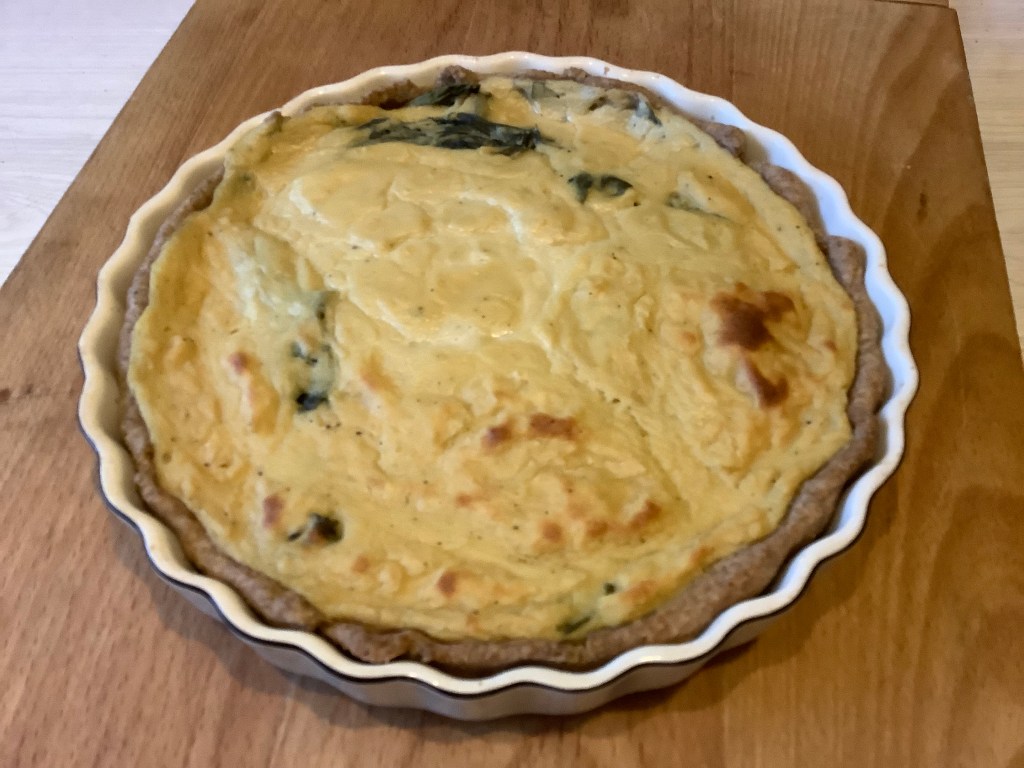
Vegan Quiche

Make a short crust pastry with 200g flour and 100g vegan butter. Use this to line a flan dish

Lightly cook a colander  full of green leaves (spinach, chard, dandelion, herbs etc).  This can be done easily in a microwave.

Make a white sauce using 3 level tablespoons of yellow pea flour and about 500ml of oat milk. (Again this can be done in a microwave). Flavour with yeast flakes and black pepper.

Sautée an onion in some oil. 

Place the onion in the encase of the flan, add the green leaves and pour the sauce over the top.

Bake at 200C for about half an hour or until the quiche is golden and the middle firm.

Counting on … day 1.116

10th May 2023

A report from Euro News – “The EU has approved plans for the Dutch government to buy out farmers. The scheme is part of the Netherlands’ plan to drastically slash nitrogen emissions, a major source of which is livestock farms. Farmers in the Netherlands have been staging protests over emissions reduction targets since October 2019 – The Dutch ruling coalition wants to cut emissions, predominantly nitrogen oxide and ammonia, by 50 per cent nationwide by 2030. Nearly €1.5 billion will be used to compensate farmers who voluntarily close farms located near nature reserves. Some 3,000 farms are expected to be eligible.” https://www.euronews.com/green/2023/05/03/dutch-farmers-could-be-paid-to-close-their-livestock-farms-under-new-scheme?utm_source=newsletter&utm_medium=green_newsletter&_ope=eyJndWlkIjoiMTJjMTk2MDNmOWI2YTEwZmZmMTQ0ODYyMWQ3NDJhNDcifQ==

The reduction in livestock numbers will also make a positive contribution to carbon emissions. 

Counting on … day 1.115

9th May 2023

This week is National Hedgerow Week. Hedgerows can be an excellent space where biodiversity thrives – both in terms of the range of plants that can be found there, and in terms of the number of birds, insects and small mammals that benefit from its ecosystem. Hedges can also serve as wild life corridors linking areas of rich biodiversity. Sadly many  hedgers have been lost as increasing industrialisation of farming has led to the use of larger  pieces of machinery (ploughs, sprayers, harvesters) which can only be used in large fields – ie combined smaller fields where the hedges have been removed. 

Since gardens too can be home to hedges, I was particularly attracted to the idea of creating a hedge using home grown plants – a long term project which will see a hedge replace a row of raspberries reaching the end of their fruitful lifespan. And the National Hedgrewo Week website provides just the information for doing this – https://treegrowersguide.org.uk/

Counting on … day 1.114

8th May 2023

Our vegetable patch is currently under a similar maintenance regimen to the lawns – limited intervention and just seeing which plants self seed and which perennials survive. One plant that self seeds freely is lamb’s lettuce which provide green salad leaves through most of the year. It is currently coming into flower but  I am still picking bits for lunch. As it is going to seed, so other plants are coming on stream. Today’s salad included marjoram, salad burnet, sweet cecily, fennel, wild garlic, garlic mustard and the inner leaves of rainbow chard. 

5th Sunday of Easter 

7th May 2023

That first Easter the risen Jesus who was seen and heard and touched was the ultimate sign of the resurrection. Now some 2000 years later what are the signs we might look for to confirm the ongoing validity of the resurrection? What signs of new or renewed life do we see that point to the power, the glory of God? 

Today’s psalm reminds us that in God we can find our refuge when life seems set against us. In our relationship with God we can find strength that offers solidity and ensuring support. This is the God of our salvation, the God of mercy and love. How and/ or where do we find this God? In our churches, in our communities, in our homes?

At what point do we realise that we are part of that community, that place, that home, that makes the living God a risen reality? When over the last weeks we have read in the Book of Acts of the new community of Christians that was growing larger by the day, eat and worshipping together, sharing their wealth with each other, we were witnessing the resurrection, the new life being nurtured in the follower of Jesus. This community – nascent church – was a place of refuge and security for the believers. It enabled people like Stephen to stand up for what he – for what they all – believed. It gave them the confidence that they were God’s children, that God was with them in this life and the next, and that in neither had they anything to fear. 

As described in the Letter of Peter this was a church, a spiritual dwelling, built in the sure corner stone that was Jesus. And on that corner stone, the followers of Jesus, the first Christians, were its walls: living stones. And now in the 21st century we are the current generation of living stones that create the spiritual dwellings, the communities, where the risen Christ is to be found. We are called to be the places of safety and refuge in what feels like an increasingly conflicted world. 

Today’s readings tell us both that Jesus is the corner stone on which we have been established, and that Jesus as ‘the Way, the Truth and the Life’ is the means – the route map, the philosophy, the blue print  – by which we can be built into the church. 

For the early church of the Book of Acts, the church being built needs the capacity to confront other religious groups who were unwilling to accept Jesus as the Messiah, the Son of God. They needed people who could preach to the crowds and talk to the authorities on this issue. They needed people who were willing to be arrested and even executed for the cause. They also needed people who could lead the church, both in terms of resolving disputes and ensuring a fair distribution of resources to meet people’s daily needs, as well as those who could lead in terms of worship, teaching and discipleship. They needed people who could explore new strands of  theology relevant to the changing circumstances in which they lived, and in this capacity they needed people who could peer into the future and see what lay ahead and what the challenges might be. In all this, they guidance came from their relationship with Jesus.

As living stones of the 21st century church, here in the UK, we need to be confront various issues including the climate crisis, the cost of living crisis, the lack of integrity and responsibility shown by the government, the refugee and asylum crisis, the bio-diversity crisis, the lack of global justice and the failure of rich countries to help the poorer ones – to name a few.

Do we as a church have people who can talk to the authorities and to the wider public on these issues? Do we have people who are sufficiently well versed in the sciences and in the art of rhetoric? Do we have people who were willing to be arrested and imprisoned for these causes? Do we have leaders administer communities sympathetically, leaders who can ensure a fair distribution of resources to meet people’s daily needs?  Do we have leaders who can lead in terms of worship, teaching and discipleship such that they reflect the crisis of the current age? Do we have  people who can explore new strands of  theology relevant to the changing circumstances in which we live? Do we have people who can peer into the future and see what lies ahead and what the challenges might be. 

In all this, can we seek  guidance from our relationship with Jesus?

Acts 7:55-60

Filled with the Holy Spirit, Stephen gazed into heaven and saw the glory of God and Jesus standing at the right hand of God. “Look,” he said, “I see the heavens opened and the Son of Man standing at the right hand of God!” But they covered their ears, and with a loud shout all rushed together against him. Then they dragged him out of the city and began to stone him; and the witnesses laid their coats at the feet of a young man named Saul. While they were stoning Stephen, he prayed, “Lord Jesus, receive my spirit.” Then he knelt down and cried out in a loud voice, “Lord, do not hold this sin against them.” When he had said this, he died.

Psalm 31:1-5, 15-16

1 In you, O Lord, have I taken refuge;
let me never be put to shame; *
deliver me in your righteousness.

2 Incline your ear to me; *
make haste to deliver me.

3 Be my strong rock, a castle to keep me safe,
for you are my crag and my stronghold; *
for the sake of your Name, lead me and guide me.

4 Take me out of the net that they have secretly set for me, *
for you are my tower of strength.

5 Into your hands I commend my spirit, *
for you have redeemed me,
O Lord, O God of truth.

15 My times are in your hand; *
rescue me from the hand of my enemies,
and from those who persecute me.

16 Make your face to shine upon your servant, *
and in your loving-kindness save me.

1 Peter 2:2-10

Like newborn infants, long for the pure, spiritual milk, so that by it you may grow into salvation— if indeed you have tasted that the Lord is good.

Come to him, a living stone, though rejected by mortals yet chosen and precious in God’s sight, and like living stones, let yourselves be built into a spiritual house, to be a holy priesthood, to offer spiritual sacrifices acceptable to God through Jesus Christ. For it stands in scripture:

“See, I am laying in Zion a stone,
a cornerstone chosen and precious;

and whoever believes in him will not be put to shame.”

To you then who believe, he is precious; but for those who do not believe,

“The stone that the builders rejected
has become the very head of the corner”,

and

“A stone that makes them stumble,
and a rock that makes them fall.”

They stumble because they disobey the word, as they were destined to do.

But you are a chosen race, a royal priesthood, a holy nation, God’s own people, in order that you may proclaim the mighty acts of him who called you out of darkness into his marvellous light.

Once you were not a people,
but now you are God’s people;

once you had not received mercy,
but now you have received mercy.

John 14:1-14

Jesus said, “Do not let your hearts be troubled. Believe in God, believe also in me. In my Father’s house there are many dwelling places. If it were not so, would I have told you that I go to prepare a place for you? And if I go and prepare a place for you, I will come again and will take you to myself, so that where I am, there you may be also. And you know the way to the place where I am going.” Thomas said to him, “Lord, we do not know where you are going. How can we know the way?” Jesus said to him, “I am the way, and the truth, and the life. No one comes to the Father except through me. If you know me, you will know my Father also. From now on you do know him and have seen him.”

Philip said to him, “Lord, show us the Father, and we will be satisfied.” Jesus said to him, “Have I been with you all this time, Philip, and you still do not know me? Whoever has seen me has seen the Father. How can you say, ‘Show us the Father’? Do you not believe that I am in the Father and the Father is in me? The words that I say to you I do not speak on my own; but the Father who dwells in me does his works. Believe me that I am in the Father and the Father is in me; but if you do not, then believe me because of the works themselves. Very truly, I tell you, the one who believes in me will also do the works that I do and, in fact, will do greater works than these, because I am going to the Father. I will do whatever you ask in my name, so that the Father may be glorified in the Son. If in my name you ask me for anything, I will do it.”

Counting on …day 1.113

7th May 2023

Plant Life is again this year promoting its No Mow May campaign. Not mowing lawns during May allows more of the flowering plants and grasses in the lawn to bloom providing pollen, and nectar for numerous insects. 

I cut our lawns perhaps twice a year, whilst at the same time encouraging/ transplanting flowering plants  such as dandelions, buttercups, plantains etc to provide a long season of plants that can  benefit wildlife. The dandelions, for example, provide nectar for bumble bees and later seeds for gold finches. Currently the front lawn is full Spanish bluebells – very colourful!

The long grass doesn’t stop us for sitting out, on either deck chairs  or blankets, and enjoying sunny weather.

The long grass is possible also better able to cope with periods of drought.