
Lent 2023
This Lent discussion course is an exploration of how our understanding of evolution reflects on, our understanding of salvation. As Paul writes in 1 Corinthians 13:12a For now we see in a mirror, obscurely but then we will see face to face. Now I know only in part
The discussion material is in five parts.
Session 1 – Survival of the fittest
Session 2 – Survival through cooperation
Session 3 – Ecosystems
Session 4 – Ecosystems and keystone figures who dominate
Session 5 – Ecosystems and keystone figures who provide

Session 1 – Survival of the fittest
At its simplest, evolution is the changing shape, character and characteristics of a living thing over time. The theory is that those with the best adapted shapes, characters and characteristics, will survive whilst others less well equipped do not, and that only the former – the best equipped – will go on to produce offspring carrying forwards those same beneficial features.
For example in a world of wolves and deer, the deer that have longer legs, stronger hearts, and faster pace, will survive and produce young with equally long legs, strong hearts and fast pace. Whilst on the other hand, deer with shorter legs, less efficient hearts and a slow pace will fall prey to the wolves and their characteristic will die with them.
We can see an example of this from recent history.
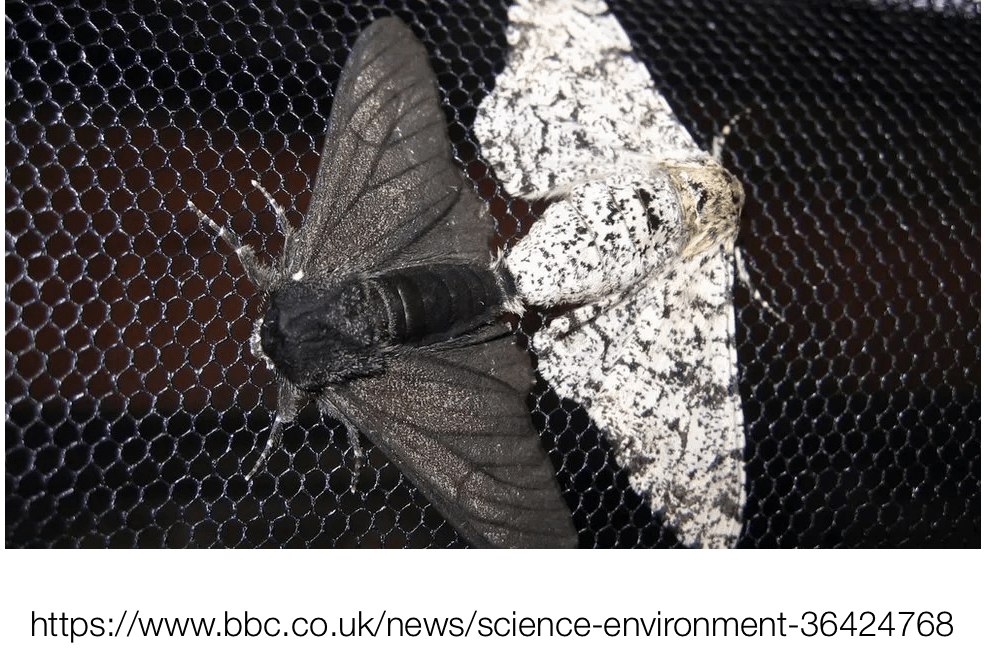
During the 19th century the peppered moth which typically had white wings peppered with grey, changed in appearance such that by the end of the century its wings were entirely black. The moth’s colouring was it camouflage, when resting on tree trunks or walls, preventing it from falling prey to the next hungry bird. But as industrialisation and its smuts changed the colour of walls and tree trunks, so it was that the darker variants of the moth were the ones that survived. Over the century the peppered moth became an insect with largely black wings. (Since the Clean Air Acts of the 1960s the colouring of these moths has again been subtly changing). A
1. Do we expect to find survival of the fittest as a biblical theme, or do we expect the Bible to be ‘above’ that? Is the ‘survival of the fittest’ God’s way or is there alternative – Godly – form of evolution?
Take for example the story of Noah and the great flood (Genesis 6 and following), of Joshua and the Battle of Jericho (Joshua 5 & 6), or of Samson and the Philistines (Judges 15). Are these stories that tell of the survival of the fittest?
2. Alternatively what about the story of David and Goliath? Is this about survival of the fittest? If so, what are the outstanding characteristics of the winner that ensured survival? What is it that makes David fitter?
In the prequel to this story, the prophet Samuel is told by God to visit the sons of Jesse so that God can direct which should be anointed as the future king. Samuel looks at Jesse’s sons and is confident that God will ask him to choose the tallest or strongest or the most beautiful of the sons. But instead it is David, the youngest son – of the smallest tribe – that is chosen. But as the story unfolds, we learn that when the people get to express their opinion as to who should be king, they are looking for the strongest and the most successful warrior. They choose David, because whilst Saul has killed thousands, David has killed tens of thousands (1 Samuel 18).
Is there a difference between God’s understanding of fitness and that of humans?
3. Or we might look at the story of Elijah. Elijah, a prophet of God, alternates between self doubt and supreme confidence. A lone figure, he is willing to challenge both King Ahab and his fearsome wife Queen Jezebel, and yet then he flees in fear wishing only to die. When it comes to a show down with Ahab, he sets up a competition between himself and the prophets of Baal but does so in a way that puts himself at a complete disadvantage (1 Kings 18). What is the message that Elijah is giving Ahab about power, fitness, and God?
4. What do these stories suggest to us as to what is the key to survival in God’s eyes?
How does God appear to rate attributes such strength or height or popularity?
What other unlikely heroes are there in the Bible?
Let us pause to consider the meaning of the word ‘salvation’. It can mean deliverance from harm, ruin, loss or in religious terms, from the consequences of sin. It can also mean preservation from such ills.
One of the key messages of the Old Testament is the survival of the people (people here being a group or nation rather than a single person) of God. When the people follow God’s way things go well for them; when they turn away from God, things go from bad to worse. When the people realise their plight and turn back to God, then things again return to favourable. The story of God’s people is a cycle of falling into sin, a period of suffering, and finally a time of restoration – of salvation.
5. Is the story of salvation also a story of survival of the fittest – where the fittest are those that follow God’s way?
Is salvation in the Old Testament measured by the survival of God’s people?
Yet the number of the Israelites will be like the sand of the sea, which cannot be measured or counted. And it will happen that in the very place where it was said to them, ‘You are not My people,’ they will be called ‘sons of the living God.’ Hosea 1:10
If the LORD Almighty had not let some of the people survive, Jerusalem would have been totally destroyed, just as Sodom and Gomorrah were. Isaiah 1:9
A time is coming when the people of Israel who have survived will not rely any more on the nation that almost destroyed them. They will truly put their trust in the LORD, Israel’s holy God. Isaiah 10:20
6. It is interesting to note that these verses from Hosea and Isaiah are used by Paul in his letter to community in Rome, exploring how it is that both Jews and Gentiles will gain from God’s salvation.
Can salvation in the New Testament also be understood as the survival of God’s people – albeit a definition that includes both Jew and Gentile – or is there a greater emphasis on inclusivity and well being?
Every day they continued to meet together in the temple courts. They broke bread in their homes and ate together with glad and sincere hearts, praising God and enjoying the favour of all the people. And the Lord added to their number daily those who were being saved. Acts 2: 46-47
7. The creation story in Genesis 1 unfolds a series of stages which ends with a complete and harmonious world full of diverse life forms. The related refrain is that everything thing that was created was good because God had willed it into being. The story doesn’t specify or explore the idea of evolution but celebrates the harmony and goodness of all that has been created.
Does this image of harmony and goodness match with the world as we see it?
8. If the world is not a place of harmony and goodness, is this because the world once was in such a state but is no longer? Or is it that that creation of the world a work in progress that has yet to achieve this state of harmony and goodness?
We know that the whole creation has been groaning in labour pains until now; and not only the creation, but we ourselves, who have the first fruits of the Spirit, groan inwardly while we wait for adoption, the redemption of our bodies. Romans 8:22,23
Then Job replied to the LORD: “I know that You can do all things and that no plan of Yours can be thwarted. Job 42:1,2
9. As the world is not yet a place of harmony and goodness, can we understand salvation as the means by which such harmony and goodness can be achieved?
Might evolution and salvation have the same goal?
Are either achievable without God?
Prayer
May the God of all love
who created us,
be our source of wisdom.
May the God of all love
who heals us,
preserve us from all evil.
May the God of all love
who desires our wellbeing,
be our guide.
Amen.
——————————————————————————————————————————————————————
Session 2 – Survival through Cooperation
Last week we looked at evolution as survival of the fittest. Whilst we might initially have thought that means survival of the strongest, the fastest or the biggest, fitness can be measured in other ways such as the camouflaging ability of a butterfly’s wings. With reference to Biblical stories, the fittest person or community might be the one most in tune with God.
If evolution is the survival of the fittest, the implication is that the least fit species die out. Darwin was ridiculed because it was understood that the theory of evolution suggested humans had evolved from apes. That people felt, was to undervalue humans because of course humans were nothing like apes, and to undermine the Bible because Genesis describes God creating humans from scratch with no intervening developmental stages, and to devalue God by suggesting that evolution not God was responsible for the design of humans.
Standing back to look at the science. (Please not I am not a scientist by training but enjoying finding out about the way things work through reading and observation. Some of the ideas below come from reading Peter Godfrey-Smith’s ‘Other Minds: The Octopus and the Evolution of Intelligent Life’).
The first living organisms to emerge from the big bang were single cell organisms floating in the sea. One of the most studied single cell organisms is the E.coli bacteria. This bacteria can taste or small the chemical around it, distinguishing chemicals that benefit it (food) and those that don’t. It can move either in a straight line or by tumbling. If it senses an increasing about of good chemicals it will move in a straight line: if not it will go into tumbling motion. And so it has existed unchanged since it first appeared as a living organism. Yet the world is not occupied solely by single cell organisms, however ‘fit’ they are.
Rather some single cell bacteria paired up with others increasing the possibilities of what they could do. Some developed features such as becoming light sensitive. This would enable the organism to respond not just to levels of chemicals in its environment but to levels of light as well. That is an evolutionary step, but not one that caused the extinction of bacteria that only had the smell/ taste sensibility. The skill of being light sensitive could lead to the development of other features such as seeking out food or seeking out shelter from would be predators. This process of acquiring developmental improvements ultimately leads to the appearance of more and more sophisticated sea creatures, land creatures etc.
This process of development is not purely linear. Each developmental step can allow for variation. Light sensors can develop into eyes but that could be eyes on the side of the head such as for a horse or at the front as for a cat, or all around like the box jelly fish (it has lots of eyes).
This type of development can be liken to a tree, with single cell organisms at the base and branches leading off in different directions . (A shrub of life might be a better description as there isn’t really a trunk)
1. At each developmental stage, is the new species inherently better than the one from which it has evolved? Are humans ‘better’ than apes? Are dogs better than wolves?
2. What advantages do apes have over humans in the way that they live? What skills do apes have that humans do not?
What disadvantages do apes contend with in comparison with those that face humans?
Initially, at the dawn of time and for a considerable time thereafter, there were just chemically enriched seas and single cell organisms floating in that liquid. As geological time continued the landscape changed, land emerged from above the waters, and some of the life forms that had been sea dwellers became land dwellers.
3. Is evolution actually an opportunistic process?
Is the availability of new opportunities or niches that can be filled or exploited the spur for change?
4. To what extent is the story of creation in Genesis 1 about species filling niches in the world as it evolves? What might this tells us about God’s vision for the world?
5. Does the theory of evolution that we have explored thus far, undermine the value of humans, or undermine the understanding of God as creator?
As the landscape of the earth has evolved and as species numbers have grown both in size of population and in types of species, so the spaces and niches to occupy have frequently come under pressure. Who gets the space? Is it resolved by bigger/ stronger/ fitter species removing or displacing others – competition? Or it could be resolved through working together, finding mutually beneficial solutions – cooperation?
In the Galápagos Islands finches and iguanas have an interdependent relationship. The finches perch on the iguana’s back and peck at loose or dead scales, mites and insects that would otherwise harm the reptile. For their part, the finch gets a meal. (The finches likes wise have a cooperative relationship with other reptiles such tortoises). The same relationship can be seen in the African Savannah where ox-peckers groom grazing mammals such as wildebeest, kudu and rhinoceros.
The aplomado falcon in South America will hunt solo when after small prey such as insects, but will team up with others when hunting a larger prey is this helps ensure more successful hunting and food for all. Jackals and cheetahs are also known to cooperate – the jackal distracts the prey allowing the cheetah a better chance of success, and the jackal is rewarded by scavenging the carcass. Not all cooperation is about improved hunting. Ostriches and zebras often live in mixed groups for mutual benefit. Ostriches have a better sense of smell than zebras, whilst zebras have a better sense of sight. Relying on warning from each other provides better protection from predators.
Another cooperative relationship across species is between humans and dogs – hunting together – or humans and cats – cats eat pests that would otherwise diminished stored food, and at the same time receive a safe place to live. Likewise dogs may guard a dwelling in return for food.
Safety also comes in numbers as with shoals or fish of herds of deer. Herding behaviour also protects vulnerable offspring and may extend to child care offered by ‘aunts’ such as is seen with elephants.
Cooperation is a good way of surviving!
6. In the second creation story in Genesis 2, for the earth to flourish it needs water and someone to till the ground and care for the plants God has sown in the garden of Eden. These plants will provide the food for those that cultivate the soil. God supplies the water and creates Adam. Then God creates a whole array of different creatures to help Adam in tilling the soil. Whilst Adam is happy to cooperate with God, to follow God’s way, all is well. But what happens when that cooperation fails?
When Adam and Eve eat the apple, is it just the relationship they had with God that has broken, or have other relationships also been broken?
7. One of the great salvation stories of the Old Testament is that of the Exodus. For a long while the Israelites have been slaves in Egypt, their freedom has been curtailed. God rescues them from the power of the Pharaoh and the people set off under the leadership of Moses across the wilderness to the Promised Land. The Israelites can no longer rely on the Egyptians to provide them with shelter, food and water. Instead they have to cooperate with one another and with God. How might the Ten Commandments have helped instil the lessons of cooperation?
8. Which of these stories provide teaching about the importance of cooperation?
The parable of the two brothers, the Good Samaritan, and/ or feeding the 5000?
Which other Biblical stories speak to you about cooperation?
9. Last week we considered how salvation can mean preservation as well as deliverance from harm or loss. In what ways can cooperation preserve us or deliver us from harm and loss?
Are there any personal experiences of cooperation that have saved you that you might share?
Prayer
May the God of all love
who created us,
be our source of wisdom.
May the God of all love
who heals us,
preserve us from all evil.
May the God of all love
who desires our wellbeing,
be our guide.
Amen.
————————————————————————————————————————————————————-
Session 3 – Ecosystems
In the first week we looked at evolution as survival of the fittest. Whilst we might initially have thought that means survival of the strongest, the fastest or the biggest, fitness can be measured in other ways such as the camouflaging ability of a butterfly’s wings. With reference to Biblical stories, the fittest person or community might be the one most in tune with God, such as Elijah.
In week 2 we looked at evolution as a non lineal process of development where species evolved in different directions depending on which opportunities they took or not. Development did not make species necessarily better or worse than others but different. We saw how development might involve cooperation within or across species. In this session we shall explore how different species, whether or not they cooperate, live together as an ecosystem.
‘An ecosystem describes a natural biological unit that is made up of both living and non-living parts. It is made up of a number of:
- habitats – the place where an organism lives
- communities – all the living organisms that live within a habitat.
A community can contain a number of different species. https://www.bbc.co.uk/bitesize/guides/z2vjrwx/revision/1
Ecosystems develop around a food chain. The base of a food chain is an autotroph. This is an organism that gains its energy either from the sun – photosynthesis – or less commonly, from oxidation of minerals – chemosynthesis. In each case what the autotroph does it is to convert the energy it derives from the sun (or mineral) into organic material that others can then consume to obtain energy.
These organisms that feed of the autotroph are known as heterotrophs.
Ecosystems start as a very simple community which then grow in complexity as time passes. The initial colonisation of a new, barren, habitat is known as the primary succession.
“Primary succession begins in barren areas, such as on bare rock exposed by a retreating glacier. The first inhabitants are lichens or plants—those that can survive in such an environment. Over hundreds of years these “pioneer species” convert the rock into soil that can support simple plants such as grasses. These grasses further modify the soil, which is then colonised by other types of plants. Each successive stage modifies the habitat by altering the amount of shade and the composition of the soil. The final stage of succession is a climax community, which is a very stable stage that can endure for hundreds of years.” https://www.britannica.com/science/primary-succession#ref1272358
There is an evolutionary process at work whereby which living beings are the fittest species changes as the habitat changes.
- In what ways can we look at the unfolding story of the Old Testament, and see a parallel with the concept of the primary succession? Who would represent the pioneer species?
2. Or is it rather that the Old Testament contains a series of such stories?
Does the story of God’s people in the Old Testament ever reach a state equivalent to the climax community?
Ecosystems do not all – or ever – achieve an indefinite climax community. Things happen. Ecosystems falter or fail, and the evolutionary process has to start afresh. This is known as a secondary succession. “Secondary succession takes place where a disturbance did not eliminate all life and nutrients from the environment. Although dire, flooding, and other disturbances may bring visible ruin to a landscape, drive out many plants and animals, and set back the biological community to an earlier stage, the habitat is not lifeless, because the soil retains nutrients and seeds that were set down before the disturbance occurred. Buried seeds can sprout shortly after the effects of the disturbance pass, and some may have greater success from reduced competition and reduced shading.”
https://www.britannica.com/science/ecosystem#ref1278287
3. If we look at the Old Testament as encompassing a series of secondary successions, what are the ‘seeds’ that pass forward the means of life – of salvation – from one generation to the next?
4. Is it important that these traditions, these ‘seeds’ were and are being passed onto the generations of the New Testament?
The development of the ecosystem as an ongoing evolutionary process, even without the cataclysmic events that lead to a complete resetting of the process. Within the different stages of development, species will necessarily adapt to the changes in the habitat they occupy and to changes in other species with whom they share an ecosystem. We saw in week 1 how a species of moth adapted its colouring to suit the changing background colour of its habitat.
As another example let’s consider the peregrine falcon. According to the RSPB, these birds require an extensive open terrain for hunting. The precise type of habitat is less important than availability of suitable prey. The chosen habitat must also include areas such cliff-ledges, quarry faces, or crags, where they can nest. Over recent years peregrine falcon have been moving into urban areas, adapting their diet to prey urban dweller such as pigeons, rats and mice, and adapting to nesting on top of tall buildings – churches, office blocks and flats, even Tate Modern.
5. Moses throughout his life time had to adjust to many changes – from being a Hebrew baby that had to be hidden away to the protege of the Pharaoh’s princess; from being part of the royal household to being a nomadic shepherd; from shepherd to diplomatic spokesman; from spokesman to tribal leader.
Saul/ Paul too, went through a number of significant changes of circumstance – what were these and how do you think these changes adapted his relationship with God?
6 In the story of the Exodus, the Israelites are a nomadic people travelling through land that they do not own. They have a portable tabernacle before which they can assemble to worship God. Once they have reached the promised land, they settle and become a people who live in towns, and they establish fixed places where they can assemble to worship God, and ultimately they opt a single temple built of stone. How might these changes have affected the way the people worshipped? Was the temple more or less accessible? Was it more amenable for regularly daily worship or a for extra special seasonal worship? How do you think these adaptations, changed their relationship with God?
7. Following the destruction of the Temple and the exile to Babylon, how do you think the people (both those who were exiled and those who remained behind in the ruins of Judea) has to adapt their thinking about and their relationship with God?
8. From an initial group of disciples to a scattering of faith communities attached to synagogues or private homes, from local fellowship to a national faith under Constantine; from faith groups ravaged by marauders when the Roman Empire collapsed to a new Holy Roman Empire; from faith as general practice to a faith challenged by new philosophies and scientific developments; from faith as a social norm to faith as a minority view amongst a sea of other views – the development of Christian faith has not been straightforward. How important, in that succession of changes, has been the ability to adapt, to find a new niche within the world?
9. Ecosystems evolve towards a climax community, when life and the number and diversity of specifies in the habitat attains a state of stability, one that easily flexes to minor changes, one that can expect to be there for the long term. What is the state to which the Christian Church is seeing to evolve? What would be the characteristics of that state?
10. Is this the salvation, the kingdom of God ‘on earth as in heaven’, that God desires?
Prayer
May the God of all love
who created us,
be our source of wisdom.
May the God of all love
who heals us,
preserve us from all evil.
May the God of all love
who desires our wellbeing,
be our guide.
Amen.
—————————————————————————————————————————————————————
Session 4 – Evolution and Keystones
In the first week we looked at evolution as survival of the fittest. Whilst we might initially have thought that means survival of the strongest, the fastest or the biggest, fitness can be measured in other ways such as the camouflaging ability of a butterfly’s wings. With reference to Biblical stories, the fittest person or community might be the one most in tune with God, such as Elijah.
In week 2 we looked at evolution as a non lineal process of development where species evolved in different directions depending on which opportunities they took or not. Development did not make species necessarily better or worse than others but different. We saw how development might involve cooperation within or across species.
In week 3 we looked at development of an ecosystem and how it grows, and how it may have to be recreated if disaster strikes.
In this and the next session will be looking at how ecosystems are shaped or controlled by significant – keystone – figures.
Very few life forms live in isolation. Most live in conjunction with a large number of others, either of their own or of other species. Within that mixed group, some individuals and species will simply coexist, others will cooperate for mutual benefit, and others will have a predator relationship. An ecosystem is the combination of numbers and species such that there is a state of balance. The development of successful ecosystems is part of the ongoing evolutionary process. However within an ecosystem not all relationships are equal.
Keystone species are those that have a disproportionately effect on the community they inhabit. Whilst we normally think of lions and wolves as keystone species, here is an alternative example in an extract from the online Encyclopaedia Britannica:
The starfish Pisaster ochraeceus is a keystone species in the rocky marine intertidal communities off the northwest coast of North America. This predatory starfish feeds on the mussel Mytilius californianus and is responsible for maintaining much of the local diversity of species within certain communities. When the starfish have been removed experimentally, the mussel populations have expanded rapidly and covered the rocky intertidal shores so exclusively that other species cannot establish themselves. Consequently, the interaction between Pisaster and Mytilus supports the structure and species diversity of these communities. In other communities in which Pisaster occurs, however, the starfish has little overall effect on the structure of the community. Therefore, a species can be a keystone species in some communities but not in others. https://www.britannica.com/science/community-ecology/Keystone-species
- The story of the Tower of Babel might be seen as an example of cooperation, for all the people came together – speaking the same language – to build the tallest tower possible. God however sees that their endeavour is not so much about cooperation as it is about proving themselves the equal of God. Who is the keystone figure in this story?
2. In more recent times we have seen other peoples come together to overcome an arch opponent – the people of the former Yugoslavia in over throwing Tito, the break up of the Soviet Union as the peoples of each State sought independence, and the just over half the British population in overthrowing their membership of the European Union. However once the one single objective had been achieved, the cooperation of the people was broken apart by the growing number of factors – faith, culture, politics, economic philosophy etc – that divided them.
What do you think might have happened if the Tower of Babel had been built? Could the people have competently taken on the role of God?
3. As with the starfish, do some – or maybe all – communities need a keystone figure who can maintain order, who can curb those who would dominate the community and overrun weaker more vulnerable members?
4. In the story of the Exodus, the overwhelming power of the pharaoh, as the keystone figure, is removed. Surely this would allow the Hebrews to thrive as a caring and loving community?
Read Exodus 18:13 -26. By appointing judges, is Moses creating a network of keystone figures? How would these people maintain or improve the wellbeing of the new community?
5. The prophets, Amos (4:1, 5:11), Hosea (12:7) and Isaiah (3:15), all take turn at lambasting the rich – the wealthy merchants, the rulers, the deceitful traders and the like – for taking advantage of their power to crush the poor. Presumably theses rich people are not the keystone figures that God desires.
In what ways might the prophets also be keystone figures?
If so, are they acting in their one behalf or as agents for another?
6. A similar message highlighting the dominance of the rich at the expense is reiterated in the Book of Revelation – 18:11-19. Who, in the vision of the writer, is going to replace these merchants and traders, as the true, God-chosen keystone figure?
7. Our current world is still dominated by the rich and the powerful who use their clout to oppress others – Amazon, British Gas, Shell and Exon, as well as more discrete traders such as hedge fund managers and futures traders.
How might a keystone figure prevent the suffering the poor and the marginalised? Who or what might such keystone figures be in our current economy?
8. If we see Jesus as the essential keystone figure, we may want to pause and consider the prayer of St Theresa of Avila:-
Christ has no body but yours,
No hands, no feet on earth but yours,
Yours are the eyes with which He looks
Compassion on this world,
Yours are the feet with which He walks to do good,
Yours are the hands, with which He blesses all the world.
Yours are the hands, yours are the feet,
Yours are the eyes, you are His body.
Christ has no body now but yours,
No hands, no feet on earth but yours,
Yours are the eyes with which he looks
compassion on this world.
Christ has no body now on earth but yours.
How do these words make you feel?
9. St Paul helpfully reminds us that it is not as individuals that we are expected to take on all the responsibilities of being Christ to the world, but as a church.
There is one body, but it has many parts. But all its many parts make up one body. It is the same with Christ. We were all baptised by one Holy Spirit. And so we are formed into one body. It didn’t matter whether we were Jews or Gentiles, slaves or free people. We were all given the same Spirit to drink. 1 Corinthians 12: 12-13
How can the church be an effective keystone figure in its –
a. local community?
b. Its nation?
and c. In the global community?
10.If the prophets are to be understood as keystone figures chosen by God to highlight and challenge the damage being caused to the community by ‘worldly’ or ungodly keystone figures, might God also be calling on today’s church to take on a prophetic role?
Prayer
May the God of all love
who created us,
be our source of wisdom.
May the God of all love
who heals us,
preserve us from all evil.
May the God of all love
who desires our wellbeing,
be our guide.
Amen.
—————————————————————————————————————————————————————
Session 5 – Evolution and Keystones as providers
In the first week we looked at evolution as survival of the fittest. Whilst we might initially have thought that means survival of the strongest, the fastest or the biggest, fitness can be measured in other ways such as the camouflaging ability of a butterfly’s wings. With reference to Biblical stories, the fittest person or community might be the one most in tune with God, such as Elijah.
In week 2 we looked at evolution as a non lineal process of development where species evolved in different directions depending on which opportunities they took or not. Development did not make species necessarily better or worse than others but different. We saw how development might involve cooperation within or across species.
In week 3 we looked at development of an ecosystem and how it grows, and how it may have to be recreated if disaster strikes. Last week we looked at the role of keystone figures in maintaining balance and harmony within an ecosystem. This week we shall looking at different group of keystone figures and how they ensure the wellbeing of an ecosystem.
So far we have thought of keystone figures as those that maintain the well being of an ecosystem by controlling those who would otherwise overdominate and overwhelm the ecosystem. But there is another type of keystone figure, one that enables the ecosystem to thrive by ensuring that availability of critical resources needed by all – or large part – of the members. Again an example from the Encyclopaedia Britannica:-
In some forest communities in tropical America, figs and a few other plants, act as keystone species but in a very different manner from the starfish Pisaster. Figs bear fruit year-round in some of these forest communities, and a large number of birds and mammals rely heavily on this small group of plant species during the times of the year when other food resources are scarce. Without figs, many species would disappear from the community. https://www.britannica.com/science/community-ecology/Keystone-species
We can see parallels in human communities –
Towns where a particular industry or manufacturer providing employment for all the resident dependent, is this a keystone figure eg Corby’s steelworks , Dagenham’s car plant, Bournville’s chocolate factory. It might be interesting to consider whether it is was steel works or the iron ore that was the keystone figure on Corby. Likewise Canadian Prairies wheat might be considered the keystone figure, and the cotton crop in the Southern United States. Both these are commercial crops, whilst as a staple food, potatoes, prior to the potato blight, were a keystone figure in Ireland.
In Sweden and other Nordic nations, the government fills a keystone role by providing high standards of social welfare for their peoples (and in return the people accept the price of higher taxes). The Labour government gained power in Britain postwar because they offered to be keystone figures of the ilk that provides for the welfare of the people.
We also see examples in the Bible.
In the Book of Genesis, Joseph becomes a keystone figure, for, having stored up wheat during the good years, he can ensure food for all in Egypt during the famine years. In the Book of Exodus God becomes the keystone figure providing daily food for the Israelites. Note that the manna is provided such than everyone benefits equally and with no chance for someone to garner extra to be sold later at a profit.
- Consider the feeding of the 5000, and Jesus’ subsequent statement ‘I am the bread of life’. How does this story inform us about the role Jesus – and thereafter the church – plays as a keystone figure? Is it about dominating or providing?
2. Read Acts4:32-34: Now the whole group of those who believed were of one heart and soul, and no one claimed private ownership of any possessions, but everything they owned was held in common. With great power the apostles gave their testimony to the resurrection of the Lord Jesus, and great grace was upon them all.There was not a needy person among them, for as many as owned lands or houses sold them and brought the proceeds of what was sold.
Who or what is the keystone figure in this story?
How might we see a link between providing for the well being of the community and salvation?
3. Read Acts 6:1-5: Now during those days, when the disciples were increasing in number, the Hellenists complained against the Hebrews because their widows were being neglected in the daily distribution of food. And the twelve called together the whole community of the disciples and said, ‘It is not right that we should neglect the word of God in order to wait at tables. Therefore, friends, select from among yourselves seven men of good standing, full of the Spirit and of wisdom, whom we may appoint to this task, while we, for our part, will devote ourselves to prayer and to serving the word.’ What they said pleased the whole community, and they chose Stephen, a man full of faith and the Holy Spirit, together with Philip, Prochorus, Nicanor, Timon, Parmenas, and Nicolaus, a proselyte of Antioch.
The community of Jerusalem is growing in both number and complexity. Who or what is the keystone figure in this story? Can we see both characteristics of a key stone figure – one that maintains order and balance, and one that provides the necessities of the community?
4. As the Christian Church was evolving, St Paul was keen to ensure that in its new and vulnerable state it was not pulled apart by different traditions. He was particularly insistent that how they ate and shared food together shouldn’t differ depending on whether those who ate were Jew or Gentile. How might having a common table practice, allow such fellowship and worship to be keystone figures for the new faith?
5. What Paul did not want was for the new faith to divide along partisan lines and thus threatening its continued existence. He writes to the Corinthians of the many gifts that different Christians have to offer. What is it that feeds these gifts? Is that which is the common root of their gifts, a keystone figure that maintains the unity of the community?
We began our look at evolution by considering how individual species might evolve. We saw how evolution is prompted by the need to survive and favours those with the most apt characteristics. We saw too that evolutionary changes happen when a species exploits a new opportunity. We have seen how different species may live together in an ecosystem, and how the dynamic of those communities can be reliant on who or what is the keystone figure. The initial proposition of survival of the fittest, can apply as much to an ecosystems as it does to a single species. What is it that makes a fit ecosystem?
From the online Encyclopaedia Britannica:
Diverse communities are healthy communities. Long-term ecological studies have shown that species-rich communities are able to recover faster from disturbances than species-poor communities. Species-rich grasslands in the Midwestern United States maintain higher primary productivity than species-poor grasslands. Each additional species lost from these grasslands has a progressively greater effect on the drought-resistance of the community… And, in the Serengeti grassland of Africa, the more diverse communities show greater stability of biomass through the seasons and greater ability to recover after grazing.
The relationship between species diversity and community stability highlights the need to maintain the greatest richness possible within biological communities. …The tight web of interactions that make up natural biological communities sustains both biodiversity and community stability. https://www.britannica.com/science/community-ecology/Effect-on-community-structure
6. Just as in ecosystems diversity is beneficial, so it is in Christian communities. This is why in question 3 above, the apostles are keen not to let the fledgling community divide into those of the Greek tradition and those of the Hebrew tradition. Can you think of examples from the gospels of Jesus’ determination that the kingdom of God he proclaimed should be inclusive?
Is this inclusivity limited just difference on Judaic practice, or is the inclusivity espoused by Jesus much wider?
Inclusivity is not just a new teaching in the gospels (although it is taken to high level). It is there in the Old Testament.
7. Read Leviticus 19: 33-34 When a foreigner resides with you in your land, you must not oppress him. You must treat the foreigner living among you as native-born and love him as yourself, for you were foreigners in the land of Egypt. I am the LORD your God.
And from Deuteronomy 10:16-19 Circumcise your hearts, therefore, and stiffen your necks no more. For the LORD your God is God of gods and Lord of lords, the great, mighty, and awesome God, showing no partiality and accepting no bribe. He executes justice for the fatherless and widow, and He loves the foreigner, giving him food and clothing. So you also must love the foreigner, since you yourselves were foreigners in the land of Egypt
Why do you think it was important that the Israelites should follow these laws? How do they protect and bring strength to the community?
8. The story of Ruth and Naomi may have been an even greater to the traditionalist. The story asks them to accept that David, Israel’s greatest king, was descended from an outsider. In a similar fashion the story of Jonah asks the traditionalists to accept that God would send a Jewish prophet to bring salvation to a foreign city, and further more, would forgive their sins if they showed penitence. How often do we feel that ‘tradition’ holds back our churches from a) being more inclusive, and b) from being open to the idea that God can act in non-traditional ways?
9. If evolution is an ongoing process of adaptation and development in response to changes in the habitat, in the places where we find ourselves, how willing are we to find ways of adapting and surviving, remembering that the fittest are those most in tune with God?
10. Looking back over all that we have explored, has – and if so how – has your understanding of salvation changed?
Prayer
May the God of all love
who created us,
be our source of wisdom.
May the God of all love
who heals us,
preserve us from all evil.

 The Green Tau