Counting on … 154

30th September 2025

What is a ‘universal basic income’? What are its benefits?

A universal basic income is a social welfare payment paid to all citizens with either a means test or a requirement to complete any sort of work. As a full basic income, it should be sufficient to cover basic needs. (That said, some people with specific needs might need a higher rate to cover their living costs – eg if they were disabled and needed additional support or equipment). 

The idea behind the UBI is that everyone in that society will have enough to live on – is that lower limited of the economic doughnut will have been secured. It allows some people to pursue voluntary work – caring for the young or the elderly, working on conservation projects etc. It allows people to take jobs with low pay – such as artists and cleaners – but might there be an argument here to say such jobs should be better paid even if that means higher prices or higher rates. It allows people with stressful jobs to work shorter hours and spend more time relaxing. It ensures security of income for people whose work is seasonal – fruit picking, local tourism etc.

There are clear benefits to society as a whole – the population will be healthier both physically and mentally. This is good in itself. It means people can work better. It reduces costs for health care. It can increase sales of non luxury goods as more people have the money to spend on essentials. Evidence from small scale trials suggests that with the UBI safety net people spend time finding a job they like and are suited to and then become more reliable committed workers.

Perhaps more importantly it allows people to feel valued and be happy and fulfilled.

“Humans need to do work that feels valuable, psychologically,” says Cleo Goodman, a UBI expert at the thinktank Autonomy. “It’s baked into us. It is complete nonsense to suggest that there’s a faction of society that just wants to sit around on the sofa all day, drinking beer and watching TV. We want to spend a fair amount of our time doing something that makes us proud.” (1)

Some people do argue that UBI would lead to people avoiding work, or not working as hard, big I wonder if that would be so? When we are children, everyone asks what do you want to be when you grow up? Getting a job or a role that you want, a job that you will enjoy, is seen as a sensible and worthwhile objective and one which motivates us. For many of us, the jobs we choose are vocational: we choose them not because of the financial reward but because we would not be happy doing anything else.

  1. https://www.theguardian.com/society/article/2024/jul/14/money-for-nothing-is-universal-basic-income-about-to-transform-society

Counting on … 153

29th September 2025

Another way – or rather a parallel way – of reducing the inequality between rich and poor (so enabling us to live within the inner and outer limits of the doughnut) is to ensure minimum pay rates that are sufficiently generous to enable a good level of wellbeing. In this regard the ‘real living wage’(1) should be a minimum. The current real living wage is £12.60 per hour (outside London) which for a 35 hour week equates to £22,050 per annum.

But how generous is that – is it just a necessary minimum?

According to the calculations of Raisin (2) a comfortable salary for a single person would be £28,018. But add in a young child, and that income would need to increase to £51,363 – or for a couple and one young child, a joint income of £65,810.

And equally what if you earn the real living wage but are only able to get 20 hours a week?

An alternative would be to pay everyone a basic income, paid for from taxation, to ensure that no one falls through the safety net of not having enough income to sustain a reasonable standard of living. 

  1. https://www.livingwage.org.uk/what-real-living-wage
  2. https://www.raisin.co.uk/budgeting/how-much-money-do-you-need-to-live-comfortably-uk/

Proper 21, 15th Sunday after Trinity 

28th September 2025

Reflection with readings below

Jeremiah’s action was made as a visible sign of hope – hope that even though it now looked as if Jerusalem and the land of Judah would be conquered by the Babylonian empire, that this occupation would not be forever. There would be a time in the future when the people would once again know freedom. By buying the field at this most inopportune time – whose land would it be when the Babylonian had invaded – and by burying the title deeds in a jar for their long time safekeeping, that land could be rightly reclaimed by Jeremiah – or more likely his descendants – Jeremiah was saying don’t give up hope there. Even if oir land is taken away from us now, even if we are dispersed to foreign lands, there will at some future date be a restoration and we will return!

Many Palestinians families – both Muslim and Christian – have in their possession keys belonging to the homes from which they were ejected by the Israeli forces in the 1948 Nakba. They hold onto these keys as a sign of hope that one day they will return to their homes. Often images of keys appear on banners and signs to symbolise this hope of returning.  The Right of Return is in fact a binding principle under international law, enshrined in United Nations General Assembly Resolution 194, adopted on December 11, 1948. It affirms that refugees wishing to return to their homes and live at peace with their neighbours should be permitted to do so at the earliest practicable date. It applies to all who have been made refugees. Surely they are right to hope that their futures will include restoration and restitution.

In today’s Psalm we are told that God is our shelter and stronghold. That God protects us because we are bound to God by love. If we call out, God will hear us. Whatever happens God is our safe place – even when a physical safe place seems an impossibility. It must be that belief that enables so many Palestinians to continue to pray and not give up on the hope of a better future.

The Letter to Timothy reminds us that we didn’t bring anything into this world and will take nothing out, and that we should seek contentment with what we have rather than being sucked into an endless desire to accumulate evermore  riches and possessions. The writer is focused here on material goods and wealth, for in fact we come onto this world with the gift of God’s love and we take with us all the love that has grown with us through our lives. Not only that, as we come into in this life so we benefit from God’s gift of a bountiful Earth within lean air to breath, water to drink, all manner of fruits and plants to supply our needs – and with their beauty to bring us joy. And it is our responsibility to ensure that we don’t despoil this through greed or stupidity, but rather ensure that all this magnificent wonder of nature is passed on to our children and our children’s children for their wellbeing too. When we leave the Earth we should not leave it in a worse state than when we entered.

Yet when we look at the destruction of land and property, trees, plants and water supplies that is being carried in what was the Holy Land, we are seeing actions that go against God’s will, that destroy the wellbeing of both current and future generations. 

We can see the same thing happening when indigenous people have their land taken away or their forests destroyed.

We can see the same thing happening when people are forced out of their homes because they cannot afford the mortgage payments or rents. And we see this happening to whole communities when their local shops and businesses, their community centres and libraries, are closed because rents are too high, funding to low, and market forces distorted by the monopolistic power of big corporations.

Where today do we see or hear the successors to Jeremiah, Moses and the prophets, calling out what is wrong in our world, drawing our attention to what matters and telling us how we can redeem what is being lost? Surely we as Christians and as church communities that are seeking to following Christ, should be the prophets of this age, calling for righteousness and justice and peace to prevail?

Jeremiah 32:1-3a, 6-15

The word that came to Jeremiah from the Lord in the tenth year of King Zedekiah of Judah, which was the eighteenth year of Nebuchadrezzar. At that time the army of the king of Babylon was besieging Jerusalem, and the prophet Jeremiah was confined in the court of the guard that was in the palace of the king of Judah, where King Zedekiah of Judah had confined him.

Jeremiah said, The word of the Lord came to me: Hanamel son of your uncle Shallum is going to come to you and say, “Buy my field that is at Anathoth, for the right of redemption by purchase is yours.” Then my cousin Hanamel came to me in the court of the guard, in accordance with the word of the Lord, and said to me, “Buy my field that is at Anathoth in the land of Benjamin, for the right of possession and redemption is yours; buy it for yourself.” Then I knew that this was the word of the Lord.

And I bought the field at Anathoth from my cousin Hanamel, and weighed out the money to him, seventeen shekels of silver. I signed the deed, sealed it, got witnesses, and weighed the money on scales. Then I took the sealed deed of purchase, containing the terms and conditions, and the open copy; and I gave the deed of purchase to Baruch son of Neriah son of Mahseiah, in the presence of my cousin Hanamel, in the presence of the witnesses who signed the deed of purchase, and in the presence of all the Judeans who were sitting in the court of the guard. In their presence I charged Baruch, saying, Thus says the Lord of hosts, the God of Israel: Take these deeds, both this sealed deed of purchase and this open deed, and put them in an earthenware jar, in order that they may last for a long time. For thus says the Lord of hosts, the God of Israel: Houses and fields and vineyards shall again be bought in this land.

Psalm 91:1-6, 14-16

1 He who dwells in the shelter of the Most High, *
abides under the shadow of the Almighty.

2 He shall say to the Lord,
“You are my refuge and my stronghold, *
my God in whom I put my trust.”

3 He shall deliver you from the snare of the hunter *
and from the deadly pestilence.

4 He shall cover you with his pinions,
and you shall find refuge under his wings; *
his faithfulness shall be a shield and buckler.

5 You shall not be afraid of any terror by night, *
nor of the arrow that flies by day;

6 Of the plague that stalks in the darkness, *
nor of the sickness that lays waste at mid-day.

14 Because he is bound to me in love,
therefore will I deliver him; *
I will protect him, because he knows my Name.

15 He shall call upon me, and I will answer him; *
I am with him in trouble;
I will rescue him and bring him to honour.

16 With long life will I satisfy him, *
and show him my salvation.

1 Timothy 6:6-19

There is great gain in godliness combined with contentment; for we brought nothing into the world, so that we can take nothing out of it; but if we have food and clothing, we will be content with these. But those who want to be rich fall into temptation and are trapped by many senseless and harmful desires that plunge people into ruin and destruction. For the love of money is a root of all kinds of evil, and in their eagerness to be rich some have wandered away from the faith and pierced themselves with many pains.

But as for you, man of God, shun all this; pursue righteousness, godliness, faith, love, endurance, gentleness. Fight the good fight of the faith; take hold of the eternal life, to which you were called and for which you made the good confession in the presence of many witnesses. In the presence of God, who gives life to all things, and of Christ Jesus, who in his testimony before Pontius Pilate made the good confession, I charge you to keep the commandment without spot or blame until the manifestation of our Lord Jesus Christ, which he will bring about at the right time– he who is the blessed and only Sovereign, the King of kings and Lord of lords. It is he alone who has immortality and dwells in unapproachable light, whom no one has ever seen or can see; to him be honour and eternal dominion. Amen.

As for those who in the present age are rich, command them not to be haughty, or to set their hopes on the uncertainty of riches, but rather on God who richly provides us with everything for our enjoyment. They are to do good, to be rich in good works, generous, and ready to share, thus storing up for themselves the treasure of a good foundation for the future, so that they may take hold of the life that really is life.

Luke 16:19-31

Jesus said, “There was a rich man who was dressed in purple and fine linen and who feasted sumptuously every day. And at his gate lay a poor man named Lazarus, covered with sores, who longed to satisfy his hunger with what fell from the rich man’s table; even the dogs would come and lick his sores. The poor man died and was carried away by the angels to be with Abraham. The rich man also died and was buried. In Hades, where he was being tormented, he looked up and saw Abraham far away with Lazarus by his side. He called out, `Father Abraham, have mercy on me, and send Lazarus to dip the tip of his finger in water and cool my tongue; for I am in agony in these flames.’ But Abraham said, `Child, remember that during your lifetime you received your good things, and Lazarus in like manner evil things; but now he is comforted here, and you are in agony. Besides all this, between you and us a great chasm has been fixed, so that those who might want to pass from here to you cannot do so, and no one can cross from there to us.’ He said, `Then, father, I beg you to send him to my father’s house– for I have five brothers– that he may warn them, so that they will not also come into this place of torment.’ Abraham replied, `They have Moses and the prophets; they should listen to them.’ He said, `No, father Abraham; but if someone goes to them from the dead, they will repent.’ He said to him, `If they do not listen to Moses and the prophets, neither will they be convinced even if someone rises from the dead.'”

Holy is God’s name

27th September 2025

The heavens declare the glory of God; the skies proclaim the work of her hands. Psalm 19:1

You Lord, are the source of all good things: 

We praise you.

You call us to tend and care for your creation: 

May we strive to do your will.

You have made us as brothers and sisters with all that lives: 

May we live together in peace.

A reading from Genesis: 1:29-31

 : God said, ‘See, I have given you every plant yielding seed that is upon the face of all the earth, and every tree with seed in its fruit; you shall have them for food. And to every beast of the earth, and to every bird of the air, and to everything that creeps on the earth, everything that has the breath of life, I have given every green plant for food.’ And it was so. God saw everything that he had made, and indeed, it was very good. And there was evening and there was morning, the sixth day. 

Prayers of praise –

Holy is your name and 

Holy is the sky above, 

shades of blue – 

azure, periwinkle, powder – 

with clouds billowing and piled high, 

little puffs and wispy streaks; 

glowing white or deepest dark greys, 

fair weather or storm bearers:

Holy is the sky!

Holy is your name and 

Holy is the earth below, 

shades of brown – 

umber, ochre, taupe – 

stones and grit, dust and hummus, 

teeming with life – 

worms and beetles, 

microfauna and fungi:

Holy is the earth!

Holy is your name and 

Holy are the waters far and wide, 

more shades of blue – 

aquamarine, cobalt, sea green – 

sparkling spring and dancing stream, 

majestic river and languid lake,

and voluminous ocean – 

each overflowing with the gift of life:

Holy are the waters! 

Holy is your name and

Holy are the weeds that toil and spin, 

shades of green – 

lime, moss, emerald – 

rooted in the earth, clinging onto rocks, 

colonising the desert, reaching for the sky, 

brimming with fruits in season,

breathing life into the air

Holy are the weeds!

Amen.

Prayers of sorrow- 

Heavenly Parent,

We have erred against you and your world.

We have polluted the air and the water, 

the seas and the soil. 

We ask for forgiveness and healing.

We have squandered the earth’s resources, 

and consumed more than our fair share.

We ask for forgiveness and healing.

We have decimated plants and animals, 

we have destroyed habitats and poisoned food chains.

We ask for forgiveness and healing.

We have abused our kin and ignored their humanity,

grinding them down into lives of misery.

We ask for forgiveness and healing.

From a place of sorrow, revive us.

From a place of penitence, quicken us. 

From a place of humility, rebuild us.

Amen.

The Grace

Counting on … 152

26th September 2025

Wealth taxes are also a good idea that could be implemented globally. 

Gabriel Zucman, a French economist, at the request of the Brazilian G20 presidency, has produced a blue print for such a tax – to be collected by participating nations. “[A] minimum tax on billionaires equal to 2% of their wealth would raise $200-250 billion per year globally from about 3000 taxpayers”. He explains that “The G20 has been a driver of international tax reforms over the past decade. Thanks to the leadership of the G20, more than 130 countries and territories have agreed to a common minimum corporate tax for large multinational companies in 2021. What we have collectively done with multinational corporations, we could in principle now do with billionaires.” (1)

One argument against taxing the rich is that it stifles enterprise. However Oxfam’s report Takers Not Makers,  revealed that 60% of billionaire wealth comes from inheritance, cronyism and corruption, or monopoly power. (2) Taxing such wealth would not undermine enterprise. Rather the revenue raised could provide much needed infrastructure for poorer communities enabling them to have more opportunities to become entrepreneurs. The revenue could equally enable poorer nations to adapt to the impact of climate change – a crisis that is being compounded by the growing number of billionaires! 

  1. https://gabriel-zucman.eu/files/report-g20.pdf

(2) https://oxfam.dk/wp-content/uploads/2025/06/2025-english_davos_full-_report.pdf

Counting on … 150

24th September 2025

Doughnut economics refutes the mainstream theory that if the wealth of an economy increases, that that wealth will not just reward the rich but will trickle down and benefit the poorest too. 

One flaw in this trickle down argument is that if you are poor is that you often pay more pro-rata than someone who is wealthy.  A rich person who owns a house has both somewhere to live rent free and the means for raising extra money to invest in money making or money saving schemes and products (eg a rich person can afford the cost of a heat pump that will longterm save money). A poor person will not be able to afford to buy a house and instead will be forced to rent so each month income will be going out of their pockets and into the pockets of someone rich enough to own a buy to let property. 

This flow of income away from the poor and to the rich (a trickle up effect) has been documented both nationally and globally. This is something Oxfam reports on annually.

“In 2024, the number of billionaires rose to 2,769, up from 2,565 in 2023. Their combined wealth surged from $13 trillion to $15 trillion in just 12 months. This is the second-largest annual increase in billionaire wealth since records began. The wealth of the world’s ten richest men grew on average by almost $100 million a day and even if they lost 99 per cent of their wealth overnight, they would remain billionaires.

“UK billionaires saw their collective wealth increase last year by £35 million a day to £182 billion …. Four new billionaires were created last year, taking the current total to 57.

“Meanwhile, according to the World Bank, the number of people still living in poverty – around 3.5 billion – has barely changed since 1990.“ (1) 

The poverty line  in the UK is determined as households whose income is under 60% of the median household income after housing costs for that year. (2) The Joseph Rowntree Report for 2025 reported that  2 in every 10 adults are in poverty in the UK, with about 3 in every 10 children being in poverty. Further the poorest families – those living in very deep poverty – had an average income that was 57% below the poverty line, with this gap increasing by almost two-thirds over the past 25 years. (3)

  1. https://www.oxfam.org.uk/media/press-releases/billionaire-wealth-surges-three-times-faster-in-2024-world-now-on-track-for-at-least-five-trillionaires-within-a-decade/
  2. https://trustforlondon.org.uk/data/poverty-thresholds/
  3. https://www.fva.org/news.asp?id=21118

For further information read more from Oxfam’s report – https://oxfamilibrary.openrepository.com/bitstream/handle/10546/621668/bp-takers-not-makers-200125-summ-en.pdf;jsessionid=1D0798BB3DCCC8B2A556159969CB2CD3?sequence=1

Counting on … 151

25th September 2025

One way of redressing the wealth and income imbalance would be via wealth taxes. In July of this year, 30 economists, the Patriotic Millionaires, the Commission for the Reform of  International Corporate Taxation, and others called for a UK wealth tax and other reforms. (1) The  proposed reforms would not only begin to rebalance wealth inequalities, but would provide useful revenue for funding those things that benefit society – schools, healthcare, a just transition to renewable energy etc

  1. Apply a 2% wealth tax on assets over £10 million, raising up to £24 billion a year.
  2. Reform capital gains tax to raise £14 billion a year.
  3. Apply National Insurance to investment income, raising up to £10.2 billion a year.
  4. Close inheritance tax loopholes to raise £1.4 billion a year.
  5. Close the loopholes in the new non-dom scheme to raise up to £1 billion.
  6. Introduce a 4% tax on share buybacks, raising approximately £2 billion a year. (2)

 Altogether this totals over £52 billion a year. 

  1. https://taxjustice.uk/blog/leading-economists-call-for-a-wealth-tax-in-the-uk/?internal=true
  2. https://www.oxfam.org.uk/get-involved/campaign-with-oxfam/fight-inequality/tax-the-rich/

Counting on … 149

23rd September 2025

The economic systems that predominate globally with their focus on growth (of GDP) and determined by the pursuit of profit (for the share holders) is a cause of growing inequality and with that (as outlined over the last few weeks) come problems such as climate change, biodiversity loss, social injustice etc.

The economic theory that underpins this is flawed. There is no trickle down effect by which one can justify growing wealth for the already wealthy. The economist Kate Raworth has proposed an alternative model known as Doughnut Economics. Its basic premise is that there is on the one hand  an outer limit to our economic activity which is determined by the limitedness of the Earth’s resources – planetary boundaries. And on the other hand a lower limit determined by what is needed to ensure the needs of each individual – food, water, housing, healthcare, education, mental well being. These inner and outer boundaries thus encasing the doughnut of economic activity. 

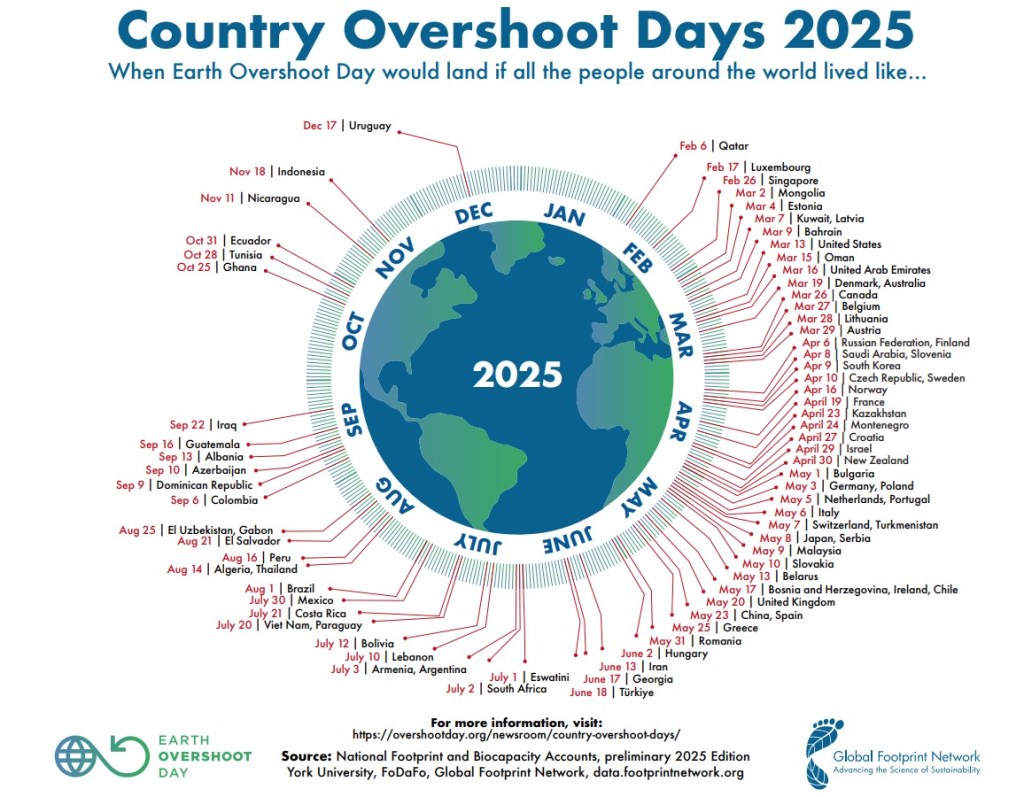
In other words we would ensure consumption levels stayed within the boundary of what the Earth can provide – and than would include not putting more waste/ pollutants, including carbon dioxide , into the Earth’s systems than can be absorbed. It would mean reining in total consumption to that which one planet can sustain – ie bringing back Earth overshoot day back to 31st December.

And it would mean ensuring a fair and equitable distribution of resources so that everyone has enough – reining in the excessive levels of income and wealth currently accruing to a minority –  and by so doing this will enable everyone contribute from the their full potential rather than being constrained by the limits of poverty, ill health etc.

Counting on … day 148

22nd September 2025

Lack of political will can also worsen the impact climate change. Ilan Kelman, Professor of Disasters and Health, UCL explains it thus: “The IPCC’s summary entirely avoids the phrase “natural disaster”. This reflects decades of work explaining that disasters are caused by sources of vulnerability – such as unequal and inequitable access to essential services like healthcare or poorly designed or built infrastructure like power plants – rather than by the climate or other environmental influences.

“The [2022 IPCC] report states, with high confidence, that “climate change is contributing to humanitarian crises where climate hazards interact with high vulnerability”. In other words, vulnerability must exist before a crisis can emerge. Climate change is not the root cause of disaster. The report explains that places with “poverty, governance challenges and limited access to basic services and resources, violent conflict and high levels of climate-sensitive livelihoods” are more vulnerable to climate change impacts.”

“The report explains that disaster risk and impacts can be reduced by tackling fundamental issues which cause vulnerability, no matter what the weather and climate do. It places high confidence in risk management, risk sharing, and warning strategies as key tasks for adapting to climate change.” (1)

(1) https://theconversation.com/ipcc-report-how-politics-not-climate-change-is-responsible-for-disasters-and-conflict-178071

Proper 20 14th Sunday after Trinity

21st September 2025

Reflection with readings below

This passages from Jeremiah seems to express both the grief and frustration of God and of Jeremiah – and it is not always clear to the listener which of the two is speaking. But that shouldn’t be surprising as a prophet is someone who is tuned into what God feels and desires, and what God is saying. The closeness of the relationship is both a joy and a stress: joy from sharing in God’s presence; stress from knowing God’s grief over the waywardness of humans. For both God and prophet it is not black and white. It is not as simple as God hating and dispensing with the one who sins, nor as God loving and rewarding the one who is righteous.

In last week’s gospel we noticed that the sinner rescued by God was no different from the ones who didn’t need rescuing. They were all sheep of which one had gone astray. They were all coins of which one had been lost. Nor is either sheep or coin discarded: both are retrieved and loved with an overriding passion. We should not then be surprised to read in Letter to Timothy that Jesus ‘gave himself a ransom for all’. Salvation is salvation for all – not just a few, not just most – but for all.

Knowing that salvation – healing – for all has always been God’s desire. Again from the Letter to Timothy ‘God our Saviour … desires everyone to be saved and to come to the knowledge of the truth.’

All and everyone is more than just humankind, but envelopes all that God has created. We should not imagine that salvation in just for humans and that other creatures, other living beings – and even ecosystems – are not part of God’s vision of healing and restoration. Indeed if only humans were rescued, life would be very bleak. What delights would we have to eat? What fresh waters would be there for us to drink? What flowers and trees would be there to delight our eyes? What sounds of bird song would enchant our ear?

And yet we humans often live as though all the other parts of creation were of no value and can be ignored, wasted and discarded with no repercussions. We seek to consume ever increasing amounts of the Earth’s resources as if there were no limits to supply. We seek to discard what we don’t want as if  the Earth could endlessly absorb our waste and are surprised when that waste returns to pollute our rivers and coasts! We seek to take more and more land away from wildlife and still expect our fields, hedgerows and gardens to be abounding with wildlife. We seek to fill the atmosphere with more and more carbon dioxide and yet are surprised when this upsets the Earth’s natural balance, triggering rising temperatures and extreme weather events.

Not only that, we also seek to live as if we were the only ones that mattered. That our actions will not affect the lives of others. Bizarrely we seem to believe that if those who are rich get richer, that growing wealth will not make others poorer. Bizarrely we seem to believe that if the rich get to buy more and bigger houses, more and bigger cars, that that will not mean fewer and smaller houses, and  fewer transport options for those who are poorer. Bizarrely we seem to believe that if larger companies take bigger and bigger profits, that smaller companies will not struggle to earn a fair share. Bizarrely we seem to think that if the rich can pay to lobby governments and authorities to shape the world to suit their wants, that those of us who can’t afford to pay lobbyists, will not find their needs excluded from decision making processes.

Yet everything could be so different. 

This week saw the CEO of Barclays calling on the government to curb public sector pay and resist calls to increase taxes in banking profits – this the same Venkatakrishnan, who can ‘earn’ a maximum annual package worth £14.3m, up from £9.8m previously. The average UK income was, in 2024, £37,430 although research suggests that a comfortable income for a family of two adults and one child is around £60,000. 

Would it not be more equitable for everyone to have a sufficiently generous income? 

A report by the Guardian last week revealed that through the privatisation of publication services – such as water, buses, mail, rail and energy – around £200bn has been paid to shareholders, diverting wealth from the common society to a private elite. In effect privatisation has cost £250 per household per year.

Would it not be better for public services to be owned by and run for the benefit of society as a whole? 

We need to use wisdom and discernment, honesty and compassion, if we are to live equally good lives one with another. Truly it is because of God’s wisdom that we are told to love our neighbours as ourselves. Unless we can act with generosity towards one other – both human and non human beings, unless we can work cooperatively with one another, unless we can live within the limits of the Earth’s resources, we are not to find salvation. To live in this way is to truly love God.

This past week the daily reflections from the Centre for Action and Contemplation have been on the theme of love: https://cac.org/daily-meditations/the-work-of-grief-and-love/

Jeremiah 8:18-9:1

My joy is gone, grief is upon me,
my heart is sick. 

Hark, the cry of my poor people
from far and wide in the land: 

“Is the Lord not in Zion?
Is her King not in her?” 

(“Why have they provoked me to anger with their images,
with their foreign idols?”) 

“The harvest is past, the summer is ended,
and we are not saved.” 

For the hurt of my poor people I am hurt,
I mourn, and dismay has taken hold of me. 

Is there no balm in Gilead?
Is there no physician there? 

Why then has the health of my poor people
not been restored? 

O that my head were a spring of water,
and my eyes a fountain of tears, 

so that I might weep day and night
for the slain of my poor people!

Psalm 79:1-9

1 O God, the heathen have come into your inheritance;
they have profaned your holy temple; *
they have made Jerusalem a heap of rubble.

2 They have given the bodies of your servants as food for the birds of the air, *
and the flesh of your faithful ones to the beasts of the field.

3 They have shed their blood like water on every side of Jerusalem, *
and there was no one to bury them.

4 We have become a reproach to our neighbours, *
an object of scorn and derision to those around us.

5 How long will you be angry, O Lord? *
will your fury blaze like fire for ever?

6 Pour out your wrath upon the heathen who have not known you *
and upon the kingdoms that have not called upon your Name.

7 For they have devoured Jacob *
and made his dwelling a ruin.

8 Remember not our past sins;
let your compassion be swift to meet us; *
for we have been brought very low.

9 Help us, O God our Saviour, for the glory of your Name; *
deliver us and forgive us our sins, for your Name’s sake.

1 Timothy 2:1-7

First of all, I urge that supplications, prayers, intercessions, and thanksgivings be made for everyone, for kings and all who are in high positions, so that we may lead a quiet and peaceable life in all godliness and dignity. This is right and is acceptable in the sight of God our Saviour, who desires everyone to be saved and to come to the knowledge of the truth. For

there is one God;
there is also one mediator between God and humankind, 

Christ Jesus, himself human,
who gave himself a ransom for all

— this was attested at the right time. For this I was appointed a herald and an apostle (I am telling the truth, I am not lying), a teacher of the Gentiles in faith and truth.

Luke 16:1-13

Jesus said to the disciples, “There was a rich man who had a manager, and charges were brought to him that this man was squandering his property. So he summoned him and said to him, `What is this that I hear about you? Give me an accounting of your management, because you cannot be my manager any longer.’ Then the manager said to himself, `What will I do, now that my master is taking the position away from me? I am not strong enough to dig, and I am ashamed to beg. I have decided what to do so that, when I am dismissed as manager, people may welcome me into their homes.’ So, summoning his master’s debtors one by one, he asked the first, `How much do you owe my master?’ He answered, `A hundred jugs of olive oil.’ He said to him, `Take your bill, sit down quickly, and make it fifty.’ Then he asked another, `And how much do you owe?’ He replied, `A hundred containers of wheat.’ He said to him, `Take your bill and make it eighty.’ And his master commended the dishonest manager because he had acted shrewdly; for the children of this age are more shrewd in dealing with their own generation than are the children of light. And I tell you, make friends for yourselves by means of dishonest wealth so that when it is gone, they may welcome you into the eternal homes.

“Whoever is faithful in a very little is faithful also in much; and whoever is dishonest in a very little is dishonest also in much. If then you have not been faithful with the dishonest wealth, who will entrust to you the true riches? And if you have not been faithful with what belongs to another, who will give you what is your own? No slave can serve two masters; for a slave will either hate the one and love the other, or be devoted to the one and despise the other. You cannot serve God and wealth.”