Counting on …day 175 

7th May 2022 

According to the recent review, the  State of the World’s Birds, 48% of bird species populations are in decline, 39% are stable,  6% showing increases whilst a further 7% have unknown trends. The major cause of decline in bird populations is the growing footprint of human consumption. Alexander Lee, of the Metropolitan University Manchester and leader of the review, says that people should not feel helpless: “We all have connections [to birds]. If a company is associated with deforestation in Brazil, don’t buy stuff from them,” he said. “And if everyone spares as much land as possible within their gardens for nature, then that adds up to quite a large area. Another lever is voting – we get the politicians we vote for.”

https://www.theguardian.com/environment/2022/may/05/canaries-in-the-coalmine-loss-of-birds-signals-changing-planet

 Counting on …day 174

6th  May 2022

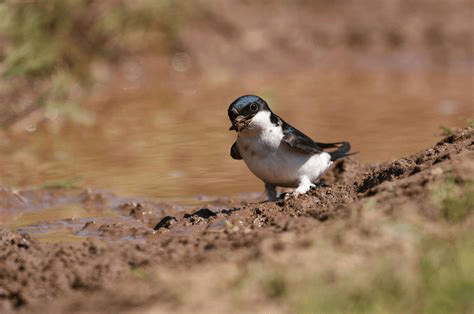
As a prolonged period of hot dry weather is forecast, the RSPB is inviting us to provide extra help for the migratory birds that are arriving in the UK. https://www.rspb.org.uk/about-the-rspb/about-us/media-centre/press-releases/mud-pies-for-house-martins/

The RSPB is urging the public to get their hands dirty this weekend and create mud pies to help endangered birds such as house martins, swifts and swallows get enough sludge to build their nests.

A nine-day mini-heatwave is hitting the UK, which coincides with the return of migratory birds here to breed. Many of these birds have flown thousands of miles on their journey. But conservationists are concerned that the ground is getting so hard it could stop them from being able to make their nests.

By leaving out dishes of mud mixed with water, or creating little puddles in the garden, the public can make a big difference, said Becca Smith, of the RSPB. “It’s the easiest thing that people can do to help these birds after they’ve flown all the way from Africa to our shores. Plus, a bit of mud pie-making is fun for the weekend.”

Putting out dishes of fresh water will also provide drinking and bathing for a variety of birds. House martins – which require the most mud for nestbuilding – can mix water with soil themselves, which they then combine with things such as grass, feathers and vegetable fibres to make little cup nests under the eaves of houses. https://www.theguardian.com/environment/2022/may/05/mud-water-to-help-nesting-migrating-birds-during-uk-heatwave-rspb-aoe

 Counting on …day 173

5th May 2022

Access to green and blue spaces is important for our own physical and  mental health as well as being good biodiversity. The Green Space Index by Fields in Trust found that more than 2.5 million people lived more than a 10-minute walk from the nearest area. The Office for National Statistics reports that one in eight households (12%) does not have access to a private or shared garden. 

Campaigners are calling on the Government to do more to ensure everyone has access to green spaces.  https://action.wildlifetrusts.org/page/97830/petition/1

Welcoming Garden Birds

The sparrow is still the most commonly observed garden bird but we have not seen one for about 20 years in our garden.

Can we do more to encourage bird populations that frequent our gardens?

  • Fresh water – provide a bird bath, pond or shallow bowl of fresh water for both drinking and bathing. Bowls and baths should be regularly cleaned and topped up with fresh water. 
  • Food – providing food is an easy way of attracting birds. Commercially produced bird food offers a wide range of seed and fat based foods. Some are specially adapted so that spilt seeds do not sprout so preventing a mini grain field growing under your bird feeder. Different foods can attract different birds. For example nyger seeds are popular with goldfinches. 
  • Growing bird food – you can provide bird food by growing it in your garden. Goldfinches like eating the seeds from dandelion heads, from teasels and from lavender bushes (leave the ‘dead’ seed heads in place). Blackbirds like apples. Starlings like the berries from the mahonia bushes and yew trees. Blue tits and great tits like eating aphids and other insects that congregate on plants stems and shoots.
  • Hygiene – birds can be killed by germs that multiply when bird feeders become fouled by bird droppings and by stale/ rotting food. Regularly cleaning bird feeders is important, as is removing stale food. The ground underneath bird feeders can also become foul so it is good to regularly move their positions and to clean the area underneath them.
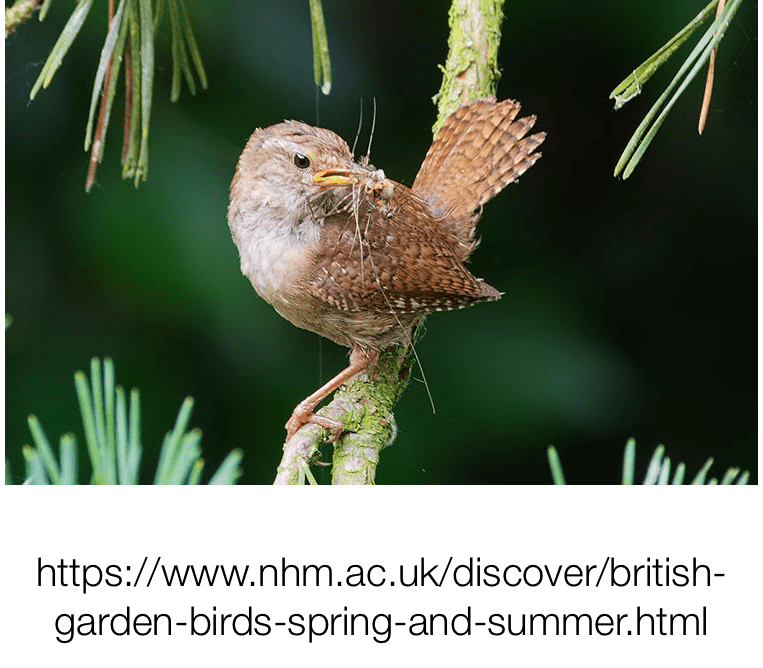
  • Shelter – hedges and shrubs provide welcome places of shelter especially for small birds such as wrens and sparrows.  Bushes can provide a safe place from which birds can check out the safety of a  bird feeder before darting out. 
  • Nesting boxes provide a particular form of shelter. Different birds have different requirements. Blue tits need boxes with only a small opening, whilst robins prefer a wider opening. Swifts and martins need high level nesting places. Hygiene again is important: winter is a good time to clean  old nesting boxes ready for the new season. 
  • Variety of habitats – by learning more about different bird species, we can understand better the habitats they prefer and how we can shape our gardens to better meet their needs. Black birds for example are ground feeders. They eat grubs and worms that they pull from the soil. Short, rather than long, grass makes this easier. Black birds can’t hang from bird feeders but they can perch on bird tables. Sparrows and wrens like hedges. Starlings like tall trees where they gather and survey the land.

Counting on …. Day 172

4th May 2022

If you are still looking for ways to reduce your gas consumption in response to the invasion of Ukraine, and  use gas to heat your hot water, there are several ways you do this. 

  • If you wash up in a bowl,  rather than drawing hot water that’s been heated by the boiler, use a kettle. One kettle is usually enough.
  • Reduce the number of showers you take – begin by showering one day and have a basin wash the next. Skin doesn’t get as dirty as we think. 
  • When you shower reduce the time under the shower – 5 minutes is a good target.
  • Wash your hands with cold water – it is just as effective at removing germs. What is important is lathering the soap and rubbing all parts of your hands. 

Counting on ….day 171

2nd May 2022

No Mow May!

This month we are encouraged not to mow our lawns. And here’s why:

On a single day in summer, one acre of wildflower meadow can contain 3 million flowers and produce 1 kg of nectar sugar for pollinators. But since the 1930s, we have lost nearly 7.5 million acres of flower-rich meadows and pastures. Just 1% of our countryside now provides this floral feast for pollinators. Against this loss, habitats such as lawns have become increasingly important. With 15 million gardens in Britain, our lawns have the potential to become major sources of nectar. 

Sign up and find out how many pollinators your lawn can support: https://nomowmay.plantlife.org.uk/sign-up/

Third Sunday of Easter

1st May 2022

Acts 9:1-6

Saul, still breathing threats and murder against the disciples of the Lord, went to the high priest and asked him for letters to the synagogues at Damascus, so that if he found any who belonged to the Way, men or women, he might bring them bound to Jerusalem. Now as he was going along and approaching Damascus, suddenly a light from heaven flashed around him. He fell to the ground and heard a voice saying to him, “Saul, Saul, why do you persecute me?” He asked, “Who are you, Lord?” The reply came, “I am Jesus, whom you are persecuting. But get up and enter the city, and you will be told what you are to do.” 

Psalm 30

1 I will exalt you, O Lord,
because you have lifted me up *
and have not let my enemies triumph over me.

2 O Lord my God, I cried out to you, *
and you restored me to health.

3 You brought me up, O Lord, from the dead; *
you restored my life as I was going down to the grave.

4 Sing to the Lord, you servants of his; *
give thanks for the remembrance of his holiness.

5 For his wrath endures but the twinkling of an eye, *
his favour for a lifetime.

6 Weeping may spend the night, *
but joy comes in the morning.

7 While I felt secure, I said,
“I shall never be disturbed. *
You, Lord, with your favour, made me as strong as the mountains.”

8 Then you hid your face, *
and I was filled with fear.

9 I cried to you, O Lord; *
I pleaded with the Lord, saying,

10 “What profit is there in my blood, if I go down to the Pit? *
will the dust praise you or declare your faithfulness?

11 Hear, O Lord, and have mercy upon me; *
O Lord, be my helper.”

12 You have turned my wailing into dancing; *
you have put off my sack-cloth and clothed me with joy.

13 Therefore my heart sings to you without ceasing; *
O Lord my God, I will give you thanks for ever.

Revelation 5:11-14

I looked, and I heard the voice of many angels surrounding the throne and the living creatures and the elders; they numbered myriads of myriads and thousands of thousands, singing with full voice,

“Worthy is the Lamb that was slaughtered

to receive power and wealth and wisdom and might

and honour and glory and blessing!”

Then I heard every creature in heaven and on earth and under the earth and in the sea, and all that is in them, singing,

“To the one seated on the throne and to the Lamb

be blessing and honour and glory and might forever and ever!”

And the four living creatures said, “Amen!” And the elders fell down and worshiped.

John 21:1-19

Jesus showed himself again to the disciples by the Sea of Tiberias; and he showed himself in this way. Gathered there together were Simon Peter, Thomas called the Twin, Nathanael of Cana in Galilee, the sons of Zebedee, and two others of his disciples. Simon Peter said to them, “I am going fishing.” They said to him, “We will go with you.” They went out and got into the boat, but that night they caught nothing.

Just after daybreak, Jesus stood on the beach; but the disciples did not know that it was Jesus. Jesus said to them, “Children, you have no fish, have you?” They answered him, “No.” He said to them, “Cast the net to the right side of the boat, and you will find some.” So they cast it, and now they were not able to haul it in because there were so many fish. That disciple whom Jesus loved said to Peter, “It is the Lord!” When Simon Peter heard that it was the Lord, he put on some clothes, for he was naked, and jumped into the sea. But the other disciples came in the boat, dragging the net full of fish, for they were not far from the land, only about a hundred yards off.

When they had gone ashore, they saw a charcoal fire there, with fish on it, and bread. Jesus said to them, “Bring some of the fish that you have just caught.” So Simon Peter went aboard and hauled the net ashore, full of large fish, a hundred fifty-three of them; and though there were so many, the net was not torn. Jesus said to them, “Come and have breakfast.” Now none of the disciples dared to ask him, “Who are you?” because they knew it was the Lord. Jesus came and took the bread and gave it to them, and did the same with the fish. This was now the third time that Jesus appeared to the disciples after he was raised from the dead.

When they had finished breakfast, Jesus said to Simon Peter, “Simon son of John, do you love me more than these?” He said to him, “Yes, Lord; you know that I love you.” Jesus said to him, “Feed my lambs.” A second time he said to him, “Simon son of John, do you love me?” He said to him, “Yes, Lord; you know that I love you.” Jesus said to him, “Tend my sheep.” He said to him the third time, “Simon son of John, do you love me?” Peter felt hurt because he said to him the third time, “Do you love me?” And he said to him, “Lord, you know everything; you know that I love you.” Jesus said to him, “Feed my sheep. Very truly, I tell you, when you were younger, you used to fasten your own belt and to go wherever you wished. But when you grow old, you will stretch out your hands, and someone else will fasten a belt around you and take you where you do not wish to go.” (He said this to indicate the kind of death by which he would glorify God.) After this he said to him, “Follow me.”

Reflection

The short passage from the Book of Acts introduces us to Paul’s Damascus Road experience (although here he is still known by his Jewish name of Saul). From being an ardent antagonist of the followers of Christ, Paul swerves, U-turns, to become the most ardent evangelist. Why? Because he encounters the risen Jesus head on. Last week, in John’s gospel, we heard how various disciples met the risen Jesus and how in different ways they began to understand what was happening and who it was – and in what nature – they were encountering, when they met Jesus. The risen Jesus was not a human brought back to life, but the  God-who-had-become-human-and-had-ascended-once-more-to-the-God-head. It is his encounter with this Jesus that confounds Paul’s previous understanding of Jesus and his followers, and brings to new life in him an understanding of and relationship with the Christ. Indeed brings him new Life.

Thereafter Paul went on to transform other people’s understanding of Jesus, to nurture in them new Life, and did so with zeal, raising the profile of the  Way of Christ to new heights. 

Today’s Psalm too tells of the way of salvation as a process of transformation that echos both Paul’s experience and that of Paul’s ministry. The mission of Paul and his contemporaries, gave rise to the exponential growth of the Christian community – from its roots as a group of believers perhaps measured in hundreds, to a faith movement that, by the third century, becomes the state religion of the whole empire. Perhaps it is this that we are seeing in the extract from the Book of Revelation: the Lamb, once a creature to be sacrificed, becomes one to be credited all ‘power and wealth and wisdom and might and honour and glory and blessing’ for ever and ever!

The gospel passage today comes from the end of John’s gospel. It is quite likely a later addition: in John’s account this is the first time we hear that Peter is a fisherman – the call of Peter away from his fishing career comes from the synoptic gospel. Without this information, there is not the sense  that Peter and his comrades are returning to where their old lives had broken off. Nevertheless this is the story that we are presented with as the final story of John’s gospel.

There is still confusion amongst Jesus’s disciples. They still do not instantly or completely recognise the figure they see as Jesus. This is not just the human Jesus who has been resuscitated. This is someone who is more. Yet even so this Jesus still understands what it is to be human, what it is that humans need – whether that is success in their work, food to satisfy their hunger, comfort, or indeed reassurance that past failures have been forgiven. And not just forgiven: Jesus assures Peter of his confidence that he, Peter, can fulfil the task which Jesus is giving him. 

I am sure many of us have felt the sense of inadequacy that Peter felt, that we are not up to the task, that we are going to fail and will let other people down. And often it is that very feeling of inadequacy that leads us to fail. In the Principles of the Franciscan Third Order, that for day 24 concerning humility, says “Nevertheless, when asked to undertake work of which they feel unworthy or incapable they do not shrink from it on the grounds of humility, but confidently attempt it through the power that is made perfect in weakness”. This has often puzzled me, but I think it is reminding us that we should not rely on our own sense of ability but rather trust to the ability that comes from God. That was certainly Peter’s experience and Paul’s too. It should give us the confidence to continue with those tasks which we know to be right even if we can’t see how they might be successful. Success will come in God’s way and God’s time. 

I find it hard to believe that we humans will get our act together such that we can forestall the worst of the climate crisis, yet I am confident that God does not desire or will the destruction of creation. Somehow God’s will will prevail. 

Counting on …day 170

1st May 2022

Never give up hope! For weeks now I have been convinced that our grape vine has died. Its two  main branches have shown no signs of life – rather the bark has been peeling away – and the stubs where last years shoots were pruned are dry and hollow. But then, I glimpsed a couple of small pale green shoots – it is alive and we can look forward to another year of leafy sunshade and luscious fruits in due season. Signs of hope are to be treasured and praised. Thanks be to God!

Counting on …day 169 

30th April 2022

Picking up on the idea of car-free Sundays, how many excursions or days out can you plan that don’t involve a car? Walks that include a pub lunch, walks that incorporate a visit to a museum or historic site, cycle rides that include stunning view points (and a downhill ride afterwards!), a bus or train ride along a scenic route, a walk along a canal….